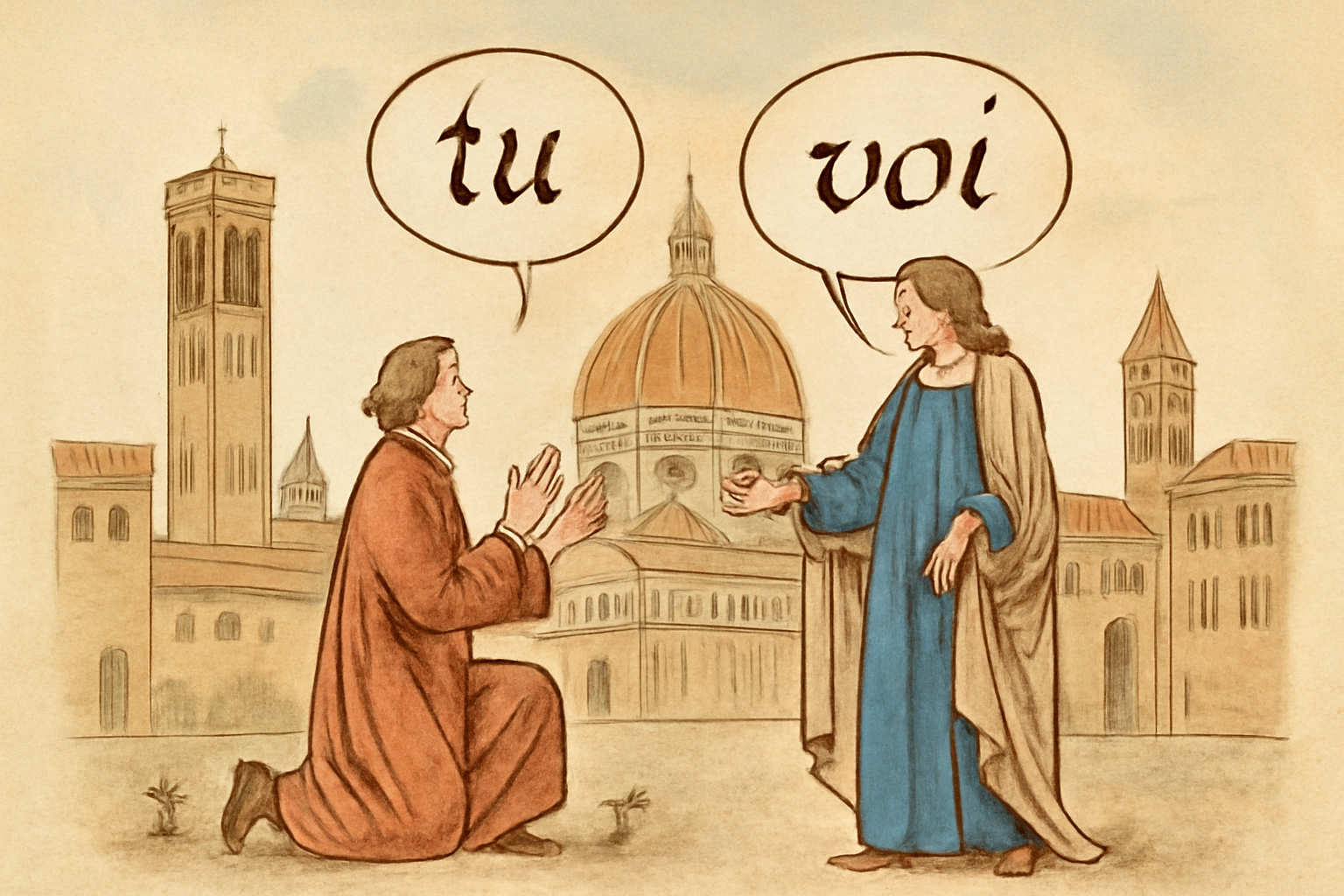
I didn’t realize how much drama was hidden in Dante’s pronoun choices until someone pointed it out. Now I can’t un-see it. Every time I reread the Commedia, I catch myself watching for those tiny Italian words—tu and voi—like they’re secret messages written in plain sight. And honestly? They are.
In medieval Tuscan Italian, the distinction was crystal clear. Tu was intimate, informal, sometimes contemptuous. Voi was formal, respectful, distant. The choice wasn’t casual. It revealed everything about power, affection, and social standing.
But here’s the catch: English has no equivalent. When you read an English translation, this entire emotional layer vanishes. You’re reading a flattened version of the text.
Dante to Virgil: The Formal Student
Dante addresses his guide with voi. Always. This is significant. Virgil isn’t just any companion—he’s Dante’s revered literary ancestor, his chosen master through Hell and Purgatory.
The formal pronoun maintains distance. In fact, it’s the respectful distance a student keeps before a teacher. Dante never presumes intimacy, even when they’ve walked together through nine circles of suffering. That formality is its own kind of love—the love of admiration.
Dante to Beatrice: The Shifting Heart
Now watch what happens when Beatrice appears. Dante’s pronoun choices become emotionally volatile. He shifts between tu and voi at crucial moments, and each shift marks a turning point in his spiritual state.
When shame or humility overtakes him, he uses the formal voi. When his heart opens again, he returns to the intimate tu. The pronouns are a heartbeat. They show us his vulnerability before they show us anything else.
Hell’s Pronoun Politics
In Hell, Dante’s choices become even more revealing. Sometimes he uses tu toward sinners—a contemptuous “you” that strips away formality, denying them dignity. But not always.
Consider Brunetto Latini, Dante’s former teacher, damned in the circle of violence. Despite finding him in Hell, Dante addresses him with voi. That choice is devastating. It says: I still respect you. I still acknowledge what you taught me. Even here.
Farinata, the proud Florentine, uses tu toward Dante instead. He treats the poet as an equal, ignoring the otherworldly hierarchy. It’s audacious—defiant, even. The pronoun choice reveals his unbroken pride.
About This Article

Written by Lucy Bamboo. Lucy Bamboo has been reading the Divine Comedy for fifteen years — first in translation, then stubbornly in Medieval Tuscan with a dictionary and far too many footnotes. Reading Dante is her scene-by-scene walk through the poem: the original Italian, seven centuries of scholarly argument presented as argument rather than answer, and the human questions sitting underneath the theology. More about this site.
Verify this against a primary source
Specifics change, and your situation may differ from the one described here. These are the authorities worth checking directly:
- Digital Dante, Columbia University — text, commentary and translation apparatus
- Princeton Dante Project — the Commedia with historical commentary
- Dartmouth Dante Project — searchable commentary from 1322 onward