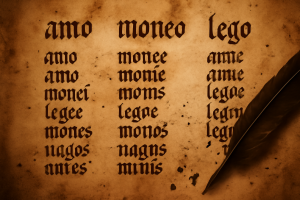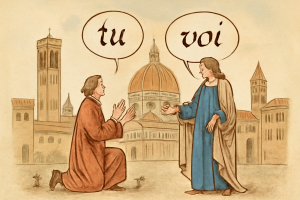
I learned the hard way that a modern Italian dictionary won’t help with half of Dante’s vocabulary. When I first tackled the Divine Comedy, I’d look up a word, find nothing, panic, then discover it was perfectly common in 14th-century Tuscany. That gap between medieval Italian and modern Italian is where reading Dante gets tricky—and fascinating.
Dante didn’t write in a dead language. He wrote in living Florentine, the dialect of his time. But language moves fast. Words disappear. Others shift meaning so far they become strangers to their origins. Here are the archaic words that tripped me up most.
Moral Concepts That Modern Italian Lost
Dismisura appears throughout the Inferno and Purgatorio. It means “excess” or “lack of moderation”—a foundational moral concept in Dante’s ethics. Modern Italian has no single word for it. We’d say “eccesso” or “mancanza di misura,” but neither captures the weight Dante gives it.
This word haunted me because I kept treating it as decoration. It’s not. Dismisura is the philosophical skeleton of why sinners burn. Understanding it changed how I read the whole poem.
Words for Desire and Movement
Drudo or druda appears in the Lust circle (Inferno V). It simply means “lover,” but with a medieval edge—often an illicit lover. Modern Italian would use “amante,” but that feels neutral by comparison. Drudo carries shame, secrecy, scandal.
Snoda haunts Paradiso. It means “unfolds” or “unties,” used in mystical and philosophical contexts. Modern Italian substitutes “scioglie” or “spiega,” but snoda has an almost musical quality—a gradual, reverent revealing. That nuance is gone now.
Geography, Direction, and Florentine Warfare
Lito appears in the Ulysses canto (Inferno XXVI). It means “shore” or “beach.” Modern Italian has “lido” and “spiaggia,” but lito is older, starker. In fact, it survived into Italian place names—but as a living word? Long gone.
Suso means “upward.” Modern Italian has “su,” but Dante uses suso for emphasis and poetic weight. You’ll see it in gravity-defying moments—when Dante ascends through the heavens. The extra syllable matters.
Quinci and quindi both mean “from here” and “from there.” Here’s the twist: quindi survived into modern Italian, but its meaning shifted. Dante’s quindi meant “from that place.” Today it means “therefore”—a completely different evolution.
Gualdana was a Florentine military term—a raiding party or troop. It’s purely medieval, tied to 14th-century warfare. Modern readers need a history book, not a dictionary.
Verbs and Philosophical Language
Vaglio comes from “valere” (to be worth, to be able). It’s an archaic conjugation: “I’m worth” or “I’m able.” Medieval writers loved it; modern Italian abandoned it entirely for clearer forms.
S’appunta means “reaches its point” or “peaks.” Dante uses it in scholastic, philosophical moments—when an argument or idea comes to its culmination. Modern Italian would say “si conclude” or “raggiunge il suo apice,” losing the geometric precision.
The gap between Dante’s Italian and ours isn’t a flaw in our language—it’s time at work. Words that once sang with meaning fade into silence. That’s why reading Dante requires patience, curiosity, and a willingness to meet him in his own era.