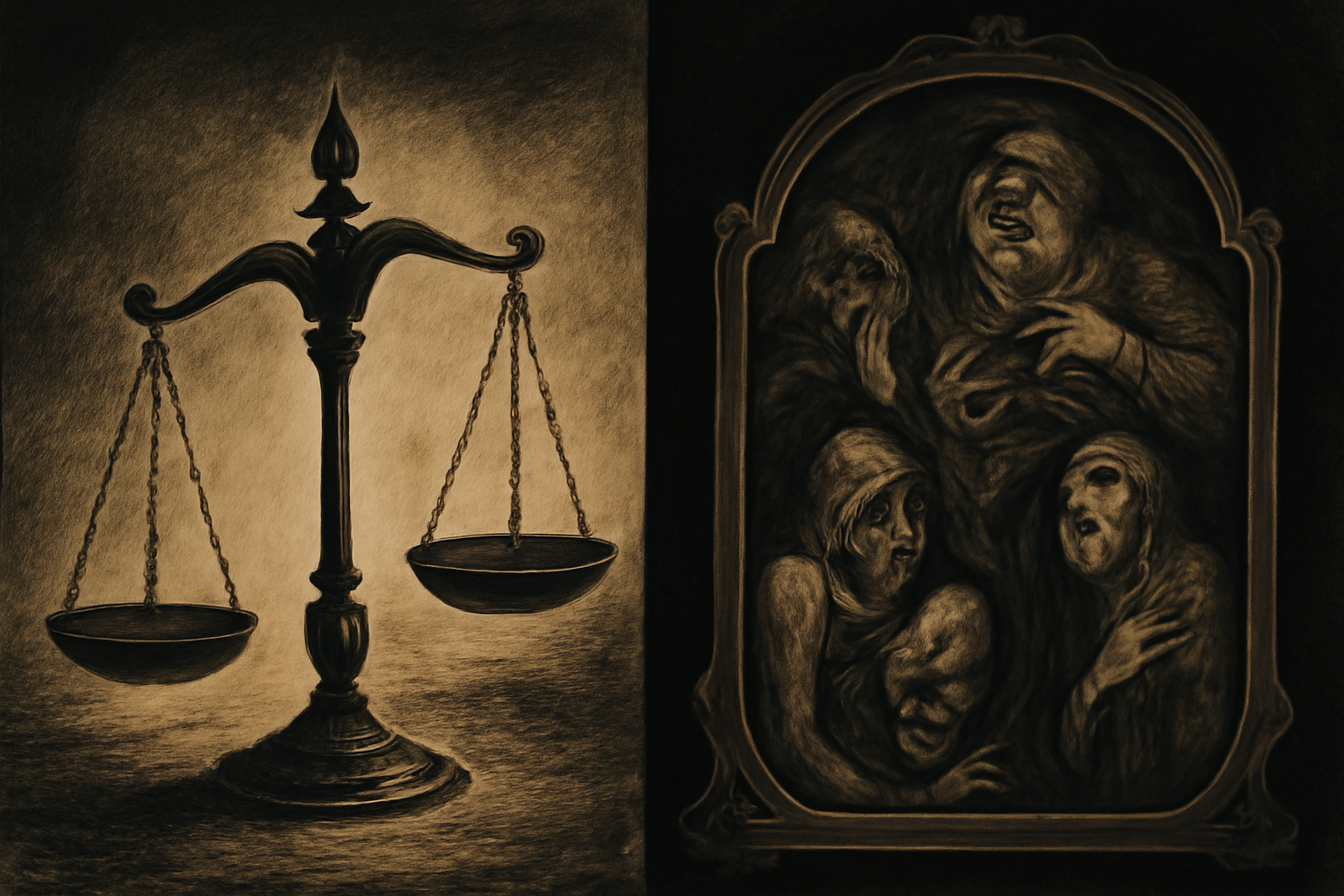
Contrapasso is the organizing principle that makes Dante’s Hell not a warehouse of arbitrary torments, but a mirror of moral truth. Once you understand it, the entire architecture of the Inferno clicks into place. Every punishment doesn’t just fit the sin—it reveals what the sin actually was.
The word itself comes from Latin: contra (against) + patior (to suffer). The punishment works against the sin by reflecting, inverting, or symbolically extending it. Dante didn’t invent contrapasso—it descends from Aristotle and Thomas Aquinas—but he applied it with extraordinary creative precision.
Three Types of Contrapasso
Dante deploys contrapasso in three distinct ways across Hell:
- Mirror punishment: The suffering resembles the sin. The lustful are blown endlessly by violent winds—they were swept away by passion, now they are swept.
- Inverted punishment: The sinner experiences the opposite of their desire. Fortune-tellers tried to see the future; now their heads twist backward, seeing only the past.
- Symbolic extension: The punishment reveals the sin’s true nature made visible. Hypocrites wear gilded lead cloaks—beautiful and gleaming outside, but crushing and heavy within.
Each type teaches the same lesson: the punishment doesn’t punish arbitrarily. It shows what the sin was all along.
Punishment Made Visible
Consider the gluttons, submerged in filthy slush under cold rain. They indulged in sensory excess; now they drown in degradation. Or the wrathful, forever fighting in the swamp of the River Styx. Their internal rage becomes external violence, eternal and inescapable.
The most striking example: the simonists—those who sold church offices for money. They’re inverted in holes, their feet above ground, burning flames consuming their soles. They tried to rise through corruption; now they’re buried upside down, denied the very ascent they craved.
In every case, the logic is identical. The sinner does not suffer for the sin so much as through it. Hell makes eternal what the sin already was.
Why This Matters
Contrapasso reveals Dante’s deepest insight: sin is its own punishment. Hell imposes no external, arbitrary torture. Instead, each circle unfolds the moral and spiritual consequences of the sin made visible and eternal. The punishment is simply what the sin becomes.
English has no single word for this concept. “Poetic justice” sounds too light. “Retribution” misses the mirror logic. Translators must paraphrase or leave it untranslated.
Understand contrapasso, and you understand why Dante’s Hell works as theology, not fantasy. The design is inevitable. It could not be otherwise.