Once you start counting in Dante, you can’t stop. The numbers aren’t decorative flourishes—they ARE the architecture. Every tercet, every circle, every celestial sphere obeys a mathematical logic that mirrors medieval theology itself. Dante didn’t just write a poem. He built a universe.
The Trinity Rules Everything
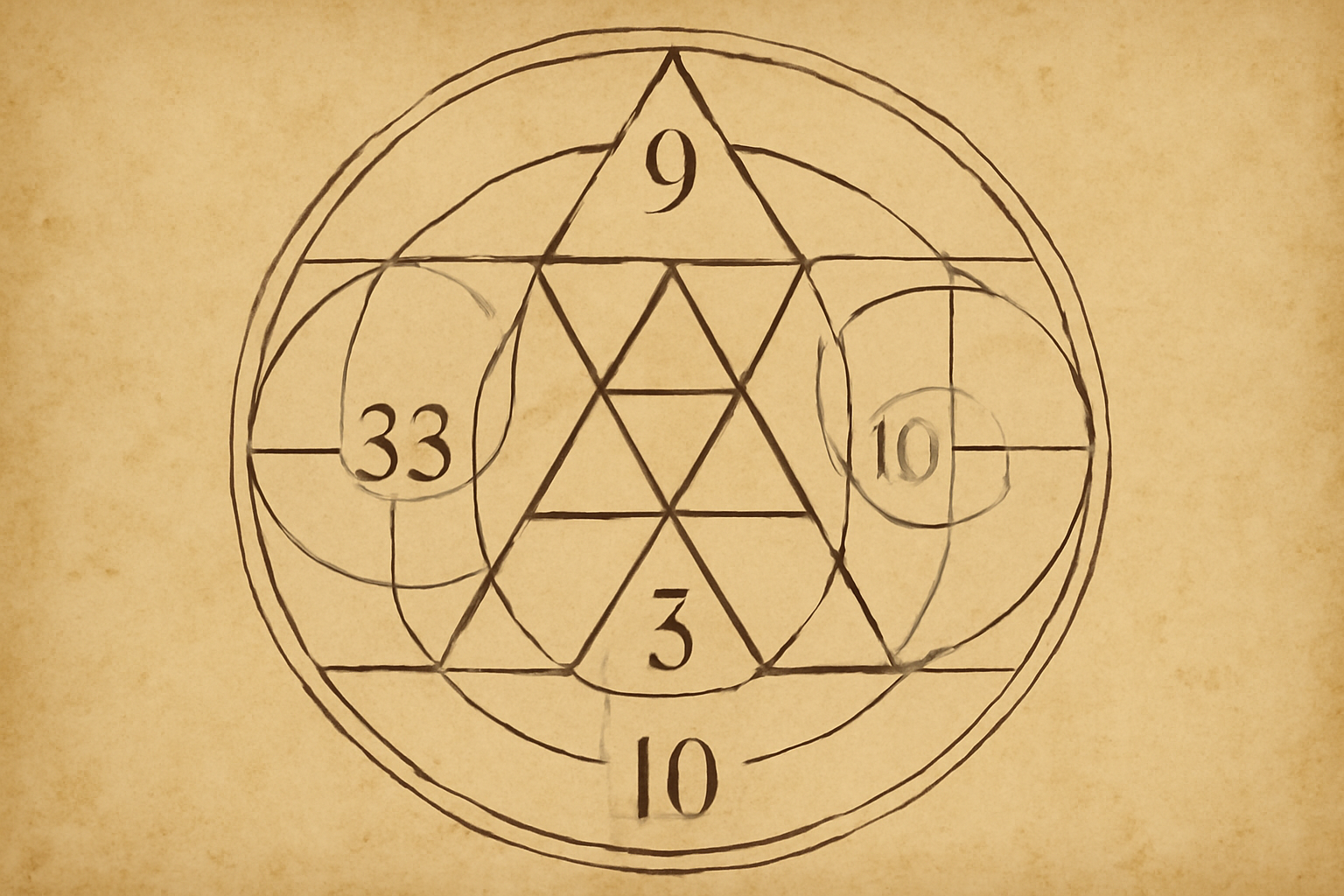
The number 3 haunts the Divine Comedy. It structures the entire work: 3 canticles, 3 guides, 3 beasts blocking the dark wood. Even the form itself is trinitarian. Terza rima—those interlocking tercets with their ABA BCB CDC rhyme scheme—embodies theological perfection in pure meter.
Consider Dante’s three guides: Virgil leads through Hell and Purgatory. Beatrice takes over in Paradise. Bernard closes the journey. Each guide represents a different mode of knowing—reason, faith, and ultimate grace. That’s no accident.
Even Satan himself is tripled. His three faces parody the Trinity—a grotesque inversion of divine mystery. In medieval thought, numbers weren’t arbitrary. They carried theological weight. Three meant completeness, divinity, the sacred.
Nine: The Square of Trinity
Nine is 3 × 3. It amplifies the sacred pattern. Hell contains 9 circles. Purgatory has 9 terraces (the 7 cardinal sins plus two antechambers). Paradise spirals through 9 celestial spheres before the empyrean.
Beatrice herself is woven into 9 throughout the Vita Nuova. She first appeared when Dante was 9 years old. She died in the year 1290—a number ending in 9. Her presence is numerologically imprinted on the poem. That’s not symbolism. That’s obsession.
The 9 circles aren’t random obstacles. They descend through sin’s logic—from violence to betrayal, from fraud to ice-bound treachery. The structure is both theological and architectural. Form and content fuse.
33 and the Perfect Hundred
Each canticle contains exactly 33 cantos. (Inferno has 34, but the first is a prologue to the whole work, not part of the count.) 33—Christ’s age at crucifixion. Medieval readers would have caught that immediately. The number resonates with redemption.
Add it up: 1 prologue + 33 + 33 + 33 = 100 cantos total. One hundred. Complete. Perfect. Whole.
In numerology, 10 represents completion. So 100 is completion squared—the ultimate expression of wholeness. Dante didn’t stumble into this. He engineered it.
The Universe Blueprint
What makes this radical: Dante’s numbers mirror cosmic reality. Medieval theologians believed the universe itself was numerically ordered. God was the supreme mathematician.
By structuring his poem through 3, 9, and 100, Dante wasn’t being decorative. He was claiming his work reflected divine geometry. The poem’s form became its content. Reading it meant encountering the structure of reality itself.
Once you see the pattern, the whole architecture glows. Every number leads deeper. Every tercet reinforces the design. Dante built a cathedral in verse—and every stone is accounted for.
“`