
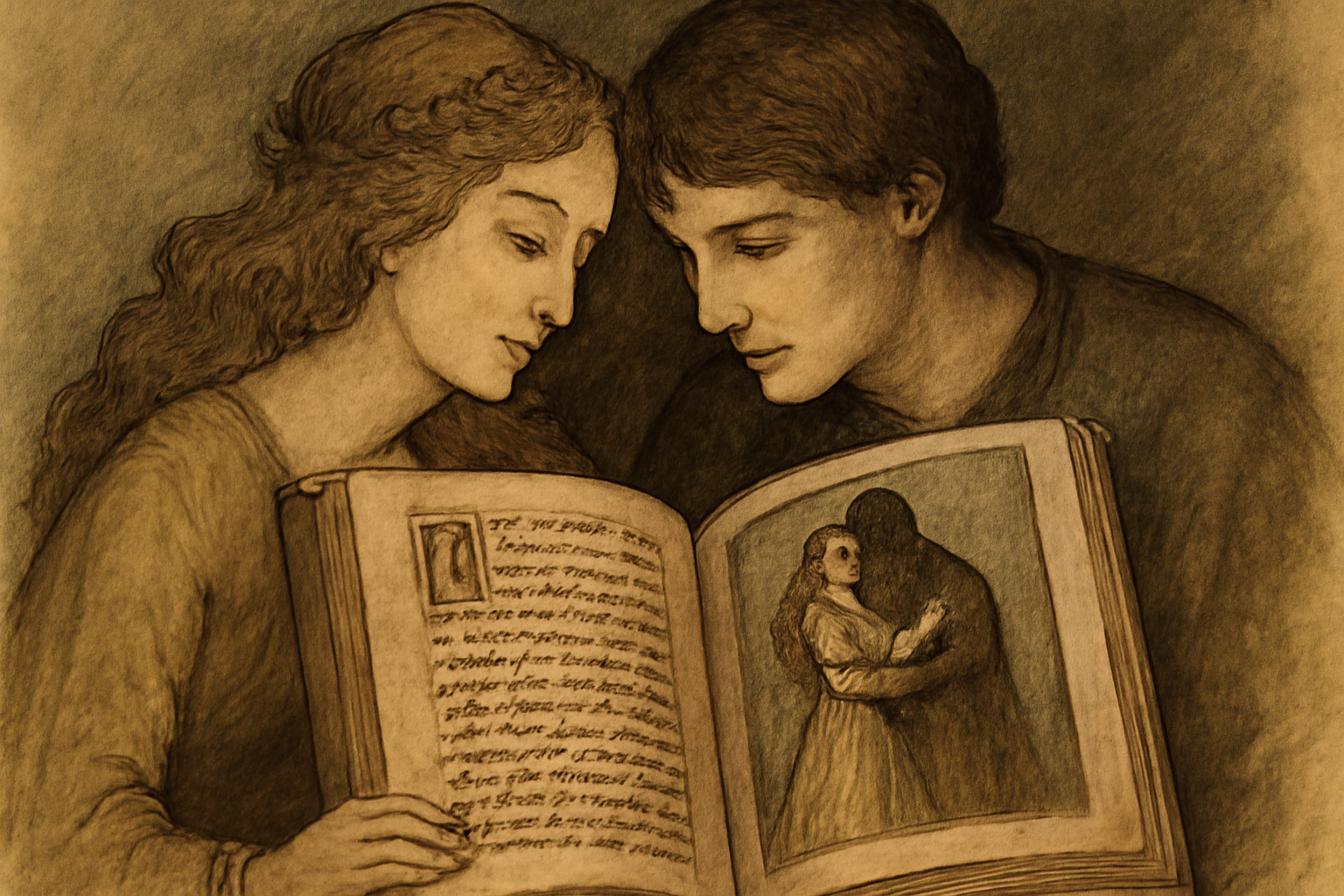
When I finally understood what “Galeotto” means, the entire Francesca episode snapped into sharper focus. This single word does three things at once—and most English readers never see it.
Here’s the line that changed everything for me. Francesca says: “Galeotto fu ‘l libro e chi lo scrisse.” In English, we usually read: “A Galehaut was the book and he who wrote it.”
That translation is technically correct. But it’s also a disaster. The wordplay dies instantly. The accusation falls flat. And Dante’s meta-literary joke—the one where he accuses literature of corruption while being a literature—vanishes entirely.
Layer One: The Arthurian Reference
Galehaut (Galeotto in Italian) is a character from the French Lancelot romance. He’s a knight and schemer who does one crucial thing: he arranges the first kiss between Lancelot and Guinevere.
Francesca is saying the Lancelot book played exactly that role for her and Paolo. The story was their go-between. It introduced them to illicit desire. It showed them what was possible. Then it pushed them together.
That’s already devastating. But Dante isn’t finished.
Layer Two: The Common Word
By Dante’s time, “galeotto” had become everyday Italian. It meant “go-between”—or more bluntly, pimp. Someone who arranges affairs. Someone who corrupts.
So Francesca isn’t just naming a character. She’s insulting the book. She’s saying: that text was our pimp. It seduced us. It made illicit love seem noble and necessary.
English has no equivalent word. We have “procurer” or “matchmaker,” but neither carries the historical weight or the sting. Translators typically abandon the pun and add a footnote instead.
Layer Three: The Accusation Against Literature Itself
But here’s what makes it brilliant. Francesca also blames the author—“chi lo scrisse,” he who wrote it.
She’s not just blaming the book. She’s blaming the act of writing. The creative choice to tell this story. Literature itself becomes the criminal. Fiction is the seducer.
Dante knew exactly what he was doing. In Canto V, he was already composing the most emotionally persuasive portrait of adultery in medieval literature. He was making readers sympathize with Francesca and Paolo. He rendered damnation beautiful.
So when Francesca accuses the Lancelot author of corruption, Dante is asking: Am I the next Galeotto? Is this poem corrupting you?
Why This Matters
Most translations render “Galeotto” as a proper noun and move on. The reader learns a fact but misses the accusation, the irony, the self-awareness.
In fact, Dante is doing something modern here. He’s questioning literature’s moral authority. Beautiful writing, he admits, can be dangerous. Art itself can seduce us into sin.
All of that lives in one untranslatable word.
About This Article

Written by Lucy Bamboo. Lucy Bamboo has been reading the Divine Comedy for fifteen years — first in translation, then stubbornly in Medieval Tuscan with a dictionary and far too many footnotes. Reading Dante is her scene-by-scene walk through the poem: the original Italian, seven centuries of scholarly argument presented as argument rather than answer, and the human questions sitting underneath the theology. More about this site.
Verify this against a primary source
Specifics change, and your situation may differ from the one described here. These are the authorities worth checking directly:
- Digital Dante, Columbia University — text, commentary and translation apparatus
- Princeton Dante Project — the Commedia with historical commentary
- Dartmouth Dante Project — searchable commentary from 1322 onward