Lucy Bamboo on why three words in Dante’s opening line contain centuries of meaning—and why English can’t quite catch it.
Dante’s first terza rima lands like a punch: “Nel mezzo del cammin di nostra vita / mi ritrovai per una selva oscura.”
“In the middle of the journey of our life, I found myself in a dark wood.”
Simple enough. Except it isn’t. The phrase selva oscura seems straightforward until you actually read it in Italian. Then it blooms into five or six meanings at once. This is where translation fails—not because translators are careless, but because the Italian language itself is doing something English can’t replicate in three words.
The Weight of “Selva”
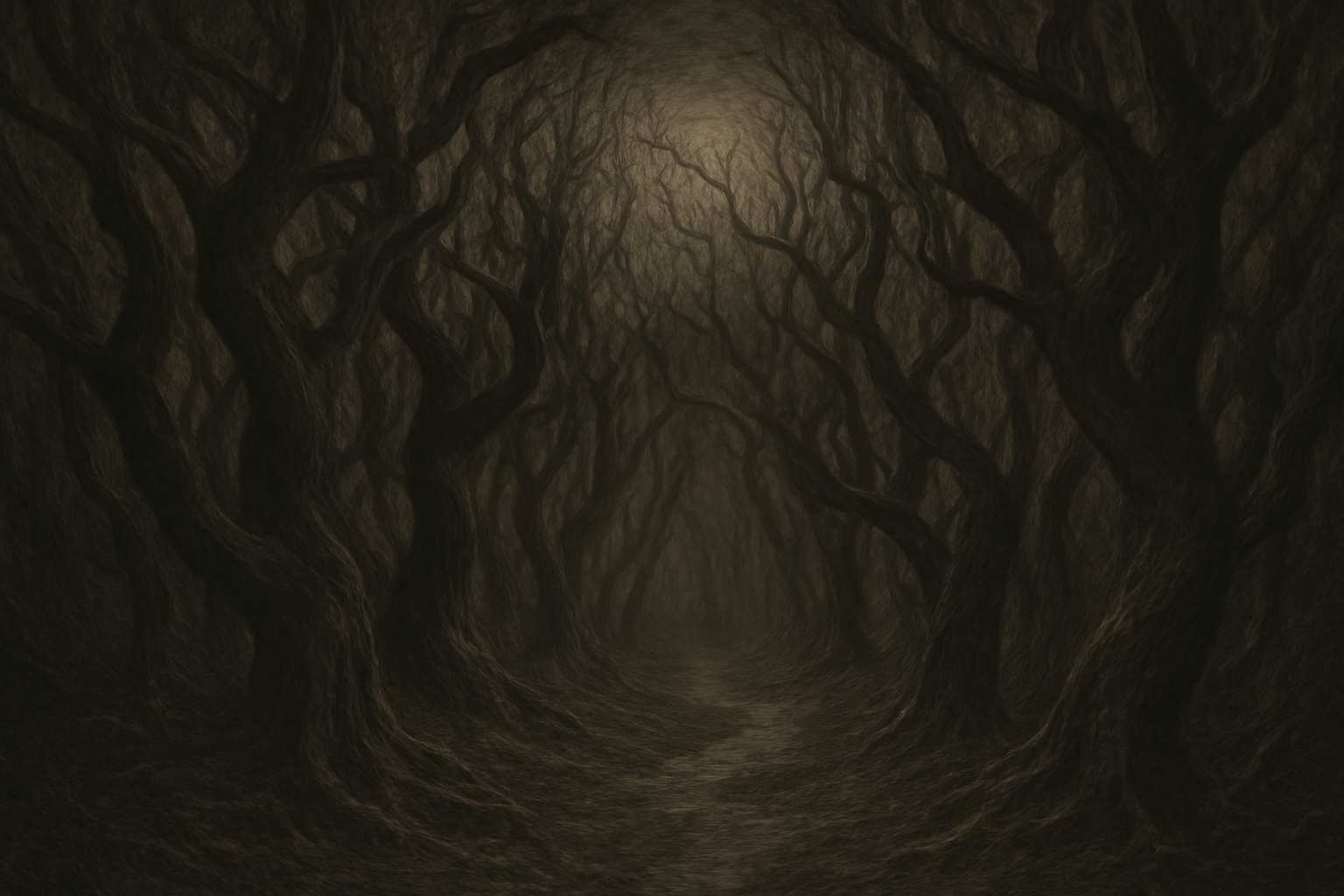
Start with selva. Yes, it means forest. But not the manicured kind. Selva is wild, dense, tangled—the opposite of civilization. Medieval readers heard it as chaos itself, disorder made physical. Gardens were human spaces. Forests were where the uncivilized lived, where logic didn’t apply.
In medieval thought, the contrast was absolute: city = law, order, reason. Forest = lawlessness, confusion, danger. When Dante says he’s lost in a selva, he’s not just describing geography. He’s saying his entire world has become untamed, uncontrollable.
English “dark wood” doesn’t carry this weight. It sounds almost pastoral—almost Romantic, like something from fairy tales. That moral chaos embedded in the Italian simply doesn’t come through.
“Oscura”: Dark and Obscure
Now consider oscura. It means dark, certainly. But in Italian, “oscuro” also means obscure, hidden, unclear, morally shadowed. The word isn’t just about light and darkness—it’s about comprehension itself.
Dante finds himself lost in a forest that is simultaneously:
- Physically dark (you can’t see)
- Morally obscure (you can’t discern right from wrong)
- Intellectually hidden (truth is veiled)
The English “dark wood” flattens this collapse into a single word. Most translators stick with “dark” because they have to, but something essential evaporates in translation.
Echoes from Scripture and Rome
Medieval ears caught something else entirely: biblical resonance. The wilderness. The desert where the Israelites wandered for forty years, lost and testing God’s patience. That selva oscura echoes Exodus—it’s a space of trial, of separation from grace.
There’s also Virgil’s Aeneid in the background. Aeneas enters the Underworld through a dark forest. By placing his selva oscura at the poem’s threshold, Dante signals: I’m following the classical descent into darkness. This is a literary doorway, not just a literal one.
The Beauty of Ambiguity
Here’s what’s maddening and magnificent: Dante never tells us what the dark wood actually is. Is it sin? Political exile? Midlife crisis? Spiritual confusion? All of them? Commentators have debated this for 700 years, and there’s no settled answer.
That ambiguity is the point. The selva oscura refuses to resolve into a single meaning because moral and spiritual confusion doesn’t announce itself clearly. It’s dark. It’s obscure. That’s the whole problem.
Translation strategies vary. Some add adjectives—”dark, dense forest.” Others risk “murk” or “gloom” to approximate the threatening tone. None of them quite work, because none of them are Italian.
And maybe that’s the real lesson: some poetry can be read in translation, but “selva oscura” must be encountered twice—once in the words you read, and once in the Italian language itself, where three words contain entire worlds.
About This Article

Written by Lucy Bamboo. Lucy Bamboo has been reading the Divine Comedy for fifteen years — first in translation, then stubbornly in Medieval Tuscan with a dictionary and far too many footnotes. Reading Dante is her scene-by-scene walk through the poem: the original Italian, seven centuries of scholarly argument presented as argument rather than answer, and the human questions sitting underneath the theology. More about this site.
Verify this against a primary source
Specifics change, and your situation may differ from the one described here. These are the authorities worth checking directly:
- Digital Dante, Columbia University — text, commentary and translation apparatus
- Princeton Dante Project — the Commedia with historical commentary
- Dartmouth Dante Project — searchable commentary from 1322 onward