Dante doesn’t do anything by accident. This principle—sacred to anyone who has spent time in the Commedia—becomes almost painfully obvious when you notice what happens at the end of each canticle. Inferno closes with “stelle.” Purgatorio ends with “stelle.” Paradiso concludes with “stelle.” Three canticles. One final word. Repeated three times.
The endings deserve quotation:
- Inferno: “E quindi uscimmo a riveder le stelle” — “And so we came out to see the stars again”
- Purgatorio: “puro e disposto a salire a le stelle” — “pure and ready to rise to the stars”
- Paradiso: “l’amor che move il sole e l’altre stelle” — “the love that moves the sun and the other stars”
No translator misses this. In fact, every serious translation preserves “stars” at all three endpoints, as if the word itself were sacred text.
The Architecture of Light
In Dante’s cosmos, stars are never merely decoration. They’re the visible signs of God’s order—eternal, unchanging, luminous. Light itself is his primary symbol for divine truth and love. The stars aren’t peripheral; they’re the map.
What makes the triple “stelle” so powerful is that it’s not repetition for its own sake. Rather, it’s a three-stage progression hidden inside three identical words. The word stays the same. Everything else transforms.
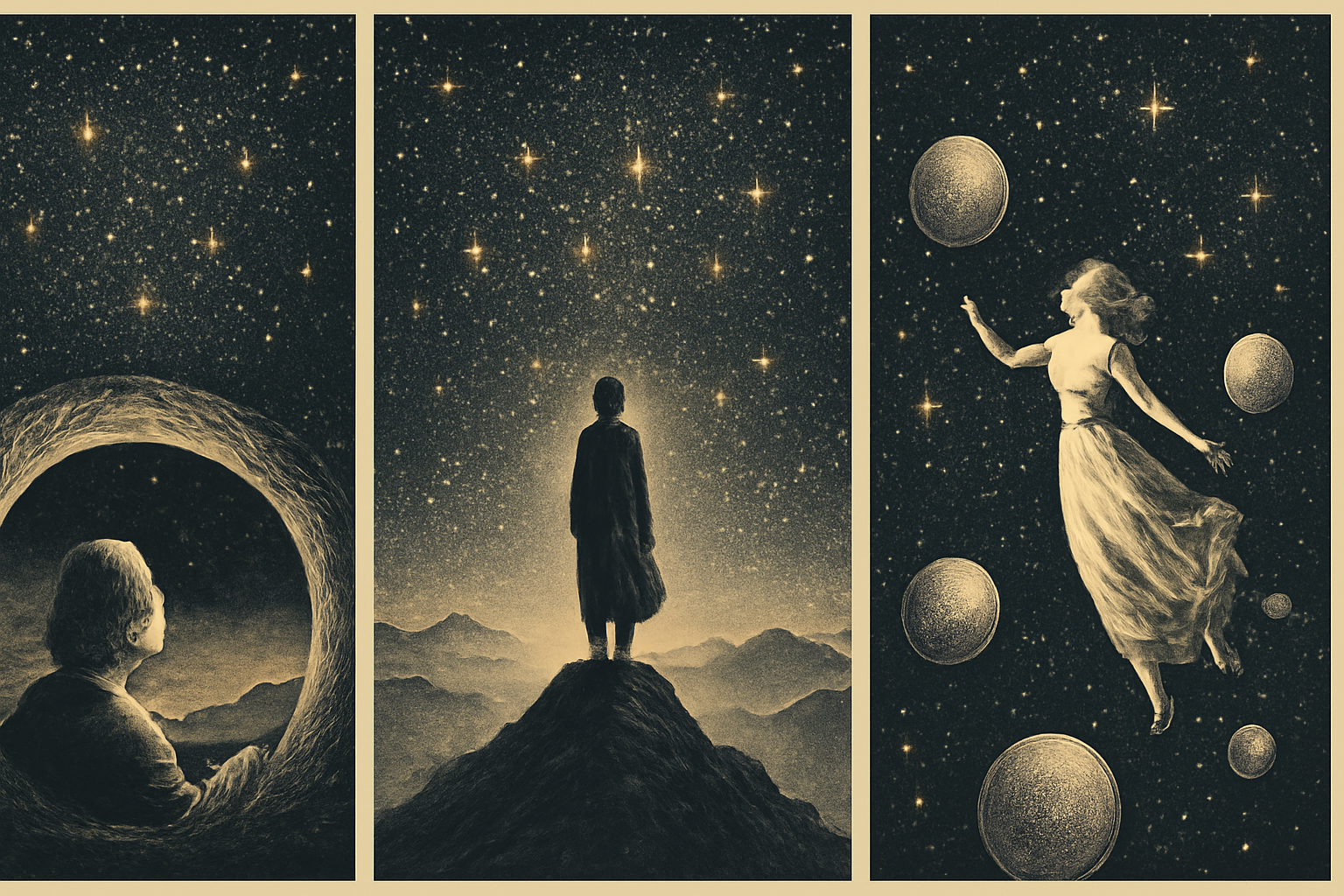
See. Rise. Understand.
After escaping Hell, Dante sees the stars. This is emergence from darkness, the first relief, survival itself. The stars are there—distant, real, almost taunting in their beauty.
After climbing Purgatory’s mountain, he is ready to rise to the stars. He’s purified now, no longer weighed down by sin. The stars have become something he can approach, even aspire to join. The relationship has shifted from observer to candidate.
In Paradise, finally, he understands the love that moves the stars. He’s achieved union with God—not as an escape or a purification, but as knowledge, direct and burning. The stars are no longer a destination. They’re proof of the force that animates everything.
The Underground-to-Sky Journey
The entire Commedia is a vertical poem. Dante begins at the center of the earth, in Hell’s depths, and ascends through Purgatory’s spiraling mountain to the crystalline heavens above. Each time he emerges into a new realm, “stelle” marks the threshold into light.
That said, there’s something untranslatable about the Italian word itself. “Stelle” has an open, liquid music that English “stars” cannot quite capture. The double-l, the terminal e—it sounds like light falling. You feel it on your tongue differently.
Dante knew this. He chose deliberately. Three canticles, three emergences, three versions of the same word—each one holding more weight, more meaning, more light than the last. It’s the architecture of the entire poem, built into its final note.