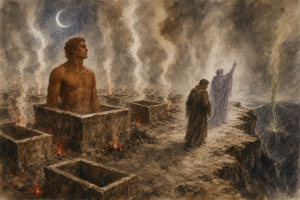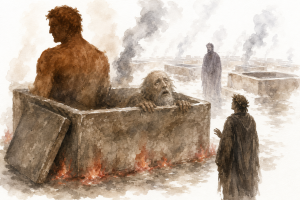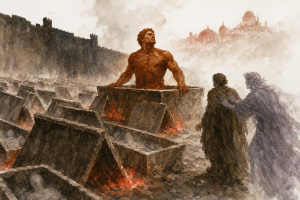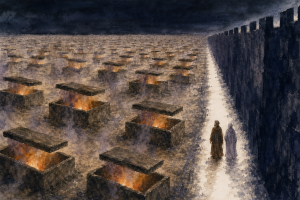
The dark wood has no cause. That is Dante’s first deliberate move. The poem opens mid-crisis — mi ritrovai, I found myself — with the straight way already lost and no account of how that happened. Line 10 confesses it directly: ‘I cannot well say how I entered there.’ Dante plants a gap at the very start of his journey and never fills it. Seven hundred years of readers have tried to fill it for him.
Inferno · Canto 1 · Lines 1–30 · Scene 1
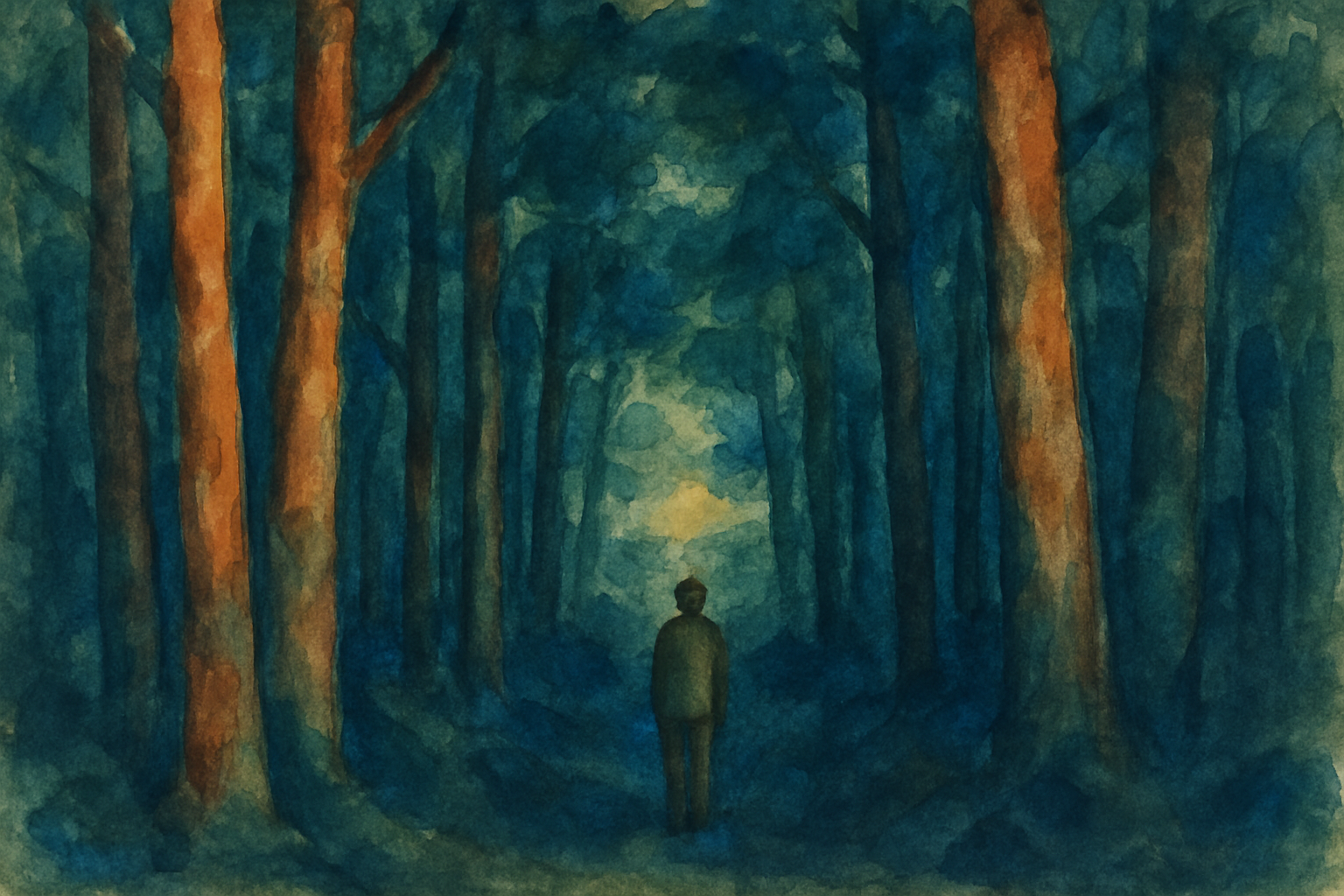
The poem opens not on a moment of transgression but on a moment of recognition. Dante finds himself in a dark wood — selva oscura — with no memory of how he entered it. The straight road, la diritta via, has been lost, though he cannot say when or how. He is thirty-five, the midpoint of a human life if one accepts the biblical span of seventy years. The crisis is already past; what remains is the awareness of it. This is where the Commedia begins: not at the first wrong step, but at the moment the wrong steps become impossible to ignore.
Go deeper: the college-level reading (about 100 words)
Quotes the Italian closely, with philological detail and cross-references.
The Comedy opens in medias res with a construction that critics have never stopped arguing about: mi ritrovai — ‘I found myself.’ Not ‘I went’ or ‘I chose’ but ‘I found myself already there.’ Dante is thirty-five — half of the biblical lifespan of seventy, writing at the midpoint of human life as medieval arithmetic understood it. The selva oscura has a long literary ancestry in Virgil’s dark forests and the classical wood of error, but one of the opening’s boldest touches is the first-person plural: nostra vita, our life’s journey — an immediate, startling invitation to the reader to recognize themselves in the crisis. Then in line 10 he admits he cannot explain how he entered. The cause of the disorientation is withheld.
Go deeper still: the scholarly reading (about 200 words)
The commentary tradition, the sources, and what is documented versus inferred.
The opening terzina establishes the poem’s central formal ambiguity. ‘Mi ritrovai’ — the reflexive past of ritrovare — carries both ‘to find oneself’ and ‘to find oneself again,’ implying a prior state of being found and then lost. The scene’s last line has its own long history of interpretation: ‘sì che ‘l piè fermo sempre era ‘l più basso’ (line 30), so that the firm foot was always the lower. John Freccero’s essay ‘Dante’s Firm Foot and the Journey without a Guide’ (1959) read the line as a figure of the wounded will: the pilgrim moves forward on the foot of the intellect, held back by the foot of the will, a homo claudus lamed by Adam’s sin. Hollander points out that Filippo Villani, around 1405, had already said much the same, linking the halting ascent to Augustine’s long delay before conversion. The impersonal construction of line 3 — ‘era smarrita,’ the way was lost, not ‘I lost it’ — stages a question the poem will revisit but not resolve: is the human being the author of its own disorientation, or its subject?
The Italian — The Dark Wood
Source: Wikisource (public domain, pre-1929 text)
Lines 1–3
1. Nel mezzo del cammin di nostra vita2. mi ritrovai per una selva oscura,3. ché la diritta via era smarrita.
translation note: Line 1 — ‘nostra vita’ — our life’s journey, not my life’s journey. The plural is the poem’s first move: Dante universalizes the crisis before he personalizes it. Every subsequent translation decision about this line is also a decision about whether this is one man’s story or everyone’s. [Model knowledge · high]
translation note: Line 2 — ‘mi ritrovai’ — reflexive past of ritrovare. Carries both ‘I found myself’ and ‘I found myself again,’ implying a prior state of orientation now lost. The reflexive construction blurs agency: Dante doesn’t say he walked into the wood, only that he found himself already inside it. [Model knowledge · high]
wordplay: Line 3 — ‘era smarrita’ — the straight way was lost, passive voice. Not ‘I lost it’ but ‘it had been lost.’ The passive is load-bearing for the theological reading: drift rather than decision. Contrast with line 12 where Dante shifts suddenly to active voice. [Model knowledge · high]
Lines 4–6
4. Ahi quanto a dir qual era è cosa dura5. esta selva selvaggia e aspra e forte6. che nel pensier rinova la paura!
wordplay: Line 5 — ‘selva selvaggia’ — forest / savage. The adjective shares its root with the noun: wild-forest, savage-forest. In Italian the repetition is felt immediately. Three adjectives follow in a sequence — selvaggia (wild), aspra (harsh/bitter), forte (strong/unyielding) — each intensifying the previous, building a wall of resistance. [Model knowledge · high]
translation note: Line 4 — ‘Ahi quanto a dir qual era è cosa dura’ — ah, how hard it is to tell what it was. Dante flags the difficulty of describing the dark wood before he describes it — the experience resists language. This is not rhetorical modesty. It establishes that the dark wood is interior, not just a physical location, and therefore not fully available to representation. [Model knowledge · high]
Lines 10–12
10. Io non so ben ridir com’ i’ v’intrai,11. tant’ era pien di sonno a quel punto12. che la verace via abbandonai.
translation note: Line 10 — ‘Io non so ben ridir com’ i’ v’intrai’ — I cannot well say how I entered there. The cause of the dark wood is withheld at the precise moment the reader expects it. This silence is often read as structural rather than accidental, though the alternative — that Dante simply cannot narrate disorientation from inside it — has its own defenders. [Model knowledge · high]
theology: Line 11 — ‘pien di sonno’ — full of sleep. Sleep as spiritual torpor has a long tradition in Augustine and medieval theology: the soul that drifts from the good does so in a kind of wakefulness failure. This is not literal sleep. [Model knowledge · medium]
wordplay: Line 12 — ‘abbandonai’ — I abandoned. Active voice, first person, sudden. Lines 1-3 open with reflexive and passive constructions (mi ritrovai, era smarrita) that blur agency. Here Dante shifts decisively to agency: ‘I abandoned the true way.’ The shift is jarring and may be the most important grammatical moment in the opening. Whether this is confession or simply narrative shift is contested. [Model knowledge · high]
Lines 13–15
13. Ma poi ch’i’ fui al piè d’un colle giunto,14. là dove terminava quella valle15. che m’avea di paura il cor compunto,
cultural ref: Line 13 — ‘Ma poi ch’i’ fui al piè d’un colle giunto’ — but when I had reached the foot of a hill. The hill (colle) catching dawn light is Dante’s first image of hope and the first failed destination — the three beasts will block the climb. The colle has been read as enlightenment, as virtue, as the papacy, as God. The multiplicity of readings is itself significant: Dante leaves it open. [Model knowledge · medium]
Lines 16–18
16. guardai in alto e vidi le sue spalle17. vestite già de’ raggi del pianeta18. che mena dritto altrui per ogne calle.
cultural ref: Line 17 — ‘il pianeta’ — the planet. In medieval cosmology the sun was a planet (one of seven), not a star. Dante’s readers would have understood this immediately. Modern readers often miss it. [Model knowledge · high]
theology: Line 18 — ‘che mena dritto altrui per ogne calle’ — that leads others straight on every path. The sun as grace: it guides everyone on every road, yet Dante has still lost his way. The implication is that divine guidance was always available and still he wandered. The ‘others’ (altrui) is a quiet accusation. [Model knowledge · medium]
Lines 22–24
22. E come quei che con lena affannata,23. uscito fuor del pelago a la riva,24. si volge a l’acqua perigliosa e guata,
translation note: Line 22 — ‘E come quei che con lena affannata’ — and like one who, with labored breath. The drowning man simile — a widely discussed moment in Inferno. Dante has just emerged from the dark wood but looks back at it as a man pulled from the sea stares back at the water that nearly killed him. The simile stages retrospective terror: the danger is past but the body remembers it as present. [Model knowledge · high]
Lines 25–27
25. così l’animo mio, ch’ancor fuggiva,26. si volse a retro a rimirar lo passo27. che non lasciò già mai persona viva.
translation note: Line 27 — ‘che non lasciò già mai persona viva’ — which has never left any person alive. The dark wood kills. This is the first time Dante names the stakes. The pass behind him is not metaphorically dangerous — it is described as fatal. No one who enters comes out. He did. [Model knowledge · high]
Seven Centuries of Reading The Dark Wood
Sleep, sin and the middle of life
The first commentators read the opening line allegorically almost at once. Guido da Pisa glossed it bluntly: «Per istud dimidium nostre vite accipe somnum», for this middle of our life understand sleep. Dante’s son Pietro offers the same reading. Line 11 supports them, since the pilgrim says he was «pien di sonno» when he abandoned the true way.
A second early tradition took the line literally, as the midpoint of a seventy-year life, so that Dante is thirty-five in 1300. Francesco Mazzoni showed that this view was common among the early commentators, beginning with Dante’s other son Jacopo. It is clearest in the third redaction of the Ottimo Commento, around 1340, which cites Dante’s own discussion of the ages of man in the Convivio (IV.xxiii) by book and chapter. Hollander notes that this may be the first precise citation of the Convivio that survives.
Boccaccio’s two readings
Boccaccio’s Esposizioni, the public lectures he gave in Florence in the 1370s, divide each canto into a literal and an allegorical exposition. His allegorical exposition of this canto treats, in order, sleep (10–12), the lost way (3), the middle of life (1) and the dark wood (4–7). The structure itself makes a point: for Boccaccio the scene works on both levels at once.
He is also precise about the body. His gloss on «lago del cor» (20) explains it as the place in the heart to which the emotions flow, with fear as the example; Singleton and many modern commentators repeat it.
What the wood is, and the third line
Modern commentary has narrowed the claims. Mazzoni argued that the wood signifies not sin itself but human life lived in the condition of sin, and Hollander agrees. Even the grammar of line 3 is disputed: Antonino Pagliaro read «che la diritta via era smarrita» as a clause of result, so that the straight way was lost, while Giorgio Petrocchi’s edition prints the causal «ché», for the straight way was lost. Hollander sides with Pagliaro, as does Guglielmo Gorni.
The climb and the firm foot
Anthony Cassell argued in 1989 that the attempted climb is prideful, a kind of Pelagian assault on grace. Hollander finds this unconvincing, partly because Virgil will later urge the pilgrim to climb.
The last line of the scene, «sì che ‘l piè fermo sempre era ‘l più basso» (30), has its own history. John Freccero’s essay on Dante’s ‘firm foot’ (1959) read the pilgrim as a limping man, moving on the foot of the intellect and held back by the foot of the will, both wounded by Adam’s sin. Hollander points out that Filippo Villani, early in the fifteenth century, had said much the same, building on Guido da Pisa.
What remains open
Seven centuries have not settled whether the wood names a sin, a habit, or a condition, and the poem does not say. Mazzoni’s own caution is worth keeping: the allegorical elements of this canto may be better described as metaphors. That leaves the reader where line 10 leaves the pilgrim, unable to say exactly how he got there.
The Two Main Positions on The Dark Wood
Augustinian / theological
The dark wood is the soul’s gradual drift from God through accumulated small failures — not a single catastrophe but the result of inattention to the good. The passive voice of line 3 is deliberate: ‘the straight way was lost,’ not ‘I lost it.’ Sin as drift, not rupture. The amnesia of line 10 is spiritual amnesia — the soul that has wandered cannot trace the steps of its own wandering.
Key passage: Inf. I.3 — ‘ché la diritta via era smarrita’ (the straight way had been lost)
Humanist / existential
The dark wood is a universal human crisis of meaning — the disorientation that comes when the life you have been living stops making sense. ‘Our life’s journey’ signals Dante is writing about all of us, not a private theological condition. The crisis is existential before it is theological. Every serious human life contains a moment where the path that seemed obvious is simply no longer there.
Key passage: Inf. I.1 — ‘Nel mezzo del cammin di nostra vita’ (midway through our life’s journey)
What the Text Does — and What That Means (Contested)
On the page: Dante opens with agency-effacing constructions — ‘I found myself,’ ‘the way had been lost’ — then in line 12 shifts abruptly to active voice: ‘I abandoned the true way.’ He gives no explanation of how he entered the wood (line 10). These are the observable facts on the page.
What scholars dispute: Whether line 12’s active voice constitutes a confession of moral agency or is simply a narrative shift is actively contested. Some readers find genuine agency here — the soul that drifted chose to drift; others read the scene as prior to moral categorization, the dark wood as a condition described before it is judged. Dante places the amnesia and the agency on the same page without arbitrating between them.
What Dante Leaves Unresolved
Line 10 — ‘Io non so ben ridir com’ i’ v’intrai’ (I cannot well say how I entered there) — is one of the most deliberate silences in the poem. The cause of the dark wood is never given. Whether this is a confession, an invitation to the reader to supply their own cause, or a structural argument that disorientation precedes self-knowledge is a question Dante opens and does not close.
The Open Question
Dante says he found himself in the dark wood — not that he chose it, not that he remembers entering. He opens not with ‘my journey’ but ‘our life’s journey.’ What kind of lost is this, and does it belong to one person or to all of us?
Explore More
About This Article

Written by Lucy Bamboo. Lucy Bamboo has been reading the Divine Comedy for fifteen years — first in translation, then stubbornly in Medieval Tuscan with a dictionary and far too many footnotes. Reading Dante is her scene-by-scene walk through the poem: the original Italian, seven centuries of scholarly argument presented as argument rather than answer, and the human questions sitting underneath the theology. More about this site.
Verify this against a primary source
Specifics change, and your situation may differ from the one described here. These are the authorities worth checking directly:
- Digital Dante, Columbia University — text, commentary and translation apparatus
- Princeton Dante Project — the Commedia with historical commentary
- Dartmouth Dante Project — searchable commentary from 1322 onward