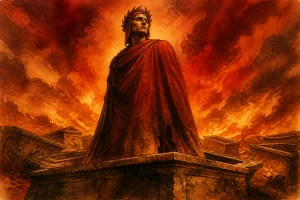

Canto XXVI of Dante’s Inferno is a masterpiece of deliberate ambiguity. Every translation you read pushes you toward a different moral conclusion about the same text. That is not a bug in translation. It’s the feature that makes this canto endlessly alive.
Years of returning to this circle of Hell—the Eighth Bolgia, where fraudsters dwell—have taught me that each encounter with Ulysses inside his flame reveals a slightly different poem. Not because Dante changed his mind, but because translators continuously remake his meaning through choices that seem small until they turn out to carry the weight of the entire interpretation.
The Scene: Fraud as Fire
Picture the Eighth Bolgia in your mind. Dante and Virgil descend into a terrible darkness. Thousands of flames dance like fireflies in a nightmare—not fires burning in the conventional sense, but individual bursts. Each flame contains a soul that deceived humanity through eloquence, cunning counsel, or manipulation of language.
Ulysses is here. Not the hero of Homer’s epic, whom Dante never read. Medieval Dante knew Homer only through Virgil’s Aeneid and scattered legends. His Ulysses is a different creature entirely.
This Ulysses didn’t sail home to Ithaca. Instead, he sailed past the Pillars of Hercules—the edge of the known Mediterranean world. He led his men westward into an unknown ocean. The Atlantic swallowed him whole. That forbidden voyage earned him his place in Hell, trapped in flame with Diomedes, sharing a single punishment.
The Speech That Damned Him: Or Did It?
Ulysses speaks. His words are among the most famous in all of Italian literature, and they sound heroic. They sound right. Here is the crucial passage:
“Considerate la vostra semenza:
— Inferno XXVI, 118-120
fatti non foste a viver come bruti,
ma per seguir virtute e canoscenza.”
The literal meaning is clear. “Consider your origin: you were not made to live as brutes, but to pursue virtue and knowledge.” This is Ulysses’ exhortation to his crew. He uses it to convince them to sail beyond all mapped territory, beyond safety, into the unknown.
On one influential reading, Ulysses is in Hell for precisely this speech — the words themselves are the fraud, honeyed lies of a false counselor dressed as noble ambition. Other readers locate the fraud earlier, in the Trojan Horse and the deception of his own men, and read the final voyage as a different order of transgression — presumption, the crossing of a limit God set rather than fraudulent counsel itself. Either way, the speech sounds magnificent and appeals to something genuinely noble in human ambition. That’s what makes the disagreement possible at all.
Translation becomes interpretation at this exact moment. How a translator renders these three lines determines whether readers see Ulysses as tragic or damned, ambitious or reckless, noble or fraudulent.
The Word “Semenza”: Seed, Breeding, Origin
Start with “semenza.” In Italian, it means seed—both literally and metaphorically. Your semenza is your origin, your ancestry, your biological and spiritual birthright. It is what you are made from.
Robert Pinsky renders it as “breeding”—a Victorian word that carries class implications and sounds aristocratic, even dusty. This choice subtly suggests Ulysses appeals to noble lineage, implying that noblemen should pursue glory.
Robert Durling uses “origin”—more neutral, more philosophical. This opens the question: what is human origin? The speaker sounds less like an aristocrat and more like a metaphysician.
Allen Mandelbaum chooses “seed,” keeping the biological metaphor alive. Seeds grow and fulfill their nature. This version makes Ulysses sound almost Aristotelian—he appeals to natural human flourishing.
Each translation implies a different philosophy of human nature. None is wrong. Each is partial, and each loads the dice.
The Weight of “Brute” and “Made”
“Fatti non foste a viver come bruti”—you were not made to live as brutes. The directness is devastating, but translations soften or sharpen this edge unpredictably.
Some translators add “merely” or “only” before “brutes.” Subtle, almost invisible — yet this qualifier changes everything. “You were not made to live merely as brutes” suggests that living like brutes is acceptable, just insufficient. It makes Ulysses’ argument less radical.
Others render “fatti” as “born” instead of “made.” This shifts responsibility. If you were born to something, perhaps nature or God designed your purpose. If you were made, someone—God, fate, the cosmos—deliberately crafted you for transcendence.
The difference seems negligible, but it isn’t. Translation is never neutral, and every choice reflects an invisible theology.
The Death That Ends All Questions
Ulysses’ voyage ends in catastrophe. His ship sinks within sight of Mount Purgatory—close enough to redemption to taste it, too late to reach it. Here is the final image:
“infin che ‘l mar fu sovra noi richiuso.
— Inferno XXVI, 141-142
…com’ altrui piacque.”
The translation: “Until the sea closed over us again…. as Another willed.” Ulysses does not name God. He says only “Another”—someone else, some external will, made this happen.
Many translators add the word “God” in brackets or parentheses: “as God willed.” This is helpful for readers who need clarity, but does it help the text or betray it?
If Ulysses knew God willed his death, perhaps he would be saved. His damnation may depend partly on his refusal to understand his own fate—his inability or unwillingness to name the power that crushed him. Translators who insert “God” erase this ambiguity. Yet readers unfamiliar with medieval theology might miss the religious implication entirely without that clarification. Translation always sacrifices something. The question is what, and whether the sacrifice is worth it.
The Interpretive Crux: Admiration or Condemnation?
Is Dante admiring Ulysses or condemning him? The text genuinely supports both readings. Dante gives Ulysses magnificent language and allows him to speak with dignity and power. No other fraud in the circle receives such eloquence.
Yet Ulysses is undeniably damned. His voyage was disobedience, his speech was manipulation, and his ambition killed his men. These are facts Dante never lets you forget.
A translator’s choices shape which reading dominates. Make the speech sound heroic—use elevated diction, classical allusions, words that echo epic poetry—and you nudge readers toward seeing Ulysses as tragic, a great soul crushed by fate or divine law. Make it sound manipulative—emphasize the flattery, the seduction, the rhetoric—and you emphasize Ulysses’ guilt as poison disguised as honey.
The most honest translators sit in this tension without resolving it. They resist the temptation to make the text simpler than Dante made it — Dante damns Ulysses with magnificent language and heroic dignity, and that’s not a mistake. His fraud is that he makes wickedness sound like virtue, and the translator has to hold both truths at once.
Primo Levi and the Flame That Survives
Translation becomes a matter of survival in an unexpected context. Primo Levi, imprisoned in Auschwitz, recited Canto XXVI from memory—no book, only memorized Italian absorbed long before the camp.
In his essay collection The Drowned and the Saved, Levi reflects on those recitations. He spoke the Italian words aloud in that hell-on-earth, and the poetry kept him alive — not literally, but spiritually. The words reminded him he was human, that humans could create beauty, that the evil around him wasn’t the whole story.
This is translation in its deepest sense — not converting one language to another, but carrying meaning across the abyss. Levi’s memory translated Dante into survival. The canto about fraudulent speech became an act of truth-telling. The flame containing Ulysses became a flame that could warm the freezing.
What you read of Dante depends partly on what you read, and that depends on who translated him and how they chose to render the impossible choices embedded in every line.
Why This Canto Matters Now
Canto XXVI is not a historical artifact locked in the fourteenth century. We live in an age of fraudulent counsel, rhetoric deployed to lead nations and individuals toward disaster, speeches that sound noble while they destroy.
Which translation you read matters because it shapes how you hear that warning. Does Ulysses sound like a cautionary tale or a romantic tragedy? Your answer determines what you learn from him.
There is no neutral translation of this canto. Every version is an interpretation, and every interpretation reflects choices about what human nature is, what ambition means, what constitutes fraud, and whether we can tell the difference between virtue and its excellent imitation.
That is not a weakness of translation. That is its essence. When you sit down with Dante’s Ulysses, you are not a passive reader. You are choosing which translation to trust — and in doing so, choosing how to read the world. There is no version of this canto that lets you stay neutral. Not even yours.
About This Article

Written by Lucy Bamboo. Lucy Bamboo has been reading the Divine Comedy for fifteen years — first in translation, then stubbornly in Medieval Tuscan with a dictionary and far too many footnotes. Reading Dante is her scene-by-scene walk through the poem: the original Italian, seven centuries of scholarly argument presented as argument rather than answer, and the human questions sitting underneath the theology. More about this site.
Verify this against a primary source
Specifics change, and your situation may differ from the one described here. These are the authorities worth checking directly:
- Digital Dante, Columbia University — text, commentary and translation apparatus
- Princeton Dante Project — the Commedia with historical commentary
- Dartmouth Dante Project — searchable commentary from 1322 onward