
I own thirteen English translations of Dante’s Inferno. Thirteen. Some sit gathering dust on my shelf. Others I’ve marked up so heavily they barely close. But here’s the strange thing: if I hand you Longfellow’s version and then Ciardi’s, you’d think they translated different poems entirely.
The opening canto reads like a funeral dirge in one, a wisecracking monologue in another. The Gate of Hell inscription is spare and Gothic in one, almost conversational in the next. By the time you reach Paolo and Francesca, you’re reading completely different emotional experiences—all from the same medieval Italian text.
This isn’t a failure of translation. It’s the inevitable consequence of an impossible choice. And understanding that choice is the key to reading Dante in English with your eyes open.
The Terza Rima Problem
Dante wrote in terza rima. For those unfamiliar, it’s a rhyme scheme of interlocking tercets: ABA, BCB, CDC, DED, and onward. The pattern creates a forward momentum, like a chain. Each stanza pulls you into the next.
In Italian, this is demanding but achievable. Italian ends are predictable. Feminine endings dominate. Rhyming words cluster naturally. But English? English is a different beast entirely. Our language lacks the abundance of rhyme Italian provides. We have fewer feminine endings. Our stressed syllables are heavier, less flexible.
Every translator faces the same brutal reality: you cannot maintain terza rima in English without sacrificing something fundamental. You choose what dies.
- Sacrifice the rhyme and you lose Dante’s musical architecture.
- Preserve the rhyme and meaning warps, rhythm limps, word order becomes grotesque.
- Try to do both and you end up with something that’s neither Dante nor English.
This is why every major translation reads like a different poem. Each translator made a different bet about what matters most.
How Six Translators Opened the Inferno
Let’s look at the opening three lines. In the original Italian, they’re perfect. They establish the poem’s voice immediately—personal, disoriented, philosophical all at once.
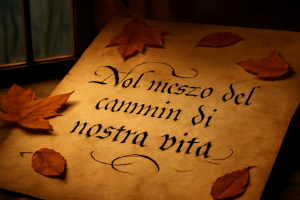
Nel mezzo del cammin di nostra vita
— Dante Alighieri, Inferno, Canto I, lines 1-3
mi ritrovai per una selva oscura
ché la diritta via era smarrita
Word for word, that’s roughly: “In the middle of the journey of our life / I found myself in a dark forest / because the straight way had been lost.” Now watch what happens when six different translators try to carry that into English.
Henry Wadsworth Longfellow (1867): The Word-for-Word Approach
Longfellow was a poet himself. He understood music. Yet he chose to abandon terza rima entirely and embrace unrhymed, nearly literal translation. His opening:
Midway upon the journey of our life
— Longfellow’s translation, Canto I, lines 1-3
I found myself within a forest dark,
For the straightforward pathway had been lost.
Notice the dignity. “Midway upon the journey of our life”—that’s solemn, almost liturgical. The phrasing is Latinate. It honors the original’s gravity. There’s no jauntiness here, no colloquialisms.
But something is gone. The terza rima chain is broken. You don’t feel the poem pulling you forward—line one doesn’t lock into line three, so there’s no sense of entrapment. You feel like you’re reading a paraphrase of something profound, not experiencing the poem itself.
John Ciardi (1954): The Colloquial American
Ciardi wanted English readers to feel the poem, not study it like a textbook. He loosened the rhyme scheme drastically and adopted conversational American English. His opening reads like a confession:
Midway in our life’s journey, I awoke
— Ciardi’s translation, Canto I, lines 1-3
in a dark wood. I had wandered off
the narrow way, and woke to find myself alone.
Listen to that voice. “I awoke in a dark wood.” It’s immediate, almost intimate. Ciardi adds elements Dante doesn’t literally say—”alone,” the sense of waking up—but they capture an emotional truth. This is Dante for readers who want to experience disorientation, not parse medieval philosophy.
The tradeoff? Precision evaporates. “Midway in our life’s journey”—that casual phrasing softens Dante’s formal nel mezzo del cammin di nostra vita. The Italian means something closer to our collective journey, not just “my journey.” Ciardi makes it personal in a way Dante didn’t explicitly. Beautiful, yes. Faithful? Less so.
Allen Mandelbaum (1980): The Poet’s Solution
Mandelbaum was a poet first, translator second. He abandoned terza rima for blank verse—unrhymed iambic pentameter. His reasoning? Maintain English naturalness while preserving Dante’s lyricism. Here’s his opening:
Midway in the journey of our life
— Mandelbaum’s translation, Canto I, lines 1-3
I came to myself in a dark wood
where the straight way was lost.
This is gorgeous. “I came to myself” carries philosophical weight. The phrasing has lyrical control without sounding forced. Readers find themselves captivated by the beauty of the language.
But—and this is crucial—it’s a different beauty than Dante’s. Mandelbaum’s version often surpasses the original in English-language poetry. Readers leave thinking, “What a beautiful poem!” They don’t necessarily think, “This is what Dante wrote.” The translation has become its own artistic achievement.
Robert Pinsky (1994): The Ambitious Hybrid
Pinsky tried to have everything: terza rima’s chain-like effect, conversational English, and accuracy. He used slant rhyme and looser rhyme patterns. His opening:
Midway on the journey of our life
— Pinsky’s translation, Canto I, lines 1-3
I woke to find myself in a dark wood,
because the way ahead was getting rough.
Notice “life/rough” and “wood”—these aren’t perfect rhymes, but they create loose sonic connections. You feel forward momentum without artificiality. The voice is modern but not flippant.
It’s an admirably ambitious middle path. Yet ambition has a cost: some readers find it neither fully musical nor fully natural. You’re always aware of the translator trying to walk a tightrope.
Robert and Jean Hollander (2000): The Scholar’s Translation
The Hollanders abandoned beautiful English entirely. Their goal was absolute fidelity. Blank verse, minimal interpretation, the Italian text facing the English on opposite pages. Their opening:
Midway in the journey of our life
— Hollander translation, Canto I, lines 1-3
I found myself within a dark wood
because I had abandoned the true path.
It’s deliberately plain. No poetry. Just meaning transferred from Italian to English as directly as possible. If you want to study Dante—to understand exactly what he wrote—this is your text.
The trade-off is obvious: it reads like a scholarly document, not a living poem. First-time readers often find it austere, even cold. Yet scholars and serious students swear by it.
Mary Jo Bang (2012): The Radical Modernist
Bang is controversial. She updated Dante’s language to contemporary American speech. Dropped terza rima. Loosened form radically. Her opening is startling:
Halfway through my life,
— Bang’s translation, Canto I, lines 1-3
I woke up in a dark woods
and couldn’t find the right path.
“Woke up”—that’s slang. “Dark woods”—that’s folk-tale language. Bang strips away any pretense of high style. She wants Dante to sound like a contemporary American talking, not a Renaissance Italian poet.
Critics argue she betrays Dante’s formal dignity. Defenders argue she captures the experience of disorientation more honestly than formal, archaic language ever could. You either find her brilliantly alive or deeply wrong.
About This Article

Written by Lucy Bamboo. Lucy Bamboo has been reading the Divine Comedy for fifteen years — first in translation, then stubbornly in Medieval Tuscan with a dictionary and far too many footnotes. Reading Dante is her scene-by-scene walk through the poem: the original Italian, seven centuries of scholarly argument presented as argument rather than answer, and the human questions sitting underneath the theology. More about this site.
Verify this against a primary source
Specifics change, and your situation may differ from the one described here. These are the authorities worth checking directly:
- Digital Dante, Columbia University — text, commentary and translation apparatus
- Princeton Dante Project — the Commedia with historical commentary
- Dartmouth Dante Project — searchable commentary from 1322 onward