
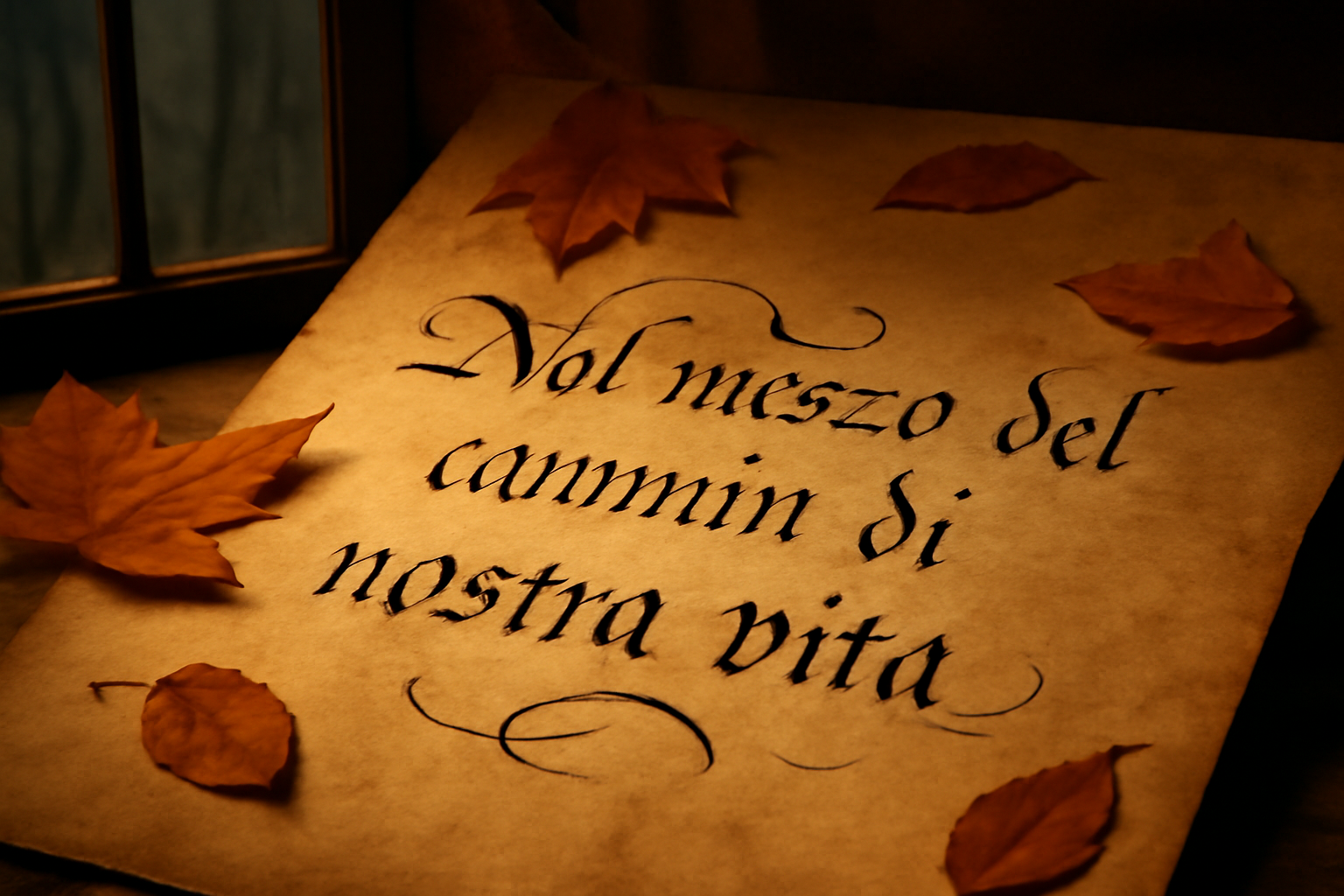
Every Italian schoolchild knows these seven words by heart. They’re the opening of Dante’s Divine Comedy, the most famous line in Italian literature. Yet ask ten translators to render them into English, and you’ll get ten different poems.
Nel mezzo del cammin di nostra vita
— Dante Alighieri, Inferno, Canto I, Line 1
I’ve spent years comparing Dante translations. I’ve dog-eared copies of Longfellow, Ciardi, Mandelbaum, Mary Jo Bang, and newer voices. What fascinated me most? These opening seven words expose every tension a translator must navigate. Precision versus poetry. Literal meaning versus spiritual resonance. Personal confession versus universal truth.
This line isn’t just beautiful. It’s a masterclass in how translation choices reshape meaning—sometimes subtly, sometimes radically. Let’s pull it apart word by word.
The Middle: A Simple Word That Isn’t Simple
Start with “Nel mezzo.” In the middle. Simple enough, yes?
Henry Longfellow, the gold standard for nineteenth-century Dante, chose “midway.” John Ciardi went with “halfway.” Robert Mandelbaum offered “midway along.” These three words sound nearly identical. Yet each carries different weight.
“Midway” feels classical—think Virgil’s Aeneid. It has gravitas. “Halfway” sounds more colloquial, almost American. “Midway along” splits the difference, adding motion. A reader who encounters “midway” imagines a moment of pause at the center. One who reads “halfway” feels the forward momentum of a journey already underway.
Dante knew what he was doing. Italian “mezzo” means middle, yes. But it also suggests center, balance, equilibrium—the exact midpoint. Not “almost there” or “partway through.” The precise middle.
This precision matters theologically. Dante sets his poem in 1300, when he was exactly thirty-five years old. Medieval theology held that human life spans seventy years (drawing from Psalm 90). Half of seventy is thirty-five. Dante isn’t being poetic here—he’s being mathematical. He’s telling us he’s reached the exact midpoint of a divinely ordained lifespan.
A translator who chooses “halfway” risks losing that theological precision. It sounds too casual for what is, in fact, a numbered calculation.
The Journey: Concrete Road or Abstract Path?
Now consider “del cammin.” Of the journey. Of the road. Of the way.
Italian “cammino” is a path you walk with your feet. It’s concrete. Physical. You can see dust on it, feel stones beneath your soles. Yet most English translators render it as “journey”—an abstract noun. A journey happens inside you.
Longfellow says “our life’s journey.” Ciardi says “our life’s way.” Some modern translators keep “road” or “path.” Which is right?
Here’s what I’ve learned from comparing these versions: there is no “right” answer. Only different poems. A translator choosing “journey” emphasizes the spiritual destination. Dante isn’t just walking—he’s on a quest. One choosing “road” or “path” preserves the sensory, physical aspect of being lost in the world.
Dante wrote “cammino,” not “viaggio” (voyage) or “peregrinazione” (pilgrimage). He wanted the solid, walkaround word. Yet English doesn’t have a perfect equivalent. Each choice involves sacrifice.
“Nostra,” Not “Mia”
The single most consequential word in the line is the one nobody stops on. Dante does not write il cammin di mia vita — the journey of my life. He writes:
Nel mezzo del cammin di nostra vita
mi ritrovai per una selva oscura,
ché la diritta via era smarrita.
Nostra vita. Our life. The first word of the poem’s first sentence that carries any ownership makes the life a shared one, and then the second line drops immediately into the first person singular: mi ritrovai, I found myself.
The poem opens by enrolling you and then abandoning you. The span is everyone’s; the wood is his. That hinge, from plural to singular across a line break, is doing more than any adjective in the tercet.
How We Know He Means Thirty-Five
The line never states an age, and yet the arithmetic is not really in doubt. Three things converge.
- The biblical span. Psalm 90 gives the days of our years as threescore and ten. Half of seventy is thirty-five.
- Dante’s own arithmetic. In the Convivio he discusses the arc of a life and places its summit around the thirty-fifth year — his own view, written before the Commedia.
- The date of the fiction. The poem is set at Easter 1300. Dante was born in 1265. In spring 1300 he was thirty-five.
So the line quietly does two jobs at once: it states a universal midpoint, and it fixes the poem to a specific Holy Week in a specific year, with a specific man at exactly the specified age. The distinction between the pilgrim and the poet begins here — the “I” who got lost is thirty-five, and the “I” writing it down is considerably older and already in exile.
Two Translators on the Same Three Lines
| Cary, 1814 | Longfellow, 1867 |
|---|---|
| “In the midway of this our mortal life, I found me in a gloomy wood, astray Gone from the path direct” | “Midway upon the journey of our life I found myself within a forest dark, For the straightforward pathway had been lost.” |
Cary adds “mortal,” which is not in the Italian, to make the life-span reading explicit — and in doing so closes off the other readings. He also converts cammin into “midway… of life” and loses the road entirely.
Longfellow keeps “journey,” keeps “our,” and renders the third line in the passive — “had been lost” — which preserves something crucial about the Italian. Era smarrita does not say who lost the way. A translation that says “I had lost the right path” has assigned blame the original withholds.
That withholding matters, because ten lines later Dante says he cannot even recall how he got in: Io non so ben ridir com’i’ v’intrai, / tant’era pien di sonno a quel punto — I cannot rightly say how I entered, so full of sleep was I at that moment.
Common Questions
What does “nel mezzo del cammin di nostra vita” mean? “Midway upon the journey of our life.” It is the opening line of Dante’s Inferno and of the whole Divine Comedy.
How old is Dante in the poem? Thirty-five. The biblical lifespan is seventy years, so its midpoint is thirty-five; the poem is set at Easter 1300 and Dante was born in 1265.
Why does Dante say “our life” and not “my life”? Because the span he is measuring is everyone’s, not his. The line makes the reader a party to the journey before the next line narrows to a single lost man.
What is “la diritta via”? The straight or right way. The Italian says it “was lost” without saying who lost it — a passive that most English versions have to decide about one way or the other.
Is “cammin” a road or a journey? Both senses are live. It is a road you walk and the course of a life, and the line works because it does not choose.
Keep Going
The wood the line drops him into is the selva oscura, and the full opening movement is read tercet by tercet in The Dark Wood — Inferno, Canto 1.
About This Article

Written by Lucy Bamboo. Lucy Bamboo has been reading the Divine Comedy for fifteen years — first in translation, then stubbornly in Medieval Tuscan with a dictionary and far too many footnotes. Reading Dante is her scene-by-scene walk through the poem: the original Italian, seven centuries of scholarly argument presented as argument rather than answer, and the human questions sitting underneath the theology. More about this site.
Verify this against a primary source
Specifics change, and your situation may differ from the one described here. These are the authorities worth checking directly:
- Digital Dante, Columbia University — text, commentary and translation apparatus
- Princeton Dante Project — the Commedia with historical commentary
- Dartmouth Dante Project — searchable commentary from 1322 onward