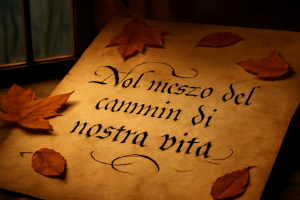
I spent an entire weekend last fall comparing twelve different English translations of nine Italian lines. Nine lines — the Gate of Hell inscription from Dante’s Inferno, Canto III. By Sunday night my desk had disappeared under paperbacks, and the nine lines had become twelve different gates.
Each translator made choices that altered Hell’s entrance. Some shouted. Others whispered. A few tried to stay invisible. Six of those versions taught me the most, and they are the six below — but first, the stone itself.
The Italian Text: Nine Lines That Changed Literature
Here is what Dante actually wrote:
Per me si va ne la città dolente,
— Dante Alighieri, Inferno, Canto III, lines 1-9
per me si va ne l’etterno dolore,
per me si va tra la perduta gente.
Giustizia mosse il mio alto fattore;
fecemi la divina podestate,
la somma sapïenza e ‘l primo amore.
Dinanzi a me non fuor cose create
se non etterne, e io etterno duro.
Lasciate ogne speranza, voi ch’intrate.
The Gate speaks. It speaks in first person. It claims to be eternal, created by Justice itself, and it demands we abandon hope. (I’ve written about the scene that follows — the neutrals, the wasps, the banner — in the Canto III close reading; this post stays at the threshold.)
Now let me break down what these lines literally say, word by word.
A Word-for-Word Translation
Line 1: “Per me si va ne la città dolente” = “Through me one goes into the city suffering/sorrowful”
Line 2: “per me si va ne l’etterno dolore” = “through me one goes into the eternal pain/sorrow”
Line 3: “per me si va tra la perduta gente” = “through me one goes among the lost/ruined people”
Line 4: “Giustizia mosse il mio alto fattore” = “Justice moved my high/exalted maker”
Lines 5-6: “fecemi la divina podestate, / la somma sapïenza e ‘l primo amore” = “the divine power made me, / the highest wisdom and the first love”
Lines 7-8: “Dinanzi a me non fuor cose create / se non etterne, e io etterno duro” = “Before me there were not things created / except eternal ones, and I eternal endure”
Line 9: “Lasciate ogne speranza, voi ch’intrate” = “Leave every hope, you who enter”
That’s the skeleton. Now for the flesh.
Henry Francis Cary (1814): The Gate as Milton
Through me you pass into the city of woe:
— tr. Henry Francis Cary, The Vision (1814)
Through me you pass into eternal pain:
Through me among the people lost for aye.
[…]
All hope abandon ye who enter here.
For most of the nineteenth century, Cary was Dante in English. Coleridge praised the translation into fame; Keats carried the pocket edition on his walking tour of Scotland. And you can hear why it traveled so well: this is blank verse in the full Miltonic register, and Cary’s gate sounds like it has read Paradise Lost. “The people lost for aye” was an archaism even in 1814 — the diction of a poet reaching for the grand style on purpose.
Two choices matter most. First, “you pass” — Cary’s gate addresses you directly, in the second person, from its opening word. The Italian doesn’t: si va, “one goes,” impersonal as a law of physics. Second, that ninth line. “All hope abandon ye who enter here” — the inversion is Cary’s, not Dante’s, and it is the version the English language decided to keep. When people misquote the Gate of Hell today, they are almost always misquoting Cary. His gate is an orator, and orators get remembered.
Henry Wadsworth Longfellow (1867): The Gate with an Accent
Through me the way is to the city dolent;
— tr. Henry Wadsworth Longfellow (1867)
Through me the way is to eternal dole;
Through me the way among the people lost.
[…]
All hope abandon, ye who enter in!
“The city dolent” is not English. It’s dolente wearing an English coat, and Longfellow knew exactly what he was doing. The first major American translator of the Commedia — working through the long grief after his wife’s death, reading cantos aloud to his Dante Club at Harvard — refused to domesticate the poem. He keeps Italian word order where he can, reaches for Latinate cognates (“dolent,” “eterne”), and lets the strangeness stand. His gate speaks with an accent, deliberately: you are meant to remember, at every line, that these words were cut into stone in another language. (I’ve traced what American translators did with his inheritance elsewhere.)
Then look at the end of his ninth line. Dante closes the inscription with a period — the gate states, it does not exclaim. Longfellow adds “in!” with an exclamation mark. The most scrupulously foreignizing translator on this list raises his voice in the one place the Italian keeps its flat, terrible calm.
Should a translation remind you that it is a translation — or is the deepest fidelity the kind that makes you forget?
John Ciardi (1954): The Gate as False Christ
I am the way into the city of woe.
— tr. John Ciardi (1954)
I am the way to a forsaken people.
I am the way into eternal sorrow.
[…]
Abandon all hope ye who enter here.
This is the boldest demolition on the list. The Italian says per me si va — “through me one goes.” The gate is a doorway; the going is yours. Ciardi’s gate says I am the way, and any reader raised within earshot of the King James Bible hears the echo instantly: “I am the way, the truth, and the life” (John 14:6). Ciardi’s gate quotes Christ. A door to damnation speaking the Gospel’s most famous self-description — it’s either blasphemy or the sharpest theological joke in American translation.
Is the echo in Dante? Arguably it’s latent — the inscription does credit Hell to the whole Trinity, power and wisdom and love, and Dante means for that to disturb you. But the Italian never touches the phrasing of John. Ciardi doesn’t gesture at the possibility; he commits to it, three times, as anaphora. And because his was the mass-market paperback assigned in American classrooms for two generations, a plurality of American readers first heard Hell’s gate sounding like a dark gospel. His middle lines rationalize the same way — “Sacred justice moved my architect” gives Hell an architect, blueprints, a building committee. Ciardi’s Hell is a made thing, and its maker signs the work.
Mark Musa (1971): The Comma That Tolls
Through me the way into the doleful city,
— tr. Mark Musa (1971)
through me the way into eternal grief,
through me the way among a race forsaken.
[…]
Abandon hope, forever, you who enter.
Musa’s tercet is the quietest of the six — “doleful city” even reaches back to the Victorians. The knife is in his ninth line, and it’s a knife made of punctuation. The Italian puts its weight on ogne: leave every hope. Cary spent that weight on his inversion; Ciardi spent it on “all.” Musa moves it onto time. “Abandon hope, forever, you who enter” — the commas around “forever” force a halt on either side of the word. You cannot read the line quickly. Hope. Forever. You.
It changes what the warning is about. In every other version on this list, the gate tells you how much to surrender — all of it, every last hope. Musa’s gate tells you how long. Damnation here isn’t the totality of the loss; it’s the duration. Read the two versions aloud back to back and decide which one you’d less like to see over a door.
Allen Mandelbaum (1980): The Gate That Addresses No One
Through me the way into the suffering city,
— tr. Allen Mandelbaum (1980)
through me the way to the eternal pain,
through me the way that runs among the lost.
[…]
Abandon every hope, who enter here.
“The suffering city.” Not a city of woe, not doleful — suffering, present participle, a city in the act of it right now, while you stand outside reading the sign. And “the way that runs among the lost”: in Mandelbaum’s line the road itself moves, alive under your feet before you’ve taken a step.
Then the famous omission. “Abandon every hope, who enter here” — no you. The Italian has it (voi ch’intrate), and Mandelbaum, the most scrupulous craftsman on this list, drops it. What’s left is stranger and colder than an address: an eternal sign doesn’t need to say “you,” because whoever is standing in front of it is who. Notice he keeps “every” — the itemized surrender, hope by hope — while cutting the reader out of the sentence. Cary’s gate performs for you. Mandelbaum’s gate was posted before you existed and will be accurate long after, like an official notice for no one in particular.
Which is crueler — a gate that speaks to you, or one that was written for whoever happened to arrive?
Robert Pinsky (1994): The Population of Loss
Through me you enter into the city of woes,
— tr. Robert Pinsky (1994)
through me you enter into eternal pain,
through me you enter the population of loss.
[…]
Abandon all hope, you who enter here.
“The population of loss.” La perduta gente — the lost people — becomes a demographic. “Population” is a word from censuses and disaster reports; it’s what human beings turn into when they are counted instead of known. It is the most twentieth-century phrase in any version of this gate, and the twentieth century earned it.
The other thing Pinsky does is invisible in an excerpt: his full inscription runs seven lines, not nine. He is keeping a disciplined slant-rhymed terza rima, and rhyme-poor English makes him pay for the rhymes in compression — the middle tercet fuses, the Trinity’s titles collapse into quick appositions (“in power divine, / wisdom supreme, love primal”). His gate talks fast and dense, like something with no patience for ceremony. And then the last line relaxes into the cadence every English reader already knows: “Abandon all hope, you who enter here.” After all that compression, the familiar words land like the one part of the sign that was always going to say what it says.
Six Warnings, One Door
Line them up and you have six theologies in miniature. Cary’s gate is an orator. Longfellow’s is a foreigner who refuses to assimilate. Ciardi’s is a false Christ. Musa’s is a bell tolling one word. Mandelbaum’s is an official notice posted for no one. Pinsky’s is a census-taker of the lost. None of them is wrong. Every one of them read the same nine lines I printed at the top of this page.
The Italian holds all six at once. Per me si va is impersonal and intimate at the same time; lasciate ogne speranza is flat enough to be a legal formula and enormous enough to be a curse. English can’t hold those registers in one sentence — the translator has to choose, and the choice happens before you reach the threshold. The inscription is the only place in the whole poem where Hell speaks for itself, with no narrator framing it and no guide yet explaining it. No translator can let it do that without deciding, on your behalf and in advance, what Hell is.
Dante saw the problem first. In the poem, the pilgrim reads the dark words over the door and doesn’t understand them. “Master,” he says to Virgil, “their meaning is hard for me” — il senso lor m’è duro. The first reader of the Gate of Hell needed a translator standing next to him before he could walk under it. Every reader since has stood exactly where he stood: in front of nine dark lines, beside a guide who has already decided what they say.
About This Article

Written by Lucy Bamboo. Lucy Bamboo has been reading the Divine Comedy for fifteen years — first in translation, then stubbornly in Medieval Tuscan with a dictionary and far too many footnotes. Reading Dante is her scene-by-scene walk through the poem: the original Italian, seven centuries of scholarly argument presented as argument rather than answer, and the human questions sitting underneath the theology. More about this site.
Verify this against a primary source
Specifics change, and your situation may differ from the one described here. These are the authorities worth checking directly:
- Digital Dante, Columbia University — text, commentary and translation apparatus
- Princeton Dante Project — the Commedia with historical commentary
- Dartmouth Dante Project — searchable commentary from 1322 onward