The hill is visible, and for a moment the path seems clear. Then the beasts appear. A spotted cat — the lonza, whose Italian name has no certain English equivalent — blocks the way first. A lion follows. The she-wolf comes last and is the worst: she fills Dante with such dread that he loses all hope of the ascent and retreats toward the dark. A few lines later Virgil appears. The three animals that stop the climb have been generating scholarly debate ever since, and the greyhound promised in lines 100–111 to drive the she-wolf back to Hell has never been satisfactorily identified.
Inferno · Canto 1 · Lines 31–60 · Scene 2
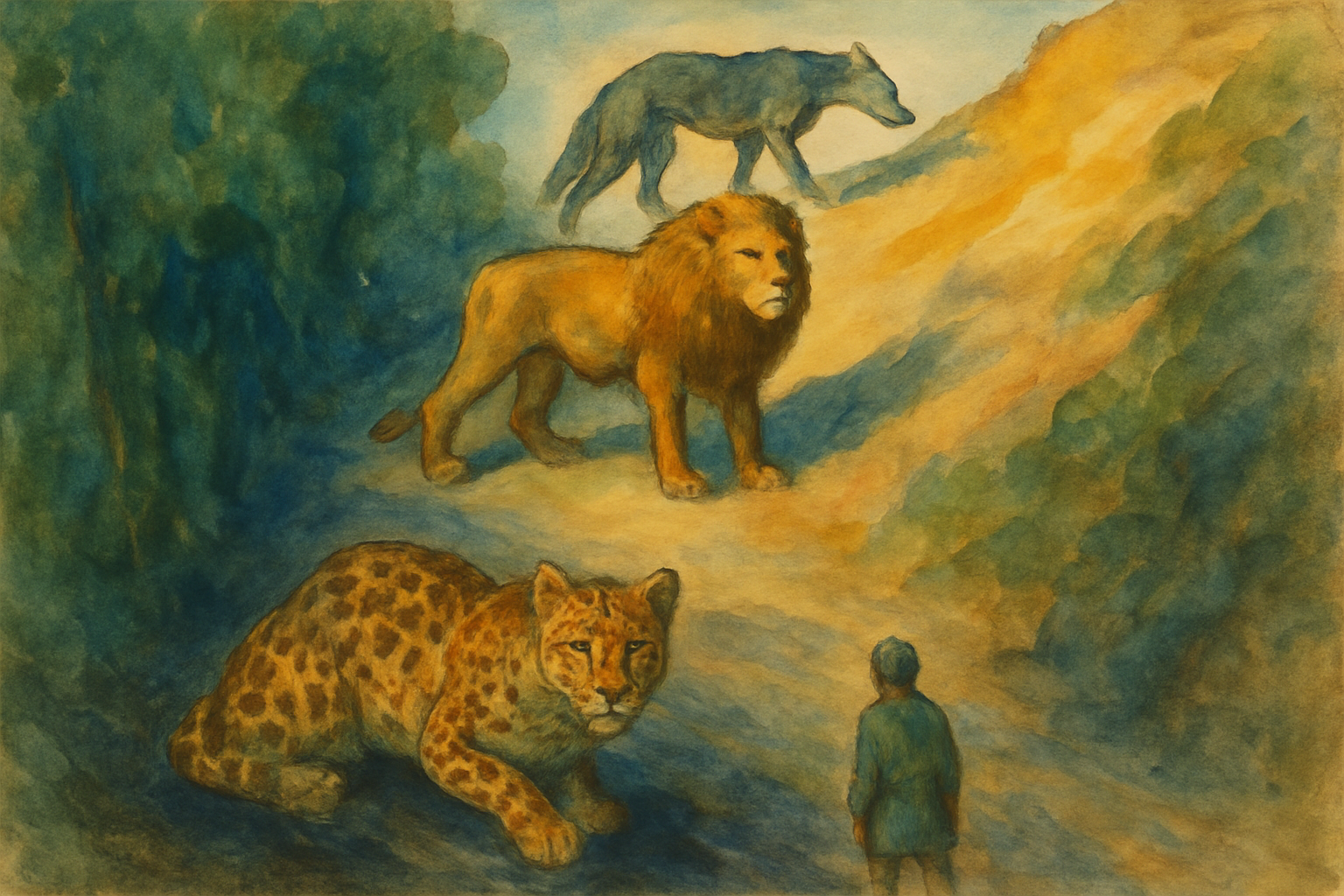
Three beasts interrupt Dante’s ascent in sequence, each worse than the last. A leopard — spotted, quick, unwilling to clear the path — appears first but does not stop him entirely; the time of day and the season sustain a measure of hope. A lion follows, head raised, advancing with such force that the air itself seems to shake. Then a she-wolf: gaunt, yet projecting an impression of insatiable accumulation, as though want itself had taken form. It is she who ends the climb. The lonza blocks, the lion menaces, but the she-wolf drives him back step by step until the dark wood he had left is beneath him again, and the sunlit slope is out of reach.
Go deeper: the college-level reading (about 150 words)
Quotes the Italian closely, with philological detail and cross-references.
Lines 31–60 stage Dante’s failed ascent as a triple refusal. Each beast escalates the stakes: the lonza (leopard or lynx — the Italian word is rare) delays with circling evasion; the leone (lion) threatens with the raised head of pride and rabid hunger; the lupa (she-wolf) defeats entirely. The brief astronomical aside in lines 37–43 is crucial — dawn, spring, the stars at the Creation — a window of cosmological hope that the she-wolf then closes. Her description is the most precise of the three: thin yet ‘laden with all cravings,’ a paradox of insatiability. She alone is described as afflicting nations, not just one traveler. And she alone will receive a prophecy: the Veltro, coming to drive her back to Hell. The scene ends with Dante pushed back ‘to where the sun is silent’ — the last phrase belongs entirely to the dark wood that opened the poem.
Go deeper still: the scholarly reading (about 200 words)
The commentary tradition, the sources, and what is documented versus inferred.
The ternary structure has invited allegorical decoding from the start, and the history of that decoding is instructive. The earliest commentators, as Ragonese’s survey of the tradition shows (reported by Hollander), were strikingly in accord: the three beasts signify three of the deadly sins — lust, pride, and avarice. Modern readers have mostly abandoned that consensus without agreeing on a replacement. One school points to the three ‘faville’ that Ciacco names at VI.74–75, ‘superbia, invidia e avarizia’; another to the three dispositions Virgil cites at XI.81–83, ‘incontenenza, malizia e la matta / bestialitade,’ though its adherents disagree about which beast is which. The correspondence is never stated in the text. Dante does not name the allegory; his readers named it for him. The she-wolf’s distinctive phrase, ‘molte genti fé già viver grame’ (she has made many nations live in grief), carries a collective and historical weight that strains any schema of personal sin. Her thinness-in-fullness — ‘carca ne la sua magrezza,’ laden in her leanness — is the poem’s first image of desire as a structure rather than an episode: appetite that perpetuates itself. The she-wolf is the only beast to generate a prophecy, and that prophecy (the Veltro of lines 100–111) has remained unresolved for seven centuries.
The Italian — The Three Beasts
Source: Wikisource (public domain, pre-1929 text)
Lines 31–33
31. Ed ecco, quasi al cominciar de l’erta,32. una lonza leggera e presta molto,33. che di pel macolato era coverta;
translation note: Line 31 — ‘quasi al cominciar de l’erta’ — almost at the beginning of the ascent. The beast appears the instant Dante starts to climb. The obstacle is inseparable from the attempt: hope generates the encounter. [Model knowledge · high]
wordplay: Line 32 — ‘lonza leggera e presta’ — light and quick. The word lonza is rare in Italian and its zoological referent is uncertain: leopard, lynx, and cheetah have all been proposed. Dante’s lonza is defined by movement and evasion — harder to name than to feel. [Model knowledge · medium]
Lines 34–36
34. e non mi si partia dinanzi al volto,35. anzi ‘mpediva tanto il mio cammino,36. ch’i’ fui per ritornar più volte vòlto.
translation note: Line 34 — ‘non mi si partia dinanzi al volto’ — it would not leave from before my face. The lonza does not attack; it circles and persists. This is obstruction through distraction, not assault. On the modern reading that maps the beasts onto Inferno XI, the lonza figures incontinence, an endlessly renewed temptation rather than a single blow; the earliest commentators took her as lust. [Model knowledge · high]
Lines 37–39
37. Temp’ era dal principio del mattino,38. e ‘l sol montava ‘n sù con quelle stelle39. ch’eran con lui quando l’amor divino
theology: Line 37 — Dawn and the spring stars of the vernal equinox: in medieval cosmology, the sun in Aries at equinox was the configuration of the first Creation. Dante situates his journey at a cosmological renewal — a narrative window of grace that the she-wolf will close. [Model knowledge · high]
Lines 40–42
40. mosse di prima quelle cose belle;41. sì ch’a bene sperar m’era cagione42. di quella fiera a la gaetta pelle
wordplay: Line 42 — ‘a la gaetta pelle’ — with the bright, gay-colored pelt. The lonza’s spotted coat is described as beautiful in this moment of hope. The same animal that blocks the path is also aesthetically striking — a detail the allegorical reading tends to pass over, but the poem doesn’t. [Model knowledge · high]
Lines 43–45
43. l’ora del tempo e la dolce stagione;44. ma non sì che paura non mi desse45. la vista che m’apparve d’un leone.
translation note: Line 44 — ‘ma non sì che’ — but not so much that. The adversative is precise: the hopeful signs were real but insufficient. Dante measures the emotional arithmetic: a dawn, a spring, a creation-moment — not enough against a lion. The poem tracks degrees of hope as if charting a temperature. [Model knowledge · high]
Lines 46–48
46. Questi parea che contra me venisse47. con la test’ alta e con rabbiosa fame,48. sì che parea che l’aere ne tremesse.
translation note: Line 47 — ‘con la test’ alta’ — with his head held high. In medieval iconography the raised head is the posture of superbia (pride). The lion does not circle or evade; he comes straight on, arrogant and hungry. His approach is direct where the lonza’s was lateral. [Model knowledge · high]
translation note: Line 48 — ‘che l’aere ne tremesse’ — so that the air seemed to tremble from it. The lion’s menace extends into the atmosphere. This is the only moment in the scene where the physical world registers the beast’s presence beyond what Dante sees — a suggestion of the lion’s scale of threat. [Model knowledge · medium]
Lines 49–51
49. Ed una lupa, che di tutte brame50. sembiava carca ne la sua magrezza,51. e molte genti fé già viver grame,
wordplay: Line 49 — ‘di tutte brame’ — of all cravings, every longing. Not one specific appetite but the universal form of want. The she-wolf doesn’t desire one thing; she embodies desire as a condition. This is what elevates her above the lonza and leone: she represents the structure of insatiability itself. [Model knowledge · high]
translation note: Line 50 — ‘carca ne la sua magrezza’ — laden in her leanness. A deliberate paradox: full of cravings, yet thin. The wanting consumes without satisfying. This oxymoron is Dante’s sharpest image of the insatiability that makes the she-wolf the most dangerous of the three. [Model knowledge · high]
translation note: Line 51 — ‘molte genti fé già viver grame’ — she has made many nations live in grief. Not one man but many nations. The she-wolf’s hunger is collective and historical, distinguishing her damage from the other two beasts. This line is the hinge of the political reading. [Model knowledge · high]
Lines 52–54
52. questa mi porse tanto di gravezza53. con la paura ch’uscia di sua vista,54. ch’io perdei la speranza de l’altezza.
translation note: Line 54 — ‘io perdei la speranza de l’altezza’ — I lost hope of the height. Not ‘the hill was taken from me’ but ‘I lost hope of it.’ The she-wolf’s defeat is psychological before it is physical — she extinguishes the will to climb rather than physically blocking the road. [Model knowledge · high]
Lines 55–57
55. E qual è quei che volontieri acquista,56. e giugne ‘l tempo che perder lo face,57. che ‘n tutti suoi pensier piange e s’attrista;
cultural ref: Line 55 — The merchant simile: a man who loves to acquire wealth, then reaches the moment he must lose it all, and weeps in all his thoughts. Dante compares himself to a ruined investor. The she-wolf’s insatiability is likened to financial ruin — not random misfortune but the collapse of something built on the wrong foundation. [Model knowledge · high]
Lines 58–60
58. tal mi fece la bestia sanza pace,59. che, venendomi ‘ncontro, a poco a poco60. mi ripigneva là dove ‘l sol tace.
wordplay: Line 58 — ‘la bestia sanza pace’ — the beast without peace. The she-wolf cannot rest, cannot be satisfied. Restlessness itself will recur as a condition of damnation — the she-wolf’s ‘sanza pace’ anticipates the ceaseless wind that drives Francesca and the other lustful in Inferno V, even though the poem doesn’t repeat the phrase verbatim there. Insatiability is itself a form of Hell — present tense, before the journey even begins. [Model knowledge · medium]
translation note: Line 60 — ‘là dove ‘l sol tace’ — to where the sun is silent. Silence assigned to light. Not darkness but a hush — the dark wood is a place where even illumination has stopped speaking. The scene ends exactly where the poem began: the silent wood, the no-exit. [Model knowledge · high]
Seven Centuries of Reading The Three Beasts
Lust, pride and avarice: the first consensus
On the meaning of the three beasts the fourteenth century was unusually united. Boccaccio states the consensus plainly: the lonza is lust, the lion pride, the she-wolf avarice, «secondo la sentenzia di tutti», in the opinion of everyone. He then undertakes to show how each animal fits its vice, and adds a characteristic reservation: whether the author meant them so, «rimangasi nello albitrio di ciascuno», let it rest with each reader’s judgment.
Benvenuto da Imola, lecturing in Bologna a few years later, worked out the lonza with zoological care. Three animals have spotted hides, he says: the lynx, the pard and the panther. Dante’s lonza may be the lynx, the animal whose spotted skin Virgil gives to Venus in disguise (Aeneid I.323). On balance Benvenuto prefers the pard, partly because of Florentine usage, and he tells a story to prove it: when a leopard was once carried through Florence, the boys ran after it shouting «vide lonciam», look, a lonza. He had the story, he says, from Boccaccio.
The Aeneid echo itself is an old observation. Hollander traces the tradition perhaps to Pietro Alighieri, with Benvenuto developing it.
The modern dissent
Modern readers mostly abandoned that consensus without agreeing on a replacement. Hollander, drawing on Ragonese’s history of the question, sets out the main alternatives. One school reads the beasts as the three ‘sparks’ Ciacco names at VI.74–75: pride, envy and avarice. Another maps them onto the three dispositions Virgil cites at XI.81–83: incontinence, malice and mad bestiality. Within that school there is no agreement about which beast is which. Giorgio Padoan, for instance, took the spotted leopard as fraud: beautiful, but maculate.
Mazzoni, drawing on the Bible and on the Fathers and Doctors of the Church, gave good reason to return to the old view of the lonza as lust. Cassell’s Lectura Dantis volume (1989) reviews the whole problem at length in English.
The merchant simile
The scene ends on a simile of a man who gains and then loses everything and weeps in all his thoughts (55–57). Gianfranco Contini insisted that Dante is thinking of gambling here: a gambler’s ruin, not just a merchant’s.
What remains open
The text never names what the beasts signify. That is why every century has supplied its own key, and why Boccaccio’s reservation still reads as sound method: the correspondences can be argued, but the poem leaves them to the reader. The she-wolf alone, as the next scene shows, receives a prophecy.
The Two Main Positions on The Three Beasts
Allegorical / Thomistic
The three beasts map onto the three categories of sin that structure Inferno’s moral geography: the lonza to incontinence (the lightest sins, uppermost in Hell), the lion to violence (the middle), the she-wolf to fraud and malice (the deepest). This is a modern reading: the earliest commentators, Boccaccio and Benvenuto among them, took the beasts as lust, pride and avarice, and the mapping onto Virgil’s Aristotelian classification in Canto XI came later, with no agreement among its adherents about which beast is which. The she-wolf as avarice fits Augustine’s framing of cupiditas as the root of all disordered love.
Key passage: Inf. XI.81–83 — Virgil’s three dispositions, ‘incontenenza, malizia e la matta / bestialitade’, which this reading maps onto the three beasts
Political / Historical
The beasts name the political forces Dante saw destroying Italy: the lonza as Florence (the city’s symbol was a lion, but its politics were spotted and shifting), the lion as the French Crown (Charles of Valois had just ravaged Florence), the she-wolf as the papacy under Boniface VIII — insatiable for temporal power, corrupting every city she touches. This political reading treats the Comedy as a political diagnosis delivered in the language of allegory.
Key passage: Inf. I.51 — ‘molte genti fé già viver grame’ (many nations made to live in grief) — civic, not merely personal, scale of damage
What the Text Does — and What That Means (Contested)
On the page: Dante gives each beast a distinct mode of obstruction: the lonza circles and delays without attacking; the lion approaches frontally with raised head; the she-wolf pushes Dante back incrementally (‘a poco a poco’). The she-wolf receives the most elaborate description, the most consequences, and the only prophecy in the scene. Dante never names the allegorical content of the beasts in the poem itself.
What scholars dispute: The allegorical assignments (lonza = lust, leone = pride, lupa = avarice, or alternately political entities) originate with medieval commentators, not with Dante’s text. Whether the poem endorses any single scheme — or strategically activates multiple readings — is among the most debated questions in Dante scholarship. The she-wolf is the crux: her scale of damage (‘many nations’) and the unresolved Veltro prophecy resist containment in any one-to-one allegory.
What Dante Leaves Unresolved
The Veltro (lines 100–111) — the greyhound who will come to drive the she-wolf back to Hell — has defied seven centuries of identification. Renaissance commentators such as Vellutello, Daniello and Castelvetro referred it to Cangrande della Scala, an identification most modern scholars reject; others have proposed Henry VII, a reformed papacy, a future emperor, or a purely spiritual redeemer. The prophecy is specific enough to feel historical (‘born between feltro and feltro’) yet vague enough to resist all anchoring. Whether Dante intended a real contemporary figure or knew that the savior was, at the time of writing, only a hope — is one of the questions the poem refuses to answer.
The Open Question
Dante names three animals without naming what they mean. The earliest readers assigned each beast a sin; later readers assigned each a political enemy. The she-wolf has been read as avarice, as the papacy, as the French court, as the appetite for power, and as the general condition of insatiability. Can a single image hold all of these at once — or does the poem choose, and refuse to say?
Explore More
About This Article

Written by Lucy Bamboo. Lucy Bamboo has been reading the Divine Comedy for fifteen years — first in translation, then stubbornly in Medieval Tuscan with a dictionary and far too many footnotes. Reading Dante is her scene-by-scene walk through the poem: the original Italian, seven centuries of scholarly argument presented as argument rather than answer, and the human questions sitting underneath the theology. More about this site.
Verify this against a primary source
Specifics change, and your situation may differ from the one described here. These are the authorities worth checking directly:
- Digital Dante, Columbia University — text, commentary and translation apparatus
- Princeton Dante Project — the Commedia with historical commentary
- Dartmouth Dante Project — searchable commentary from 1322 onward