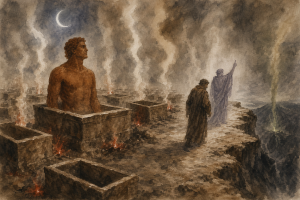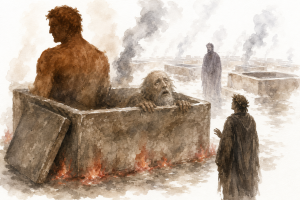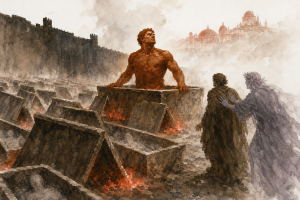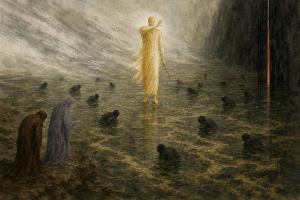
The gate that needed a heavenly messenger to open it now stands wide, and the two travellers walk through without a fight; what is waiting inside the walls of Dis is not a battle but a cemetery — a great plain scored with open stone coffins, laid out like the Roman burial fields at Arles and at Pola, except that flames run among these graves until the stone glows past any heat a smith would ask of iron, the lids all stand lifted, and the voices coming out of them belong to people whose guide declines to name a single one, offering instead only their sects.
Inferno · Canto 9 · Lines 106–133 · Scene 28
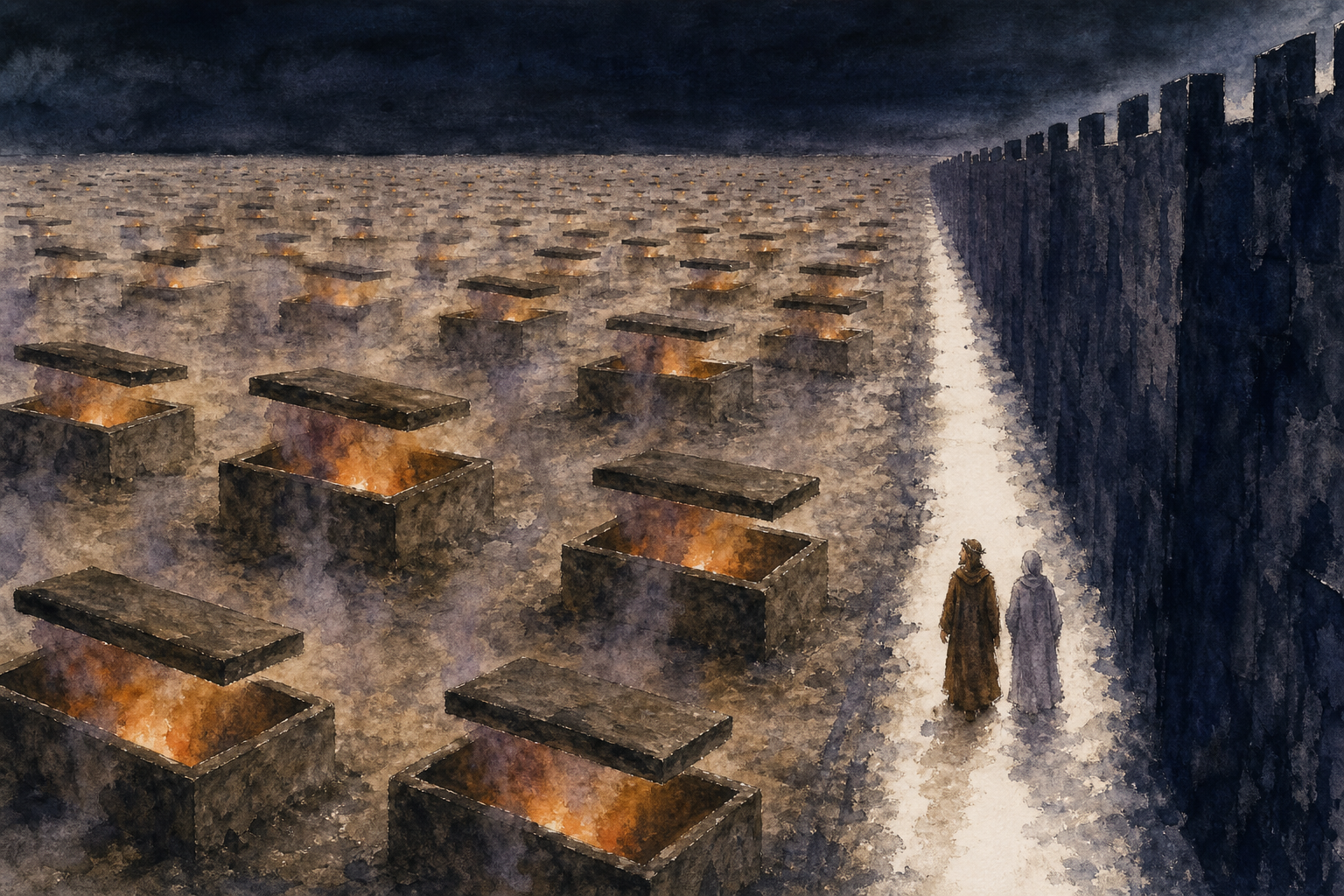
The whole first half of this canto has been a siege. Devils slammed a gate, three Furies screamed for Medusa, Virgil ran out of arguments, and finally a messenger from Heaven walked across the marsh, opened the gate with a touch of a wand, and left without waiting for thanks. So you expect a fight. What you get is line 106: «Dentro li ‘ntrammo sanz’alcuna guerra» — we went in without any war at all. The battle was over before it started, and Dante deliberately lets the air out of it. That is his method here: the drama was in the doorway, not in the room.
Inside, the pilgrim looks. That matters, because twenty lines earlier Virgil had spun him round and covered his eyes with his own hands so he would not see Medusa. Now he says he had «di riguardar disio» (107), a desire to look at what a fortress like this locks up, and «l’occhio intorno invio» (109) — he sends his eye out, as if the eye were a scout. What it finds is a plain, «grande campagna» (110), full of grief and cruel torment. It is the first wide open horizontal space in Hell; the earlier circles were slopes, rivers, cliffs and crowds.
Then Dante does something that is easy to miss and is one of his most characteristic moves. To describe the strangest landscape yet, he names two real places you could go and see. At Arles, in Provence, where the Rhône slows and spreads in its delta, there was a famous Roman burial ground crowded with stone coffins. At Pola, in Istria, near the gulf of Quarnaro that closes Italy at its eastern edge, there was another. In both places, he says, the tombs make the ground uneven — «fanno i sepulcri tutt’il loco varo» (115). Hell looks like that, he tells us: like a tourist site. And then he takes it back in the next line: «salvo che ‘l modo v’era più amaro» (117), except that here the manner of it was bitterer. Because here flames are scattered among the coffins, and they are heated to a temperature Dante measures against a workshop: hotter than any craft needs iron to be (120). He does that constantly — reaches for a smithy, an arsenal, a farmer, a shepherd, to make the impossible measurable.
Every lid is lifted, «Tutti li lor coperchi eran sospesi» (121), and hard cries come out. That detail is a clock. Virgil told Dante in Canto VI that at the Last Judgment every soul returns to its body and its grave; here the graves are open and, as we learn in the next canto, they will be shut for ever when the dead come back from the valley of Jehoshaphat. Everywhere else in Christian imagination the tomb opens at the end of the world. Here it closes.
Dante asks who these people are. Virgil’s answer is short and, oddly, general: «Qui son li eresïarche / con lor seguaci, d’ogne setta» (127–128) — the founders of heresies with their followers, of every sect, and the tombs are far more crowded than you think. Then two lines that give the whole logic of the place: «Simile qui con simile è sepolto, / e i monimenti son più e men caldi» (130–131). Like is buried with like, and the graves run hotter and cooler. Guilt here is not personal. It is membership. You are filed with the people who thought what you thought, and the temperature is set by the group, not by you.
Hold on to that, because it is about to break. They turn right — unusual; in Hell they almost always bear left — and the canto’s last line walks them into the gap between the burning graves and the city wall: «passammo tra i martìri e li alti spaldi» (133). One line later, in Canto X, a man will stand up out of one of these tombs, waist-high, name his family, and ask Dante who his ancestors were. The system Virgil has just described is the last thing said before the poem starts pulling individuals out of it.
Go deeper: the college-level reading (about 1,200 words)
Quotes the Italian closely, with philological detail and cross-references.
The entry into the city is deliberately anticlimactic. After a hundred lines of blocked gates, tower-signals, Furies, the threat of Medusa and the arrival of the messo celeste, the crossing itself takes half a line: «Dentro li ‘ntrammo sanz’alcuna guerra» (106). The noun is loaded. «Guerra» is the word of the poem’s second line-group, where Dante prepares to recount «la guerra / sì del cammino e sì de la pietate» (Inf. II.4–5); the campaign against Dis, which had looked like the poem’s first real military reverse, ends with no engagement at all. Dante’s habit of placing the crisis at the threshold and then declining to dramatise the interior of the crossing recurs — the gate of Purgatory will also open with a sound and no struggle — but here the effect is specifically deflationary: the devils were bluffing, and the poem says so by refusing them a battle scene.
What follows is a passage about seeing. Twenty lines earlier Virgil had physically overridden the pilgrim’s eyes («Volgiti ‘n dietro e tien lo viso chiuso», IX.55) and then covered them with his own hands. Now: «e io, ch’avea di riguardar disio / la condizion che tal fortezza serra» (107–108). «Disio» is the canto’s currency and the appetite that has just been forbidden; here it is licensed. The verb in «com’io fui dentro, l’occhio intorno invio» (109) is unusual and worth pausing on — inviare, to dispatch, to send off on an errand, as if the eye were an agent sent out over territory. And the territory is new: «grande campagna» (110), a wide plain. Until this point Hell has been vertical and constricted — slope, river, whirlwind, mire. The sixth circle opens out.
The verb «serra» in 108 is also a plant. The fortress «shuts in» a condition; in Canto X Virgil will say of these same tombs «Tutti saran serrati / quando di Iosafàt qui torneranno / coi corpi che là sù hanno lasciati» (X.10–12). The reader who registers the repetition sees that the whole circle is organised around closing rather than opening.
Then the similes. «Sì come ad Arli, ove Rodano stagna, / sì com’a Pola, presso del Carnaro / ch’Italia chiude e suoi termini bagna, / fanno i sepulcri tutt’il loco varo» (112–115). Two Roman necropolises: the Alyscamps outside Arles, where the Rhône slackens in its delta, and the burial field at Pola in Istria. Neither is exotic; both were visitable, and medieval readers knew them by report if not by sight. This is one of the Inferno’s structural techniques — the most unbelievable landscape in the poem so far is measured against places with names on a map, in the same way that the ditch of the barrators will be measured against the Venetian arsenal. The geography of 114 does a second job: the Quarnaro «Italia chiude e suoi termini bagna», closes Italy and bathes her borders, a line that quietly asserts the eastern limit of an Italy Dante elsewhere insists on as a real, if politically unrealised, entity. The rhyme-set stagna/Carnaro–bagna/varo/amaro carries three rare words in four lines: «stagna» (stands still), «varo» (uneven, broken up), «amaro».
And «amaro» is where the simile is withdrawn: «così facevan quivi d’ogne parte, / salvo che ‘l modo v’era più amaro» (116–117). Dante’s comparisons routinely end by conceding their own inadequacy, but the concession is not decorative — it names exactly what has been added to the real necropolis, namely fire. «ché tra li avelli fiamme erano sparte, / per le quali eran sì del tutto accesi, / che ferro più non chiede verun’arte» (118–120): no craft requires iron hotter. The measure is artisanal, drawn from the smith’s judgement of colour in heated metal, and it introduces the idea of degree that Virgil will pick up at 131.
The lexical variety of the passage is striking and probably deliberate: within twenty lines the graves are «sepulcri» (115), «avelli» (118), «arche» (125), «tombe» (129) and «monimenti» (131) — five nouns, ranging from the Latinate and monumental to the domestic «arca», a chest. It is the vocabulary of a man who has looked at a lot of stone coffins, and it forestalls monotony in a scene which is, physically, one repeated object.
«Tutti li lor coperchi eran sospesi» (121). The lids are lifted, suspended — the participle suggests hovering rather than merely leaning. The theological clock this sets running is the exact inverse of the one Virgil described in Canto VI, where at the trumpet «ciascun rivederà la trista tomba, / ripiglierà sua carne e sua figura» (VI.97–98). At the end of the world the graves of the dead open. These open now and shut then. It is a small, cold piece of engineering: for those who denied the resurrection of the body, the resurrection consists of being sealed in.
Dante’s question (124–126) is a normal pilgrim’s question, and it asks for identities: «quai son quelle genti». Virgil’s answer refuses them. «Qui son li eresïarche / con lor seguaci, d’ogne setta, e molto / più che non credi son le tombe carche» (127–129). «Eresïarche» is a learned Graecism, the leaders or founders of heresies, and it draws a distinction familiar from canon law between the heresiarch and the sequaces who adhere to him; the two are lodged together. The syntax of 128–129 is genuinely ambiguous and commentators divide: either the tombs are far more heavily laden than you believe, or there are far more laden tombs than you believe. Either way the note is one of unspecified multitude, and it is the last thing said before the poem narrows, in the next canto, to two men.
«Simile qui con simile è sepolto, / e i monimenti son più e men caldi» (130–131). The first clause is an old proverbial formula — like with like — applied here as a principle of infernal filing: the dead are sorted by what they believed, not by who they were. The second introduces graded punishment within a single circle, which is orthodox enough (degrees of pain answering degrees of guilt) but here calibrated by sect rather than by person. Note also what Virgil does not do: he never explains why heresy is inside the walls of Dis and yet above violence and fraud. In Canto XI, when he does lay out the moral architecture of lower Hell, the schema he offers — injury done by force or by fraud — has no slot for this circle at all, and he passes over it while the travellers shelter behind the tomb of Pope Anastasius (XI.8–9).
The canto ends with movement: «E poi ch’a la man destra si fu vòlto, / passammo tra i martìri e li alti spaldi» (132–133). The rightward turn is anomalous — the descent is otherwise a leftward spiral — and no explanation is offered; the commentary tradition has proposed several and settled on none. The final line puts them in a corridor between the torments and the high battlements, which is precisely where, at the opening of Canto X, a voice will come out of a tomb. «Martìri» carries the ordinary Duecento sense of torments, but the word is martyrdoms, and it is being used of heretics.
Go deeper still: the scholarly reading (about 1,100 words)
The commentary tradition, the sources, and what is documented versus inferred.
Walk out of Arles today along the old road south-east of the town and you come to the Alyscamps: a long avenue lined with stone chests, lids gone or shoved askew, the limestone pitted, the whole thing arranged less like a garden of remembrance than like a masons’ yard that never closed. The name preserves its own gloss — Elisii Campi, the Elysian Fields — and the site was already ancient and already famous when Dante wrote, a Roman burial ground outside the walls that had been absorbed into Christian use and into vernacular epic, the Aliscans of the Guillaume cycle. Pola, at the far end of the Adriatic, offered the same spectacle in a different register: a Roman colony with an amphitheatre still standing, and beyond the walls a field of sarcophagi that travellers described in numbers. Neither site was mysterious. Both were the sort of place a merchant, a pilgrim or a notary might have crossed on ordinary business, and both consisted of the same thing: open stone boxes above ground, in rows, with their covers displaced.
That is the material fact Dante is working from, and it explains why the similes are so specific about geography rather than about grief. «ove Rodano stagna» (112) is a delta observation — the Rhône slackening and spreading before the sea. «ch’Italia chiude e suoi termini bagna» (114) is an administrative one: the Quarnaro as the eastern limit of Italy, the boundary that Roman geography had fixed in Istria and that Dante, who elsewhere maps the peninsula by its watersheds and frontiers, treats as a known line on a known map. Between the two clauses he has staked out the western and eastern extremities of the Latin world, and put a cemetery at each end. The verse that describes their effect — «fanno i sepulcri tutt’il loco varo» (115) — is oddly technical: the tombs make the ground uneven, broken, varied in surface. It is what a surveyor would notice first.
The similes are therefore not decorative but evidential, and they work by an asymmetry Dante makes explicit at once: «salvo che ‘l modo v’era più amaro» (117). Arles and Pola supply the plan — the disposition of the chests over the terrain — and nothing else. What they cannot supply is fire, or sound. Real necropolises are silent and cold, and their lids are lifted because the tombs have been emptied. Here the arrangement is identical and every term is inverted. «ché tra li avelli fiamme erano sparte» (118), and the stone is heated past the point any smith would want: «che ferro più non chiede verun’arte» (120). The comparison shifts trade, from the quarry to the forge. And the tombs are graded by temperature — «i monimenti son più e men caldi» (131) — which turns the cemetery into something closer to a kiln floor, where each vessel sits at the heat proper to it.
That grading is the doctrinal hinge, and it is reached through the stones rather than in spite of them. Virgil’s answer is a classification: «Qui son li eresïarche / con lor seguaci, d’ogne setta» (127–128), and «Simile qui con simile è sepolto» (130). The tomb here is a container in the strict sense — a box that holds a category. Guilt is assigned not to a biography but to a membership; the heat is set by the sect, not by the sinner. Nowhere else in the Inferno is punishment so nearly a filing system, and the poem admits how large the archive is: «molto / più che non credi son le tombe carche» (128–129).
Why heresy should occupy this position at all is a question the poem does not resolve. The sixth circle lies inside the walls of Dis, on the far side of the barrier that separates incontinence from what lies below, and yet above the violent. When Virgil comes to expound the plan of lower Hell in Canto XI, he does so with the Aristotelian triad — incontinence, malice, brutishness — and heresy fits none of the three; it is passed over in the exposition even though the travellers are at that moment sheltering behind the lid of a heresiarch’s tomb, the one bearing the inscription «Anastasio papa guardo, / lo qual trasse Fotin de la via dritta» (XI.8–9). Some readers take the placement as juridical, following the civil and canonical treatment of heresy as a crime against the community; others as structural, wrong belief being the point at which the will stops merely failing and starts denying. The early commentators noticed the difficulty and did not agree about it, and there is no reason to pretend the matter is settled. What can be said is that Dante has made unbelief the threshold of the lower city — the first sin you meet after the gate that had to be opened from outside, «Sicuri appresso le parole sante» (105), the single moment in the Inferno when speech from beyond the poem’s world makes a place safe to enter.
One more material detail carries doctrine. «Tutti li lor coperchi eran sospesi» (121). At Arles and Pola the lids are off because the graves have been robbed; here they are off because the graves are not yet finished. Virgil had told Ciacco’s circle that at the trumpet «ciascun rivederà la trista tomba, / ripiglierà sua carne e sua figura» (VI.97–98). For everyone else the Judgment opens the grave; for these it will shut it. The resurrection runs backwards through this circle, and the reader who has walked a stripped Roman necropolis is being shown its exact photographic negative — a cemetery in the process of being sealed.
Then the itinerary resumes with a turn to the right, «a la man destra si fu vòlto» (132), unusual in a descent that normally bears left, and with a line that is pure topography: «passammo tra i martìri e li alti spaldi» (133). A path between the ramparts and the burning chests. It is a narrow way, and it is about to be interrupted. Everything the canto has just established is categorical — sect, class, temperature, the tomb as a box for a kind. In the next canto a lid will be no barrier at all, one figure will rise from the waist up out of a single arca and name his own city, and a second head will appear at its rim asking after a living son. The system is set out here in stone so that Farinata and Cavalcante can break it.
The Italian — Inside Dis: The Burning Tombs
Source: Wikisource (public domain, pre-1929 text)
Lines 106–108
106. Dentro li ‘ntrammo sanz’alcuna guerra;107. e io, ch’avea di riguardar disio108. la condizion che tal fortezza serra,
literary key: Line 106 — «sanz’alcuna guerra» — without any war. After a hundred lines of siege, the crossing takes half a verse. The noun points back to the poem’s own opening promise to recount «la guerra / sì del cammino e sì de la pietate» (Inf. II.4–5), and the deflation is deliberate: the devils who slammed the gate, the Furies, the summoned Medusa, all of it evaporates once the messenger has passed. Dante puts his crisis at the threshold and then declines to dramatise the interior of the crossing. It is also the last military noun before a landscape of graves. [Source: Inferno II.4–5]
literary key: Line 107 — «di riguardar disio» — desire to look. Twenty lines earlier Virgil had physically overridden the pilgrim’s sight, spinning him round («Volgiti ‘n dietro e tien lo viso chiuso», IX.55) and then clamping his own hands over Dante’s eyes against Medusa. Now looking is licensed, and the appetite that had to be suppressed becomes the motor of the description. The sixth circle is introduced, in other words, as the first thing in the poem the pilgrim is permitted to stare at after being forbidden to. [Source: Inferno IX.55–60]
vocabulary: Line 108 — «la condizion che tal fortezza serra» — the condition such a fortress shuts in. The verb «serrare», to lock or seal, is planted here and harvested in the next canto, where Virgil says of these tombs «Tutti saran serrati / quando di Iosafàt qui torneranno» (Inf. X.10–11). The whole circle turns out to be organised around closure rather than opening: a walled city, sealed graves, a sin defined by obstinacy. ‘Condizion’ is the technical term for a state or status, not merely a plight. [Source: Inferno X.10–11]
Lines 109–111
109. com’io fui dentro, l’occhio intorno invio:110. e veggio ad ogne man grande campagna,111. piena di duolo e di tormento rio.
wordplay: Line 109 — «l’occhio intorno invio» — I send my eye around. «Inviare» means to dispatch, to send off on an errand; the eye is treated as an agent sent out to reconnoitre, which is exactly what a man who has just entered a fortress would do. The present tense — ‘invio’, ‘veggio’ at 110 — pulls the narration out of the past for three lines, so that the reader arrives inside the walls at the same moment the pilgrim does. [Model knowledge · high]
literary key: Line 110 — «grande campagna» — a great plain. This is the first wide horizontal space in Hell. Everything before it has been slope, ravine, river-bank, whirlwind and mire, all of them constricting; the sixth circle opens out, and the openness is part of the effect — a cemetery is legible as a cemetery only when you can see the rows. The word returns in kind, if not in form, for the burning sand of the seventh circle, the other flat, fire-scattered expanse in the Inferno. [Model knowledge · medium]
Lines 112–114
112. Sì come ad Arli, ove Rodano stagna,113. sì com’a Pola, presso del Carnaro114. ch’Italia chiude e suoi termini bagna,
cultural ref: Line 112 — «ad Arli, ove Rodano stagna» — at Arles, where the Rhône stagnates. The reference is to the Alyscamps, the great late-antique necropolis outside the city, in the delta country where the river slackens and spreads. It was famous enough to have acquired epic legend, being named in the Roland tradition as the burial place of Charlemagne’s dead; the early commentators cite the legend with varying enthusiasm. What matters structurally is that Dante’s first move in describing an impossible landscape is to name a place with a road to it. [Model knowledge · medium]
history: Line 113 — «a Pola, presso del Carnaro» — Pola (modern Pula), at the southern tip of Istria on the Gulf of Quarnaro, possessed a Roman burial field comparable to the Alyscamps. Benvenuto da Imola compares the multitude of tombs here to those at Arles and Pola, describing the great number near Arles, and later commentators have sometimes claimed Dante saw them himself during the exile years. That claim is possible and entirely undocumented. The pairing of a Provençal and an Istrian site brackets the known world of an exiled Italian: the far west and the far east of the peninsula’s reach. [Model knowledge · medium]
history: Line 114 — «ch’Italia chiude e suoi termini bagna» — which closes Italy and bathes her borders. The Quarnaro is asserted as Italy’s eastern limit. Dante returns repeatedly to the question of what Italy is and where it ends, at a period when nothing politically corresponded to the answer; whether the definition here is his own or taken from the standard medieval geographies cannot be settled from the line. What the verse does is give a nation borders in the middle of a description of the damned, and it does so in the same breath as a graveyard. [Model knowledge · medium]
Lines 115–117
115. fanno i sepulcri tutt’il loco varo,116. così facevan quivi d’ogne parte,117. salvo che ‘l modo v’era più amaro;
vocabulary: Line 115 — «fanno i sepulcri tutt’il loco varo» — the tombs make the whole place uneven. «Varo» is rare: broken up, irregular, variegated. It carries the visual fact — a field of raised stone chests, so that the ground has no level — and it sets up a rhyme-chain of unusual words across the two tercets, stagna / Carnaro / bagna / varo / amaro, in which three of the five are outside ordinary lyric vocabulary. Dante is straining the language slightly, in the way he does when a scene has no literary precedent. [Model knowledge · high]
literary key: Line 117 — «salvo che ‘l modo v’era più amaro» — except that the manner of it was bitterer. Dante’s similes habitually end by conceding their own inadequacy, and the concession is never merely decorative: it names precisely what has to be added to reality to get Hell. Here what is added is fire. The pattern recurs throughout the canticle, from the frogs of the Styx to the arsenal of the barrators; the real world supplies the shape, and the poem supplies the surplus of suffering. [Model knowledge · high]
Lines 118–120
118. ché tra li avelli fiamme erano sparte,119. per le quali eran sì del tutto accesi,120. che ferro più non chiede verun’arte.
vocabulary: Line 118 — «tra li avelli» — among the graves. Within twenty lines Dante uses five different nouns for the same object: «sepulcri» (115), «avelli» (118), «arche» (125), «tombe» (129), «monimenti» (131). The range runs from the monumental Latinism to the domestic «arca», a chest of the kind that stood in a house. The variation is partly metrical convenience and partly a defence against monotony in a scene that consists, physically, of one repeated object multiplied to the horizon. [Model knowledge · high]
cultural ref: Line 120 — «che ferro più non chiede verun’arte» — hotter than any craft requires of iron. The measure is the smith’s: metalworkers judged temperature by the colour of the glow, and different crafts required different heats. Dante calibrates a supernatural fire against a workshop, as he later measures a pit of pitch against the Venetian arsenal (XXI.7–15). The line also introduces the notion of degree, which Virgil will apply doctrinally eleven lines later when he says the monuments run hotter and cooler. [Model knowledge · high]
Lines 121–123
121. Tutti li lor coperchi eran sospesi,122. e fuor n’uscivan sì duri lamenti,123. che ben parean di miseri e d’offesi.
theology: Line 121 — «Tutti li lor coperchi eran sospesi» — all their lids were lifted, hovering rather than merely ajar. This is a clock. In Canto VI Virgil described the general resurrection, when «ciascun rivederà la trista tomba, / ripiglierà sua carne e sua figura» (VI.97–98); in Canto X he will say these lids close for ever when the dead return from the valley of Jehoshaphat. Everywhere in Christian imagination the grave opens at the end of the world. Here it shuts — a resurrection that consists of being sealed in, aimed at souls who denied the body would rise at all. [Source: Inferno VI.94–99; Inferno X.10–12]
translation note: Line 123 — «di miseri e d’offesi» — of the wretched and the injured. «Offeso» is stronger than ‘wounded’ in a merely physical sense; it carries the juridical charge of one who has suffered an ingiuria, a wrong done. The irony is quiet and probably intended: the noise coming out of the graves is the noise of people who sound like victims. Dante will hear that tone again out of these same tombs when Cavalcante accuses him of having taken his son from him. [Model knowledge · medium]
Lines 124–126
124. E io: "Maestro, quai son quelle genti125. che, seppellite dentro da quell’arche,126. si fan sentir coi sospiri dolenti?".
vocabulary: Line 125 — «seppellite dentro da quell’arche» — buried inside those chests. «Arca» is the plainest of the passage’s five words for tomb: a box, a coffer, the object one keeps things in. It is also the word that will attach to Farinata’s grave in the next canto. The rhyme it generates — arche / eresïarche / carche — yokes the ordinary household noun to the most technical theological term in the passage, which is a small joke about where the great heresiarchs have ended up. [Model knowledge · medium]
Lines 127–129
127. E quelli a me: "Qui son li eresïarche128. con lor seguaci, d’ogne setta, e molto129. più che non credi son le tombe carche.
theology: Line 127 — «Qui son li eresïarche» — a learned Graecism, the founders or leaders of heresies, as distinct from those who follow them. Canon law drew exactly this line, treating the haeresiarcha as the author of an error and the sequaces as adherents; the two carried different degrees of culpability and different penalties. Dante’s Virgil names the distinction and then abolishes it in practice, since leaders and followers share a single grave. Note also that no heresy is specified, no error described, no polemic offered: the circle is announced entirely as a category. [Model knowledge · high]
theology: Line 128 — «con lor seguaci, d’ogne setta» — with their followers, of every sect. The organising unit here is the sect, not the person, and the placement of the circle is a genuine crux: heresy sits inside the walls of Dis but above violence and fraud, whereas Aquinas ranks unbelief as the gravest sin in the moral genus. Virgil’s own classification of lower Hell in Canto XI, delivered beside Anastasius’s tomb (XI.8–9), derives its circles from injury by force or fraud and never accounts for this ground at all. No explanation is offered anywhere in the poem. [Source: Inferno XI.8–9; Aquinas ST II-II q.10]
translation note: Line 129 — «più che non credi son le tombe carche» — the syntax admits two readings, and translators divide. Either the tombs are far more heavily laden than you believe (crowded with bodies), or far more tombs are laden than you believe (the field extends further than it looks). Most modern commentators take the first; the second makes the plain wider rather than the graves fuller. Either way the note is one of unquantified multitude, delivered immediately before a canto that will extract two individuals from it. [Model knowledge · medium]
Lines 130–132
130. Simile qui con simile è sepolto,131. e i monimenti son più e men caldi".132. E poi ch’a la man destra si fu vòlto,
literary key: Line 130 — «Simile qui con simile è sepolto» — like is buried here with like. An old proverbial formula (similis simili) turned into a principle of infernal filing. Guilt in this circle is categorical: you lie with the people who held what you held. It is the strongest statement of collective identity anywhere in the Inferno, and it is the last line of doctrine before Canto X produces, from a single grave, two men who share a sect and nothing else — one consumed by Florentine faction, the other by a son, neither able to hear the other’s grief. [Source: Inferno X]
theology: Line 131 — «i monimenti son più e men caldi» — the monuments are more and less hot. Graded punishment within a single circle is orthodox: pain answers guilt in degree, a principle Virgil himself expounds at Inferno VI.106–108. What is unusual is the calibration. The thermostat is set by sect rather than by the individual soul, so that a man’s temperature is a function of what school he joined. The doctrine is standard; the unit of measurement is not. [Source: Inferno VI.106–108]
literary key: Line 132 — «a la man destra si fu vòlto» — he turned to the right. The descent through Hell is otherwise a leftward spiral, and the exceptions are few: this turn, and the rightward movement along the edge before the descent on Geryon in Canto XVII. Commentators have proposed allegorical explanations — the right hand as the way of justice, a symbolic correction at the threshold of lower Hell — and other commentators have dismissed them all as unfounded. The text records the turn and does not gloss it. [Source: Inferno XVII.31–33]
Lines 133
133. passammo tra i martìri e li alti spaldi.
wordplay: Line 133 — «passammo tra i martìri e li alti spaldi» — we passed between the torments and the high battlements. «Martìri» means torments in ordinary Duecento usage, but the word is martyrdoms, and it is being applied to heretics: the sufferings of those who died for the wrong faith. The line also does structural work, walking the travellers into the exact corridor from which Farinata will rise, waist-high out of his tomb, in the opening lines of Canto X. The canto ends in a space rather than on an image. [Source: Inferno X.22–36]
Seven Centuries of Reading Inside Dis: The Burning Tombs
Wrath, and the entry
Virgil had said at 33 that they could not enter Dis «sanz’ira», without wrath. Boccaccio took the wrath to be that of the city’s defenders, and most early commentators took it to be the travellers’ own. In the nineteenth century Gregorio di Siena, haltingly, and then Andrea Scartazzini argued that it is the angel’s: his assault on the closed city. Gino Casagrande defended that reading. Hollander finds confirmation at line 106, where the travellers enter «sanz’alcuna guerra», without any war, once the angel has done the fighting.
Arles, Pola, and the sects
The comparison with the Roman cemeteries at Arles and at Pola (112–115) tells the reader what kind of graves these are: raised stone sarcophagi, not mounds. Hollander notes that the heretics are heard and not seen, as the false counsellors will be heard from within their flames in Cantos XXVI–XXVII. He links the sins punished in these places, heresy, sodomy and false counsel, as uses of intelligence to lead others into wrong belief.
Why heresy is punished inside the walls, among sins of the will, was answered by many early commentators with a single word for obstinacy, the Latin «pertinax». Hollander cites Boccaccio, Benvenuto, Francesco da Buti, John of Serravalle and Daniello. Some may reflect Aquinas’s definition: a man who is not pertinacious in his disbelief is not a heretic but only in error.
The turn to the right
At 132 the travellers turn right, one of only two rightward turns in Hell; the other is at XVII.32. The Scartazzini-Vandelli explanation, that heresy and fraud both deform the truth, has been welcomed by some. Hollander objects that treachery also deforms the truth, and that the second turn comes before the realm of fraud in any case. Gabriele Rossetti found allegorical meaning in the second turn. Hollander concludes that the commentary tradition has not resolved Dante’s plan, if there was one.
What remains open
Virgil’s account files the dead by sect and by degree of heat, «più e men caldi» (131), and names no one. The next canto will test that categorical frame at once, with two men from one tomb who have nothing in common but the stone.
The Two Main Positions on Inside Dis: The Burning Tombs
The Sect Is the Sin
The categorical treatment is exact, and Dante means it. Heresy is not a private failing but an adherence — a party, a school, a following — and the appropriate description of it is therefore collective. Virgil’s distinction between «li eresïarche» and «lor seguaci» is the canon-law distinction between the author of an error and those who hold it, and lodging them in one grave states the doctrinal point that the follower’s guilt is the leader’s guilt received. The graded heat, «più e men caldi» (131), preserves the orthodox principle of degrees of pain proportioned to degrees of guilt while keeping the unit of measurement the sect. Nothing in the poem retracts this.
Key passage: Virgil’s answer is never corrected, here or later; Canto X does not overturn the classification but confirms it, identifying the occupants of the tomb by school — Epicurus and his followers — rather than by individual heresy, and the two speakers defend no doctrine at all, because a sect-sin has no individual doctrinal content to defend. The eternal sealing of the tomb (X.10–12) answers a proposition, that the soul dies with the body, not a biography. And the plain itself is described as populous and undifferentiated: the poem gives no faces to a landscape of tens of thousands.
The Frame Built to Break
Virgil’s tidy answer is the last word of a schematiser who is about to be embarrassed by the terrain. Dante repeatedly supplies a classification and then makes the reader watch it fail on contact with a person, and nowhere more sharply than here: the canto closes on «Simile qui con simile è sepolto» and the next canto immediately produces one tomb containing two men who could not be less alike, who cannot hear each other, and whose grief is entirely individual — one about Florentine faction, the other about a son. The anonymity of Canto IX is an establishing shot, deliberately cold, so that the human noise of Canto X breaks over a reader who has just been told there are no individuals down here.
Key passage: Virgil’s own moral map in Canto XI cannot accommodate this circle and passes over it in silence; the guide who explains everything conspicuously does not explain where he is standing. Dante devotes an entire canto — an unusual expenditure — to two souls out of one grave, and gives Farinata and Cavalcante the most individuated speech in the Inferno to that point. The pilgrim’s question at 124 asked for identities («quai son quelle genti») and received a category; the poem then answers the question Virgil declined.
What the Text Does — and What That Means (Contested)
On the page: No individual is named in the sixth circle in Canto IX; Virgil’s only identification is by category and sect (127–128). The lids are described as lifted at 121, and Inferno X.10–12 states they will be shut when the dead return from Jehoshaphat, inverting the resurrection Virgil described at VI.94–99. Heresy is located inside the walls of Dis but above the circles of violence and fraud. Virgil’s classification of lower Hell in Canto XI, delivered beside the tomb of Anastasius (XI.8–9), derives its circles from injury by force or fraud and does not account for the sixth circle. The travellers turn right at 132; the descent is otherwise leftward. The canto’s final line places them between the torments and the wall, which is where Farinata speaks at the opening of Canto X. Canto X identifies the tomb’s occupants as followers of Epicurus, «che l’anima col corpo morta fanno» (X.15).
What scholars dispute: Whether Dante endorses the categorical logic he has Virgil state, or stages it in order to expose its inadequacy, is contested and has been since the nineteenth century. The placement of heresy above violence has no clear scholastic warrant — Aquinas ranks unbelief as the gravest sin in its genus — and the explanations offered (heresy as a sin of will rather than appetite; the sixth circle as a hinge rather than a circle; an ad hoc arrangement made for the sake of the Florentine material) are all inferences about intent, none of them stated in the poem. The rightward turn at 132 is unexplained by the text and every reading of it is conjecture.
What Dante Leaves Unresolved
The poem never says why heresy is inside the walls of Dis and yet above the violent, and it never has Virgil connect this circle to the taxonomy he expounds two cantos later. It does not explain the rightward turn. It does not state whether the anonymity of the sixth circle is the punishment or merely the view from the entrance, nor whether the graded heat that sorts the graves by sect is undone or merely supplemented when two irreducibly separate men rise from the same stone. Dante gives the system and then gives the exception, and leaves the reader to decide which of the two he thinks is true.
The Open Question
Virgil’s account of the sixth circle files the dead by what they believed — heresiarchs with their followers, sect by sect, like buried with like, the graves running hotter and cooler by category. Is that the poem’s real verdict on heresy, guilt as a form of membership? Or has Dante built a taxonomy at the end of one canto precisely so that the next can break it open, with two men rising from one tomb who have nothing in common but the stone?
Explore More
About This Article

Written by Lucy Bamboo. Lucy Bamboo has been reading the Divine Comedy for fifteen years — first in translation, then stubbornly in Medieval Tuscan with a dictionary and far too many footnotes. Reading Dante is her scene-by-scene walk through the poem: the original Italian, seven centuries of scholarly argument presented as argument rather than answer, and the human questions sitting underneath the theology. More about this site.
Verify this against a primary source
Specifics change, and your situation may differ from the one described here. These are the authorities worth checking directly:
- Digital Dante, Columbia University — text, commentary and translation apparatus
- Princeton Dante Project — the Commedia with historical commentary
- Dartmouth Dante Project — searchable commentary from 1322 onward