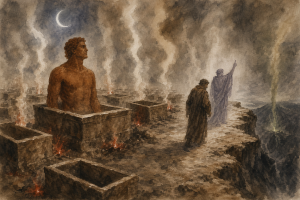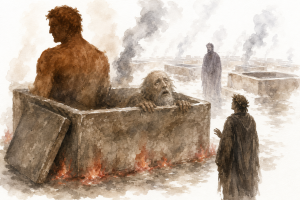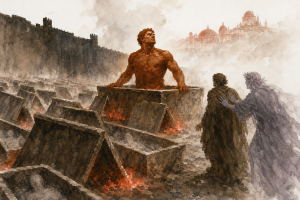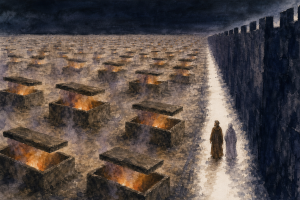
After a canto of stalled threats — a Virgil who cannot open the gate, three Furies calling for Medusa, and a warning to the reader to look under the veil — the rescue finally arrives, and it arrives as weather: a crash of sound over the marsh, both banks shaking, a simile of wind tearing through a forest, and then, walking across the Styx without wetting his soles, a figure the poem will not name, who scatters a thousand devils like frogs before a snake, opens with a twig what a thousand rebel angels had held shut, delivers a rebuke that never once mentions God by name, and departs down the filthy road without a word or a glance for the two men he has just saved.
Inferno · Canto 9 · Lines 64–105 · Scene 27
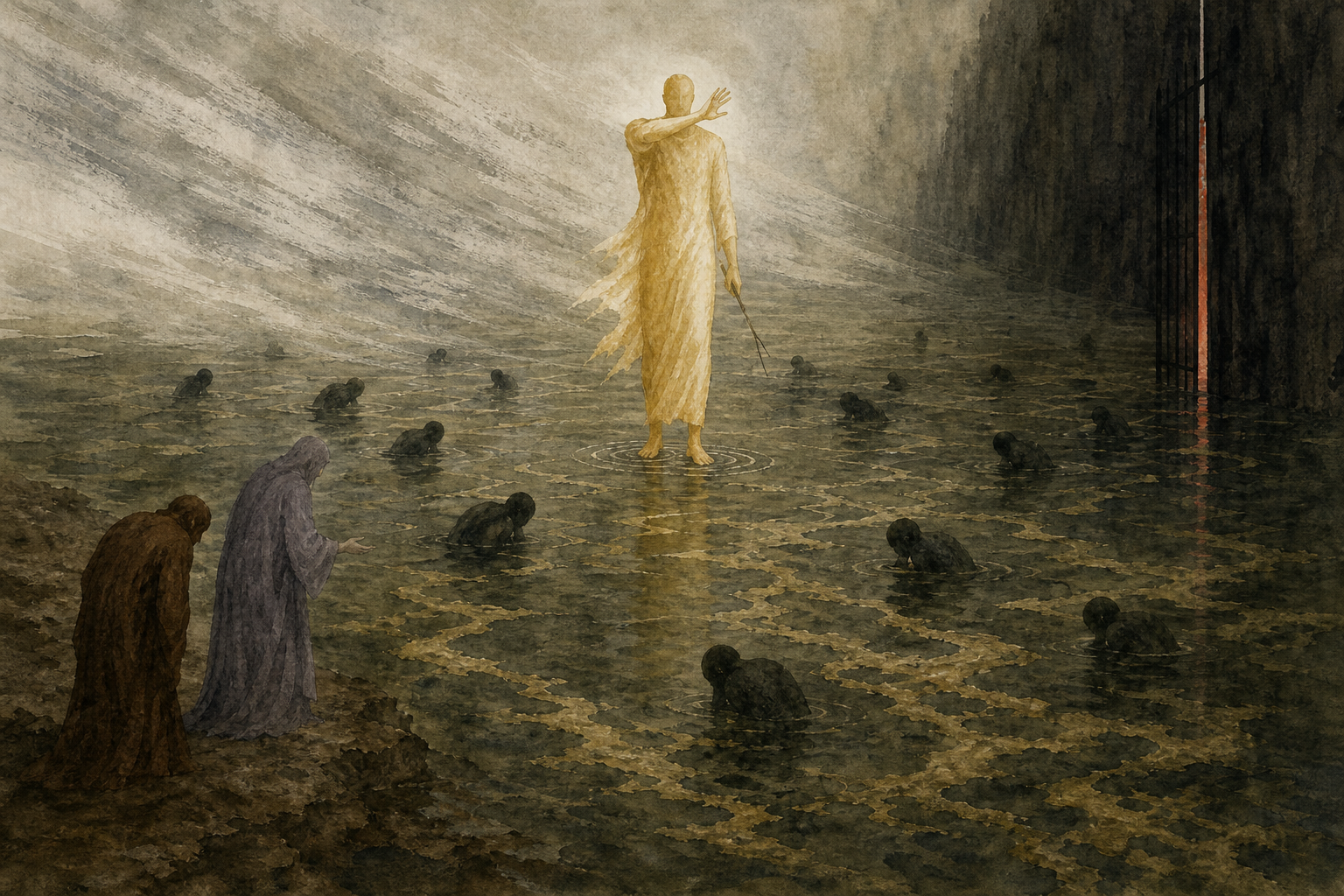
Something is coming, and Dante hears it before he sees it: «un fracasso d’un suon, pien di spavento» (65), a crash of noise so violent that both banks of the marsh shake. Then the poem stops the action and spends six lines on a comparison. It is like a wind, born where hot and cold air collide, that hits a forest and does not slow down for anything: it snaps the branches, knocks them flat, carries them off, and moves ahead of itself in a cloud of dust, driving the wild animals and the shepherds into flight. This is the longest single simile in the Inferno so far, and it is worth noticing what it does not contain. There is no figure in it. Whatever is arriving is described only as force — and the word used for how the wind travels is «superbo» (71), proud, the exact vice of the devils it has come to put down.
Virgil has been covering Dante’s eyes since the Furies threatened to fetch Medusa. Now he uncovers them and tells him where to look: across «quella schiuma antica» (74), the ancient scum on the water, to the place where the smoke is thickest. And what Dante sees is a rout. The comparison this time is small and ugly instead of grand: frogs scattering underwater before a snake, each one squashing itself down into the mud at the bottom. More than a thousand ruined souls are running like that from one figure — «un ch’al passo / passava Stige con le piante asciutte» (80–81), one who was crossing the Styx with dry feet.
Hold on to that detail. Dante himself had to be ferried across this water in a boat that sank under his weight because he was alive. This figure walks. Nothing about the crossing is described as an effort; the water simply does not register. And then comes the detail the whole scene turns on. He keeps moving his left hand in front of his face, brushing away the greasy air — «e sol di quell’angoscia parea lasso» (84), and only that annoyance seemed to tire him. That is how the poem measures the strength of a heavenly power: not by anything it does, but by the one thing it finds mildly unpleasant. The air of Hell is a nuisance to him. The devils are not.
Dante works out for himself that this is someone sent from heaven, and Virgil signals him to keep quiet and bow. Notice that nobody tells Dante who this is. He infers it. The poem never gives the figure a name, and it never lets him speak to the travellers at all. He walks to the gate, opens it with «una verghetta» (89) — a little wand, a twig — and there is no resistance whatever. A thousand rebel angels had held that gate shut against Virgil; a stick opens it.
The speech he gives is aimed entirely at the devils. He calls them outcasts of heaven, a despised people, and asks why they keep kicking against a will that can never be stopped and that has already made things worse for them more than once. Then he ends with a threat in their own language: remember your Cerberus, still bald on the chin and throat where he was dragged. That is a reference to Hercules hauling the guard-dog of Hell up by a chain — a pagan story, told to pagan monsters, by an agent of the Christian God.
And then he leaves. He turns back down the dirty road and says nothing to Dante and Virgil — «non fé motto a noi» (101) — with the look of a man whose mind is on some other worry, one that pinches and bites harder than any concern for the person standing in front of him. Dante is not thanked, not addressed, not even looked at; the poem reduces him to «colui che li è davante» (103), the one who happens to be there. The two of them walk in through the gate, safe now, «sicuri appresso le parole sante» (105) — and those holy words never named God once.
Go deeper: the college-level reading (about 1,300 words)
Quotes the Italian closely, with philological detail and cross-references.
The rescue begins as noise. «E già venìa su per le torbide onde / un fracasso d’un suon, pien di spavento, / per cui tremavano amendue le sponde» (64–66): the redundancy of «un fracasso d’un suon» is not sloppiness but amplification, sound doubled on itself, and the trembling of both banks establishes that whatever approaches is felt on the Dis side of the water as much as on Dante’s. Only then does the poem supply its longest sustained simile so far, six lines of it (67–72), and the simile is remarkable for containing no agent at all. A wind «impetüoso per li avversi ardori» — generated, in the meteorology Dante inherited from the Aristotelian tradition and its Arabic and scholastic commentators, by the collision of contrary heats — strikes a forest «sanz’alcun rattento» (69), without any check, and then three verbs in a single line: «li rami schianta, abbatte e porta fori» (70). The escalation is snapping, flattening, carrying away. Line 71, «dinanzi polveroso va superbo», gives the wind the vice of the beings it comes to humble; «superbia» is the sin of the fallen angels behind the wall, and the poem loans the word to the instrument of their defeat. The closing line, «e fa fuggir le fiere e li pastori» (72), imports the only living creatures in the canto — a Georgic landscape of beasts and herdsmen dropped into the Styx, and one of the few glimpses in Inferno of a world where things merely happen rather than being deserved.
«Li occhi mi sciolse» (73). Virgil had turned Dante round and pressed his own hands over the boy’s at 58–60, on the theory that the pilgrim’s covered eyes were not covered enough; now he unbinds them, and the verb «sciolse», loosed, treats sight as something that had been tied. The instruction is technical: «Or drizza il nerbo / del viso su per quella schiuma antica / per indi ove quel fummo è più acerbo» (73–75). The «nerbo del viso» is the optic nerve of medieval optics, and «drizza» aims it like a weapon. «Schiuma antica» gives the marsh a scum as old as the Fall; «acerbo» applied to smoke is synaesthetic, harsh and unripe at once.
What the aimed eye finds is a rout, and Dante scales the simile down savagely: «Come le rane innanzi a la nimica / biscia per l’acqua si dileguan tutte, / fin ch’a la terra ciascuna s’abbica» (76–78). «S’abbica» is from «bica», a heap or stook of sheaves: the frogs pile themselves flat on the bottom. The frog will become one of Dante’s signature devil-images — the demons of Malebolge surface and duck like frogs at a ditch’s edge (Inf. XXII.25–33), and the traitors show their faces above the ice in the same posture (Inf. XXXII.31–32) — and here it is used to unmake, in a single tercet, the same population that had looked formidable one canto earlier. «Vid’io più di mille anime distrutte» (79) answers, almost word for word, Virgil’s «Io vidi più di mille in su le porte / da ciel piovuti» at Inf. VIII.82–83. The same thousand; the opposite verb.
Then the figure. «Un ch’al passo / passava Stige con le piante asciutte» (80–81). The indefinite article is the whole point: not «un angelo», simply «un», one. The figura etymologica «al passo / passava» locks the crossing into its own noun, and the enjambment carries the sentence over the tercet boundary as the walker carries himself over the water. Dante had needed Phlegyas’ skiff, which rode low only when it took his living weight (Inf. VIII.27). This one does not wet his soles. The scriptural resonance is unmistakable — the sea crossed dry-shod in Exodus, and the walking on the water of Matthew 14 — and it is attached to a being the poem declines to identify.
The next tercet is where the episode’s argument actually lies. «Dal volto rimovea quell’aere grasso, / menando la sinistra innanzi spesso; / e sol di quell’angoscia parea lasso» (82–84). He fans the thick air away with his left hand, and only that discomfort seems to tire him. Omnipotence is characterised by litotes: the one thing in Hell that constitutes a difficulty for this being is the smell. The left hand is doing quiet work too — the lesser hand, used repeatedly, casually, while whatever the right hand is for goes unemployed.
«Ben m’accorsi ch’elli era da ciel messo» (85). The recognition is the pilgrim’s inference, not a revelation granted to him; «messo» is simply the past participle pressed into a noun, one sent. Virgil, who knows the protocol, «fé segno / ch’i’ stessi queto ed inchinassi ad esso» (86–87), and the exclamation that follows is Dante’s alone: «Ahi quanto mi parea pien di disdegno!» (88). The disdain is not aimed at him, and he feels it anyway — a useful contrast with Farinata in the next canto, who holds Hell «a gran dispitto» (Inf. X.36) from inside it, where here the contempt comes from outside and is answered by the demons’ own name, «gente dispetta» (91).
«Venne a la porta e con una verghetta / l’aperse, che non v’ebbe alcun ritegno» (89–90). The diminutive carries the theology. Virgil’s authority failed at this gate; a twig suffices, and «alcun ritegno» — any holding-back at all — is denied in the flattest possible phrasing. It is worth setting against the gate of Purgatory, where an angel with a sword and two keys performs an elaborate ritual before the «porta sacra» will turn (Purg. IX). Where entry is meaningful, it costs something; here it costs nothing, because nothing here is being earned.
The speech (91–99) is addressed exclusively to the devils; Dante and Virgil are not in it. «Ond’esta oltracotanza in voi s’alletta?» (93) uses a Provençal-flavoured word for overweening arrogance and a verb built on «letto»: pride beds down in them, makes itself at home. «Perché recalcitrate a quella voglia / a cui non puote il fin mai esser mozzo» (94–95) recalls the words the risen Christ speaks to Saul on the road — hard for thee to kick against the pricks — and, like every other reference to God inside Hell, refuses the name: «quella voglia», that will, exactly as Virgil says «vuolsi così colà dove si puote» (Inf. III.95–96, V.23–24) and Dante says «s’altri nol niega» (Inf. V.81). Then «Che giova ne le fata dar di cozzo?» (97): a pagan plural, the fata, in the mouth of heaven’s agent, and a verb of butting rams. The closing threat is entirely mythological — «Cerbero vostro, se ben vi ricorda, / ne porta ancor pelato il mento e ‘l gozzo» (98–99) — Hercules’ chain, the hound dragged up by the throat, the fur still not grown back. The possessive «vostro» is contemptuous, and the whole rebuke is delivered in the demons’ own literary register.
Then the coldness. «Poi si rivolse per la strada lorda, / e non fé motto a noi, ma fé sembiante / d’omo cui altra cura stringa e morda / che quella di colui che li è davante» (100–103). He does not fly; he walks back up the filthy road. He says nothing. The doubled «stringa e morda» gives the other business teeth, and the syntax finishes the humiliation: Dante, the reason for the entire intervention, is «colui che li è davante», the one in front of him. Only then: «e noi movemmo i piedi inver’ la terra, / sicuri appresso le parole sante» (104–105). «Terra» for city, as in Francesca’s «Siede la terra dove nata fui» (Inf. V.97). And the words are called «sante» though they named no God, invoked no Christ, and threatened in the idiom of Greek myth.
Go deeper still: the scholarly reading (about 1,100 words)
The commentary tradition, the sources, and what is documented versus inferred.
Six centuries of illustrators have had to decide what he looks like, and nearly all of them have given him wings. The trecento illuminators wing him, Botticelli wings him, Doré wings him; and the wings are an interpolation, because the poem says nothing about them. The name is an interpolation too. Italian criticism calls him «il messo celeste», the heavenly messenger, a title assembled out of the poem’s own participle — «Ben m’accorsi ch’elli era da ciel messo» (85) — with the noun quietly supplied from outside. The early glossators reach for «angelo» almost at once and almost without argument, as though the alternative had not presented itself; and once the word is in place, the wings follow, and then the halo, and then the calm frontal face that no line here authorises. What the poem gives instead is a relative clause: «un ch’al passo / passava Stige con le piante asciutte» (80-81). One who was crossing. The identification that everyone has completed, the poem leaves open.
Its reluctance begins in the simile. Whatever arrives arrives first as «un fracasso d’un suon, pien di spavento» (65) and then as weather — an epic wind striking a forest, six lines of it, with no figure inside the comparison at all. An illustrator working from lines 64 to 72 has nothing to draw but bent trees. The pedigree is Virgilian (the colliding winds of the Aeneid’s storms stand behind «per li avversi ardori»), and Dante is plainly building a set piece; but the effect of putting his longest simile so far at precisely this point is to fill the arrival with force while withholding a body. The body, when it comes, is given in three attributes only: dry feet, a left hand, a small stick.
The stick is what the pictorial tradition has fastened on, correctly. «Venne a la porta e con una verghetta / l’aperse, che non v’ebbe alcun ritegno» (89-90). Not a sword, not a hand laid on the panels: a verghetta, a diminutive, a twig of a thing, and the gate that a thousand fallen angels had held shut against Virgil’s authority opens with no resistance whatever. The rhetorical work is entirely in the disproportion, and the sources for the object pull in two directions that no one has been able to reconcile into a single figure. On one side is the Virgilian Mercury, who takes up his wand — «virgam capit» — at Aeneid IV 242 to summon souls from Orcus and drive others down to Tartarus, an errand-runner sent by a higher god to a lower power, travelling through air. On the other is the rod of Exodus, and with it the dry crossing: «con le piante asciutte» (81) is a walking-on-water image, but the water is a marsh in Hell, and the phrase points as strongly to Israel passing over on dry ground as to Christ on the lake of Galilee. Wand plus dry feet is Moses; wand plus flight plus message from above is Mercury; dry feet alone, on water, is the Gospel. The figure holds all three and settles into none, and readers who insist that he must be Christ, or the emperor, or a specific archangel, are generally forced to argue away one of the three.
Between the wand and the feet stands the detail on which the whole portrait turns, and it is the one the illustrators find hardest to use: «Dal volto rimovea quell’aere grasso, / menando la sinistra innanzi spesso; / e sol di quell’angoscia parea lasso» (82-84). He fans the greasy air away from his face with his left hand, repeatedly, and that alone tires him. Nothing else in Hell registers on him at all — not the marsh, not the thousand souls scattering like frogs, not the walls of Dis — and the poem measures his power by the smallness of the only thing that inconveniences him. The gesture also embarrassed the tradition, and it is worth saying why. If he is pure spirit he has no face to shield; the scholastic solution, familiar from Aquinas, is that angels appearing to men assume bodies of condensed air, which would give him something to be fanned and something to be wearied. But that solution makes the fanning a concession to the fiction, and the line does not read like a concession. It reads like observation, and it is observed by a pilgrim who has been told to bow and stay silent (86-87) and who is therefore watching hands. The «disdegno» of line 88 — «Ahi quanto mi parea pien di disdegno!» — belongs to the same portrait: not serenity, but a controlled distaste at having been sent here at all.
The speech confirms the mixture. «O cacciati del ciel, gente dispetta» (91) addresses them by their history; «ond’esta oltracotanza in voi s’alletta?» (93) names their vice with the word Virgil had used of them a canto earlier, «tracotanza» (VIII 124), now intensified. Then the register shifts. «Che giova ne le fata dar di cozzo?» (97) puts pagan Fate where a Christian argument would put providence — though the preceding tercet has already given the orthodox version, «quella voglia / a cui non puote il fin mai esser mozzo» (94-95) — and the clinching threat is pure mythology: «Cerbero vostro, se ben vi ricorda, / ne porta ancor pelato il mento e ‘l gozzo» (98-99). Hercules dragged the hound up by the chain and rubbed its throat bald; the messenger does not name him, any more than the poem names the messenger. A classical strongman stands behind a heavenly errand, unnamed, as the Furies’ fear of Theseus stood behind their threat a few dozen lines earlier. The demons are told off in their own idiom, by someone who evidently knows it.
Then he goes. «Poi si rivolse per la strada lorda, / e non fé motto a noi, ma fé sembiante / d’omo cui altra cura stringa e morda / che quella di colui che li è davante» (100-103). No word, no glance, no acknowledgement that two travellers have just been rescued; the simile is administrative — a man with something else on his desk. Some readers take this as decorum, the proper coldness of an instrument that is not there on its own account; others as characterisation, heaven’s business conducted without courtesy because courtesy is not owed. The poem does not adjudicate, and the pilgrims walk in «sicuri appresso le parole sante» (105) — safe, on the strength of words that were not addressed to them.
The Italian — The One Who Crossed the Styx Dry-Shod
Source: Wikisource (public domain, pre-1929 text)
Lines 64–66
64. E già venìa su per le torbide onde65. un fracasso d’un suon, pien di spavento,66. per cui tremavano amendue le sponde,
literary key: Line 65 — ‘un fracasso d’un suon, pien di spavento’ — a crash of a sound, full of terror. The doubling of ‘fracasso’ and ‘suon’ is amplification rather than redundancy: the noise is given a body and then given a quality, and the fear is attributed to the sound itself rather than to the hearer. The rescue announces itself acoustically before anything is visible, and the trembling of ‘amendue le sponde’ (66) registers it on the Dis side of the water as well as on Dante’s, so that the devils feel the arrival before the pilgrim sees it. [Model knowledge · high]
Lines 67–69
67. non altrimenti fatto che d’un vento68. impetüoso per li avversi ardori,69. che fier la selva e sanz’alcun rattento
cultural ref: Line 68 — ‘impetüoso per li avversi ardori’ — made violent by opposing heats. This is textbook scholastic meteorology in the Aristotelian tradition: winds are generated by the collision of vapours of contrary temperature, an explanation Dante takes as physical fact rather than metaphor. The same physics underlies the wind that shakes the tearful land at the end of Inferno III. The simile is thus not decorative; it makes the messenger’s approach a natural event with a natural cause, which is one of the reasons the passage resists being read as a straightforward theophany. [Source: Aristotelian meteorology as transmitted by scholastic commentary; cf. Inf. III.130-133]
Lines 70–72
70. li rami schianta, abbatte e porta fori;71. dinanzi polveroso va superbo,72. e fa fuggir le fiere e li pastori.
wordplay: Line 71 — ‘dinanzi polveroso va superbo’ — it goes ahead of itself, dusty and proud. ‘Superbo’ is the cardinal vice of the fallen angels barricaded behind the wall, and the poet lends the word to the force that has come to put them down. The wind marches with the same arrogance it is about to punish. Dante does this elsewhere with contrapasso vocabulary, but here the loan is aimed at an instrument of heaven, and it is one of the details that gives the messenger his hard, unlovely edge. [Model knowledge · medium]
Lines 73–75
73. Li occhi mi sciolse e disse: "Or drizza il nerbo74. del viso su per quella schiuma antica75. per indi ove quel fummo è più acerbo".
vocabulary: Line 73 — ‘Li occhi mi sciolse’ — he loosed my eyes. At IX.58-60 Virgil had turned Dante around and pressed his own hands over the pilgrim’s, judging Dante’s covering of his own eyes insufficient against Medusa. ‘Sciolse’ treats sight as something that had been bound; the verb belongs to the vocabulary of knots and release that runs through the poem. Note that Virgil unbinds him at precisely the moment when there is something worth seeing, and that the pilgrim’s next act is an inference made without help. [Source: Inferno IX.55-60]
translation note: Line 74 — ‘quella schiuma antica’ — that ancient scum. ‘Schiuma’ is the froth or filth on the surface of the Styx; ‘antica’ gives it the age of the Fall, and belongs to the poem’s habit of describing infernal furniture as old (‘l’antica riva’, ‘l’antico verso’). English versions vary between ‘scum’, ‘foam’ and ‘slime’, and the choice matters: ‘foam’ makes the marsh turbulent, ‘scum’ makes it stagnant, and the frogs of the next tercet argue for stagnation. [Model knowledge · medium]
vocabulary: Line 75 — ‘quel fummo è più acerbo’ — where the smoke is harshest. ‘Acerbo’ means unripe, sour, bitter; applied to smoke it is synaesthetic, transferring a taste to a thing seen and smelled. Virgil directs Dante’s aimed sight to the worst patch of air, and three tercets later that same greasy atmosphere turns out to be the only thing in Hell capable of inconveniencing the being who has come to open the gate. The instruction and the detail are quietly linked. [Model knowledge · high]
Lines 76–78
76. Come le rane innanzi a la nimica77. biscia per l’acqua si dileguan tutte,78. fin ch’a la terra ciascuna s’abbica,
vocabulary: Line 78 — ‘fin ch’a la terra ciascuna s’abbica’ — until each heaps itself on the bottom. ‘S’abbica’ derives from ‘bica’, a stook or heap of sheaves: a rustic, agricultural verb, and a contemptuous one. The demons do not retreat, they pile up like harvested straw. Dante’s frog imagery recurs for devils and traitors alike — the Malebranche surfacing and ducking at Inf. XXII.25-33, the shades in the ice at Inf. XXXII.31-32 — and it is always used to make something formidable look small and amphibian. [Source: Inferno XXII.25-33; Inferno XXXII.31-32]
Lines 79–81
79. vid’io più di mille anime distrutte80. fuggir così dinanzi ad un ch’al passo81. passava Stige con le piante asciutte.
literary key: Line 79 — ‘più di mille anime distrutte’ — more than a thousand ruined souls. The phrase answers Virgil’s report one canto earlier: ‘Io vidi più di mille in su le porte / da ciel piovuti’ (Inf. VIII.82-83), the rebel angels raining down from heaven onto the battlements. The same census, the same source, and now the opposite verb: those who were ‘da ciel piovuti’ are ‘distrutte’ and running. Dante counts them twice so that the reader can watch the number lose its force. [Source: Inferno VIII.82-83]
theology: Line 81 — ‘passava Stige con le piante asciutte’ — crossing the Styx with dry soles. The image carries the weight of the sea crossed dry-shod in Exodus and of the walking on the water in Matthew 14, and Dante applies it to a figure he pointedly refuses to identify: the line before gives only ‘un’, one. Note the contrast with the pilgrim’s own crossing, in a skiff that rode low only when it took his living weight (Inf. VIII.27). Whatever this is, it is not carried; and the poem tells us how it moves before telling us anything about what it is. [Source: Exodus 14; Matthew 14:25; cf. Inferno VIII.25-27]
Lines 82–84
82. Dal volto rimovea quell’aere grasso,83. menando la sinistra innanzi spesso;84. e sol di quell’angoscia parea lasso.
literary key: Line 83 — ‘menando la sinistra innanzi spesso’ — waving his left hand before him, often. The left is the lesser hand, used casually and repeatedly, while whatever the right is for goes unemployed; ‘spesso’ makes the gesture habitual rather than urgent. This is the detail the whole episode turns on. Dante measures a heavenly power not by any exertion it makes but by the single trivial thing it finds unpleasant, and the gesture is one any traveller makes in bad air. The devils are not worth a hand. [Model knowledge · high]
literary key: Line 84 — ‘e sol di quell’angoscia parea lasso’ — and only from that distress did he seem weary. The restrictive ‘sol’ does the theological work by litotes: no siege, no thousand devils, no ancient marsh registers as effort, and the one word for suffering in the tercet, ‘angoscia’, is spent on smoke. ‘Parea’ also hedges — this is how he seemed to the watching pilgrim, not a report of what he felt. The poem gives us appearances of this being and nothing else. [Model knowledge · high]
Lines 85–87
85. Ben m’accorsi ch’elli era da ciel messo,86. e volsimi al maestro; e quei fé segno87. ch’i’ stessi queto ed inchinassi ad esso.
literary key: Line 85 — ‘Ben m’accorsi ch’elli era da ciel messo’ — I well perceived that he was sent from heaven. This is an inference, not a disclosure: nobody tells Dante who this is, and ‘messo’ is simply the past participle of ‘mettere/mandare’ used as a noun, one sent. The critical commonplace ‘messo celeste’ is assembled from this half-line. The poem never writes ‘angelo’ here, though it names angels freely in Purgatorio, and any reading that begins by calling him an angel has already answered a question the text leaves open. [Model knowledge · high]
Lines 88–90
88. Ahi quanto mi parea pien di disdegno!89. Venne a la porta e con una verghetta90. l’aperse, che non v’ebbe alcun ritegno.
vocabulary: Line 88 — ‘Ahi quanto mi parea pien di disdegno!’ — how full of disdain he seemed to me. The exclamation is the pilgrim’s, and again mediated by ‘parea’. The disdain is not aimed at Dante, and he feels it anyway. Set it beside Farinata in the next canto, who holds Hell ‘a gran dispitto’ (Inf. X.36) from inside it: there contempt is a damned man’s grandeur, here it is heaven’s default posture, and the devils are given the matching adjective in the very next line, ‘gente dispetta’. [Source: Inferno X.36]
literary key: Line 89 — ‘con una verghetta’ — with a little wand. The diminutive carries the argument. A thousand rebel angels held this gate shut against Virgil’s authority; a twig opens it, and line 90 explicitly denies any resistance at all. Commentators since the fourteenth century have connected the object to Moses’ rod and, more persuasively, to the virga of Mercury in Aeneid IV, with which the god calls pale souls out of Orcus. Contrast Purgatorio IX, where an angel with a sword and two keys performs a full ritual before the sacred gate will turn. [Model knowledge · medium]
Lines 91–93
91. "O cacciati del ciel, gente dispetta",92. cominciò elli in su l’orribil soglia,93. "ond’esta oltracotanza in voi s’alletta?
literary key: Line 91 — ‘O cacciati del ciel, gente dispetta’ — you who were driven out of heaven, despised people. The entire speech, nine lines of it, is addressed to the devils; Dante and Virgil are not in it and are not referred to. ‘Cacciati’ fixes the demons’ history in a single participle, and ‘dispetta’ answers the ‘disdegno’ of line 88: contempt travels one way here. Readers who find the messenger cold generally start from the fact that he opens his mouth only to insult somebody else. [Model knowledge · high]
wordplay: Line 93 — ‘ond’esta oltracotanza in voi s’alletta?’ — whence does this arrogance nestle in you? ‘Oltracotanza’ is a Provençal-flavoured word for overweening presumption, of the kind Dante reserves for grand insolence. ‘S’alletta’ is built on ‘letto’, a bed: the vice does not merely exist in them, it beds down and makes itself comfortable. The metaphor is domestic and faintly disgusted, and it treats the devils’ rebellion as a bad habit rather than a threat. [Model knowledge · medium]
Lines 94–96
94. Perché recalcitrate a quella voglia95. a cui non puote il fin mai esser mozzo,96. e che più volte v’ ha cresciuta doglia?
theology: Line 94 — ‘Perché recalcitrate a quella voglia’ — why do you kick back against that will? The verb echoes the words of the risen Christ to Saul on the Damascus road, hard for thee to kick against the pricks, transferred from a persecutor to the fallen angels. And the object of the kicking is ‘quella voglia’, that will — unnamed, like every reference to God inside Hell. Compare Virgil’s formula ‘vuolsi così colà dove si puote / ciò che si vuole’ (Inf. III.95-96, V.23-24) and the pilgrim’s own ‘s’altri nol niega’ (Inf. V.81). [Source: Acts 9:5 / 26:14; Inferno III.95-96, V.23-24, V.81]
Lines 97–99
97. Che giova ne le fata dar di cozzo?98. Cerbero vostro, se ben vi ricorda,99. ne porta ancor pelato il mento e ‘l gozzo".
cultural ref: Line 97 — ‘Che giova ne le fata dar di cozzo?’ — what use is butting against the fates? Two things are odd at once. ‘Fata’ is a Latin neuter plural, pagan Fate, in the mouth of an agent sent from the Christian heaven; and ‘dar di cozzo’ is the butting of rams or goats, an animal verb for the devils’ resistance. The messenger speaks the demons’ language rather than his own, which is one reason readers have hesitated to reduce him to a straightforward angelic apparition. [Model knowledge · high]
cultural ref: Line 99 — ‘ne porta ancor pelato il mento e ‘l gozzo’ — still carries his chin and gullet peeled. The reference is to Hercules dragging Cerberus up from Hell by a chain. In Aeneid VI it is Charon who complains of that outrage, so Dante’s messenger throws the ferryman’s own grievance back at the infernal party. The bald chin and throat, where the fur has not grown back, appear to be Dante’s addition: a veterinary detail attached to a mythological injury, and the second time in two cantos that a classical strongman is invoked as a precedent for what heaven can do to this place. [Source: Virgil, Aeneid VI.392-397; cf. Inferno VI.13-33, IX.54]
Lines 100–102
100. Poi si rivolse per la strada lorda,101. e non fé motto a noi, ma fé sembiante102. d’omo cui altra cura stringa e morda
literary key: Line 101 — ‘e non fé motto a noi, ma fé sembiante’ — and he made no word to us, but had the look. The flat negative is a sentence Dante did not have to write; he could simply have let the messenger go. Instead the refusal of acknowledgement is stated, and the repetition of ‘fé’ balances what he did not do against what he seemed. Note ‘sembiante’: everything we are told about this being’s attitude is appearance, reported by a bowed pilgrim who has been told to keep quiet. [Model knowledge · high]
Lines 103–105
103. che quella di colui che li è davante;104. e noi movemmo i piedi inver’ la terra,105. sicuri appresso le parole sante.
literary key: Line 103 — ‘che quella di colui che li è davante’ — than that of the one who is in front of him. The syntax completes the snub. Dante, whose rescue is the whole occasion of the intervention, is not named, not addressed, and finally not even described: he is a demonstrative and a position, the person who happens to be standing there. The doubled verbs of the previous line, ‘stringa e morda’, give the messenger’s other business teeth, and the comparison ranks it above the pilgrim. [Model knowledge · high]
literary key: Line 105 — ‘sicuri appresso le parole sante’ — safe, after the holy words. The poet’s own verdict, and it is generous: the words in question named no God, invoked no Christ, threatened in the idiom of Greek myth and were addressed entirely to devils. ‘Sicuri’ answers the fear of the previous canto, where Virgil’s colour changed and he could not open the gate. ‘Terra’ in line 104 means city, as in Francesca’s ‘Siede la terra dove nata fui’ (Inf. V.97). [Source: Inferno V.97; Inferno VIII.115-130]
Seven Centuries of Reading The One Who Crossed the Styx Dry-Shod
Simile and sources
The messenger arrives with a wind that tears through the forest (64–72). Hollander suggests the simile may be built from two in the Aeneid: the Trojans’ counter-attack on the Greeks in their city, and the final assault of Aeneas’s forces. The frogs that scatter before a snake (76–78) probably come from Ovid; Hollander notes that they flee to land, as Dante says, and not to the bottom of the pond, as some translators have them. The messenger crosses the Styx «con le piante asciutte», walking on water like Christ (Matthew 14:25), and fans the thick air from his face like Mercury in Statius’s Thebaid, returning from the underworld with his caduceus. David Quint studied the scene’s classical sources.
Angel, Mercury, or Michael?
That he is «da ciel messo» (85) shows him to be an angel, and Virgil’s command that the pilgrim bow removes almost any doubt. The debate has continued nonetheless. Over the centuries readers have argued between Mercury and an angel, and among the angelic readings, for the archangel Michael, who led the war in heaven against the same rebels. Silvio Pasquazi made the strongest case for Michael, though Hollander rejects his further argument that Michael dwells in Limbo. More recently Massimo Seriacopi and Susanna Barsella returned to the question. Hollander’s own view is that Dante gives us Michael dressed as Mercury, a fusion characteristic of the poem.
The wand with which the messenger opens the gate (89–90) has a model that the commentary tradition seems not to have recognized: Mercury opening the doors of Herse’s chamber with his rod in Ovid’s Metamorphoses (II.819). Hollander and Barsella both point it out.
A campaign won
Hollander reads the whole passage from the end of Canto VII to the entry into Dis as a military campaign. The travellers approach by sea; the defenders signal, shut the gates and man the walls; the Furies threaten their secret weapon, Medusa; the invaders deploy theirs, a heavenly battering-ram that wins in a moment. The angel’s reference to Cerberus’s chained throat recalls Hercules (Aeneid VI.392–396), and the pilgrim has now been associated with two classical heroes, Theseus and Hercules.
What remains open
The angel says nothing to the travellers and leaves at once, looking like someone with other cares. Hollander takes this to show how little the plight of the damned weighs from heaven’s perspective. Whether the figure is Michael, an unnamed angel, or a deliberate fusion with Mercury remains disputed, and the text never names him.
The Two Main Positions on The One Who Crossed the Styx Dry-Shod
The Coldness Is the Content
The passage is a deliberate portrait of divine agency as it appears to a human being who has just been rescued by it: overwhelming, wholly unobstructed, and completely uninterested in him. Dante is given no name to hold, no exchange, no thanks, no glance. The one measure of the messenger’s power is a complaint about the air, and the one measure of Dante’s importance is a demonstrative pronoun. Where the poem wants intimacy with heaven it supplies it lavishly — the angels of Purgatorio sing, bless and mark foreheads — so the withholding here is a choice, and it says that the machinery which keeps the journey moving does not run on the pilgrim’s account and does not stop to reassure him.
Key passage: ‘e sol di quell’angoscia parea lasso’ (84) restricts the being’s entire exertion in Hell to fanning smoke; ‘non fé motto a noi’ (101) is a flat negative the poet did not have to write; ‘colui che li è davante’ (103) reduces the protagonist to a position rather than a person; the rebuke at 91-99 is aimed exclusively at the devils; and the recognition at 85 is Dante’s inference, ‘Ben m’accorsi’, not a disclosure granted to him.
Figural Decorum
The messenger is playing a role in a pattern, and the pattern is the Harrowing of Hell: gates barred by demons, an authority who opens them without contest, a rebuke to the powers of the place. In that scene there is no dialogue with bystanders because there are no bystanders in the type; Christ addresses the gate and the devils, not the souls. Naming the agent would individualise what the poem wants to keep figural, and thanking him would import a courtesy economy into an act of grace, which by definition is not exchanged. The ‘other care’ that presses him is not contempt but the plenitude of celestial employment. The reader who feels snubbed is measuring heaven by the manners of the courtly world Dante has just left behind in the storm of Canto V.
Key passage: Virgil has already established the type at Inf. VIII.124-127, where the devils tried the same resistance at a gate whose bolts are still broken; Virgil’s response here is ‘segno / ch’i’ stessi queto ed inchinassi ad esso’ (86-87), the correct posture of a creature before a power, and he does not treat the silence as an offence; the closing ‘sicuri appresso le parole sante’ (105) calls the words holy, which is the poet’s own verdict on an intervention supposedly delivered coldly; and the wand at 89 makes the entry costless precisely because nothing here is being earned.
What the Text Does — and What That Means (Contested)
On the page: The figure is designated ‘un ch’al passo / passava Stige con le piante asciutte’ (80-81) and ‘da ciel messo’ (85); the word ‘angelo’ does not appear in the passage. He speaks nine lines, all of them addressed to the devils. He says nothing to Dante or Virgil, which the text states explicitly: ‘non fé motto a noi’ (101). The recognition at 85 is the pilgrim’s own inference, introduced by ‘Ben m’accorsi’. The only exertion attributed to him is fanning the air, at 82-84, where ‘sol’ restricts the weariness to that. The gate opens ‘con una verghetta’ (89) with ‘alcun ritegno’ denied. The rebuke names no divine person, using ‘quella voglia’ (94) and ‘ne le fata’ (97), and closes with a mythological threat about Cerberus at 98-99. Dante is referred to in the final tercet of the episode as ‘colui che li è davante’ (103). The words are called ‘sante’ at 105. The address to the reader about the veiled doctrine stands twenty-four lines earlier, at IX.61-63.
What scholars dispute: Whether the anonymity and the silence are characterisation or decorum is contested, and has been since the nineteenth century. Nothing in the text tells us the messenger’s attitude to the pilgrim; ‘altra cura stringa e morda’ (102) reports how he seemed, in a ‘sembiante’, not what he was. Identifications — Michael, an angel in Mercurial guise, an allegory of grace, an imperial deliverer — are all supplied by readers, not by the poem, and any reading that begins by naming him has already decided the question.
What Dante Leaves Unresolved
Who this is, and whether the poem’s silence about it is reverence or design. Dante names the Furies, Medusa, Theseus and Cerberus within fifty lines and withholds this one name; he also plants an instruction to look under the veil twenty-four lines earlier without saying what the veil covers. The result is a rescue whose agent remains a pronoun and whose motive is reported only as a ‘sembiante’ — a look on a face the poem never describes. Every naming, from Michael to Mercury to grace itself, is the reader’s supplement, and the text goes on refusing all of them.
The Open Question
Dante stages his rescue around a figure he refuses to name, who never addresses him, who finds nothing in Hell difficult except the smell of the air, and who leaves without a word because something else is pressing him harder than the man standing in front of him. Is that refusal of acknowledgement the poem telling us what heaven’s power actually looks like from below — impersonal, unbothered, indifferent to the individual it happens to be saving — or is it decorum, a figural role played correctly, in which naming and thanking would be category errors?
Explore More
About This Article

Written by Lucy Bamboo. Lucy Bamboo has been reading the Divine Comedy for fifteen years — first in translation, then stubbornly in Medieval Tuscan with a dictionary and far too many footnotes. Reading Dante is her scene-by-scene walk through the poem: the original Italian, seven centuries of scholarly argument presented as argument rather than answer, and the human questions sitting underneath the theology. More about this site.
Verify this against a primary source
Specifics change, and your situation may differ from the one described here. These are the authorities worth checking directly:
- Digital Dante, Columbia University — text, commentary and translation apparatus
- Princeton Dante Project — the Commedia with historical commentary
- Dartmouth Dante Project — searchable commentary from 1322 onward