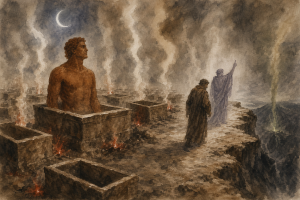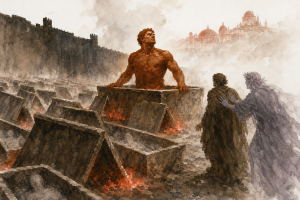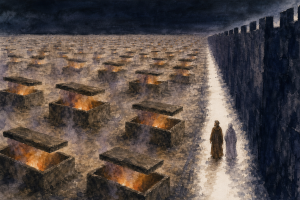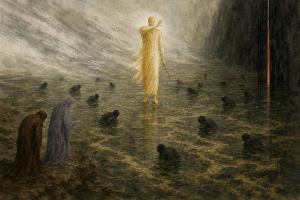
Halfway through Dante’s quarrel with Farinata, a second shade rises from the same open tomb, visible only to the chin, looks past the pilgrim for someone who is not there, and asks in tears where his son is; the son is Guido Cavalcanti, Dante’s closest friend in youth and a poet in his own right, and a single verb in Dante’s answer is enough to make the father believe him dead.
Inferno · Canto 10 · Lines 52–72 · Scene 30
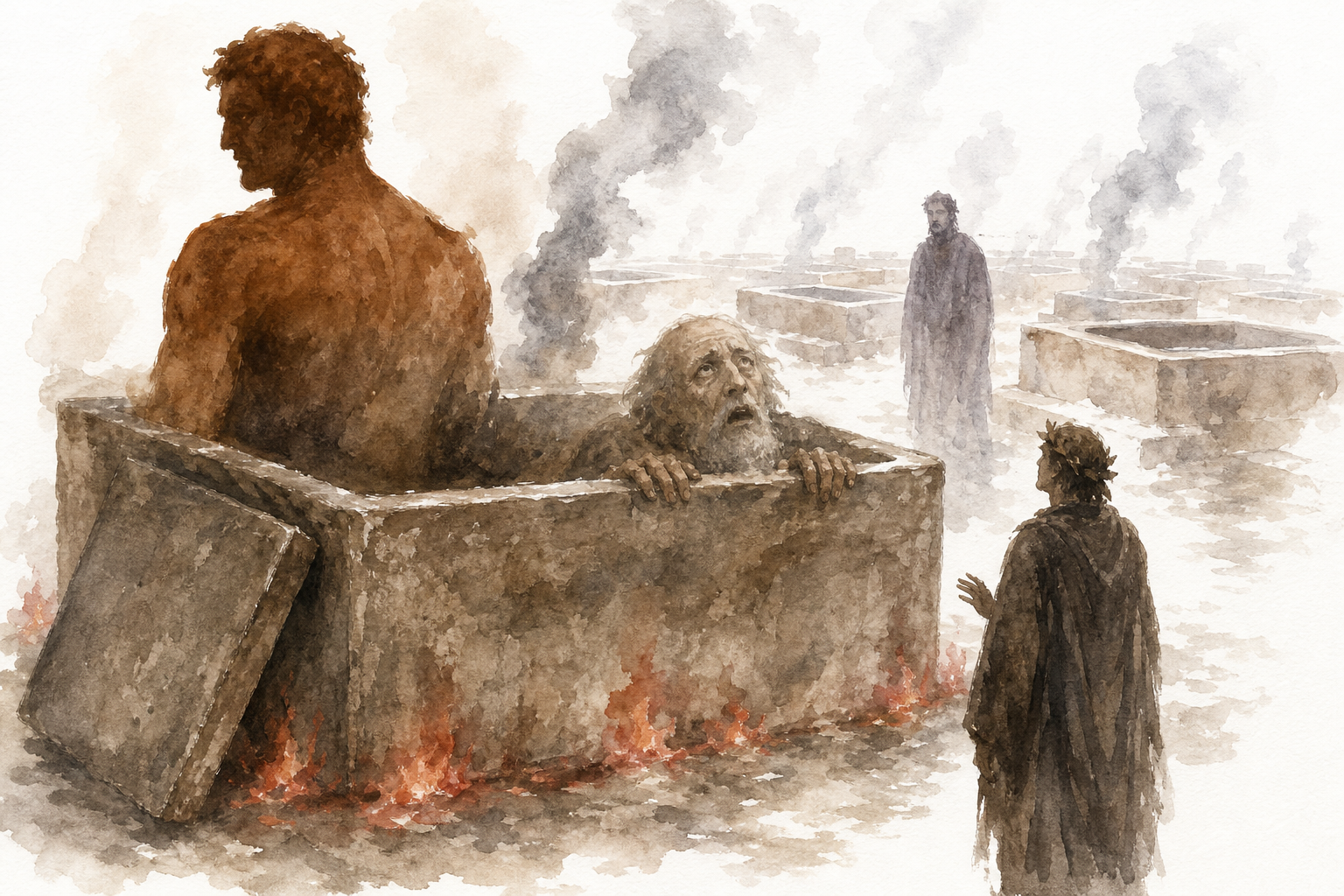
Dante and Farinata are in the middle of their argument about Florence when something happens that neither of them planned. Out of the same open tomb a second head appears, «un’ombra, lungo questa, infino al mento» (53), a shade next to Farinata, visible only up to the chin. Dante guesses he must be kneeling. Farinata stood tall from the waist up; this man barely clears the rim.
He does not look at Dante first. He looks around him, as if he wants to see whether anyone else has come along. When that hope dies, he starts to cry and asks a question: if you travel through this blind prison by the height of your genius, «mio figlio ov’è? e perché non è teco?» (60), where is my son, and why isn’t he with you?
The speaker is Cavalcante de’ Cavalcanti, and his son is Guido Cavalcanti, one of the best poets in Florence and, when they were young, Dante’s closest friend. Dante dedicated his early book, the Vita nuova, to Guido. Cavalcante’s reasoning is simple and very human. A living man is walking through Hell, so he must be here because of his brilliance. His son is just as brilliant. So why isn’t his son with him?
Dante answers carefully. «Da me stesso non vegno» (61), I do not come by my own power. The one waiting over there, he says, meaning Virgil, is leading me, perhaps to someone «cui Guido vostro ebbe a disdegno» (63), whom your Guido held in disdain. That line is one of the most argued-over in the whole poem, and we will come back to it. Cavalcante hears only one word: «ebbe», held. It is in the past tense.
Before answering, Dante tells us how he knew who this was: the man’s words and the kind of punishment had already told him his name. Guido was famous for doubting that the soul survives death, so a man talking only about Guido, in the tombs of those who deny the afterlife, could only be his father.
Cavalcante shoots upright and cries out. What did you say, «elli ebbe»? Isn’t he still alive? «non fiere li occhi suoi lo dolce lume?» (69), doesn’t the sweet light strike his eyes anymore? Then he notices that Dante pauses before answering. That pause is enough. He falls back flat into the tomb and does not appear again.
It all takes seven tercets. Cavalcante rises, hopes, misunderstands, and collapses, and Farinata, standing beside him, does not move at all. The two men share a tomb, and they are related by marriage, because Guido married Farinata’s daughter. Yet they do not exchange a single word.
Why does Dante hesitate? Later in the canto he explains that he was confused: he had assumed the dead could see what was happening on earth, and Cavalcante’s question made no sense to him. He will ask Farinata to pass a message on: your son is still alive.
There is a darker fact behind the scene. The poem is set in spring 1300. In June of that year Dante, serving on Florence’s governing council, approved a decision to banish the leaders of both political factions to keep the peace. Guido was among them. He fell ill in exile and died that August. When Dante wrote this canto, he knew that the father’s fear was only a few months early, and that his own vote was part of the story.
Go deeper: the college-level reading (about 1,000 words)
Quotes the Italian closely, with philological detail and cross-references.
The interruption is abrupt and spatially exact. «Allor surse a la vista scoperchiata / un’ombra, lungo questa, infino al mento» (52–53): the new shade rises into the uncovered opening («la vista scoperchiata» means the open mouth of the tomb, more than the view), beside Farinata, and only to the chin. The narrator adds a guess, «credo che s’era in ginocchie levata» (54), the only conjecture of its kind in the scene. The two men are measured against each other in body before either is named. Farinata stood «da la cintola in sù» (33). Cavalcante kneels and peers.
His first action is a look that goes past the pilgrim. He looked around «come talento / avesse di veder s’altri era meco» (55–56). «Talento» is desire, the word that defined the lustful at V.39, «che la ragion sommettono al talento»; here it is a father’s longing, and it is disappointed in the line’s own syntax: «e poi che ‘l sospecciar fu tutto spento» (57), once the suspicion, the half-hope, was wholly put out. Only then does he speak, and he speaks weeping.
The question has a premise and a conclusion. The premise: «Se per questo cieco / carcere vai per altezza d’ingegno» (58–59). Hollander notes that «cieco carcere» has long been heard as Virgil’s «carcere caeco» (Aeneid VI.734), the dark prison of the body in Anchises’ account of souls. The phrase «altezza d’ingegno» looks back to Dante’s invocation, «O muse, o alto ingegno, or m’aiutate» (II.7). How the echo works depends on how that invocation is read. If «alto ingegno» there is the poet’s own genius, Cavalcante’s question is the natural one between rival talents. If it is a higher power, the father has misunderstood the nature of the journey from the start. The conclusion: «mio figlio ov’è? e perché non è teco?» (60). Daniello, in 1568, heard Andromache’s «Hector ubi est?» (Aeneid III.312); Durling proposed Genesis 4:9, God’s question to Cain about Abel, and observed that both stories end in exile.
Dante’s reply opens with a disclaimer: «Da me stesso non vegno» (61), possibly shaped by John 8:28, where Christ says he does nothing of himself. Then the crux: «colui ch’attende là, per qui mi mena / forse cui Guido vostro ebbe a disdegno» (62–63). The grammar allows two constructions. «Cui» can be the object of «ebbe a disdegno» with Virgil as its antecedent, so that the sense is: he leads me, he whom perhaps your Guido held in scorn. Or «cui» can be the destination of «mi mena», so that Virgil leads me through here perhaps to her whom your Guido scorned, which points to Beatrice, promised as the pilgrim’s later guide at I.122–123, «anima fia a ciò più di me degna». Hollander reports roughly half of those who have engaged the question for Virgil, a strong line for Beatrice (Del Lungo, Gorni, Cherchi, and Hollander himself, via a sonnet of Cino da Pistoia that turns «disdegno» and «ingegno» against Guido), and a small minority for God.
The tense matters as much as the referent. «Ebbe» is the past definite, the tense of a completed event. Singleton’s 1962 essay on Guido’s disdain argued over its force without settling it. Chimenz proposed that the tense marks a specific act: at some point after Beatrice’s death Guido came to disdain Dante’s continuing devotion to her, and Dante thinks of that rejection as a dated event. Either way, the tense is what Cavalcante hears.
Before the father reacts, the narrator explains his own fullness: «Le sue parole e ‘l modo de la pena / m’avean di costui già letto il nome; / però fu la risposta così piena» (64–66). The words (his question about Guido) and the manner of punishment (the Epicurean tombs) had read out his name. The verb «letto» suggests an inscription, which is apt in a cemetery.
Then the reversal. «Di sùbito drizzato gridò: "Come? / dicesti "elli ebbe"? non viv’elli ancora? / non fiere li occhi suoi lo dolce lume?"» (67–69). Three questions in two and a half lines, each shorter than the last. Chiavacci Leonardi argued that the punctuation should be «Come / dicesti? elli ebbe?», as in the 1921 edition; the Wikisource text printed here follows the other arrangement, which isolates «Come?» as a cry. The «dolce lume» is the sun and life together; the same adjective will name the upper world at 82, «dolce mondo», in Farinata’s mouth.
The last tercet is about silence. «Quando s’accorse d’alcuna dimora / ch’io facëa dinanzi a la risposta, / supin ricadde e più non parve fora» (70–72). Cavalcante takes the pause as confirmation. Hollander notes the shape of the episode: he «surse» at 52 and «ricadde» at 72, a resurrection that fails. The dieresis on «facëa» slows the verse at exactly the point where the pilgrim is slow. The explanation for the delay comes forty lines later, at 112–114, where Dante says he had assumed the damned could see the present.
The scene is also built on a pattern of looking. Cavalcante’s first act is a gaze that goes around the pilgrim, «Dintorno mi guardò» (55), searching for someone else; his last question is whether his son can still see. Between them stands a pilgrim who has been told to look (31) and who now cannot meet the father’s question with an answer. The canto has moved from Farinata, on whom the pilgrim fixed his own gaze (34) and who looked him over «quasi sdegnoso» (41), to a father who looks past him, and the contrast between the two gazes does much of the characterising work that speech does elsewhere.
The kinship is left unspoken. Guido had married Farinata’s daughter, so the two shades who share this tomb are in-laws, the Ghibelline magnate and the Guelf father joined by a marriage arranged across the factions. Neither addresses the other, and the poem does not mention the connection. Readers who know it feel the silence between them; readers who do not see only two men in one grave.
Throughout, Farinata has not moved. The narrator will say so at 73–75, and the next scene begins from his stillness.
Go deeper still: the scholarly reading (about 800 words)
The commentary tradition, the sources, and what is documented versus inferred.
Begin with the author, because this is the passage in the Inferno where his own record is most directly in play.
The poem is set in the spring of 1300. On 24 June of that year, during the two months Dante served as one of Florence’s six priors (15 June to 15 August), the priorate resolved to banish the leaders of both Guelf factions to stop the street fighting. Guido Cavalcanti was among those sent away. He fell ill at Sarzana, was recalled soon after Dante’s term ended, and died in Florence at the end of August; he was buried on 29 August. When Dante wrote Canto X, some years into his own exile, he knew three things the pilgrim does not: that Guido would die within months of the fictional date, that the priors had sent him into the exile that killed him, and that he had been one of the priors.
The scene can be read without that knowledge, and many readers do. It cannot be read the same way with it. Cavalcante’s question, «mio figlio ov’è? e perché non è teco?» (60), becomes an accusation the father does not know he is making, and Durling’s suggestion that Genesis 4:9 lies behind it sharpens the point: God’s question about Abel is asked of the man who caused his brother’s absence, and both stories end in exile. Dante’s pause at 70–71, which the poem later explains as a theological confusion (112–114), becomes, on this reading, the poet’s own hesitation translated into the pilgrim’s. Hollander says plainly that, given the history between the poet and Guido, it is not surprising that the author stages the drama of his understandable guilt in this somewhat strained way.
The rupture between the two poets is real but poorly documented. Barolini’s survey of the evidence concludes that we cannot be certain of its course, but that a dispute between the former friends is mirrored in Guido’s canzone Donna me prega and Dante’s Vita nuova. Guido’s sonnet I’ vegno ‘l giorno a te ‘nfinite volte, which reproaches Dante for his manner of life, is usually cited in the same file. None of this establishes what Guido disdained, and that is why the «cui» of line 63 remains open.
The reputation that puts Cavalcante in this tomb is better attested. Boccaccio, commenting on these lines, describes Guido as following Epicurus’s opinion that the soul does not outlive the body. In the Decameron (VI.9) he tells a story that matters for this scene: Guido, known among common people for speculations aimed at proving that God did not exist, was cornered by a company of young gentlemen among the marble tombs by San Giovanni. He told them they could say what they liked to him «a casa vostra», in your own house, and vaulted over one of the tombs and escaped. Boccaccio’s narrator explains the insult: the tombs are the home of the ignorant, who are as good as dead. Benvenuto adds that Guido argued from Ecclesiastes 3:19 that men and beasts share one fate.
The family is therefore damned by report. Cavalcante’s own beliefs are not stated in the poem; Dante identifies him from «Le sue parole e ‘l modo de la pena» (64), his talk of his son and the Epicurean tomb. The glosses cited here concern the son, and the poem, too, identifies the father through him; Cavalcante died around 1280.
Two further facts complicate the arrangement. Guido had married Farinata’s daughter, so the two shades in this tomb are in-laws, a Ghibelline and a Guelf joined by a political marriage. Neither acknowledges the other. And Guido is absent in two senses. He is alive at the fictional date, so he cannot appear. He was dead when the canto was written, so the poem could have placed him, and it does not. The only judgment it passes on him is in a verb whose tense, as Singleton saw, is itself the problem.
Auerbach chose this scene, with Farinata’s, for his chapter in Mimesis, and its structure explains why. The interruption mixes registers that classical decorum kept apart: the high political exchange stops dead for a father’s grief, and then resumes as if nothing had happened. The juxtaposition does not resolve into a single tone, and Auerbach treated that refusal as characteristic of the whole poem’s realism.
The narrator’s own guess at 54, «credo», is worth setting beside this. In a canto where the poet controls every posture, the one admitted uncertainty falls on the father of the friend he helped to exile. Whether that is design or accident cannot be shown, but it is the kind of detail a biographical reading is entitled to notice and not entitled to prove.
What the author knew, and what he chose to let the pilgrim not know, is the deepest layer of the scene. It is also the layer where the evidence ends soonest.
The Italian — Cavalcante de’ Cavalcanti
Source: Wikisource (public domain, pre-1929 text)
Lines 52–54
52. Allor surse a la vista scoperchiata53. un’ombra, lungo questa, infino al mento:54. credo che s’era in ginocchie levata.
vocabulary: Line 52 — «surse a la vista scoperchiata» — rose into the uncovered opening. «Vista» here is the visible gap left by the raised lid, not the pilgrim’s view; «scoperchiata» repeats the lifted lids of 8–9. Hollander observes that the episode is shaped as a failed resurrection: Cavalcante «surse» here and «ricadde» at 72. The same verb of rising is used of no one else in this canto; Farinata «s’è dritto» (32), he has stood himself up, which is a different and more deliberate action. [Source: Inferno X.32, 72]
literary key: Line 53 — «infino al mento» — up to the chin. The measurement answers Farinata’s «da la cintola in sù» (33), from the belt up. Both men rise out of one tomb, one visible to the waist and one only to the chin, and the poem makes their difference legible in the body before it is legible in speech. Auerbach built his reading of the canto on this pairing: two figures of opposite temperament presented side by side, in a contrast the classical rules of style would have kept apart. [Source: Inferno X.32–33]
literary key: Line 54 — «credo che s’era in ginocchie levata» — I think he had raised himself on his knees. The narrator guesses. In a canto of precise posture, this is the one place he admits he cannot see clearly, and the uncertainty belongs to the figure: Cavalcante is partly hidden, lower than his neighbour, and seen through a gap. The kneeling posture also carries connotations of supplication that Farinata’s stance pointedly lacks. [Model knowledge · medium]
Lines 55–57
55. Dintorno mi guardò, come talento56. avesse di veder s’altri era meco;57. e poi che ‘l sospecciar fu tutto spento,
vocabulary: Line 55 — «talento» — desire, inclination. The word defined the lustful in the second circle, «che la ragion sommettono al talento» (V.39), who subject reason to desire. Here it names a father’s longing to see his son. The repetition is probably not a moral judgment on Cavalcante; it shows the poem’s vocabulary for desire stretching from appetite to love. His desire is to see «s’altri era meco» (56), whether someone else was with me, and it governs his first action, a look that goes past the pilgrim. [Source: Inferno V.37–39]
vocabulary: Line 57 — «’l sospecciar fu tutto spento» — the suspecting was wholly put out. «Sospecciare» is to suspect or surmise, and here it carries the sense of an anxious hope. The verb «spento», extinguished, is used for flames and lights; a hope going out in a circle of fire is a characteristic Dantean compression. Only after this does Cavalcante speak, and «piangendo» (58), weeping, is the first word of the next line. [Model knowledge · medium]
Lines 58–60
58. piangendo disse: "Se per questo cieco59. carcere vai per altezza d’ingegno,60. mio figlio ov’è? e perché non è teco?".
cultural ref: Line 58 — «cieco / carcere» — blind prison. Hollander notes the long-recognised echo of Virgil’s «carcere caeco» (Aeneid VI.734), where Anchises describes souls shut in the dark prison of the body. The enjambment across 58–59 holds the noun back, and the borrowed phrase is turned inside out: in Virgil the body is the prison, while for this Epicurean father, who denied the soul a life without the body, Hell is the prison. The image of blindness prepares the father’s last question about light. [Model knowledge · high]
literary key: Line 59 — «per altezza d’ingegno» — by height of genius. The phrase recalls Dante’s invocation, «O muse, o alto ingegno, or m’aiutate» (II.7). Hollander sets out the alternatives. If «alto ingegno» there means the poet’s own talent, Cavalcante’s assumption is reasonable and his question a rival father’s. If it names a higher power, the father has misunderstood the journey: genius is not the vehicle. Either way, Cavalcante measures the pilgrim by the one standard he can imagine, and his son meets it. [Source: Inferno II.7–9]
cultural ref: Line 60 — «mio figlio ov’è?» — where is my son? Bernardino Daniello, in 1568, heard Andromache’s «Hector ubi est?» (Aeneid III.312), a grieving question about an absent man who is dead. Durling proposed instead Genesis 4:9, God’s question to Cain, «Ubi est Abel frater tuus?», and noted that both that story and Guido’s end in exile. The two sources pull in different directions: Andromache’s question is pure grief, while God’s question to Cain is an accusation. [Model knowledge · medium]
Lines 61–63
61. E io a lui: "Da me stesso non vegno:62. colui ch’attende là, per qui mi mena63. forse cui Guido vostro ebbe a disdegno".
theology: Line 61 — «Da me stesso non vegno» — I do not come of myself. The disclaimer answers the premise of Cavalcante’s question directly: the journey is not powered by genius. Hollander suggests an echo of John 8:28, where Christ says «a meipso facio nihil», I do nothing of myself. If the echo is active, the pilgrim describes his journey in the terms of an obedient mission, which is precisely the category Cavalcante, as an Epicurean, cannot supply. [Model knowledge · medium]
translation note: Line 63 — «forse cui Guido vostro ebbe a disdegno» — perhaps whom your Guido held in disdain. Grammatically «cui» can refer to Virgil (he leads me, he whom Guido scorned) or point beyond him (he leads me through here, perhaps to her whom Guido scorned, that is Beatrice). Hollander reports roughly half of interpreters for Virgil, a strong group for Beatrice, and a few for God. Any English version has to choose; the Italian does not. The word «forse» may qualify the destination, the scorn, or both. [Model knowledge · low]
history: Line 63 — «Guido vostro» — your Guido. Guido Cavalcanti, six to ten years older than Dante, was the leading poet of their circle; Dante calls him his first friend in the Vita nuova. He married Farinata’s daughter, so the two shades in this tomb are related by marriage. Note the respectful «vostro»: Hollander observes that only three Florentines in Hell receive the plural of respect, Farinata, Cavalcante, and Brunetto Latini. Guido was banished in June 1300 during Dante’s priorate and died that August. [Model knowledge · high]
Lines 64–66
64. Le sue parole e ‘l modo de la pena65. m’avean di costui già letto il nome;66. però fu la risposta così piena.
history: Line 65 — «m’avean di costui già letto il nome» — had already read out his name to me. The father’s words, all about Guido, and the manner of punishment, the Epicurean tombs, identify him. Guido’s reputation was the key. Boccaccio, commenting on these lines, says Guido followed Epicurus in believing the soul died with the body, and in the Decameron (VI.9) he records that common people said Guido’s speculations aimed at proving God did not exist. The verb «letto» suits a cemetery: the name is read as if from a stone. [Model knowledge · high]
literary key: Line 66 — «però fu la risposta così piena» — that is why my answer was so full. The narrator justifies naming Guido and pointing to Virgil: he knew whom he was addressing. The adjective is ironic in hindsight, because the answer contains one word, «ebbe», that will empty it of everything the father needs. Fullness of reference and failure of communication sit in the same sentence. [Model knowledge · medium]
Lines 67–69
67. Di sùbito drizzato gridò: "Come?68. dicesti "elli ebbe"? non viv’elli ancora?69. non fiere li occhi suoi lo dolce lume?".
translation note: Line 68 — «dicesti "elli ebbe"?» — did you say «he had»? The father repeats the verb back, which is why it appears in quotation marks inside his speech. The punctuation of 67–68 is disputed. Chiavacci Leonardi argued for the arrangement of the 1921 edition, «Come / dicesti? elli ebbe?», against the version that isolates «Come?» as a cry; the Wikisource text printed here follows the latter. The difference is between a stunned question and a shout followed by a question. [Model knowledge · medium]
vocabulary: Line 69 — «lo dolce lume» — the sweet light. Sunlight and life together. The adjective recurs in the canto: Farinata will say «nel dolce mondo» at X.82, the world of the living, while at X.130 Virgil’s «dolce raggio» is the sweet ray of Beatrice’s eye, the light of the life to come. Set against «cieco / carcere» at 58–59, the father’s last question is about whether his son can still see, which is also a question about whether he can still be seen by the living. [Source: Inferno X.82, 130]
Lines 70–72
70. Quando s’accorse d’alcuna dimora71. ch’io facëa dinanzi a la risposta,72. supin ricadde e più non parve fora.
literary key: Line 70 — «alcuna dimora» — some delay. Cavalcante reads Dante’s hesitation as confirmation of the worst. The explanation comes forty-two lines later: Dante, «come di mia colpa compunto» (X.109), asks Farinata to tell the fallen father that his son is still alive, and says he was silent because he believed the damned could see the present (X.112–114). The message is never shown being delivered. The dieresis on «facëa» (71) lengthens the verse at exactly the point of the pause. [Source: Inferno X.109–114]
literary key: Line 72 — «supin ricadde e più non parve fora» — fell back supine and appeared outside no more. Supine is the position of a corpse. The verse is quick and final: three verbs of motion and disappearance in one line. Guido Cavalcanti died at the end of August 1300, about four months after the fictional date of the journey, so the father’s grief is premature by a season. [Model knowledge · high]
Seven Centuries of Reading Cavalcante de’ Cavalcanti
Boccaccio and the Epicurean reputation
The earliest readers did not need to be told why Cavalcante was here. Boccaccio, lecturing on the poem in Florence in the 1370s, glossed the line about Guido by saying that Guido followed Epicurus in believing the soul died with the body. In the Decameron he had already told a story built on the same reputation. Common people said that Guido’s speculations were only an attempt to prove that God did not exist. Cornered once among the marble tombs by San Giovanni, Guido told his tormentors they could say what they liked to him in their own house, and leapt over a tomb to escape.
Benvenuto da Imola added that Guido cited Ecclesiastes to argue that men and beasts share one fate. These glosses explain the narrator’s line «Le sue parole e ‘l modo de la pena / m’avean di costui già letto il nome» (64–65). Dante recognised the father by the son’s reputation.
Hearing other grieving voices
Renaissance commentators listened for classical models. Bernardino Daniello, in 1568, heard in «mio figlio ov’è?» (60) Andromache asking where Hector was. The comparison puts Cavalcante beside a widow who already fears the answer. Much later, Robert Durling proposed Genesis 4:9 instead: God asking Cain where his brother Abel is. That source turns the father’s grief into a question aimed, without his knowing it, at the man in front of him.
The argument over “disdegno”
Line 63, «forse cui Guido vostro ebbe a disdegno», has produced more argument than almost any other line in the Inferno. The question is whom Guido disdained. Many readers, old and modern, answer Virgil, the guide standing nearby. Others answer Beatrice, the destination of the journey, a case argued by Paolo Cherchi among others. Following the lead of Isidoro Del Lungo (1889) and Guglielmo Gorni (1981), Robert Hollander found the same pair of words, «disdegno» and «ingegno», used against Guido in a sonnet by Cino da Pistoia, which strengthens the case for Beatrice.
The verb has its own literature. In 1962 Charles Singleton examined the force of the past definite «ebbe» without reaching a firm conclusion. Siro Chimenz argued that it marks a single past act: Guido’s rejection, after Beatrice’s death, of Dante’s continuing devotion to her. Anna Maria Chiavacci Leonardi reopened even the punctuation of Cavalcante’s cry at 67–68.
Auerbach’s two figures
Erich Auerbach‘s chapter “Farinata and Cavalcante” in Mimesis (1946) made this scene a test case for literary realism. A grand political exchange stops for a father’s grief, then resumes as if nothing had happened. Auerbach saw in that clash of registers something classical decorum would not allow, and something characteristic of the Commedia as a whole. The kneeling father, visible only «infino al mento» (53), beside the standing magnate, is the image his argument rests on.
Open questions
Recent work has concentrated on the friendship itself. Teodolinda Barolini reviewed the evidence for a quarrel between Dante and Guido, as mirrored in Guido’s canzone Donna me prega and Dante’s Vita nuova. She concluded that the dispute is real even though its course cannot be fixed with certainty. That leaves the reader where the father is left at line 72: with a verb, a pause, and no answer the text will confirm.
The Two Main Positions on Cavalcante de’ Cavalcanti
Guido Disdained Virgil
The simplest construction of line 63 makes «cui» the object of «ebbe a disdegno» and Virgil its antecedent: the one waiting there leads me, he whom your Guido perhaps held in scorn. Virgil is the nearest candidate in the sentence and the only one present. The reading also answers Cavalcante’s premise directly. The father assumes that genius alone brings a poet here; Dante replies that he comes by a guide, and that the guide is the author Guido would not follow. Guido’s poetry is philosophical and lyric, and nothing Virgilian appears in it; for a poet whose Commedia is built on Virgil’s Aeneid, that indifference is a real difference of vocation. Roughly half of those who have engaged the question take this view.
Key passage: «colui ch’attende là, per qui mi mena / forse cui Guido vostro ebbe a disdegno» (62–63): «colui» is Virgil, and the most natural antecedent of «cui» is the noun just named.
Guido Disdained Beatrice
«Cui» can equally be the goal of «mi mena»: Virgil leads me through here, perhaps to her whom Guido scorned. The destination of the journey, announced at I.122–123, is Beatrice, and the past definite «ebbe» suits a specific act better than a lifelong indifference to a classical poet. Chimenz argued that Guido came to disdain Dante’s devotion to Beatrice after her death, an event the pilgrim would think of as dated. Hollander, following the lead of Del Lungo and Gorni, finds the words «disdegno» and «ingegno» used against Guido in a sonnet by Cino da Pistoia, which would make Dante’s line a pointed reply in a known quarrel. Cherchi and others have argued the case independently.
Key passage: «anima fia a ciò più di me degna: / con lei ti lascerò nel mio partire» (I.122–123): Virgil leads toward a woman, and the journey Cavalcante thinks is powered by genius is in fact directed to her.
What the Text Does — and What That Means (Contested)
On the page: Cavalcante asks why his son is not with Dante if Dante travels by «altezza d’ingegno» (59). Dante’s answer denies coming of himself (61), points to Virgil as the one waiting (62), and contains the clause «forse cui Guido vostro ebbe a disdegno» (63), in which «cui» has no unambiguous antecedent and «ebbe» is in the past definite. Cavalcante reacts to the tense, not to the referent (67–68). Dante delays before answering (70–71) and later attributes the delay to his belief that the damned know the present (112–114). Guido Cavalcanti is never named by his father; Dante names him once, at 63. The poem’s fictional date is 1300; the historical Guido died at the end of August 1300.
What scholars dispute: The referent of «cui» is among the most debated questions in the poem. Hollander reports roughly half of those who address it for Virgil, a substantial group for Beatrice, and a few for God; the syntax supports either of the first two. What «ebbe» implies (a single past act, as Chimenz argued, or a habitual attitude awkwardly expressed) is also disputed. Whether the scene encodes Dante’s guilt over his role in Guido’s banishment is an inference from biography, not something the text states.
What Dante Leaves Unresolved
The poem never says whom Guido scorned, and it never says what Guido believed. It lets his father rise and fall on a verb, explains the pilgrim’s silence with a theological error forty lines later, and leaves the reader holding a fact the pilgrim does not have: that the son would be dead before the year was out, sent into exile by a council on which the poet sat.
The Open Question
Dante tells a grieving father that Virgil leads him, perhaps, to someone «cui Guido vostro ebbe a disdegno». Whom did Guido disdain — Virgil, and with him the classical tradition the pilgrim follows, or Beatrice, and with her the love that turned Dante’s poetry toward God? And why does the poet put the verb in a tense that sounds like an epitaph?
Explore More
About This Article

Written by Lucy Bamboo. Lucy Bamboo has been reading the Divine Comedy for fifteen years — first in translation, then stubbornly in Medieval Tuscan with a dictionary and far too many footnotes. Reading Dante is her scene-by-scene walk through the poem: the original Italian, seven centuries of scholarly argument presented as argument rather than answer, and the human questions sitting underneath the theology. More about this site.
Verify this against a primary source
Specifics change, and your situation may differ from the one described here. These are the authorities worth checking directly:
- Digital Dante, Columbia University — text, commentary and translation apparatus
- Princeton Dante Project — the Commedia with historical commentary
- Dartmouth Dante Project — searchable commentary from 1322 onward