Farinata has not moved while Cavalcante rose and fell beside him, and now he picks up the quarrel exactly where it broke off: the art of returning from exile, he tells Dante, is one the pilgrim will soon learn the weight of; then, after a sigh and a defence of the day he saved Florence, he explains why the damned can see the future but not the present, and the canto ends with Virgil promising that someone else will tell the rest.
Inferno · Canto 10 · Lines 73–136 · Scene 31
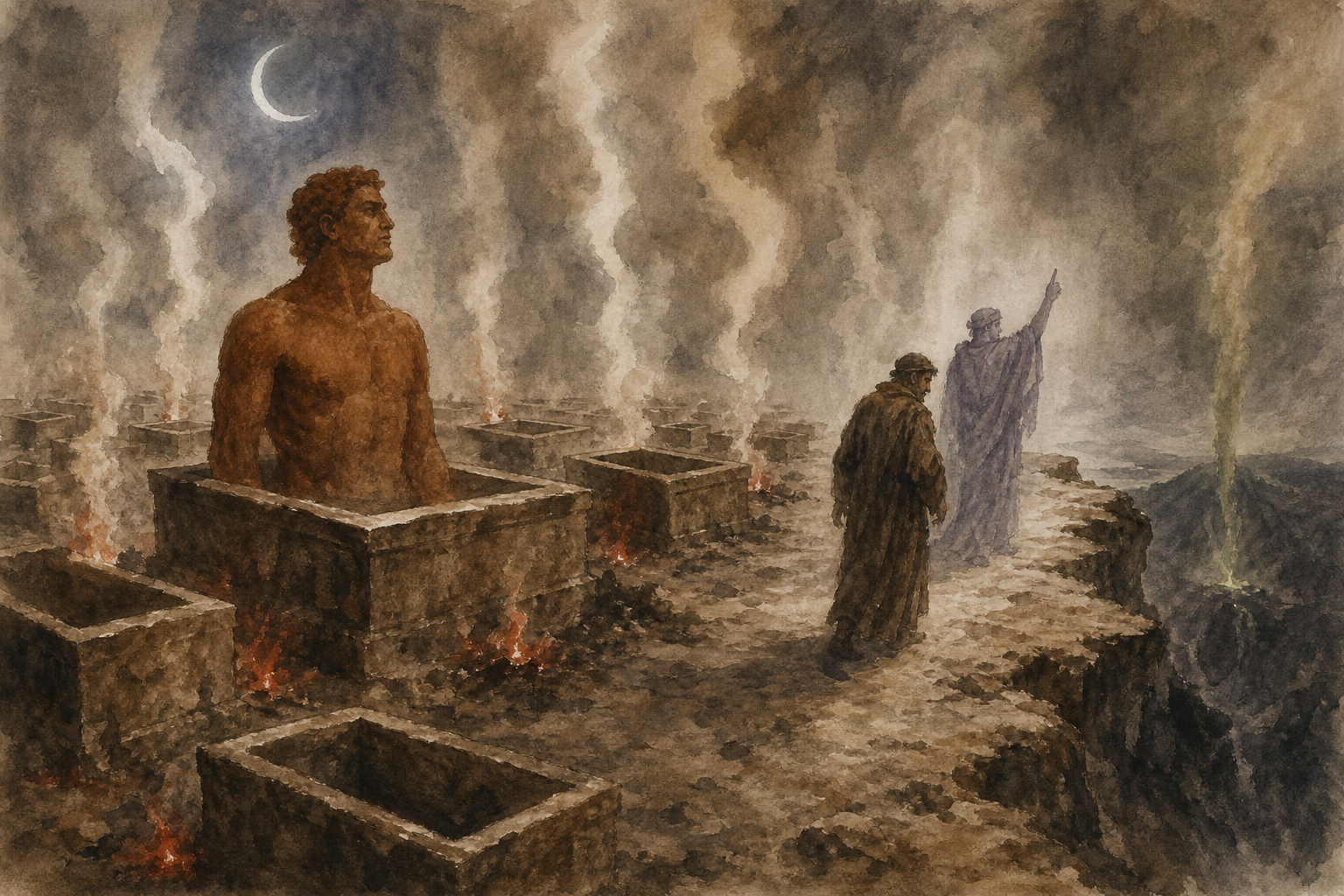
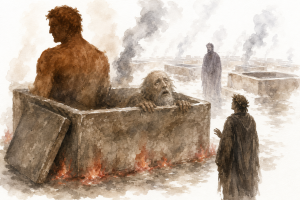
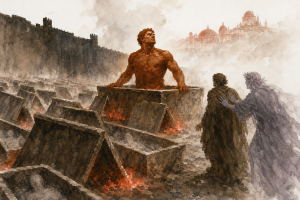
While Cavalcante rose, wept and fell back, Farinata did not move a muscle. Dante calls him «quell’altro magnanimo» (73), that other great-souled man, and says he did not change his expression, turn his neck, or bend his side. Then Farinata simply carries on the argument from where it was interrupted, as if nothing had happened.
If my people have learned that art badly, he says, meaning the art of coming home from exile, «ciò mi tormenta più che questo letto» (78), that torments me more than this bed. He calls his burning tomb a bed. His family’s defeat hurts him more than Hell.
Then he hits back. Before the face of the lady who rules here is rekindled fifty times, «tu saprai quanto quell’arte pesa» (81), you will know how much that art weighs. The lady is the moon, identified with Proserpina, queen of the underworld. Fifty moons is about fifty months. The poem is set in spring 1300, so Farinata is pointing to mid-1304. Dante was exiled from Florence in 1302, and by the summer of 1304 the exiles’ last attempts to fight their way home had failed. The man Dante mocked for his family’s exile has just told him that he will be an exile too, for good.
Farinata asks why Florence is so harsh to his family in every law it passes. Dante answers with a memory: the slaughter that dyed the river Arbia red. That was the battle of Montaperti in 1260, when Farinata’s side crushed the Florentine Guelfs. Florence has not forgotten it.
For the first time Farinata sighs. I was not alone in that, he says, and I did not join in without reason. «Ma fu’ io solo» (91), but I was alone, at the meeting where everyone agreed to wipe Florence off the map, «colui che la difesi a viso aperto» (93), the one who defended her openly. After Montaperti the winners met at Empoli and proposed to destroy the city. Farinata stood up alone and refused.
Dante now asks about something puzzling him. Farinata can predict the future, but Cavalcante did not know whether his own son was alive. How does that work? Farinata explains. The damned see like people with poor eyesight who can make out things far away but not close up. When events come near or are actually happening, their minds are empty, and they know nothing of the living unless someone tells them. And when the future ends, on Judgment Day, their knowledge will be completely dead.
Dante feels guilty. He asks Farinata to tell the fallen father that his son is still among the living, and to explain that Dante only hesitated because he had not understood this rule.
Virgil is calling him back. Dante asks quickly who else is in the tomb. More than a thousand, Farinata says, including the Emperor Frederick II and «’l Cardinale», the Cardinal, and he will say no more. Then he sinks out of sight.
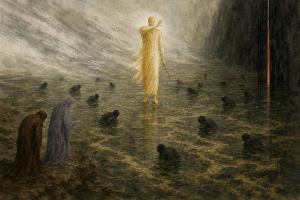
Dante walks on, brooding over what sounded like a threat. Virgil asks why he is so lost in thought, and Dante tells him. Virgil’s answer is firm and kind: remember what you heard against you, and when you stand before the sweet light of the lady whose beautiful eye sees everything, you will learn from her the whole journey of your life. The lady is Beatrice. Yet when Dante finally does learn the details of his exile, deep in Paradise, it will be his great-great-grandfather Cacciaguida who tells him, not Beatrice.
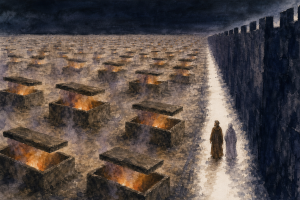
They turn left, away from the wall, toward a valley whose stench rises all the way up to where they stand.
Go deeper: the college-level reading (about 1,000 words)
Quotes the Italian closely, with philological detail and cross-references.
The narrator’s first words after Cavalcante’s fall reassign the reader’s attention with a single adjective: «Ma quell’altro magnanimo, a cui posta / restato m’era, non mutò aspetto, / né mosse collo, né piegò sua costa» (73–75). «Magnanimo» is Aristotle’s great-souled man, and the term carried an ambivalence even in antiquity, the fear that greatness of soul shades into pride; J. A. Scott traced its double valence and its decline among Christian writers. Scott later suggested that «quell’altro» implies a this one, so that the epithet might extend to Cavalcante too. Hollander thinks the insistent focus on Farinata erodes the suggestion. The three negatives, no change of face, no turn of the neck, no bend of the side, describe a figure who has watched a father’s grief from inches away without a flicker.
He resumes «continüando al primo detto» (76), and the first thing he says is «S’elli han quell’arte … male appresa» (77), taking back the word Dante scored with at 51. The tomb becomes a «letto» (78), a bed, and the political failure torments him more than it does. Hollander’s comment is pointed: in this poem there should be no torment greater than damnation.
Then the prophecy. «Ma non cinquanta volte fia raccesa / la faccia de la donna che qui regge, / che tu saprai quanto quell’arte pesa» (79–81). The lady who rules here is the moon as Proserpina, queen of the underworld; fifty kindlings of her face are fifty months. Counted from the spring of 1300, they run out in mid-1304, and Hollander notes that by July 1304 the White exiles’ last attempts on Florence had failed. Dante, banished in 1302, had already parted company with them. The art the pilgrim mocked will weigh on him for the rest of his life.
Line 82 plays on line 80: «E se tu mai nel dolce mondo regge». The rhyme word repeats with a different sense, an equivocal rhyme. At 80 «regge» means rules; at 82 it belongs to a formula of entreaty, so may you return to the sweet world, which is how most readers take it. Farinata then asks why the people of Florence are «sì empio / incontr’a’ miei in ciascuna sua legge» (83–84). The answer is the battle: «Lo strazio e ‘l grande scempio / che fece l’Arbia colorata in rosso, / tal orazion fa far nel nostro tempio» (85–87). Montaperti was fought near the Arbia on 4 September 1260. Hollander reads the prayers in the temple as votes in council, so that Florentine politics appears as a deformed liturgy. It is the one point in the canto where heresy and politics touch directly.
The rhyme set of these lines, «empio», «scempio», «tempio», returns in the feminine at Paradiso XVII.62–66, «scempia», «empia», «tempia», in Cacciaguida’s account of Dante’s exile and of the «compagnia malvagia e scempia» (XVII.62) he will fall in with. The prophecy begun here is completed there, in the same sounds.
Farinata sighs (88), the first break in his composure, and makes his defence: «A ciò non fu’ io sol … né certo / sanza cagion con li altri sarei mosso. / Ma fu’ io solo, là dove sofferto / fu per ciascun di tòrre via Fiorenza, / colui che la difesi a viso aperto» (89–93). «Sol» and «solo» frame the speech. Not alone in the battle; alone at Empoli, where the victorious Ghibellines proposed to destroy the city and he openly refused. Hollander, who is hard on Farinata elsewhere, concedes the poem’s admiration here.
Dante’s question about knowledge opens with a courteous formula, «se riposi mai vostra semenza» (94), so may your descendants ever find rest, which is pointed when addressed to the head of a family barred from Florence. He asks Farinata to untie the «nodo» (95): the damned seem to see what time brings, but to be otherwise in the present (97–99). The answer is a simile of failing sight: «Noi veggiam, come quei c’ ha mala luce, / le cose … che ne son lontano» (100–101), like the long-sighted, «cotanto ancor ne splende il sommo duce» (102). Near or present things leave their intellect «vano» (103–104), and they know nothing of the living «s’altri non ci apporta» (104). When «del futuro fia chiusa la porta» (108), at the Judgment, their knowledge will be «tutta morta» (106).
Singleton took this as a rule for all the damned; Cassell argued it is specific to the heretics. Alberigo’s later admission that he knows nothing of how his body fares in the world (XXXIII.122–123) is consistent with the general reading. The image of the closing door also repeats the closing lids of 10–12, which suggests the end of knowledge and the sealing of the tombs are a single event.
The pilgrim, «come di mia colpa compunto» (109), sends word to «quel caduto» (110), the fallen one, that his son is «co’ vivi ancor congiunto» (111), and explains his earlier silence as an error now resolved (112–114). Virgil calls him back (115). Farinata’s last words name «’l secondo Federico / e ‘l Cardinale» (119–120), Frederick II, whom Salimbene called an Epicurean, and Cardinal Ottaviano degli Ubaldini, remembered by fourteenth-century commentators for saying he had lost his soul a thousand times for the Ghibellines. Then «e de li altri mi taccio» (120).
The pilgrim leaves «ripensando / a quel parlar che mi parea nemico» (122–123). Virgil asks «Perché se’ tu sì smarrito?» (125), with the word that described the lost way at I.3. He commands memory, «La mente tua conservi quel ch’udito / hai contra te» (127–128), raises a finger (129), and promises that before «quella il cui bell’occhio tutto vede» (131) Dante will learn «di tua vita il vïaggio» (132). The promise is not kept as stated. Cacciaguida delivers it in Paradiso XVII; Chiarenza argues the substitution is deliberate, on the model of the Aeneid, where the Sibyl is promised and Anchises speaks.
The scene closes on a leftward turn (133), the descent’s normal direction, and on a smell: a path toward a valley «che ‘nfin là sù facea spiacer suo lezzo» (136).
Go deeper still: the scholarly reading (about 800 words)
The commentary tradition, the sources, and what is documented versus inferred.
Read the scene from the far end of the poem, because that is where it was finished.
When Farinata promises that within fifty moons the pilgrim «saprai quanto quell’arte pesa» (81), the poem is prophesying events that had already happened when it was written. Dante was banished in 1302. He was associated for a time with the exiled White Guelfs and their Ghibelline allies in their efforts to force a return, and he had broken with them before the last of those efforts collapsed in the summer of 1304. Fifty lunar months from the fictional date of spring 1300 land almost exactly there, as Hollander observes. The prophecy is precise because it is retrospective.
The poem completes it in Paradiso XVII, and the completion is marked in the verse. Farinata’s question and Dante’s reply rhyme on «empio», «scempio» and «tempio» (83–87). Cacciaguida’s prophecy of the exile uses the same rhyme set in the feminine, «scempia», «empia», «tempia» (XVII.62–66), to describe the «compagnia malvagia e scempia» (XVII.62) with whom Dante will fall and who will turn against him. A few lines later Cacciaguida concludes that it will be to Dante’s honour «averti fatta parte per te stesso» (XVII.69), to have made a party of himself. Set beside Farinata’s «a me e a miei primi e a mia parte» (47), the line reads as the poem’s final answer to the Ghibelline: the exile who succeeds is the one who leaves faction behind.
This reading has a cost. It makes Canto X a station on a route whose endpoint the reader of 1310 or 1315 could not have known in detail, and it rests partly on rhyme echoes that the text does not gloss. But the echo is there to be heard, and the narrative promise of Canto X, «da lei saprai di tua vita il vïaggio» (132), points forward explicitly. That the promise is kept by Cacciaguida and not by Beatrice is the best-known inconsistency in the Commedia. Chiarenza’s solution is that the substitution imitates the Aeneid, where Helenus promises that the Sibyl will reveal Aeneas’s future and Anchises does it instead. If she is right, the switch is structural; if not, it is a trace of revision. The text does not decide.
Farinata’s defence at 89–93 belongs to the same political reading. He was not alone at Montaperti, he says, but alone at Empoli, «colui che la difesi a viso aperto» (93). The chronicle tradition supports him: after the battle, when the Ghibelline leaders proposed to raze Florence, he refused openly. The poem lets him make the claim without contradiction. Florence, by contrast, has answered his family with laws excluding the Uberti from every amnesty, and Dante explains those laws by the river «colorata in rosso» (86). The canto holds both memories, the massacre and the rescue, in one man, and assigns neither the last word.
The theory of knowledge at 97–108 is the canto’s other large structure, and it bears on how far the political reading can go. The damned see distant things and are blind to the near and the present; when the future ends, their knowledge dies. Singleton took this as a condition of all the damned. Cassell argued that it is specific to the heretics, a contrapasso for those who denied any future life and are left with nothing but the future until that, too, is taken away. The general reading has to explain why the rule is stated only here, in answer to a puzzle peculiar to this tomb; the specific reading has to explain Alberigo, who knows nothing of how his body fares above (XXXIII.122–123), far below the sixth circle. Neither position is decisive. What is clear is the shape of the image: the closing «porta» of 108 completes the closing lids of 10–12, so that the end of knowledge and the sealing of the tombs coincide.
The two names at 119–120 extend the circle from Florence to the empire and the Church. Frederick II, whom Salimbene calls an Epicurean, is the emperor whose court Dante praises elsewhere as the cradle of Italian poetry, in the De vulgari eloquentia. Cardinal Ottaviano degli Ubaldini is remembered by nearly every fourteenth-century commentator for his remark that if he had a soul he had lost it a thousand times for the Ghibellines. Farinata names them and falls silent, «e de li altri mi taccio» (120). The silence is consistent with his character: he names the great and declines to list the rest, as if the other thousand were beneath mention.
The scene ends with Virgil’s finger raised (129) and a turn to the left (133). The pilgrim walks away with a threat in his ears and a promise that someone else will explain it. The poem has made the reader a witness to both, and in Paradiso it keeps the appointment in a different voice.
The Italian — The Exile Foretold
Source: Wikisource (public domain, pre-1929 text)
Lines 73–75
73. Ma quell’altro magnanimo, a cui posta74. restato m’era, non mutò aspetto,75. né mosse collo, né piegò sua costa;
vocabulary: Line 73 — «magnanimo» — great-souled. The term is Aristotle’s, from the Ethics, where the magnanimous man claims great honours because he deserves them. Even in antiquity it carried a risk of pride, and J. A. Scott traced how its value declined among Christian writers. Scott later suggested that «quell’altro» implies a this one and that the adjective might extend to Cavalcante. Hollander finds the suggestion interesting but thinks the canto’s focus on Farinata erodes it. The punctuation of the phrase, which manuscripts do not settle, affects the reading. [Model knowledge · medium]
literary key: Line 75 — «né mosse collo, né piegò sua costa» — moved neither neck nor side. The three negatives of 74–75 describe complete immobility during the scene just ended. Cavalcante rose, searched, wept, sprang up and fell back within the same tomb; Farinata did not even turn his head. The contrast is the structural joke and the structural point of Canto X. Hollander calls Farinata, unmoved and unmoving, the exemplification of the ‘stone man’ admired by Stoic philosophers. [Model knowledge · high]
Lines 76–78
76. e sé continüando al primo detto,77. "S’elli han quell’arte", disse, "male appresa,78. ciò mi tormenta più che questo letto.
wordplay: Line 77 — «quell’arte … male appresa» — that art badly learned. Farinata answers Dante’s retort of 51, «ma i vostri non appreser ben quell’arte», by taking up both the noun and the verb. The quarrel resumes in its own vocabulary after seven tercets of interruption, as if Cavalcante had never spoken. At 81 the same noun will be turned against the man who first used it: «tu saprai quanto quell’arte pesa». The word «arte» therefore appears three times in thirty lines, each time with a different owner. [Source: Inferno X.49–51, 81]
literary key: Line 78 — «ciò mi tormenta più che questo letto» — that torments me more than this bed. Farinata calls his burning tomb a bed, a domestic word for an eternal punishment, and ranks it below his family’s political failure. Hollander observes that in the universe of this poem nothing should torment more than damnation. The line can be read as selfless loyalty or as a mind so fixed on faction that it cannot register where it is. It is one of the canto’s sharpest instances of a single line supporting both readings. [Model knowledge · high]
Lines 79–81
79. Ma non cinquanta volte fia raccesa80. la faccia de la donna che qui regge,81. che tu saprai quanto quell’arte pesa.
cultural ref: Line 80 — «la faccia de la donna che qui regge» — the face of the lady who rules here. The moon, identified in classical mythography with Proserpina (or Hecate), queen of the underworld. Her face is kindled each month, so «non cinquanta volte» means fewer than fifty months. Counted from the fictional date in spring 1300, the term falls in mid-1304. The periphrasis is characteristic of prophecy in the poem, which tends to give dates in astronomical riddles. [Model knowledge · high]
history: Line 81 — «tu saprai quanto quell’arte pesa» — you will know how much that art weighs. Dante was banished from Florence in 1302. The exiled Whites and their allies tried several times to force their way back; Hollander notes that by July 1304, roughly fifty months after the fictional date, the last of those efforts had failed, and Dante had already given up on them. The prophecy is precise because it was written after the event, a convention the poem uses throughout. [Model knowledge · high]
Lines 82–84
82. E se tu mai nel dolce mondo regge,83. dimmi: perché quel popolo è sì empio84. incontr’a’ miei in ciascuna sua legge?".
wordplay: Line 82 — «regge» — the same rhyme word as line 80, with a different meaning, an equivocal rhyme. At 80 the lady rules, «regge». At 82 the word belongs to a formula of entreaty, «E se tu mai nel dolce mondo regge», usually understood as so may you return to the sweet world, from a form related to «riedere», to return. The formula is a courtesy, but it is also a reminder of the theme: Farinata wishes the pilgrim the return his own family was refused. [Model knowledge · medium]
history: Line 84 — «in ciascuna sua legge» — in each of its laws. After Benevento in 1266 the Uberti were banished, and later peace settlements regularly named them among the families excluded from amnesty. Farinata’s complaint is accurate: the city’s legislation singled out his house. The word «empio» at 83, pitiless or impious, applies a religious adjective to civic law, which Dante’s answer will carry further. [Model knowledge · high]
Lines 85–87
85. Ond’io a lui: "Lo strazio e ‘l grande scempio86. che fece l’Arbia colorata in rosso,87. tal orazion fa far nel nostro tempio".
history: Line 86 — «l’Arbia colorata in rosso» — the Arbia coloured red. The Arbia is a river near Siena, close to the battlefield of Montaperti, where on 4 September 1260 the Ghibelline exiles, the Sienese, and troops sent by King Manfred destroyed the Florentine Guelf army. The image of a river reddened with blood is the whole of Dante’s answer to why Florence hates the Uberti. He gives a cause, not a justification, and Farinata does not dispute it. [Model knowledge · high]
theology: Line 87 — «tal orazion fa far nel nostro tempio» — causes such prayers to be made in our temple. Hollander reads the prayers as decrees voted in council, so that Florence’s politics appear as a deformed liturgy, and calls this the only point in the canto where heresy and politics are directly linked. The rhyme set of 83–87, «empio / scempio / tempio», returns in the feminine at Paradiso XVII.62–66, «scempia / empia / tempia», in Cacciaguida’s prophecy of Dante’s exile. [Source: Hollander, comm. Inf. X.85–87; Paradiso XVII.62–66]
Lines 88–90
88. Poi ch’ebbe sospirando il capo mosso,89. "A ciò non fu’ io sol", disse, "né certo90. sanza cagion con li altri sarei mosso.
Lines 91–93
91. Ma fu’ io solo, là dove sofferto92. fu per ciascun di tòrre via Fiorenza,93. colui che la difesi a viso aperto".
literary key: Line 91 — «Ma fu’ io solo» — but I was alone. The defence turns on «sol» (89) and «solo» (91): not alone in the battle, alone in the council. After Montaperti the Ghibelline leaders met at Empoli and proposed to raze Florence; the chronicle tradition reports that Farinata alone refused and the proposal was dropped. The repeated word isolates him rhetorically as he was isolated politically. Hollander, otherwise severe on Farinata, concedes the poem’s admiration for this act. [Model knowledge · high]
vocabulary: Line 93 — «a viso aperto» — with open face, openly. The phrase has two edges here. It means publicly and without subterfuge, the opposite of conspiracy. It also returns to the canto’s vocabulary of faces and uncovering, from the lifted lids of 8–9 and the «vista scoperchiata» of 52 to the moon’s face at 80. Farinata, who rose from an open tomb, claims to have defended his city with an uncovered face. [Source: Inferno X.8–9, 52, 80]
Lines 94–96
94. "Deh, se riposi mai vostra semenza",95. prega’ io lui, "solvetemi quel nodo96. che qui ha ‘nviluppata mia sentenza.
literary key: Line 94 — «se riposi mai vostra semenza» — so may your descendants ever find rest. The conditional formula of entreaty is conventional; addressed to the head of a family barred from Florence, it is barbed. The Uberti had no rest in their city. Dante uses the plural of respect, «vostra», as he did at 51. The courtesy of the request and the pain of its content exist side by side, much as they did in Farinata’s own «se tu mai nel dolce mondo regge» at 82. [Source: Inferno X.51, 82]
Lines 97–99
97. El par che voi veggiate, se ben odo,98. dinanzi quel che ‘l tempo seco adduce,99. e nel presente tenete altro modo".
Lines 100–102
100. "Noi veggiam, come quei c’ ha mala luce,101. le cose", disse, "che ne son lontano;102. cotanto ancor ne splende il sommo duce.
literary key: Line 100 — «come quei c’ ha mala luce» — like one who has bad light, that is, poor sight. The simile describes long sight: distant things are clear, near ones blurred. The damned see the future at a distance by a remnant of divine light, «cotanto ancor ne splende il sommo duce» (102), so much does the highest ruler still shine on us. The image is optical and exact, and it explains in one stroke how Ciacco and Farinata can prophesy while Cavalcante cannot tell whether his son is alive. [Source: Inferno X.100–105]
Lines 103–105
103. Quando s’appressano o son, tutto è vano104. nostro intelletto; e s’altri non ci apporta,105. nulla sapem di vostro stato umano.
theology: Line 104 — «s’altri non ci apporta» — unless others bring us news. Present knowledge reaches the damned only by report. Singleton took the rule as general for all of Hell; Cassell argued it applies to the heretics. Hollander points to Alberigo, far below, who says «Come ‘l mio corpo stea / nel mondo sù, nulla scïenza porto» (XXXIII.122–123), as consistent with the general reading. The question has consequences for every conversation in the Inferno in which a sinner asks the pilgrim for news. [Source: Inferno XXXIII.121–123; Singleton and Cassell, via Hollander, comm. Inf. X.100–108]
Lines 106–108
106. Però comprender puoi che tutta morta107. fia nostra conoscenza da quel punto108. che del futuro fia chiusa la porta".
theology: Line 108 — «del futuro fia chiusa la porta» — the door of the future will be shut. At the Last Judgment time ends; Hollander cites Apocalypse 10:6, that there shall be time no longer. With no future left, the damned will know nothing at all, «tutta morta» (106). The image of a closing door completes the closing lids promised at 10–12: «Tutti saran serrati / quando di Iosafàt qui torneranno». Tombs and knowledge shut together, on the same day. [Source: Inferno X.10–12; Apocalypse 10:6]
Lines 109–111
109. Allor, come di mia colpa compunto,110. dissi: "Or direte dunque a quel caduto111. che ‘l suo nato è co’ vivi ancor congiunto;
literary key: Line 110 — «quel caduto» — that fallen one. Cavalcante «supin ricadde» at 72, and Dante now names him by the fall. The message, that his son is still «co’ vivi ancor congiunto» (111), is entrusted to the shade beside him, who has shown no interest in him. The poem never shows it delivered. Dante’s motive is named in the narrator’s frame, «come di mia colpa compunto» (109), as if pricked by my fault, a word of conscience, not of grammar. [Source: Inferno X.70–72]
Lines 112–114
112. e s’i’ fui, dianzi, a la risposta muto,113. fate i saper che ‘l fei perché pensava114. già ne l’error che m’avete soluto".
Lines 115–117
115. E già ‘l maestro mio mi richiamava;116. per ch’i’ pregai lo spirto più avaccio117. che mi dicesse chi con lu’ istava.
Lines 118–120
118. Dissemi: "Qui con più di mille giaccio:119. qua dentro è ‘l secondo Federico120. e ‘l Cardinale; e de li altri mi taccio".
history: Line 119 — «’l secondo Federico» — Frederick II (1194–1250), Holy Roman Emperor and King of Sicily, called stupor mundi. He spent much of his reign in conflict with the papacy. The Franciscan chronicler Salimbene called him an Epicurean who searched scripture for proof that there was no life after death. Dante honours him elsewhere: in the De vulgari eloquentia he credits Frederick and his son Manfred with the court where Italian poetry began. The poem damns the emperor it admires. [Model knowledge · high]
history: Line 120 — «’l Cardinale» — the Cardinal, needing no name. Ottaviano degli Ubaldini, made bishop of Bologna young and cardinal in 1244, a Ghibelline sympathiser who died in 1272 or 1273. Nearly every fourteenth-century commentator repeats his reported saying that if he had a soul, he had lost it a thousand times for the Ghibellines. His nephew is Archbishop Ruggieri of Inferno XXXIII. Farinata then stops: «e de li altri mi taccio», and of the others I say nothing. [Model knowledge · high]
Lines 121–123
121. Indi s’ascose; e io inver’ l’antico122. poeta volsi i passi, ripensando123. a quel parlar che mi parea nemico.
Lines 124–126
124. Elli si mosse; e poi, così andando,125. mi disse: "Perché se’ tu sì smarrito?".126. E io li sodisfeci al suo dimando.
vocabulary: Line 125 — «sì smarrito» — so lost. Virgil’s word for the pilgrim’s state is the word of the poem’s third line, «ché la diritta via era smarrita» (I.3). Hollander tracks its recurrences as reminders of the initial crisis. The bewilderment here is specific: Dante is turning over «quel parlar che mi parea nemico» (123), Farinata’s prophecy of exile. The lost way of Canto I and the lost city of the prophecy are beginning to converge. [Source: Inferno I.1–3]
Lines 127–129
127. "La mente tua conservi quel ch’udito128. hai contra te", mi comandò quel saggio;129. "e ora attendi qui", e drizzò ‘l dito:
literary key: Line 128 — «quel ch’udito / hai contra te» — what you have heard against you. Virgil commands memory, not consolation: «La mente tua conservi» (127), let your mind keep it. The phrase «contra te» frames the prophecy as testimony in a case, to be preserved until it can be judged. The finger raised at 129, «drizzò ‘l dito», points up and ahead, toward the light in which the testimony will be explained. [Model knowledge · medium]
Lines 130–132
130. "quando sarai dinanzi al dolce raggio131. di quella il cui bell’occhio tutto vede,132. da lei saprai di tua vita il vïaggio".
literary key: Line 132 — «da lei saprai di tua vita il vïaggio» — from her you will learn the journey of your life. The lady «il cui bell’occhio tutto vede» (131) can only be Beatrice. The promise is repeated at XV.88–90, where Dante says he will save Brunetto’s words «a chiosar con altro testo / a donna che saprà». It is fulfilled instead by Cacciaguida in Paradiso XVII. Chiarenza argues the substitution is deliberate, modelled on the Aeneid, where Helenus promises the Sibyl and Anchises speaks. [Source: Inferno XV.88–90; Paradiso XVII.46–69]
Lines 133–135
133. Appresso mosse a man sinistra il piede:134. lasciammo il muro e gimmo inver’ lo mezzo135. per un sentier ch’a una valle fiede,
Lines 136
136. che ‘nfin là sù facea spiacer suo lezzo.
literary key: Line 136 — «che ‘nfin là sù facea spiacer suo lezzo» — whose stench made itself unpleasant even up there. The scene, and the canto, end on smell. Canto XI opens at the edge of the descent, where the stench thrown up by the abyss is so overpowering that the travellers shelter behind the lid of a tomb (XI.4–9) and use the pause to map lower Hell. The leftward turn at 133 restores the direction of the descent after the rightward turn at IX.132. [Source: Inferno XI.1–9; IX.132]
Seven Centuries of Reading The Exile Foretold
The fourteenth century: names and anecdotes
The first commentators treated the end of Canto X as a roll call to be filled in. They explained who «’l Cardinale» (120) was without needing a surname. Nearly all of them repeat the saying attributed to Ottaviano degli Ubaldini: if he had a soul, he had lost it a thousand times for the Ghibellines. They told the Empoli story behind «colui che la difesi a viso aperto» (93) from the same Florentine chronicle memory that Giovanni Villani preserved.
For «’l secondo Federico» (119) they had a ready reputation. The chronicler Salimbene had already called the emperor an Epicurean who searched scripture for proof that there was no afterlife.
Counting the moons
The fifty moons of line 79 invited calculation from the start. Proserpina, queen of the underworld, is the moon, so fifty kindlings of her face mean fewer than fifty months. Counted from spring 1300, they run out in mid-1304. Modern commentators, Robert Hollander among them, connect that date to the collapse of the exiled Whites’ last attempts to return to Florence. By then Dante had already broken with them. The prophecy works because it was written after the event, and its precision is part of how the poem makes the reader trust its prophecies.
The knowledge of the damned
Farinata’s account of how the damned see, «Noi veggiam, come quei c’ ha mala luce» (100), became a set piece of theological commentary. Charles Singleton read it as a law for all of Hell. Anthony Cassell argued that it applies to the heretics only, as their particular punishment: those who denied any life to come are left knowing only what is coming, until that knowledge too is «tutta morta» (106). The argument is not settled.
Hollander points out that Alberigo, in the ninth circle, also knows nothing of how his body fares above. That evidence fits Singleton better, though it does not rule Cassell out.
Magnanimity on trial
The adjective «magnanimo» (73) has drawn its own scholarship. J. A. Scott traced the double value of Aristotle’s great-souled man, admirable and dangerously close to pride, and its decline among Christian writers. He later proposed that «quell’altro» might extend the word to Cavalcante as well. The motionless figure of 74–75, which turns neither neck nor side while a father collapses beside him, is what the adjective has to describe, and readers still divide over whether it praises or diagnoses.
The promise kept by someone else
Virgil promises that Beatrice will reveal «di tua vita il vïaggio» (132). In the poem it is Cacciaguida who does so, in Paradiso XVII, and generations of readers have found the switch troubling. Marguerite Mills Chiarenza proposed that it is deliberate, modelled on the Aeneid, where Helenus promises that the Sibyl will reveal Aeneas’s future and Anchises reveals it instead.
Whether one accepts her solution or not, the two passages are linked in the verse itself. Farinata’s rhymes «empio», «scempio», «tempio» (83–87) return in Cacciaguida’s prophecy as «scempia», «empia», «tempia» (Paradiso XVII.62–66). The poem appears to have saved the sounds of this exchange for the moment it finally answers it.
The Two Main Positions on The Exile Foretold
A Law of All Hell
Farinata is explaining how the damned know, and he does so in general terms because the condition is general. Souls cut off from God retain only a dim, distant light, «cotanto ancor ne splende il sommo duce» (102), and lose sight of the world as it is. That explains why Ciacco can prophesy Florence’s future in Canto VI and why sinners throughout the Inferno ask the living for news. The ending of all knowledge at the Judgment is the final privation of every damned soul, the moment when time stops and nothing remains to be seen. Singleton reads the passage this way, and so do most commentators.
Key passage: «Come ‘l mio corpo stea / nel mondo sù, nulla scïenza porto» (XXXIII.122–123): Alberigo, in the ninth circle, lacks knowledge of the present just as Farinata describes.
A Punishment for Deniers of the Future
The «noi» of 100 is the heretics’, and the rule is their contrapasso. Those who held that the soul dies with the body are left with knowledge of nothing but the future, and that knowledge will die, «tutta morta» (106), when the future ends, just as they claimed the soul dies. The image is bound to this circle: the door of the future closes as the lids of the tombs close at the Judgment (10–12). Cassell argues that the condition belongs to the heretics specifically. The reading also explains why the rule is stated here and nowhere else, as an answer to the special puzzle of a father who does not know whether his son is alive.
Key passage: «Però comprender puoi che tutta morta / fia nostra conoscenza da quel punto / che del futuro fia chiusa la porta» (106–108), set beside «Tutti saran serrati / quando di Iosafàt qui torneranno» (10–11).
What the Text Does — and What That Means (Contested)
On the page: Farinata’s account is in the first person plural, «Noi veggiam» (100), «nostro intelletto» (104), «nostra conoscenza» (107), and is addressed to a question about Cavalcante’s ignorance and Farinata’s foresight (94–99). The account states that knowledge depends on distance in time, fails for the near and present, depends on report from others, and will be wholly dead when the future’s door is closed (100–108). The closing of that door follows the closing of the tombs foretold at 10–12. Elsewhere in the Inferno, Alberigo says he has no knowledge of how his body fares in the world above (XXXIII.122–123). Virgil promises that Beatrice will reveal Dante’s future (130–132); in the poem it is Cacciaguida who does so (Paradiso XVII).
What scholars dispute: Whether the rule applies to all the damned or only to the heretics is disputed: Singleton takes the general view, Cassell the specific. The «noi» can be read either way. Each reading has to absorb counter-evidence from other cantos, and the poem never restates the rule. Whether Virgil’s unkept promise at 130–132 is a deliberate substitution (Chiarenza, on the model of Helenus and Anchises in the Aeneid) or a trace of revision is likewise unresolved.
What Dante Leaves Unresolved
The canto states a rule of knowledge once, in the mouth of a heretic, and never says how widely it applies. It sends a message to a fallen father and never shows it delivered. It names an emperor and a cardinal and leaves the other thousand unnamed. And it promises that Beatrice will explain the prophecy, then, three canticles later, gives the task to someone else.
The Open Question
Farinata explains that the damned see the distant future but are blind to the present, and that their knowledge will die when the future ends. Is this a general law of Hell, the condition of every soul cut off from God, or a punishment fitted to these particular sinners, who denied any life to come and are left knowing only what is coming until that, too, is shut?
Explore More
About This Article

Written by Lucy Bamboo. Lucy Bamboo has been reading the Divine Comedy for fifteen years — first in translation, then stubbornly in Medieval Tuscan with a dictionary and far too many footnotes. Reading Dante is her scene-by-scene walk through the poem: the original Italian, seven centuries of scholarly argument presented as argument rather than answer, and the human questions sitting underneath the theology. More about this site.
Verify this against a primary source
Specifics change, and your situation may differ from the one described here. These are the authorities worth checking directly:
- Digital Dante, Columbia University — text, commentary and translation apparatus
- Princeton Dante Project — the Commedia with historical commentary
- Dartmouth Dante Project — searchable commentary from 1322 onward