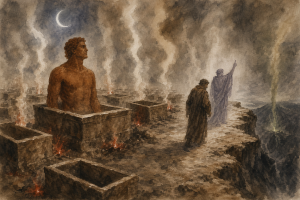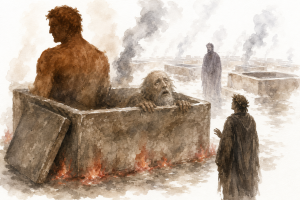
Inside the walls of Dis the travellers take a narrow path between the rampart and the open tombs, and Dante, who has been holding a question since the circle of the gluttons, gets his answer before he can ask it: a voice comes out of a burning sarcophagus, places him by his Florentine accent, and a man rises from the waist up to ask him, before anything else, who his ancestors were.
Inferno · Canto 10 · Lines 1–51 · Scene 29
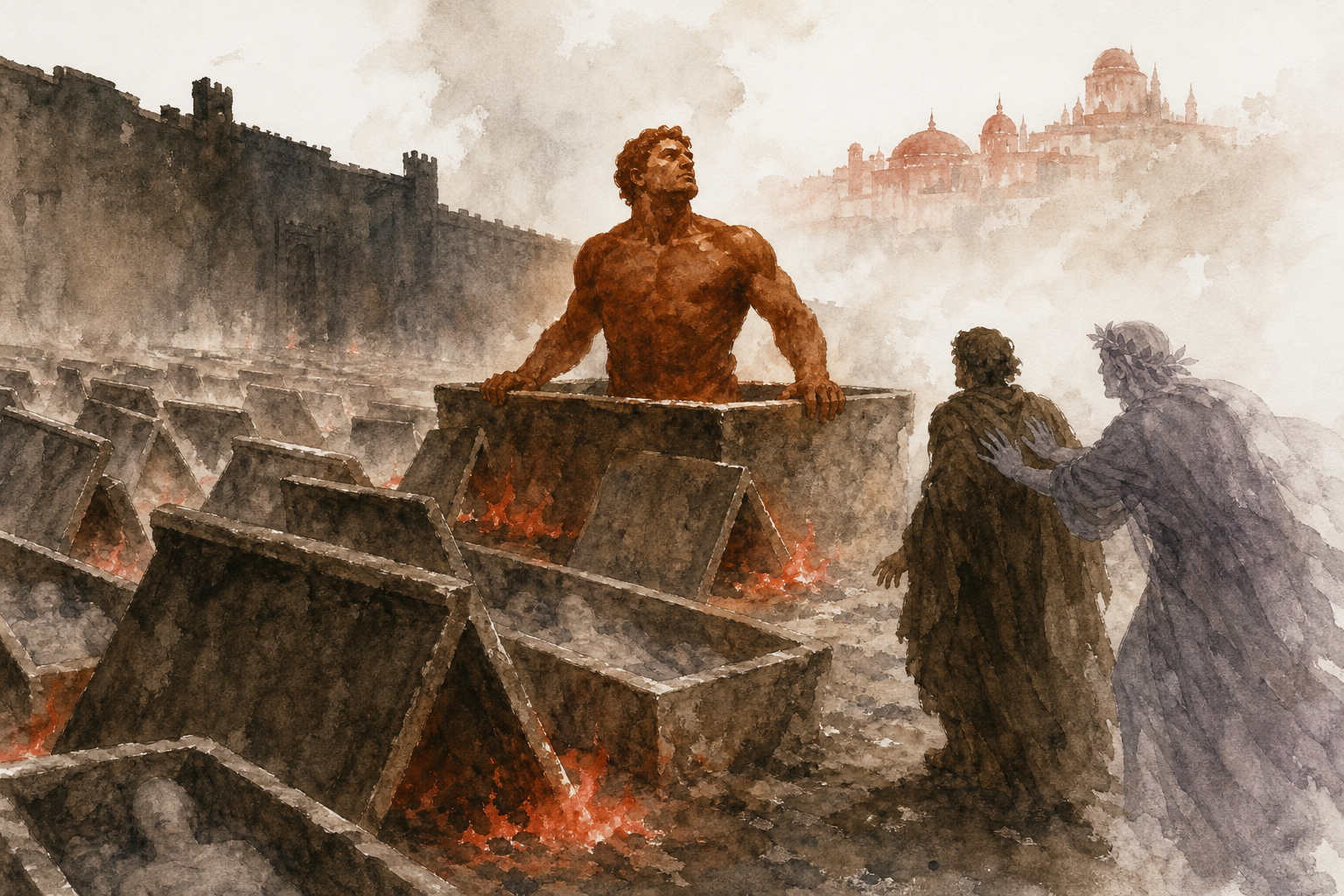
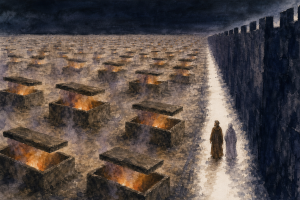
Canto IX ended with the two travellers walking along a narrow strip between the wall of Dis and a field of burning, open coffins. Canto X begins on that same strip: «Ora sen va per un secreto calle» (1), now he goes along a hidden path, Virgil first and Dante behind his shoulders. The word «secreto» here means set apart, out of the way. It is a back street of Hell.
Dante asks a question he has been holding since the last canto. The lids of the tombs are all raised and nobody guards them, so can the people inside be seen? Virgil’s answer is stranger than the question. The lids are open now, he says, but they will all be shut «quando di Iosafàt qui torneranno» (11), when the souls come back from Jehoshaphat with the bodies they left on earth. Jehoshaphat is the valley where, according to a tradition built on the prophet Joel, the Last Judgment will take place. Back in Canto VI, Virgil explained that at the end of time every soul will take up its body again. Now we learn what that means here: on Judgment Day these souls get their bodies back, and then the lid comes down for good.
Then Virgil says who lies in this part of the cemetery: Epicurus and all his followers, «che l’anima col corpo morta fanno» (15), who make the soul die with the body. These are people who denied that the soul survives death. The punishment has a grim neatness. They thought the grave was the end, and the grave is where they stay.
Virgil adds that Dante will soon have his answer, and the wish he is keeping quiet as well. That unspoken wish goes back to Canto VI, where Dante asked the glutton Ciacco where certain famous Florentines had ended up, naming Farinata first. Virgil has read him.
Then a voice comes out of one of the tombs. «O Tosco», it says, O Tuscan, you who walk alive through the city of fire speaking so courteously, please stop here. Your way of speaking shows you were born in that noble homeland «a la qual forse fui troppo molesto» (27), to which I was perhaps too harmful. The speaker has placed Dante by his accent before seeing his face.
Dante is frightened and edges closer to Virgil, who tells him sharply to turn round and look: there is Farinata, standing up, visible from the waist up. Then comes one of the best-known images in the poem. Farinata lifts his chest and his forehead «com’avesse l’inferno a gran dispitto» (36), as if he held Hell itself in great contempt. He is standing in a burning coffin and behaving like a lord receiving a visitor.
Virgil pushes Dante forward between the tombs with one piece of advice: «Le parole tue sien conte» (39), let your words be clear. Farinata looks at him a moment, almost scornfully, and asks a single question: «Chi fuor li maggior tui?» (42), who were your ancestors? He does not ask Dante’s name. He asks about his family, because in Farinata’s Florence your family told everyone which side you were on.
Dante tells him everything. Farinata raises his eyebrows a little and says Dante’s people were fierce enemies to him, to his forebears and to his party, so that twice he scattered them. Farinata led the Ghibellines, the faction that generally backed the emperor; Dante’s family were Guelfs, their rivals. The two expulsions he is boasting about happened in 1248 and 1260.
Dante answers back. If they were driven out, they came back from every side, both times; «ma i vostri non appreser ben quell’arte» (51), but your people never learned that art properly. The art is coming home from exile. Farinata’s family was banished and never allowed back.
So the first conversation inside the walls of Dis becomes a quarrel between two Florentines, each speech a short, hard blow. The canto has a sting saved for later: the skill Dante is mocking is one he himself will need.
Go deeper: the college-level reading (about 1,100 words)
Quotes the Italian closely, with philological detail and cross-references.
The canto opens in motion and in a register of discretion. «Ora sen va per un secreto calle» (1): the path is «secreto» because it runs apart, between «’l muro de la terra e li martìri» (2), the city wall and the torments. Hollander hears Virgil’s own «secreti calles» (Aeneid VI.443), the paths that lead Aeneas into the Fields of Mourning and to Dido. If the echo is meant, the canto begins by borrowing the road on which Virgil’s hero met a figure from his own past who would not forgive him.
Dante’s address to his guide is formal and slightly anxious: «O virtù somma, che per li empi giri / mi volvi» (4–5). «Mi volvi», you turn me, probably registers the rightward turn at IX.132; the descent has been leftward until now, and it will be again at X.133. The question that follows is practical. The lids are raised, «già son levati / tutt’i coperchi» (8–9), «e nessun guardia face» (9): no one keeps watch. Durling and Martinez, whom Hollander follows, hear in the open tombs and the absent guard the garden of the Resurrection, where the stone was rolled back and the soldiers lay like dead men. The image will matter by line 32.
Virgil’s reply turns the open lids into a temporary condition. «Tutti saran serrati / quando di Iosafàt qui torneranno / coi corpi che là sù hanno lasciati» (10–12). The valley of Jehoshaphat is Joel’s (3:2, 12), the place of gathering for judgment. The verse completes something Virgil began at VI.97–98, «ciascun rivederà la trista tomba, / ripiglierà sua carne e sua figura». There the resurrection of the body was stated as doctrine to a glutton’s circle. Here it becomes a sentence passed on a particular group: these souls will receive back the flesh whose survival they denied, and with it a closed lid. The verb «serrare» was planted at IX.108, «la condizion che tal fortezza serra»; the sixth circle is organised around closure.
The sinners are identified next, by a philosopher’s name and a doctrine. «Suo cimitero da questa parte hanno / con Epicuro tutti suoi seguaci, / che l’anima col corpo morta fanno» (13–15). Hollander notes that in the Convivio (IV.vi.11–12) Dante treats Epicureanism as an ethical school whose highest good is pleasure, without calling it heresy; here he adopts the harder Christian construction, in which «epicureo» names anyone who denies the soul’s survival. Mazzoni’s suggestion, reported by Hollander, that Servius on Aeneid IV.34 («qui animam cum corpore dicunt perire») shaped the phrasing is worth keeping in view: the line sounds like a gloss, and may descend from one. The verb «fanno» is sharp. These people do not merely believe the soul dies; they make it die.
Virgil then tells Dante that his question «quinc’entro satisfatto sarà tosto, / e al disio ancor che tu mi taci» (17–18). The silent desire points back to VI.79, where Dante asked Ciacco about «Farinata e ‘l Tegghiaio, che fuor sì degni», and to VI.85, where Ciacco put them «tra l’anime più nere». Dante’s apology, «non tegno riposto / a te mio cuor se non per dicer poco» (19–20), says that he hides his heart only to keep his speech short, and that Virgil taught him to (21); the lesson may be the rebuke at III.76–78.
The voice that breaks in is all decorum. «O Tosco che per la città del foco / vivo ten vai così parlando onesto» (22–23): Farinata names the place with Virgil’s own phrase for Dis (VIII.73, «Il foco etterno»), and praises the pilgrim’s «onesto» speech, meaning seemly and dignified more than truthful. The next line is a scriptural calque: «La tua loquela ti fa manifesto» (25) renders the Vulgate «loquela tua manifestum te facit» (Matthew 26:73), what the bystanders said to Peter before his second denial. Hollander traces the observation back to Guido da Pisa. The context is uncomfortable. Recognition by speech belongs, in the Gospel, to a scene of disavowal, and here it introduces a man who denied the resurrection.
Farinata’s self-description, «a la qual forse fui troppo molesto» (27), has two readings. The common one takes «forse» as a flicker of regret for Montaperti. Cassell calls it instead the false modesty of gloating understatement. Kleinhenz, and Ronconi before him, proposed Micah 6:3, «quid molestus fui tibi?», God’s complaint to his people; if that source is active, Farinata speaks a line that belongs to the injured party.
The narrative then speeds up. The sound comes «Subitamente» (28) out of one of the «arche», and the pilgrim edges toward Virgil, who snaps «Volgiti! Che fai?» (31). At IX.55 the same imperative meant turn away, from Medusa; here it means turn and look. «Vedi là Farinata che s’è dritto: / da la cintola in sù tutto ‘l vedrai» (32–33). The half-figure is precise and, for some readers, pointed: Durling and Cassell independently saw in it the imago pietatis, Christ rising waist-up from the tomb. Cavalcante will appear only «infino al mento» (53).
The portrait that follows is three lines long: «Io avea già il mio viso nel suo fitto; / ed el s’ergea col petto e con la fronte / com’avesse l’inferno a gran dispitto» (34–36). Chest and brow are the organs of pride in Dante’s anatomy. The word «dispitto» belongs to the family of «dispettoso», the posture of Capaneus at XIV.47, who lies «dispettoso e torto» under the fire.
Virgil’s hands are «animose» and «pronte» (37); he physically pushes his charge forward and adds «Le parole tue sien conte» (39). «Conte» is a crux. It can mean known and clear, as at III.76, «Le cose ti fier conte», or measured, or polished. The advice is to speak carefully in front of a man who notices speech.
Farinata’s first question, «Chi fuor li maggior tui?» (42), asked «quasi sdegnoso» (41), is genealogical. Dante answers completely (44); Farinata raises «le ciglia un poco in suso» (45), the gesture Satan makes against his maker at XXXIV.35, «contra ‘l suo fattore alzò le ciglia». His reply arranges enmity in three tiers, «a me e a miei primi e a mia parte» (47), and boasts «per due fïate li dispersi» (48), the Guelf expulsions of 1248 and 1260.
Dante’s retort answers «mia parte» with «d’ogne parte» (49): the Guelfs came back from every quarter, both times. The rhyme then lands on «arte» (51), «ma i vostri non appreser ben quell’arte». Note the «voi» of respect in «i vostri»: Hollander observes that only three Florentines in Hell receive it, Farinata, Cavalcante and Brunetto Latini. The word «arte» is not finished with. Farinata will pick it up at 77 and turn it on its speaker at 81.
Go deeper still: the scholarly reading (about 850 words)
The commentary tradition, the sources, and what is documented versus inferred.
Start with the documents, because they disagree with the poem in an instructive way.
Manente degli Uberti, called Farinata, led his house from 1239 and the Florentine Ghibellines for most of the following quarter-century. The Guelfs were driven out in 1248 and returned in 1251; the Ghibellines were driven out in 1258, regrouped at Siena, and with Sienese and imperial support destroyed the Florentine Guelf army at Montaperti on 4 September 1260. At the council the victors held at Empoli, the chronicle tradition reports, a proposal to raze Florence met Farinata’s open refusal, and the city stood. He died around 1264, the year before Dante was born. After Benevento in 1266 the Uberti were banished and kept out of every later settlement.
The heresy record is separate and later. On 16 October 1283 the Franciscan inquisitor Salomone da Lucca ordered the remains of Farinata and his wife Adaleta exhumed from Santa Reparata and burned, condemning them as Cathar consolati, people who had received the Cathar rite. That is the documentary basis for finding Farinata in the sixth circle, and it does not say what the poem says. The inquisitor convicted a Cathar. Virgil files him among the followers of Epicurus, «che l’anima col corpo morta fanno» (15). Cathar dualism and Epicurean mortalism are, doctrinally, nearly opposite errors: one despises the body to free the soul, the other denies the soul any life beyond the body.
Several explanations are available, none stated in the text. The first is lexical. In thirteenth-century Italian polemic «epicureo» had loosened into a term for the worldly unbeliever, often aristocratic and often Ghibelline; Salimbene uses it of Frederick II, who will be named in this tomb at 119. Read that way, the label is a social description and the doctrinal mismatch does not trouble the poet. The second is architectural. Dante needed a single heresy that could be punished by a single, legible contrapasso, and denial of the soul’s survival yields the coffin that closes at the resurrection; Catharism yields no comparable image. The third is pointed. By substituting the Epicurean for the Cathar, the poem moves Farinata’s guilt from a sectarian rite to the political creed of a class, the conviction that this world is the only theatre, which is exactly how Farinata behaves when he asks first after Dante’s ancestors.
The Gospel material complicates any reading that treats the episode as simple history. The open, unguarded tombs (8–9) are read by Durling and Martinez as a Resurrection scene; the calque «La tua loquela ti fa manifesto» (25) on Matthew 26:73 has been noticed since Guido da Pisa; and Durling and Cassell, separately, saw the waist-up figure at 32–33 as the imago pietatis. If the three are taken together, the canto stages a sustained parody: a man who denied the resurrection rises from a tomb in the posture of the risen Christ, and recognises the pilgrim with words spoken to Peter at the moment of denial. Whether the parody is meant as indictment or as irony that leaves room for admiration is not settled by the allusions themselves.
That question, admiration or indictment, organises the critical history. The Romantic reading took Farinata’s disdain at 36 at face value, as greatness unbroken by punishment, and Hollander notes with some dryness that Romantic readers found the stance enthusiastically admirable. Against it stand the textual signals of pride that Hollander collects: chest and brow (35), the raised eyebrows that reappear on Satan at XXXIV.35 and recall Manfred, and the «quasi sdegnoso» of 41. Cassell’s reading of «forse» at 27 as gloating understatement belongs to the same case.
Auerbach’s chapter in Mimesis on this canto stands to one side of the dispute. His argument concerns representation: the eternal frame, far from dissolving the historical person, fixes and intensifies him, so that Farinata in his tomb is more completely the Ghibelline magnate than he could be in any chronicle. The theological judgment is not cancelled by this intensity, but it ceases to be the thing the reader notices first. Auerbach’s case is strongest for exactly the tercets in this scene, where the speeches are short and nothing interrupts yet.
The chronology sharpens the encounter. Farinata died around 1264 and Dante was born in 1265, so the two men never met. The pilgrim knows his interlocutor by reputation, and Farinata knows the pilgrim by his accent and his surname. Everything that passes between them at 42–51 is inherited. Farinata’s enmity toward the Alighieri is enmity toward a party, and Dante’s retort defends a family history he did not live through. Ciacco had already named the condition, «la città partita» (VI.61), the divided city, and this exchange shows it at the level of two individuals. In that city a man had to be placed before he could be judged, which is why the first question in this conversation concerns ancestors and not names.
One more historical fact belongs here because the poem withholds it until the next scene. Guido Cavalcanti, whose father is lying in this same tomb, was married to Farinata’s daughter. The two shades are related by marriage, and they never speak to each other.
The Italian — Farinata degli Uberti
Source: Wikisource (public domain, pre-1929 text)
Lines 1–3
1. Ora sen va per un secreto calle,2. tra ‘l muro de la terra e li martìri,3. lo mio maestro, e io dopo le spalle.
cultural ref: Line 1 — «secreto calle» — a hidden, out-of-the-way path. Hollander hears Virgil’s «secreti calles» (Aeneid VI.443), the paths that lead Aeneas into the Fields of Mourning, where he meets the shade of Dido and she turns away from him without a word. If the echo is intended, the road into this canto is borrowed from a scene in which a traveller meets someone from his past whom he has wronged, or who believes he has. The Italian adjective chiefly means set apart, between the wall of Dis and the tombs. [Model knowledge · medium]
Lines 4–6
4. "O virtù somma, che per li empi giri5. mi volvi", cominciai, "com’a te piace,6. parlami, e sodisfammi a’ miei disiri.
vocabulary: Line 5 — «mi volvi» — you turn me. A guide who turns his charge is a guide who chooses the direction. Hollander takes the phrase to register the change of direction at the end of Canto IX, where Virgil turned to the right before passing between the torments and the walls. The descent through Hell is otherwise leftward, and the leftward course resumes at the end of this canto (X.133). Dante’s honorific «O virtù somma» frames a mundane question with high formality, which is typical of his manner with Virgil just after a crisis. [Source: Inferno IX.132; X.133]
Lines 7–9
7. La gente che per li sepolcri giace8. potrebbesi veder? già son levati9. tutt’i coperchi, e nessun guardia face".
theology: Line 9 — «nessun guardia face» — nobody keeps guard. Durling and Martinez, followed by Hollander, hear in the lifted lids and the missing watch the details of the Resurrection narrative: the sealed tomb, the soldiers posted to guard it, and the stone found rolled away. Where the lids physically sit is not clear from the text; a line in the next canto (XI.6–9) suggests they can be leaned against or hidden behind. The suggestion matters chiefly as the first of several Resurrection echoes that converge on Farinata’s rising at line 32. [Model knowledge · medium]
Lines 10–12
10. E quelli a me: "Tutti saran serrati11. quando di Iosafàt qui torneranno12. coi corpi che là sù hanno lasciati.
theology: Line 11 — «Iosafàt» — Jehoshaphat, the valley named in Joel 3:2 and 3:12 as the place where the nations will be gathered for judgment. Medieval tradition made it the site of the Last Judgment. Hollander points out that neither Joel nor the judgment scene in Matthew 25:31–46 mentions bodily resurrection, which Dante supplies from other texts. The open lids are therefore provisional: on the day the souls return from the valley with their bodies, every tomb in this circle will close. [Model knowledge · high]
literary key: Line 12 — «coi corpi che là sù hanno lasciati» — with the bodies they left up there. Virgil stated the doctrine in Canto VI: at the last trumpet «ciascun rivederà la trista tomba, / ripiglierà sua carne e sua figura» (VI.97–98). The present line applies that general statement to a specific population with a cruel fit. People who held that the soul dies with the body will receive their bodies back, intact and immortal, and the reunion will seal them in. The resurrection they denied becomes the instrument of their confinement. [Source: Inferno VI.94–99]
Lines 13–15
13. Suo cimitero da questa parte hanno14. con Epicuro tutti suoi seguaci,15. che l’anima col corpo morta fanno.
history: Line 14 — «Epicuro» — Epicurus (341–270 BC), whose school taught that pleasure, understood as tranquillity, is the highest good. In the Convivio (IV.vi.11–12) Dante describes Epicureanism in those ethical terms without calling it heretical. Here he uses the stricter Christian sense, in which an Epicurean is anyone who denies the soul’s survival. Medieval Italian polemic used the word loosely for the worldly unbeliever: the chronicler Salimbene calls Frederick II «epicureus», and Frederick will be named in this very tomb at X.119. [Model knowledge · high]
translation note: Line 15 — «che l’anima col corpo morta fanno» — who make the soul dead with the body. English versions usually soften the verb to believe or hold. Dante’s «fanno» gives the doctrine agency, as if teaching mortality were an act performed on the soul. Mazzoni, reported by Hollander, suggests the phrasing descends from Servius’s note on Aeneid IV.34, which describes the Epicureans as those who say the soul perishes with the body. The line reads like a gloss turned into verse, which may be exactly what it is. [Model knowledge · medium]
Lines 16–18
16. Però a la dimanda che mi faci17. quinc’entro satisfatto sarà tosto,18. e al disio ancor che tu mi taci".
literary key: Line 18 — «al disio ancor che tu mi taci» — and the desire you keep silent from me. The desire was voiced once, to Ciacco in the circle of the gluttons: «Farinata e ‘l Tegghiaio, che fuor sì degni» (VI.79), where are they? Ciacco answered that they were «tra l’anime più nere» (VI.85), among the blacker souls. Farinata was the first name on Dante’s list. Whether Virgil literally reads his mind or simply infers what a Florentine would want to see here is a question Hollander leaves open; the poem does the same. [Source: Inferno VI.79–87]
Lines 19–21
19. E io: "Buon duca, non tegno riposto20. a te mio cuor se non per dicer poco,21. e tu m’ hai non pur mo a ciò disposto".
vocabulary: Line 21 — «non pur mo» — not only now. Dante explains that he keeps his heart hidden from Virgil only to speak briefly, and that Virgil disposed him to do so on earlier occasions too. Hollander links this to the rebuke at the shore of Acheron, where an over-eager question was deferred with «Le cose ti fier conte / quando noi fermerem li nostri passi» (III.76–77) and the pilgrim fell silent in shame. The pupil has learned restraint, and the restraint is about to be tested by the most commanding speaker in the canticle so far. [Source: Inferno III.76–81]
Lines 22–24
22. "O Tosco che per la città del foco23. vivo ten vai così parlando onesto,24. piacciati di restare in questo loco.
literary key: Line 22 — «O Tosco che per la città del foco» — O Tuscan, who through the city of fire. Farinata’s first words name his listener by region and the place by its defining element. Virgil introduced Dis in the same terms, explaining that its red mosques glow because of «Il foco etterno / ch’entro l’affoca» (VIII.73–74). The vocative «O Tosco» also tells us something about the speaker: in the city of the damned, the first thing this Florentine notices about a living man is where he comes from. [Source: Inferno VIII.67–75]
vocabulary: Line 23 — «parlando onesto» — speaking decorously. «Onesto» in Dante’s Italian usually means seemly, dignified, honourable in bearing, and only secondarily truthful. Farinata has overheard the pilgrim’s exchange with Virgil, a formal address and a modest apology, and approves of its manner. The compliment is also a credential. A man of Farinata’s rank notices whether a stranger speaks like a gentleman before he decides to address him, and his praise establishes the courtly register in which the following quarrel will be conducted. [Model knowledge · medium]
Lines 25–27
25. La tua loquela ti fa manifesto26. di quella nobil patrïa natio,27. a la qual forse fui troppo molesto".
theology: Line 25 — «La tua loquela ti fa manifesto» — your speech makes you manifest. The line translates almost word for word the Vulgate «loquela tua manifestum te facit» (Matthew 26:73), said to Peter by the bystanders before his second denial of Christ. Hollander notes that commentators have observed the echo since Guido da Pisa, around 1328. The borrowed context is uneasy: recognition by speech, in the Gospel, precedes a disavowal, and here it introduces a man the poem places among those who denied the life to come. [Model knowledge · high]
literary key: Line 27 — «forse fui troppo molesto» — I was perhaps too harmful. Most readers take «forse» as a trace of regret for the slaughter at Montaperti in 1260. Cassell reads it instead as the false modesty of gloating understatement, a reading Hollander invites the reader to consider. Kleinhenz, and Ronconi earlier, proposed a source in Micah 6:3, «quid molestus fui tibi?», God’s question to his people. If the source is active, Farinata borrows the voice of the injured party while speaking to a citizen of the city he defeated. [Model knowledge · medium]
Lines 28–30
28. Subitamente questo suono uscìo29. d’una de l’arche; però m’accostai,30. temendo, un poco più al duca mio.
Lines 31–33
31. Ed el mi disse: "Volgiti! Che fai?32. Vedi là Farinata che s’è dritto:33. da la cintola in sù tutto ‘l vedrai".
literary key: Line 31 — «Volgiti! Che fai?» — Turn round! What are you doing? The command repeats, and reverses, the one Virgil gave before the walls of Dis: «Volgiti ‘n dietro e tien lo viso chiuso» (IX.55), turn back and keep your eyes shut, against Medusa. There, turning meant refusing to look. Here it means looking at once. Hollander reads the urgency as a sign that the pilgrim, frightened by the voice, was about to back away, a small piece of comedy that the narrator records without comment. [Source: Inferno IX.55–60]
literary key: Line 33 — «da la cintola in sù» — from the belt up. Farinata appears as a half-figure, like a portrait bust. Durling and Cassell, independently, identified the pose with the imago pietatis, the image of Christ rising waist-up from the tomb. If the identification holds, the man who denied the resurrection performs it. Within the canto the measurement also sets up a contrast: Cavalcante, rising from the same tomb, will be visible only «infino al mento» (X.53), up to the chin, perhaps kneeling. [Source: Durling (1981); Cassell (1984); Inferno X.52–54]
Lines 34–36
34. Io avea già il mio viso nel suo fitto;35. ed el s’ergea col petto e con la fronte36. com’avesse l’inferno a gran dispitto.
vocabulary: Line 36 — «dispitto» — contempt, scorn, from Latin despectus. The line is the scene’s emblem and its interpretive battleground. Romantic readers found the disdain heroic; Hollander notes their enthusiasm drily. The word’s relative «dispettoso» describes Capaneus in the burning sand, who lies «dispettoso e torto» (XIV.47) as if the fire did not touch him. The poem gives the posture of contempt for punishment to two sinners, and in the later case answers it directly: Capaneus’s defiance is called his punishment. [Source: Inferno XIV.46–48]
Lines 37–39
37. E l’animose man del duca e pronte38. mi pinser tra le sepulture a lui,39. dicendo: "Le parole tue sien conte".
vocabulary: Line 39 — «Le parole tue sien conte» — let your words be clear. «Conte» is disputed: known and plain (from cognitus), measured and few (from computus), or refined and noble. Dante uses the word elsewhere in the first sense, as when Virgil promises «Le cose ti fier conte» (III.76), things will be made known to you. Whatever its root, the advice is to speak carefully before a man who has just judged him by his speech. Hollander suggests Virgil may also remember how freely his pupil gave himself away with Francesca. [Source: Inferno III.76]
Lines 40–42
40. Com’io al piè de la sua tomba fui,41. guardommi un poco, e poi, quasi sdegnoso,42. mi dimandò: "Chi fuor li maggior tui?".
history: Line 42 — «Chi fuor li maggior tui?» — who were your ancestors? «Maggiori» are forebears. In thirteenth-century Florence lineage determined party, and party determined who could hold office, own a tower, or remain in the city. Farinata’s question is therefore a request for Dante’s faction, and his tone is set by «quasi sdegnoso» (41). Dante’s own ancestry receives fuller treatment in Paradiso XV–XVI, where he meets his great-great-grandfather Cacciaguida and is warned against pride in noble blood. [Model knowledge · high]
Lines 43–45
43. Io ch’era d’ubidir disideroso,44. non gliel celai, ma tutto gliel’apersi;45. ond’ei levò le ciglia un poco in suso;
literary key: Line 45 — «levò le ciglia un poco in suso» — raised his eyebrows a little. The gesture is small and exact, a magnate’s reaction to minor gentry. The poem uses it twice more with heavier freight: Satan, who once «contra ‘l suo fattore alzò le ciglia» (XXXIV.35), raised his brows against his maker, and Hollander also links Manfred’s brow in Purgatorio III. Read through those later lines, the lifted eyebrow is pride in miniature, though in this scene it reads first as social disdain. [Source: Inferno XXXIV.34–36]
Lines 46–48
46. poi disse: "Fieramente furo avversi47. a me e a miei primi e a mia parte,48. sì che per due fïate li dispersi".
history: Line 48 — «per due fïate li dispersi» — twice I scattered them. The two Guelf expulsions from Florence were in 1248, with imperial backing, and in 1260, after the Ghibelline victory at Montaperti on 4 September. The Guelfs returned in 1251 and again after the Angevin victory at Benevento in 1266, after which the Uberti were banished and excluded from every subsequent peace. Farinata died around 1264, so he did not live to see the second return. [Model knowledge · high]
Lines 49–51
49. "S’ei fur cacciati, ei tornar d’ogne parte",50. rispuos’io lui, "l’una e l’altra fïata;51. ma i vostri non appreser ben quell’arte".
wordplay: Line 49 — «d’ogne parte» — from every side. Dante answers Farinata’s «a mia parte» (47), my party, with the same word in a different sense: the Guelfs came back from every quarter. The rhyme then closes on «quell’arte» (51), the art of returning from exile. The word will return twice in Farinata’s reply, «S’elli han quell’arte … male appresa» (X.77) and «tu saprai quanto quell’arte pesa» (X.81). Hollander compares the exchange to a tenzone, the formal poetic quarrel, already glimpsed with Filippo Argenti. [Source: Inferno X.77, 81; VIII.31–39]
Seven Centuries of Reading Farinata degli Uberti
What the first readers knew
The earliest commentators came to this scene knowing much more about Farinata than a modern reader does. Some had grown up with the families involved. The council of Empoli, where Farinata refused to let Florence be razed after Montaperti, was common knowledge in the Florentine chronicle tradition that Giovanni Villani wrote down in the next generation. So was the fact that the Uberti had been shut out of the city for good after 1266.
They also knew about the trial. In October 1283 the inquisitor Salomone da Lucca had Farinata’s remains and his wife Adaleta’s exhumed from Santa Reparata and burned as those of Cathars. A reader in 1330 who met Farinata among the heretics would not have been surprised to find him there. What might have puzzled that reader is the label Virgil gives the circle, followers of Epicurus «che l’anima col corpo morta fanno» (15), a description of materialism, not of the Cathar faith.
One fourteenth-century observation has lasted. Guido da Pisa, writing around 1328, noticed that «La tua loquela ti fa manifesto» (25) translates the words said to Peter before his second denial of Christ. Commentators have kept rediscovering the echo ever since, sometimes without knowing that Guido got there first.
The Romantic Farinata
The nineteenth century made Farinata a hero. Readers who prized individual greatness found it in the man who rises «com’avesse l’inferno a gran dispitto» (36), unbowed by punishment and loyal to his city. Francesco De Sanctis gave the figure an essay of its own, and the image of Farinata as the grand, undefeated spirit of the Inferno became standard in Italian schools.
That reading has never gone away, because the lines support it. Dante gives Farinata the most memorable posture in the canto. He also gives him the plural of respect, «i vostri» (51), which only three Florentines in Hell receive.
Auerbach and the person in the tomb
In 1946 Erich Auerbach devoted a chapter of Mimesis to this canto, under the title “Farinata and Cavalcante.” His interest was in how the poem represents a person. Eternity, he argued, does not dissolve the historical man; it fixes and intensifies him. Farinata in his tomb is more completely the Ghibelline magnate than any chronicle could make him, and that human intensity tends to crowd the theological verdict out of the reader’s attention.
The short, hard exchange at 42–51, a few speeches framed by brief gestures, shows what such a reading responds to: nothing in the quarrel itself mentions the fire or the tomb.
The case against him
Later twentieth-century critics read the same details as an indictment. Robert Durling and Anthony Cassell, working independently, saw in Farinata rising «da la cintola in sù» (33) the pose of the imago pietatis, Christ rising from the tomb. If they are right, the man who denied the resurrection is made to act it out. Cassell also read the «forse» of line 27 as gloating understatement, not regret.
Robert Hollander’s commentary collects the signs of pride: chest and brow at 35, and raised eyebrows at 45 that anticipate Satan’s at XXXIV.35. Yet Hollander also insists that Dante’s view of Farinata is complex. His argument is that the poem admires the leader who stood alone at Empoli while condemning the politics that ran without God.
Questions still open
Two questions remain live. The first is the label: why does Dante file a convicted Cathar among the Epicureans? The answers on offer are lexical, structural and political, and the text confirms none of them. The second is tone. «Com’avesse l’inferno a gran dispitto» is either the poem’s tribute or its charge sheet, and most careful readers end up holding both possibilities at once.
The Two Main Positions on Farinata degli Uberti
Greatness Undiminished
The scene grants Farinata a stature no punishment touches, and the poem means the reader to feel it. His speech is courteous before it is proud; he recognises a fellow citizen by his language and asks him to stay. The narrator gives him the line of the canto, and the Romantic reading that followed it has never fully lost the field because the verse supports it. Dante also addresses him with the «voi» reserved for only three Florentines in Hell. The canto will soon reveal that he alone saved Florence at Empoli, and nothing in these tercets diminishes him in advance. The damnation is real, and so is the grandeur, and Dante declines to let one cancel the other.
Key passage: «ed el s’ergea col petto e con la fronte / com’avesse l’inferno a gran dispitto» (35–36): the narrator, who controls every adjective, chooses a simile that dignifies.
Pride on Display
The splendour is the indictment. Every detail the admirers cite is also a sign the poem uses elsewhere for pride: chest and brow, the half-disdainful look, the eyebrows Satan lifts against his maker. Farinata’s first question reduces a living man on a journey through eternity to a party label, and his boast about scattering Dante’s family is the politics that ruined Florence, spoken from a grave. The scriptural texture, Peter’s denial at 25 and, on Durling’s and Cassell’s reading, the posture of the risen Christ at 32–33, makes the figure a parody of the faith he rejected. Dante builds Farinata large so that the reader can measure how large the error is.
Key passage: «ond’ei levò le ciglia un poco in suso» (45), set against Satan, who «contra ‘l suo fattore alzò le ciglia» (XXXIV.35).
What the Text Does — and What That Means (Contested)
On the page: Farinata’s first words are a request to stop, framed as praise of the pilgrim’s speech (22–24), and his self-description contains the word «forse» (27). Virgil, not Farinata, speaks his name (32). The narrator describes Farinata’s posture with the clause «com’avesse l’inferno a gran dispitto» (36), and his manner with «quasi sdegnoso» (41). The first thing Farinata asks is who Dante’s ancestors were (42). He raises his eyebrows on hearing the answer (45), a gesture the poem later gives to Satan (XXXIV.35). Dante addresses him with the plural of respect (51). Farinata is placed in the sixth circle among the followers of Epicurus (14–15). The historical Farinata was posthumously condemned in 1283 as a Cathar, which the poem does not mention.
What scholars dispute: Whether the poem admires Farinata, condemns him, or does both is the central dispute over this scene, and each side reads the same lines. The posture at 36 is cited as heroic by one tradition and as pride by another; «forse» at 27 is read as regret or as gloating understatement (Cassell); the waist-up rising at 32–33 is read by Durling and Cassell as a parody of the risen Christ, a reading that is persuasive to many and unprovable. Why Dante files a convicted Cathar among Epicureans is not explained anywhere in the text; every explanation is an inference about intent.
What Dante Leaves Unresolved
The scene never says why this man is in this tomb. History offers a Cathar conviction; the poem offers Epicurus; Farinata himself offers neither, and talks only about Florence. Nor does the narrator, who reports Farinata’s posture with evident force, tell us what he thought of it. The quarrel at 46–51 ends with Dante ahead on points, but the word he scores with, «arte», is left hanging, and the canto has not yet said what it will cost him.
The Open Question
Farinata stands in a burning tomb as if he held Hell in contempt, asks after Dante’s ancestors before his name, and wins the first exchange with a boast about scattering them. Is the poem showing us greatness that damnation cannot shrink, or using the full splendour of the figure to expose a pride so complete that it survives even the evidence of its own error?
Explore More
About This Article

Written by Lucy Bamboo. Lucy Bamboo has been reading the Divine Comedy for fifteen years — first in translation, then stubbornly in Medieval Tuscan with a dictionary and far too many footnotes. Reading Dante is her scene-by-scene walk through the poem: the original Italian, seven centuries of scholarly argument presented as argument rather than answer, and the human questions sitting underneath the theology. More about this site.
Verify this against a primary source
Specifics change, and your situation may differ from the one described here. These are the authorities worth checking directly:
- Digital Dante, Columbia University — text, commentary and translation apparatus
- Princeton Dante Project — the Commedia with historical commentary
- Dartmouth Dante Project — searchable commentary from 1322 onward