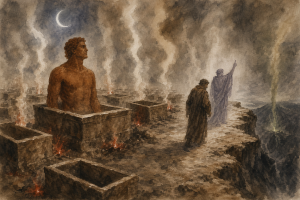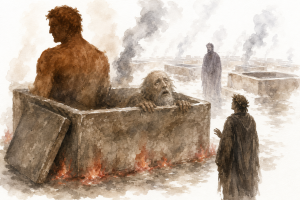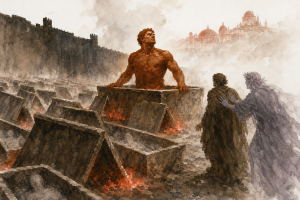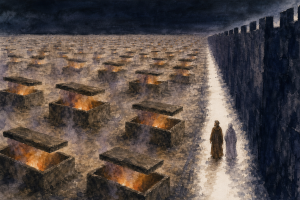
Virgil has just been shut out of a city by devils, and the first thing this canto notices is a colour — cowardice painted on the pilgrim’s face from outside, and then a new colour on Virgil’s, pushed back in faster than it arrived — after which the guide stands listening for a rescue he will not name, breaks a sentence off in the middle rather than finish it, tells a story about a Thessalian witch that no surviving source contains, and, when three bloodied Furies scream down from the burning tower for Medusa, turns his pupil round and clamps his own hands over the pupil’s already-shut eyes, at which point the poem stops the action and speaks directly to us.
Inferno · Canto 9 · Lines 1–63 · Scene 26
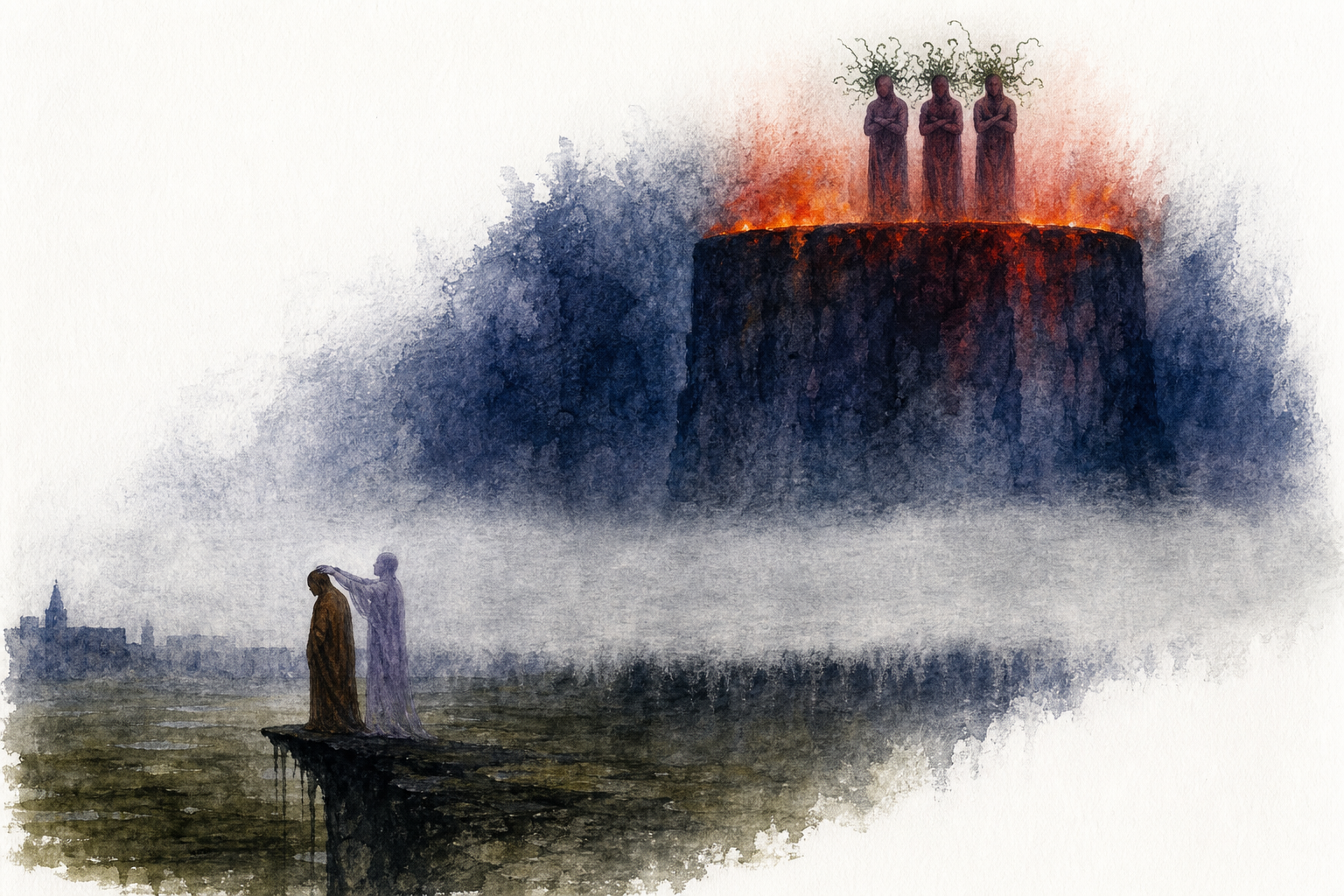
The last canto ended badly. Devils slammed a gate in Virgil’s face, and he came back to Dante looking beaten. This canto opens on the two faces. Dante’s cowardice has painted itself on the outside — the verb is ‘pinse’, painted — and when Virgil sees it he pulls his own new colour back inside, quickly. Notice the wording: he does not lack the colour, he suppresses it. He gets it back in faster than his pupil can. That is the guide’s authority reduced to a matter of speed.
Then Virgil stops and listens, ‘com’uom ch’ascolta’ (4), like a man listening — and the reason given is that the eye cannot get him far through black air and thick fog. The one who leads by seeing has to fall back on hearing. And then he says the strangest thing he says in the poem: ‘Pur a noi converrà vincer la punga’, we will have to win the fight, ‘se non …’ — unless — and he stops. He cannot finish the sentence. In its place he puts a different sentence: such a one offered herself to us. Meaning Beatrice, back in Canto II. Meaning help is coming. But he has said ‘unless’ first, and Dante hears the ‘unless’.
What follows is one of the most honest passages in the poem about how listening works. Dante says he saw perfectly well how Virgil covered over the beginning with what came afterwards, words unlike the first ones — and that he was frightened anyway, because he pulled the broken sentence toward a worse meaning than perhaps it had. Not ‘than it had’. ‘Forse’, perhaps. He admits he may have over-read. Hold on to that, because in fifty lines the poem will order us to go looking for a hidden meaning.
To change the subject, Dante asks a schoolroom question: does anyone from Limbo, whose only punishment is hope cut off, ever come down here? Virgil says rarely — and then volunteers that he did, once, dragged down by the witch Erichtho shortly after he died, to fetch a soul out of the pit of traitors. So he knows the road. This story exists nowhere else. Dante invented a journey for his guide, and nobody has ever settled why.
While Virgil is still talking, Dante stops listening — ‘E altro disse, ma non l’ ho a mente’ (34), he said more, but I do not have it in mind — because his eye has been dragged to the top of the glowing tower. Three Furies are standing there, bloody, with women’s limbs and women’s bearing, belted with bright green hydras, small snakes and horned serpents for hair. Virgil knows them at once and names them: Megaera left, Alecto weeping right, Tisiphone in the middle. He calls them the serving-women of the queen of eternal weeping — that is Proserpina, and the poem does not apologise for putting the classical queen of the underworld inside a Christian Hell.
They claw their own breasts and beat themselves with their palms and scream, and Dante presses up against Virgil. Then they call for Medusa, to turn him to stone, and regret not having killed Theseus when he came down here alive. Medusa never arrives. But Virgil takes no chances: he tells Dante to turn round and shut his eyes, then turns him bodily, and then — not trusting Dante’s own hands over his eyes — puts his hands over them as well. Two layers. It is the most protective thing Virgil ever does.
And exactly there, with the pilgrim blindfolded twice over, the poem turns and addresses us: you who have sound intellects, look at the doctrine hidden under the veil of these strange verses. The pilgrim is forbidden to look. We are commanded to.
Go deeper: the college-level reading (about 1,400 words)
Quotes the Italian closely, with philological detail and cross-references.
The canto opens on two complexions. «Quel color che viltà di fuor mi pinse / veggendo il duca mio tornare in volta, / più tosto dentro il suo novo ristrinse» (1–3). The painting verb is the point: cowardice paints Dante from the outside, and Virgil, seeing the finished picture, restrains his own newly arrived colour more quickly. In Inferno IV Virgil had explained a change in his face to the pilgrim, insisting that what looked like fear was pity for the souls below; here nothing is explained, and the syntax concedes that Virgil had the colour — only that he mastered it sooner. The whole first movement of the canto works this way, by conceding.
«Attento si fermò com’uom ch’ascolta» (4). The simile’s vehicle is simply ‘uom’, a man: Virgil compared to a generic human being at the moment his function fails. The reason is optical: «ché l’occhio nol potea menare a lunga / per l’aere nero e per la nebbia folta» (5–6). ‘Menare’ is the verb of leading — the same verb the poem uses of forces that drive souls — and it is the eye, not the guide, that is said to be unable to lead. Sight is cancelled, hearing takes over, and this small transfer of the senses governs everything that follows: the canto will end by shutting the pilgrim’s eyes and opening the reader’s.
Then the break. «"Pur a noi converrà vincer la punga", / cominciò el, "se non … Tal ne s’offerse. / Oh quanto tarda a me ch’altri qui giunga!"» (7–9). ‘Converrà’ is the poem’s verb of providential necessity; ‘punga’ is a rhyme-driven form of pugna, war, and it turns the standoff at the gate into a siege. And then ‘se non …’ — a conditional whose consequence Virgil does not utter. Aposiopesis is a recognised figure, but this is not decorative: the protasis has no apodosis because the apodosis is defeat. In its place Virgil substitutes a completed past fact, ‘Tal ne s’offerse’, such a one offered herself to us — almost certainly Beatrice, who came down to Limbo in Inferno II, though ‘Tal’ is common in gender and some readers have taken it of divine aid in general. The tercet ends with impatience: ‘altri’, another, unnamed, whose arrival is late. Hell’s habitual anonymity, used here not of God but of the messenger who will come at line 64.
What Dante does with this is the most self-conscious act of reading in the Inferno. «I’ vidi ben sì com’ei ricoperse / lo cominciar con l’altro che poi venne, / che fur parole a le prime diverse» (10–12). ‘Ricoperse’ — covered over: the guide’s rhetoric is described as a covering, fifty lines before we are told to look for doctrine under a ‘velame’. «ma nondimen paura il suo dir dienne, / perch’io traeva la parola tronca / forse a peggior sentenzia che non tenne» (13–15). ‘Sentenzia’ is the technical term for the meaning a text holds; ‘tenne’ is the verb of holding that meaning. The pilgrim confesses to drawing a truncated utterance toward a worse sense than it perhaps contained — and the ‘forse’ is left standing. A poem that is about to demand allegorical reading has just staged an allegorical reading gone wrong.
The question that follows is a change of subject with a purpose: «In questo fondo de la trista conca / discende mai alcun del primo grado, / che sol per pena ha la speranza cionca?» (16–18). ‘Conca’ makes Hell a shell or basin; ‘la speranza cionca’, hope maimed or lopped, is the exact Limbo of Inferno IV, where the virtuous pagans live in desire without hope. Virgil answers with a statistic and then a memory: «Ver è ch’altra fïata qua giù fui, / congiurato da quella Eritón cruda / che richiamava l’ombre a’ corpi sui» (22–24), and «Di poco era di me la carne nuda, / ch’ella mi fece intrar dentr’a quel muro, / per trarne un spirto del cerchio di Giuda» (25–27). Erichtho is Lucan’s Thessalian necromancer, consulted in Pharsalia VI; she reanimates a corpse there, but she never conjures Virgil, and could not have, since the Pharsalia’s action falls decades before his death. Dante has given his guide a private history, and the fourteenth-century commentators were already arguing about it. Its narrative function is plain enough — it licenses ‘ben so ‘l cammin’ (30) — and it dovetails with Inferno XII.34–36, where Virgil recalls a previous descent into lower Hell before the rock fell at the Crucifixion.
The cosmology in 28–29 is exact: «Quell’è ‘l più basso loco e ‘l più oscuro, / e ‘l più lontan dal ciel che tutto gira». Distance from God is rendered as distance from the outermost turning sphere; the Giudecca of Inferno XXXIV is a measurement. Then 33: «u’ non potemo intrare omai sanz’ira». Whose wrath is not specified, and editors have divided over it — the devils’ anger already met at the gate, or a heavenly anger that must intervene, or anger simply as the atmosphere of a marsh which is itself the punishment of the wrathful.
And then the narration breaks off: «E altro disse, ma non l’ ho a mente; / però che l’occhio m’avea tutto tratto / ver’ l’alta torre a la cima rovente» (34–36). Something Virgil said is lost. The pretext is distraction — the eye ‘dragged’ him, ‘tratto’, a violent verb — but the effect is a hole in the record at precisely the point where the canto turns towards its own hermeneutic problem.
The Furies are Virgilian furniture, handled with total assurance: «tre furïe infernal di sangue tinte, / che membra feminine avieno e atto, / e con idre verdissime eran cinte; / serpentelli e ceraste avien per crine» (38–41). ‘Ceraste’, horned serpents, come out of Lucan’s Libyan snake catalogue; ‘verdissime’ is the sort of intensifying superlative Dante reserves for things he wants seen. Virgil identifies them without hesitation as «le meschine / de la regina de l’etterno pianto» (43–44) — the serving-girls of Proserpina, who is queen of an eternal weeping that belongs to Christian damnation, not to Ovid. He names them left, right and centre — «Quest’è Megera dal sinistro canto; / quella che piange dal destro è Aletto; / Tesifón è nel mezzo» (46–48) — and then «e tacque a tanto». He supplies the labels and stops. No gloss. The glossing is being left to someone else.
Their self-punishment is the ordinary gesture of the damned turned on themselves: «Con l’unghie si fendea ciascuna il petto; / battiensi a palme e gridavan sì alto, / ch’i’ mi strinsi al poeta per sospetto» (49–51). Then the threat: «"Vegna Medusa: sì ‘l farem di smalto" … "mal non vengiammo in Tesëo l’assalto"» (52–54). ‘Smalto’ is enamel, hard glaze — the same noun used of the green enamel of Limbo’s meadow in Inferno IV.118, which quietly puts Virgil’s homeland and Medusa’s petrifaction into the same material. Theseus came down alive to seize Proserpina and was let go; the Furies think that was a mistake, and their logic is that a living trespasser can in fact be stopped.
Virgil’s response is physical and doubled: «"Volgiti ‘n dietro e tien lo viso chiuso; / ché se ‘l Gorgón si mostra e tu ‘l vedessi, / nulla sarebbe di tornar mai suso"» (55–57), and then «ed elli stessi / mi volse, e non si tenne a le mie mani, / che con le sue ancor non mi chiudessi» (58–60). Note what is threatened: not death, but ‘nulla sarebbe di tornar mai suso’ — no return, ever, upward. Petrifaction is the abolition of pilgrimage. And note the repeated verb: Dante is to ‘tien lo viso chiuso’, and Virgil ‘non si tenne’ — did not hold himself back — from adding his own hands. He turns the body, he does not trust the hands, he covers the eyes twice.
Over a pilgrim who has been blinded for his own safety, the poem addresses us: «O voi ch’avete li ‘ntelletti sani, / mirate la dottrina che s’asconde / sotto ‘l velame de li versi strani» (61–63). ‘Mirate’ is a command to look, issued at the one moment in the canto when looking is fatal.
Go deeper still: the scholarly reading (about 1,100 words)
The commentary tradition, the sources, and what is documented versus inferred.
Few stretches of the poem have been argued over as continuously as these sixty-three lines, and the arguing starts almost at once. The reason is structural: at line 61 the poem turns and tells its readers that something is hidden, and every reader since has been obliged either to say what it is or to explain why the question is badly put. «O voi ch’avete li ‘ntelletti sani, / mirate la dottrina che s’asconde / sotto ‘l velame de li versi strani» (61–63) is less a key than a provocation, and the history of its reception is a history of people accepting the provocation on very different terms.
The fourteenth-century glossators mostly took the invitation at face value and supplied doctrine, drawing on the allegorising habits they had inherited. The Furies had long been available as a moral triad: a late-antique scheme going back to Fulgentius’s Mitologiae distributes the three sisters across the stages of sin, and medieval readers were comfortable mapping Alecto, Megaera and Tisiphone onto evil thought, evil speech and evil act. Benvenuto da Imola and Francesco da Buti, working in the last decades of the century, elaborate along these lines; Boccaccio, in the public lectures of 1373–74 that break off at Inferno XVII, expounds the mythology at length. On this reading the «dottrina» is essentially psychological and moral: the pilgrim at the walls of Dis is confronting the hardening of the sinful will, and Medusa is the obduracy that would fix him there for good. Nothing in the text forbids this, and it has the merit of taking the Furies as what they visibly are — «le meschine / de la regina de l’etterno pianto» (43–44), the handmaids of Proserpina, a feudal Italian word for servant girls laid over a classical goddess who is left in undisturbed possession of a Christian hell.
But the tercet’s rhetoric — the appeal to intellects that are «sani», implying others that are not — has always attracted readers who wanted the hidden doctrine to be genuinely hidden, not merely conventional. In the nineteenth century these three lines became the charter text of the esoteric Dante: Gabriele Rossetti, in the 1830s, read the Commedia as a coded political and sectarian document, and Luigi Valli’s Il linguaggio segreto di Dante e dei «Fedeli d’Amore» (1928) revived the project on a linguistic footing. The tradition has never quite died. Against it, Benedetto Croce’s La poesia di Dante (1921) took the opposite line with some contempt, treating the allegorical scaffolding as extraneous to the poetry — which leaves lines 61–63 as an unfortunate lapse into the theologising Dante rather than the poet. Between the cryptographers and Croce lies most of the modern discussion.
That discussion changed shape when the question became not what the doctrine is but what kind of concealment is in play. Charles Singleton’s Dante’s Allegory (1950) argued that the poem operates by the allegory of the theologians rather than of the poets — that its literal level is to be taken as historically true, with further senses resting on it, as in scriptural exegesis — and the veil of Inferno IX becomes evidence in that case. The opposing evidence is Dante’s own earlier definition in Convivio II.i, where allegory is «una veritade ascosa sotto bella menzogna», a truth hidden under a beautiful lie. Whether the Commedia repudiates that formula, and whether the Epistle to Cangrande (whose authenticity Bruno Nardi contested, and which is still not settled) may be used to decide the matter, remains genuinely open. John Freccero’s essay on Medusa, published in 1972 and collected in Dante: The Poetics of Conversion (1986), shifted the ground again by reading the Gorgon as the threat of idolatry — the sign taken for the thing, the letter that petrifies because it is never read through to the spirit. On that account the address to the reader is not a footnote to the episode but its continuation: the danger being described is a danger of reading.
Even the direction of the gesture is disputed. Does «mirate» point backwards, to the Furies and the withheld Medusa, or forwards, to the messenger who will open the gate later in the canto? The early commentators mostly took it retrospectively; a strong modern minority takes it prospectively, on the grounds that the arrival of heavenly aid is the doctrinally weighty event and the Gorgon merely its foil. There is no way to adjudicate from the syntax. And «strani» itself has been read as strange, as obscure, as foreign, and as harsh — a small philological disagreement that quietly determines how programmatic the tercet sounds.
Two further cruces have generated their own literatures. The first is Erichtho. Lucan’s Pharsalia gives the Thessalian witch who reanimates a corpse for Sextus Pompey before Pharsalus; it does not give her Virgil, and Virgil, dying in 19 BC, was not available in 48. Yet the poem has him say «Di poco era di me la carne nuda, / ch’ella mi fece intrar dentr’a quel muro, / per trarne un spirto del cerchio di Giuda» (25–27). The chronology was noticed in the fourteenth century, and the proposed remedies have included a second Erichtho, a lost legend, textual emendation, and — the most consequential modern option — the suggestion that Virgil is simply improvising, that «ben so ‘l cammin; però ti fa sicuro» (30) is reassurance manufactured for a frightened pupil by a guide who has just been shut out of a gate. The second is Medusa’s non-arrival. «Vegna Medusa: sì ‘l farem di smalto» (52) is a summons that produces nothing; the most terrifying threat in the Inferno is never executed. Whether this is Dante measuring the limits of what infernal power can do without permission, or a deliberate withholding designed to throw all the weight onto Virgil’s covering of the eyes — «non si tenne a le mie mani, / che con le sue ancor non mi chiudessi» (59–60), a double blinding, hands over hands — is again a matter on which good readers differ.
What unites these disputes is that the passage keeps making its interpreters do the thing it warns against. Virgil’s broken «se non …» (8) is the small model: the tradition has never been able to leave the gap alone, and glossators from the Trecento onward have obligingly supplied the missing apodosis, mostly some version of defeat. Dante had already reported his own reading of the silence as possibly excessive — «forse a peggior sentenzia che non tenne» (15). The canto tells you not to look, and tells you to look; and seven centuries of commentary have declined, consistently and productively, to choose.
The Italian — The Furies on the Tower
Source: Wikisource (public domain, pre-1929 text)
Lines 1–3
1. Quel color che viltà di fuor mi pinse2. veggendo il duca mio tornare in volta,3. più tosto dentro il suo novo ristrinse.
literary key: Line 1 — ‘Quel color che viltà di fuor mi pinse’ — the colour that cowardice painted on me from outside. ‘Pinse’, painted, makes the face a surface worked on by an emotion rather than an expression of one, and ‘di fuor’ insists on the outside: what is visible is a pigment, not a state of soul. ‘Viltà’ is Virgil’s own diagnostic word from Inferno II, where he tells the pilgrim that his soul is struck with viltade and that this is what keeps him from the journey. The canto begins by re-applying to Dante the charge he was cured of at the outset, and then extends it, in the next line and a half, to his physician. [Source: Inferno II (Virgil on ‘viltade’)]
translation note: Line 3 — ‘più tosto dentro il suo novo ristrinse’ — he more quickly restrained his own new colour within. The comparative concedes the thing it seems to deny: Virgil did change colour, and ‘novo’ suggests a colour unfamiliar on him. All he has over his pupil is speed of recovery. In Inferno IV Virgil had headed off exactly this inference, explaining that what Dante took for fear on his face was pity for the souls below; here there is no explanation, and the difference between the two passages is one measure of how far the guide’s authority has fallen since the devils shut the gate. [Source: Inferno IV (Virgil’s pallor explained as pity)]
Lines 4–6
4. Attento si fermò com’uom ch’ascolta;5. ché l’occhio nol potea menare a lunga6. per l’aere nero e per la nebbia folta.
literary key: Line 4 — ‘Attento si fermò com’uom ch’ascolta’ — he halted attentive like a man listening. The vehicle of the simile is merely ‘uom’, a man: at the moment his guidance fails, Virgil is compared to a generic human being, the least distinguishing comparison in the poem. He is listening for the messenger whose arrival he complains of at line 9, and who will in fact announce himself by sound at line 64 rather than by sight. The senses are being reallocated: what the eye cannot do here, the ear will. [Model knowledge · high]
wordplay: Line 5 — ‘ché l’occhio nol potea menare a lunga’ — for the eye could not lead him far. ‘Menare’ is the poem’s verb for being led or driven, and it is here given to the organ rather than to the man: the guide is guided by his eye, and the eye has stopped working in the black air and thick fog of the Styx. The word returns transformed at 55–60, where the eye is deliberately closed and Virgil leads by turning a body and covering a face with his hands. The canto’s whole sensory argument is set up in this half-line. [Model knowledge · medium]
Lines 7–9
7. "Pur a noi converrà vincer la punga",8. cominciò el, "se non … Tal ne s’offerse.9. Oh quanto tarda a me ch’altri qui giunga!".
vocabulary: Line 7 — ‘Pur a noi converrà vincer la punga’ — still, we shall have to win the fight. ‘Punga’ is a rhyme-serving form of pugna, battle, and it recasts the standoff at the gate of Dis as a siege with a military outcome. ‘Converrà’, it will behove, is the poem’s standard verb of providential necessity: what must happen because it has been decreed. Virgil therefore asserts the decree and, in the same breath, cannot articulate the alternative — the rhetoric of certainty and the failure of nerve occupy one and the same tercet. [Model knowledge · high]
literary key: Line 8 — ‘se non … Tal ne s’offerse’ — a genuine aposiopesis, the figure in which a speaker breaks off rather than complete a thought. The protasis ‘se non’ has no apodosis because the apodosis would be defeat, and Virgil replaces it with an accomplished fact: such a one offered herself to us. Most readers take ‘Tal’ of Beatrice’s descent to Limbo in Inferno II; because the pronoun is common in gender, others take it of divine assistance in general. The text does not decide. What it does record is that the guide cannot finish a sentence, and that his pupil watches him fail to. [Source: Inferno II (Beatrice’s descent); model_knowledge on the figure]
literary key: Line 9 — ‘Oh quanto tarda a me ch’altri qui giunga!’ — how long it seems to me till another arrive here. ‘Altri’, another, is unnamed, in Hell’s habitual manner of referring to powers it will not name; the same impersonal pronoun does duty for God elsewhere in the Inferno. Here it designates the messenger of line 64. Two implications sit uncomfortably together: Virgil knows help is coming, which is why he is impatient, and he does not know when, which is why he had to break off at line 8. Foreknowledge without agency is the exact condition of Limbo’s inhabitants. [Model knowledge · medium]
Lines 10–12
10. I’ vidi ben sì com’ei ricoperse11. lo cominciar con l’altro che poi venne,12. che fur parole a le prime diverse;
wordplay: Line 10 — ‘I’ vidi ben sì com’ei ricoperse / lo cominciar’ — I saw well how he covered over the beginning. ‘Ricoperse’ is a covering verb, and it puts the guide’s consoling rhetoric into the same metaphorical family as the ‘velame’ of line 63. A reader who takes the address to the reader as a straightforward promise of hidden doctrine has to reckon with the fact that the canto’s first covered meaning is a piece of protective evasion, and that the pilgrim sees through it and is frightened by what he sees. [Model knowledge · high]
Lines 13–15
13. ma nondimen paura il suo dir dienne,14. perch’io traeva la parola tronca15. forse a peggior sentenzia che non tenne.
literary key: Line 15 — ‘forse a peggior sentenzia che non tenne’ — perhaps to a worse meaning than it held. ‘Sentenzia’ is the technical term for the sense a text carries, and ‘tenne’ the verb of holding it: the vocabulary is that of the schools. So the pilgrim performs an interpretation of a truncated utterance, and the narrator marks it as possibly excessive, with the ‘forse’ left unresolved. Fifty lines later the reader will be commanded to extract a doctrine from beneath a covering. The juxtaposition is one of the strongest cards held by those who read the address at 61–63 as a test rather than a key. [Model knowledge · high]
Lines 16–18
16. "In questo fondo de la trista conca17. discende mai alcun del primo grado,18. che sol per pena ha la speranza cionca?".
theology: Line 18 — ‘che sol per pena ha la speranza cionca’ — whose only penalty is hope lopped off. ‘Cionca’ is a physical word, of a limb cut short, and it defines Limbo exactly as Inferno IV does: souls who live in desire without hope, punished by privation alone rather than by torment. The pilgrim’s question is tactful — he is asking his guide about his guide’s own neighbourhood without saying so — and it is also a change of subject away from the broken sentence. Virgil answers with a general statistic and then, unprompted, with a personal confession. [Source: Inferno IV (the virtuous pagans in desire without hope)]
Lines 19–21
19. Questa question fec’io; e quei "Di rado20. incontra", mi rispuose, "che di noi21. faccia il cammino alcun per qual io vado.
Lines 22–24
22. Ver è ch’altra fïata qua giù fui,23. congiurato da quella Eritón cruda24. che richiamava l’ombre a’ corpi sui.
cultural ref: Line 22 — ‘quella Eritón cruda / che richiamava l’ombre a’ corpi sui’ — Erichtho, the Thessalian necromancer of Lucan’s Pharsalia VI, consulted by Sextus Pompey before Pharsalus, who reanimates a soldier’s corpse to obtain a prophecy. Lucan gives Dante the witch and the power to recall shades to their bodies, and nothing else: Virgil does not appear in that scene, and cannot, since its action falls decades before his death. No source for the descent Virgil reports here has ever been found. Fourteenth-century commentators fell back on a lost authority, on the popular medieval legend of Virgil the Neapolitan magician, or on frank invention. [Model knowledge · high]
Lines 25–27
25. Di poco era di me la carne nuda,26. ch’ella mi fece intrar dentr’a quel muro,27. per trarne un spirto del cerchio di Giuda.
history: Line 25 — ‘Di poco era di me la carne nuda’ — my flesh had lately been stripped from me. The dating is deliberate: Virgil is conjured as a newly dead shade, which places the episode after 19 BC and therefore long after Lucan’s necromancy. It also makes his knowledge of lower Hell predate the Crucifixion, which is consistent with Inferno XII.34–36, where he recalls having descended into lower Hell before the earthquake brought down the rock. Whether that consistency is careful architecture or later patching of an improvisation cannot be settled from the text. [Source: Inferno XII.34–36 (the earlier descent, before the rock fell)]
theology: Line 27 — ‘per trarne un spirto del cerchio di Giuda’ — to draw out a spirit from the circle of Judas. The Giudecca is the innermost zone of Cocytus, reserved for traitors to their lords and reached only in Inferno XXXIV. The spirit is never identified, and the claim is theologically awkward: souls do not leave Hell. It should be noted that Dante does not assert this in his own voice; it is reported speech, part of the magical fiction Virgil ascribes to Erichtho, and the poem never returns to it. [Source: Inferno XXXIV (the Giudecca)]
Lines 28–30
28. Quell’è ‘l più basso loco e ‘l più oscuro,29. e ‘l più lontan dal ciel che tutto gira:30. ben so ‘l cammin; però ti fa sicuro.
cultural ref: Line 29 — ‘e ‘l più lontan dal ciel che tutto gira’ — and the farthest from the heaven that turns everything. The heaven that moves all the others is the Primum Mobile, the outermost sphere of the Ptolemaic-Aristotelian cosmos; Hell’s centre, at the earth’s core, is thus the point at maximum distance from it. Dante’s universe converts a moral fact into a measurement: distance from God is literally distance, and Satan is at the bottom of a funnel because he is as far from the circling heaven as a body can be. [Model knowledge · high]
Lines 31–33
31. Questa palude che ‘l gran puzzo spira32. cigne dintorno la città dolente,33. u’ non potemo intrare omai sanz’ira".
translation note: Line 33 — ‘u’ non potemo intrare omai sanz’ira’ — where we cannot now enter without wrath. Whose wrath is unspecified and editors divide. It may be the devils’ anger, already met at the gate and now unavoidable; or the anger of heaven, which is what actually opens the gate at line 89; or wrath as the ambient condition of a marsh which is itself the punishment of the wrathful. The ambiguity is not obviously accidental: this is a canto in which every partly-said thing invites the reader to complete it, and one such completion has already been marked as an error at line 15. [Model knowledge · medium]
Lines 34–36
34. E altro disse, ma non l’ ho a mente;35. però che l’occhio m’avea tutto tratto36. ver’ l’alta torre a la cima rovente,
literary key: Line 34 — ‘E altro disse, ma non l’ ho a mente’ — and he said more, but I do not have it in mind. Elsewhere the poem excuses its gaps by the inadequacy of memory to excess, especially in the Paradiso; here the cause is mere distraction, the eye ‘tratto’, dragged, to the glowing tower. The effect is a hole in the record at the precise point where the canto turns towards its own hermeneutic problem: something Virgil said about entering the city has been lost, and the reader who is shortly ordered to find a hidden doctrine is being told, in passing, that part of the evidence is missing. [Model knowledge · high]
Lines 37–39
37. dove in un punto furon dritte ratto38. tre furïe infernal di sangue tinte,39. che membra feminine avieno e atto,
Lines 40–42
40. e con idre verdissime eran cinte;41. serpentelli e ceraste avien per crine,42. onde le fiere tempie erano avvinte.
cultural ref: Line 40 — ‘e con idre verdissime eran cinte; / serpentelli e ceraste avien per crine’ — girt with the greenest hydras, small snakes and cerastes for hair. ‘Ceraste’ are horned vipers, and the word comes to Dante from the great catalogue of Libyan serpents in Pharsalia IX, one of several places where Lucan rather than Virgil supplies his reptilian vocabulary. ‘Verdissime’ is an intensifying superlative of the kind Dante reserves for details he wants the eye to fix on — which, given what the Furies are about to threaten, is a nicely placed provocation. [Model knowledge · medium]
Lines 43–45
43. E quei, che ben conobbe le meschine44. de la regina de l’etterno pianto,45. "Guarda", mi disse, "le feroci Erine.
vocabulary: Line 43 — ‘le meschine’ — the serving-girls, handmaids. The word reaches Italian through Provençal from Arabic miskīn, poor or wretched, and in Dante’s usage it carries the sense of a household servant rather than a demon. Applied to the Erinyes it domesticates them: they are not sovereign horrors but staff, employed by someone. The demotion matters for the scene’s politics, since it makes their threat an exercise of delegated authority — and delegated authority, as the next fifty lines demonstrate, can be overruled from above. [Model knowledge · medium]
cultural ref: Line 44 — ‘de la regina de l’etterno pianto’ — of the queen of eternal weeping. Proserpina, never named, is made queen of a Hell whose weeping is Christian and everlasting; Hecate and Persephone are the classical possibilities behind the periphrasis, and the poem does not adjudicate or apologise. This is the clearest instance in the canto of pagan machinery kept running inside a Christian cosmos: the Furies are real functionaries with a real mistress, and no attempt is made to demythologise them into mere figures. [Model knowledge · high]
Lines 46–48
46. Quest’è Megera dal sinistro canto;47. quella che piange dal destro è Aletto;48. Tesifón è nel mezzo"; e tacque a tanto.
literary key: Line 48 — ‘Tesifón è nel mezzo’; e tacque a tanto’ — and he said no more. Virgil identifies the three by name and position, left, right, centre, with the assurance of a man reading his own poem — Tisiphone guards the gate of Tartarus in Aeneid VI, Allecto is unleashed by Juno in Aeneid VII — and then stops. The labels are supplied; the gloss is withheld. Since the early commentators, readers have supplied it for him, mostly moralising the three as vices or as movements of the guilty conscience, but they do not agree with each other and the text authorises none of them. [Model knowledge · medium]
Lines 49–51
49. Con l’unghie si fendea ciascuna il petto;50. battiensi a palme e gridavan sì alto,51. ch’i’ mi strinsi al poeta per sospetto.
Lines 52–54
52. "Vegna Medusa: sì ‘l farem di smalto",53. dicevan tutte riguardando in giuso;54. "mal non vengiammo in Tesëo l’assalto".
wordplay: Line 52 — ‘Vegna Medusa: sì ‘l farem di smalto’ — let Medusa come, so we shall make him of enamel. ‘Smalto’ is not raw stone but glaze, a hard vitrified surface, and Dante has already used the word for the green enamel of the meadow in Limbo where the great pagan souls are shown. The same substance therefore names Medusa’s threatened petrifaction and the floor of Virgil’s own eternal home. Whether that echo is designed or fortuitous is a matter of judgement; the verbal fact is not. [Source: Inferno IV (‘sovra ‘l verde smalto’)]
cultural ref: Line 54 — ‘mal non vengiammo in Tesëo l’assalto’ — ill did we not avenge on Theseus his assault. Theseus came down alive with Pirithous to carry off Proserpina, was captured, and in the version Dante follows was freed by Hercules; Aeneid VI leaves him seated in Tartarus for ever. The Furies’ complaint is a policy argument: leniency towards one living trespasser has produced another. Its force in the scene is to establish that a living intruder can in principle be stopped — which is why Virgil’s response at 55–60 is physical rather than rhetorical. [Model knowledge · high]
Lines 55–57
55. "Volgiti ‘n dietro e tien lo viso chiuso;56. ché se ‘l Gorgón si mostra e tu ‘l vedessi,57. nulla sarebbe di tornar mai suso".
theology: Line 57 — ‘nulla sarebbe di tornar mai suso’ — there would be no returning up, ever. Note what is not threatened: not death, not torment, but permanence. Petrifaction is the abolition of pilgrimage, the traveller made into scenery, and it is therefore the precise inversion of everything the Comedy is about. The verse also uses an irregular sequence — indicative in the first clause, subjunctive in the second — which the commentators have discussed as a metrical or expressive licence rather than a fault. [Model knowledge · medium]
Lines 58–60
58. Così disse ‘l maestro; ed elli stessi59. mi volse, e non si tenne a le mie mani,60. che con le sue ancor non mi chiudessi.
literary key: Line 60 — ‘non si tenne a le mie mani, / che con le sue ancor non mi chiudessi’ — he did not stop at my hands, but closed my eyes with his own as well. Three actions in two lines: he turns the body, he distrusts the hands, he adds his own. It is the most physically protective thing Virgil ever does, comparable only to the moment in Inferno XXIII when he snatches the pilgrim up as a mother rescues her child from a burning house. Note the verb: Dante is told to ‘tien lo viso chiuso’ and Virgil ‘non si tenne’ — the same holding, once commanded and once overridden. [Source: Inferno XXIII (Virgil carries Dante down the slope)]
Lines 61–63
61. O voi ch’avete li ‘ntelletti sani,62. mirate la dottrina che s’asconde63. sotto ‘l velame de li versi strani.
literary key: Line 61 — ‘O voi ch’avete li ‘ntelletti sani’ — you who have sound intellects. One of about twenty direct addresses to the reader in the poem, a device isolated as structurally distinctive by Erich Auerbach in 1954 and by Leo Spitzer immediately after; both stressed that such addresses manage the reader’s participation rather than explain the fiction. The flattery is also a filter: it presupposes readers whose intellects are unsound, and offers no criterion for telling which you are. And ‘mirate’, look hard, is issued over a pilgrim whose eyes have just been shut twice for his own safety. [Model knowledge · high]
literary key: Line 63 — ‘sotto ‘l velame de li versi strani’ — under the veil of the strange verses. ‘Velame’ belongs to the twelfth-century vocabulary of integumentum and involucrum, the fabulous covering through which philosophical truth is transmitted, familiar from Bernardus Silvestris and William of Conches; Dante had described the allegorical sense in comparable terms in the Convivio. ‘Strani’ means strange, unfamiliar, foreign. What the doctrine is has never been agreed: obduracy and despair, the impotence of reason before grace, or — in John Freccero’s reading — the petrifying letter itself, the sign taken for the thing. The Epistle to Cangrande’s four senses is often invoked here, but its authorship remains contested. [Model knowledge · medium]
Seven Centuries of Reading The Furies on the Tower
Red or white?
The canto opens on two faces: the pilgrim pale with fear, and Virgil hastily composing his own. Commentators have divided almost evenly for centuries over whether Virgil’s colour is the red of the anger he showed at VIII.121 or the pallor of frustration. Guido da Pisa thought pale, citing Aeneas, who feigns hope on his face while stifling anguish in his heart (Aeneid I.209–210). Hollander prefers red, since Dante’s verb «ristrinse» suits restraining anger, and it gives the contrast of a white-faced pupil and a red-faced guide.
Virgil’s broken sentence at 7–9, «se non … Tal ne s’offerse», has also been debated, both as text and as sense. Most take the «tal» to point to Beatrice and her promised help. Mark Musa’s remark is often repeated: Virgil, who in life could not believe in the coming of Christ, cannot now believe in the coming of the angel, despite what Beatrice told him.
Virgil and Erichtho
Virgil’s claim that the witch Erichtho once conjured him down to the circle of Judas (22–27) has raised nothing but questions. Boccaccio, Benvenuto da Imola and Francesco da Buti all understood correctly that Dante is inventing here. No such tale exists before him, and Hollander calls it perhaps the most outrageous example of Dante’s liberty with classical literature. Erichtho comes from the sixth book of Lucan’s Pharsalia. Later commentators tried to say whom Virgil was sent to fetch: Ernesto Trucchi suggested Brutus, and Gregorio di Siena proposed Dido. Boccaccio was the first, and perhaps the only one, to think of the one biblical parallel, Saul and the witch of Endor, who calls up Samuel’s spirit (I Samuel 28).
The Furies and Medusa
In the Aeneid the three Furies are punishers of blood-guilt and are never named together. Dante makes them handmaids of the queen of Hell and names all three. Pietro Alighieri cited an anonymous Latin poem as his father’s source, which distributes the sisters across the stages of sin: Tisiphone when evil is in the mind, Megaera when it foams from the mouth, Alecto when the deed is done. For Medusa, Hollander points to Lucan’s account of Perseus (Pharsalia IX), in which Athena guides the hero and Perseus rises winged, «aliger», a word that may pun on the Alighieri name.
The address to the reader
Lines 61–63, «O voi ch’avete li ‘ntelletti sani», have caused more difficulty than any other address to the reader. Hollander says that no solution has won general consent from the first commentators until today. Readers divide over whether the lines point back, to Medusa or to the Furies, or forward, to the messenger. Amilcare Iannucci surveyed the problem. Many take the tercet as a key to reading the whole poem allegorically. Hollander takes it as local and limited, perhaps to the lines just before it.
The Two Main Positions on The Furies on the Tower
The Veil Hides Something Nameable
The signpost means what it says: a specific doctrine is encoded, and the canto supplies the materials for reading it. The Furies and Medusa are moral figures — obduracy, remorse, the hardening of the will that makes repentance impossible — guarding a city of unbelief; and the frame around them teaches the limit of unaided reason, since Virgil’s pallor, his broken sentence, his lapse of memory and his blindfolding of his pupil are a systematic demonstration that the guide can protect but cannot open the gate. In its strongest modern forms this reading is either theological (Singleton’s allegory of the theologians, where the literal event carries its further sense as history does) or poetic-autobiographical (Freccero’s Medusa as the petrifying letter, the sign mistaken for the thing, continuous with the stony lady of the rime petrose). Both insist the poem is not teasing: ‘dottrina’ is a doctrinal noun, and Dante used the same vocabulary of veil and hidden truth in the Convivio to describe a technique he expected to be practised.
Key passage: Dante’s own theoretical writing describes allegory as truth hidden under a fiction, in the same lexicon of covering used at 63; the twelfth-century integumentum tradition gives the phrase a settled technical sense. Structurally, the address falls between the threat of petrifaction and the arrival of a heavenly messenger, so that the sequence reason-fails / eyes-closed / grace-arrives is completed within twenty lines. Virgil’s failure is unusually thorough — he loses his colour (3), his sight (5–6), his syntax (8), and part of his own speech is lost from the record (34) — which is difficult to read as accidental. Medusa’s non-appearance suits an allegory of a danger averted by grace rather than a narrative threat.
The Veil Is the Lesson
The passage is an incitement, not a key, and its function is to implicate the reader in an act of interpretation that the canto has already shown to be perilous. Twenty lines before he commands us to look under the veil, Dante records himself pulling a covered utterance toward a worse meaning than it perhaps held, and flags the error with ‘forse’. Virgil names the Furies and refuses to explain them. A stretch of his speech is simply forgotten. The command ‘mirate’ is issued over a pilgrim whose eyes have just been shut twice, which makes looking the very thing the scene forbids. On this account the centuries of incompatible solutions are evidence about the text: Dante builds a hermeneutic trap, and the ‘intelletti sani’ are precisely those who notice that reading can turn a reader to stone. Auerbach and Spitzer’s work on the addresses to the reader supports treating them as devices for managing participation rather than as glosses; Hollander’s scepticism draws the consequence that no single content was ever encoded.
Key passage: Lines 10–15 place a demonstrably faulty act of interpretation, complete with the poet’s own ‘forse’, immediately before the invitation to interpret; the verb ‘ricoperse’ (10) and the noun ‘velame’ (63) are the same metaphor. Virgil’s ‘e tacque a tanto’ (48) withholds the gloss at the one point a guide would supply it. The narrator’s confessed amnesia at 34 removes evidence from the reader at the decisive moment. And the danger the canto is built around, Medusa, never arrives — so the reader’s fixation, not the pilgrim’s, is the only petrifaction actually on offer.
What the Text Does — and What That Means (Contested)
On the page: The address at 61–63 is one of roughly twenty direct addresses to the reader in the poem, and it is placed immediately after the pilgrim’s eyes have been shut twice and immediately before the messenger’s arrival at 64. Virgil’s sentence at 8 is left grammatically incomplete. At 10–15 the pilgrim states that he read the fragment ‘forse a peggior sentenzia che non tenne’. At 34 the narrator states that part of Virgil’s speech is not in his memory. At 48 Virgil names the three Furies and then falls silent, offering no gloss. Medusa is named twice, at 52 and (as ‘l Gorgón) at 56, and does not appear anywhere in the canto. The Erichtho descent at 22–27 has no known source; Lucan’s Erichtho reanimates a corpse but does not conjure Virgil, and the Pharsalia’s action precedes Virgil’s death. The Furies are called the handmaids of ‘la regina de l’etterno pianto’ (44), a periphrasis for Proserpina, who is not named. The threat at 57 is not death but ‘nulla sarebbe di tornar mai suso’.
What scholars dispute: Whether Dante intends a recoverable allegorical content here, and if so what it is, has been disputed continuously since the fourteenth century; the identity of ‘Tal’ at line 8, the referent of ‘sanz’ira’ at 33, and the source or motive of the Erichtho fiction are all unsettled. The four-fold scheme usually invoked to license a decoding comes from the Epistle to Cangrande, whose authenticity is itself contested. Any statement about what Dante means the reader to extract is interpretation, and the interpretations are irreconcilable rather than complementary.
What Dante Leaves Unresolved
He never says what the doctrine is, and he never lets the threat that frames it materialise. The sentence Virgil could not finish is not finished; the words Virgil said after line 33 are not recovered; the Furies are named and not explained; Medusa is summoned and does not come. The canto simultaneously supplies the poem’s most explicit instruction to read allegorically and its most explicit demonstration of allegorical reading gone wrong, and it declines to say which of the two is the instruction.
The Open Question
At the moment his pilgrim’s eyes are covered twice over, Dante turns and orders the reader to look hard at ‘la dottrina che s’asconde / sotto ‘l velame de li versi strani’. Is there a determinate teaching under that veil which a competent reader can name — or is the veil itself the teaching, an incitement to interpret placed where interpretation is most dangerous and, in this very canto, most demonstrably goes wrong?
Explore More
About This Article

Written by Lucy Bamboo. Lucy Bamboo has been reading the Divine Comedy for fifteen years — first in translation, then stubbornly in Medieval Tuscan with a dictionary and far too many footnotes. Reading Dante is her scene-by-scene walk through the poem: the original Italian, seven centuries of scholarly argument presented as argument rather than answer, and the human questions sitting underneath the theology. More about this site.
Verify this against a primary source
Specifics change, and your situation may differ from the one described here. These are the authorities worth checking directly:
- Digital Dante, Columbia University — text, commentary and translation apparatus
- Princeton Dante Project — the Commedia with historical commentary
- Dartmouth Dante Project — searchable commentary from 1322 onward