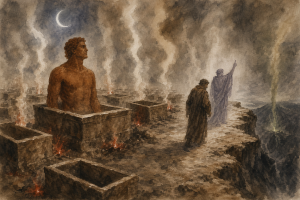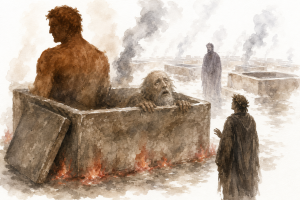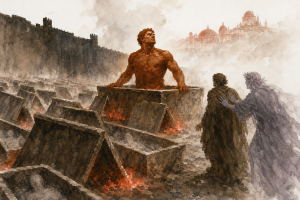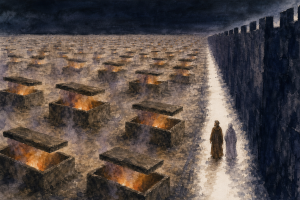
Phlegyas’ boat rounds the last bend of the marsh and puts them out under iron walls, inside which Dante can already make out red domes glowing like metal taken from a forge; on the battlements more than a thousand angels rained down from heaven demand to know who this is who walks the kingdom of the dead without dying, and when Virgil — who has talked his way past Charon, Minos, Cerberus and Plutus with the same four words about a will that cannot be resisted — asks for a private word, they hear him out, refuse him, and slam the gates in his chest, so that the guide comes back with his eyes on the ground and his brows shorn of every boldness, and the canto ends with a promise rather than an entrance.
Inferno · Canto 8 · Lines 67–130 · Scene 25
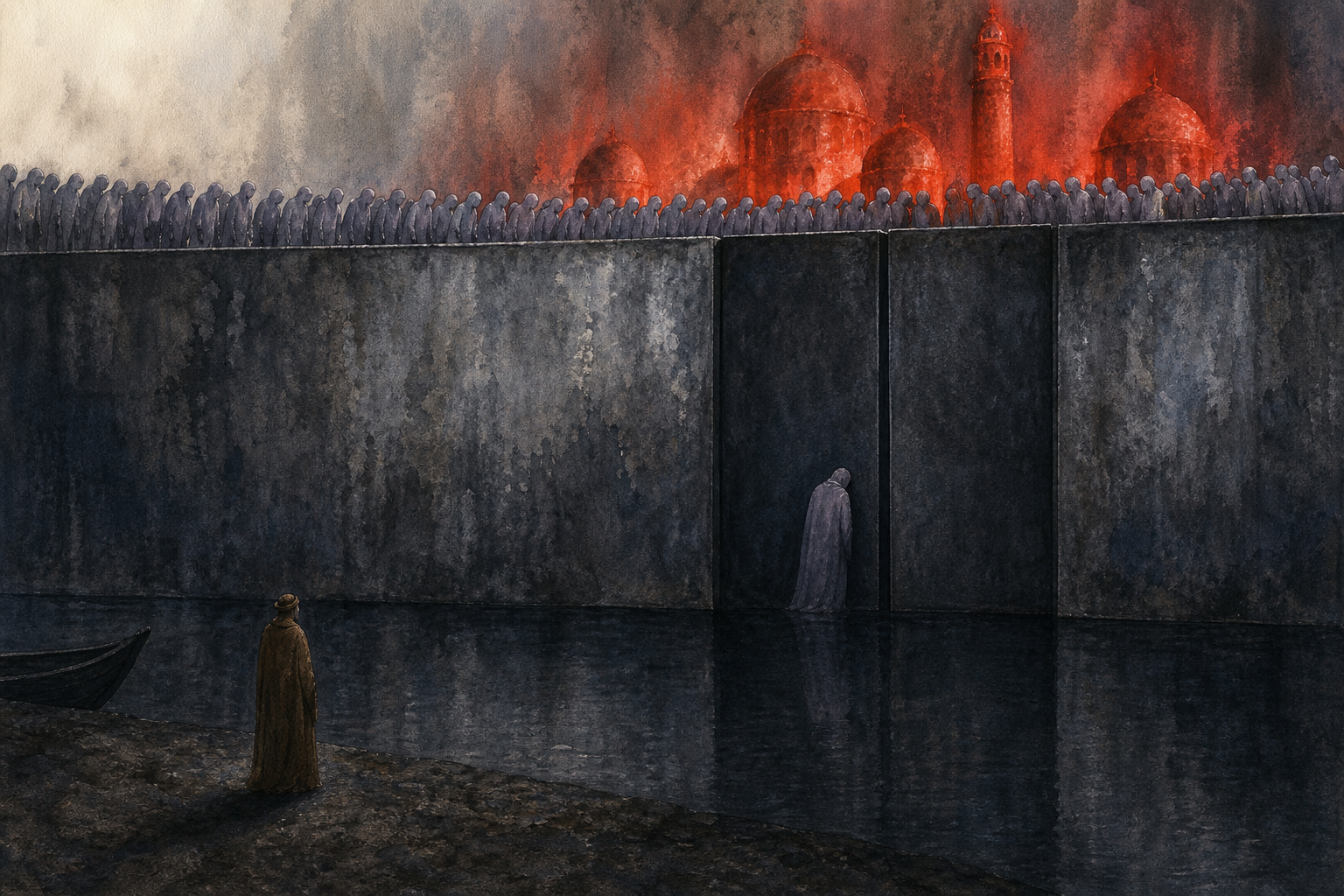
Virgil announces what is coming: «s’appressa la città c’ ha nome Dite, / coi gravi cittadin, col grande stuolo» (68-69). A city, with citizens and a garrison. Nothing in Hell so far has had civic institutions. Dante answers that he can already see the domes down in the valley, and the word he uses for them is ‘meschite’ — mosques. To a Florentine in 1300, that one word does an enormous amount of work: the fortress of the enemies of God is built to look like a Saracen city, the sort of skyline crusader chronicles described. The domes are red, and Virgil explains why: an eternal fire burns inside and shows them that colour, the way iron in a forge glows from the heat within.
They come to the moats. The walls look like iron. The boat has to make a long detour before it can land, and then Phlegyas shouts one brusque word — «Usciteci» (81) — get out, here is the entrance. He never speaks again.
On the battlements are more than a thousand souls ‘da ciel piovuti’ (83), rained down from the sky. These are the angels who fell with Lucifer, and Dante describes them with a weather verb, as though they had not so much rebelled as precipitated. They are furious, and they ask a question: «Chi è costui che sanza morte / va per lo regno de la morta gente?» (84-85). Who is this, going alive through the kingdom of the dead? That is the question the whole Comedy exists to answer, and it is put by demons.
Virgil signals that he wants a private word. Up to now his method has been public and it has always worked: at Charon’s boat and at Minos’ judgment seat he said, in effect, this is willed where what is willed can be done, and the obstruction dissolved. This time the demons listen, cool down slightly, and make a counter-offer: you come in alone; send him back the way he came; let him try, if he knows how; you stay here. Then Dante speaks directly to us — «Pensa, lettor, se io mi sconfortai» (94), think, reader, whether I lost heart. It is the first time in the poem that the narrator turns and addresses the person reading it, and he does it at the exact moment he wants us frightened.
Dante begs. He reminds Virgil that more than seven times he has given him back his courage, and asks that if the way on is refused they turn round together, at once, and retrace their footprints. Virgil tells him not to be afraid: nobody can take their passage from them, «da tal n’è dato» (105) — it is given by such a one. It is the same formula as before, now compressed to four words. But he does not say it to the demons. He says it to Dante, and then he walks away and leaves him.
What follows is the most exposed moment the pilgrim has had. «io rimagno in forse, / che sì e no nel capo mi tenciona» (110-111): yes and no are holding a debate inside his head, using a verb that means to conduct a formal dispute. He cannot hear what Virgil offers them. He does not have to wait long. The demons all rush back inside, and the gates shut «nel petto al mio segnor» (116) — in his lord’s chest. Not in his face: against his body, a physical shove.
Virgil comes back slowly, eyes on the ground, his brows ‘rase / d’ogne baldanza’ (118-119), shaved clean of all boldness, and sighs a question that has no addressee: who has denied me the houses of grief? Then he steadies himself. Do not be dismayed because I am angry; I will win this trial, whoever inside is organising the defence. Their insolence is not new. They tried it once before at a gate less secret than this one — the gate of Canto III, still standing today without a lock, because Christ broke it open when he came down to harrow Hell. And already someone is on his way down the slope, crossing the circles without a guide, by whom this city will be opened.
And there the canto stops. Dante has invented the cliffhanger, and the guide he has trusted for eight cantos has just been proved insufficient.
Go deeper: the college-level reading (about 1,400 words)
Quotes the Italian closely, with philological detail and cross-references.
The approach is staged as a sighting. Virgil names the objective — «s’appressa la città c’ ha nome Dite, / coi gravi cittadin, col grande stuolo» (68-69) — and the vocabulary is civic and military at once: cittadini, stuolo, a populace and a garrison. Dis is the first construction in Hell that is a polity. Dante replies with the detail that has occupied commentators ever since: «già le sue meschite / là entro certe ne la valle cerno, / vermiglie come se di foco uscite / fossero» (70-73). ‘Meschite’ is a mosque, the word arriving in Italian through crusading and mercantile contact with Arabic masjid, and it makes the citadel of unbelief architecturally Islamic to a reader in Florence — minarets and domes rather than campanili. ‘Certe’ at 71 is a small crux: read adverbially it means ‘certainly, for sure’, read adjectivally it agrees with ‘meschite’ and means the shapes are distinct, sharply outlined. Both are defensible and the early commentators divide. Virgil’s gloss, «Il foco etterno / ch’entro l’affoca le dimostra rosse» (73-74), turns on a figura etymologica, foco/affoca, and gives the image its mechanism: the redness is not paint or firelight from outside but metal heated from within, the whole city a forge — an anticipation of the incandescent tombs of Canto X and of the red-hot walls Dante will walk between.
The landing is deliberately laborious. «le mura mi parean che ferro fosse» (78) is grammatically loose — a Latinising anacoluthon that most editors leave standing — and the iron is Virgil’s own: the Tartarus of Aeneid VI has a triple wall, an iron tower and gates that no force of men or gods can break. The guide is being stopped by the architecture he wrote. Then «Non sanza prima far grande aggirata» (79), a wide circuit before they can put in, and Phlegyas’ single imperative, «Usciteci» (81). He is called only ‘il nocchier’ (80), the same職 title the poem gives Charon, and after this word he vanishes from the Comedy altogether.
The garrison is introduced by a meteorological verb: «più di mille in su le porte / da ciel piovuti» (82-83). The passive participle removes agency — they did not fall, they were rained down — and it recalls the vengeance Michael took on the proud rout at VII.11-12. Dante never calls them angels here; the identification is universal in the commentaries and is an inference from ‘da ciel piovuti’ and from the messenger’s rebuke in Canto IX. Their challenge, «Chi è costui che sanza morte / va per lo regno de la morta gente?» (84-85), is the poem’s own governing question, and Dante gives it to his enemies. The polyptoton morte/morta, and the pointed ‘costui’ rather than a name, make it an accusation rather than an enquiry.
Virgil’s response is a change of method. «fece segno / di voler lor parlar segretamente» (86-87): up to now his diplomacy has been public and formulaic, delivered over the heads of Charon and Minos for the pilgrim’s benefit as much as the demons’. This is the only negotiation in the Inferno that the poem refuses to report. The demons ‘chiusero un poco il gran disdegno’ (88) — the verb is the one that will shortly be used of the gates — and produce terms: «Vien tu solo, e quei sen vada / che sì ardito intrò per questo regno. / Sol si ritorni per la folle strada: / pruovi, se sa» (89-92). ‘Folle’ is loaded. Dante had feared at II.35 that his coming might be folle; Ulysses will call his last voyage a folle volo at XXVI.125. The demons hand the pilgrim the word he is most afraid of, and they separate the two travellers by grammar before they do it by a gate: tu solo, quei, sol si ritorni.
Then the narrator turns round: «Pensa, lettor, se io mi sconfortai / nel suon de le parole maladette» (94-95). This is normally counted the first direct address to the reader in the Comedy, and its placement is exact — it arrives at the instant the narrative needs the reader’s fear, not the pilgrim’s. Auerbach’s essay on the addresses treats them as the poem’s device for conscripting the reader into the fiction’s stakes; here the conscription is done under threat. Dante’s plea, «che più di sette / volte m’ hai sicurtà renduta» (97-98), uses a biblical idiom for indefinite plurality (septies in die); the attempts to count the actual rescues — the she-wolf, Charon, Minos, Cerberus, Plutus, Phlegyas — never quite reach seven, which is the point of the idiom. What he asks for is retreat, and he asks for it in a beautiful phrase: «ritroviam l’orme nostre insieme ratto» (102), let us find our own footprints again, together, fast.
Virgil’s answer contains the canto’s structural hinge: «’l nostro passo / non ci può tòrre alcun: da tal n’è dato» (104-105). This is the formula of III.95-96, repeated verbatim to Minos at V.23-24 — the appeal to an unnamed authority whose will settles everything. Compressed to four words, it is still the same instrument. But note where it is spoken: to Dante, on this side of the wall, not to the demons. Whatever Virgil actually says to them at 112 is withheld, and the formula, for the first time in the poem, does not by itself open anything. Then, «Così sen va, e quivi m’abbandona / lo dolce padre» (109-110). ‘Padre’ for Virgil, and ‘abbandona’ for a temporary absence — a rehearsal, in miniature, of Purgatorio XXX, where the same relationship is named at its most tender and the abandonment is final. Left alone, Dante becomes a disputation: «che sì e no nel capo mi tenciona» (111), where ‘tenciona’ is the verb of the tenzone, the formal poetic and legal quarrel. The singular verb with a compound subject is not carelessness; yes and no are one process.
The defeat is bodily. «Chiuser le porte que’ nostri avversari / nel petto al mio segnor» (115-116): not in his face, in his chest, so that a shade who elsewhere in the poem cannot be embraced is here physically struck by a door. He returns ‘con passi rari’ (117), with slow, spaced steps, «Li occhi a la terra e le ciglia avea rase / d’ogne baldanza» (118-119) — ‘rase’, shaved or razed, and ‘baldanza’, the confident bearing that is the exact opposite of the ‘ardito’ the demons had thrown at Dante. His sigh, «Chi m’ ha negate le dolenti case!» (120), is punctuated as a question in most editions and as an exclamation in others; either way he does not name the answer.
The recovery is a piece of legal-military reasoning. ‘Prova’ runs through the passage — the demons’ «pruovi, se sa» (92), their scramble «a pruova» (114), Virgil’s «ch’io vincerò la prova» (122) — and ‘la difension’ (123) keeps it in the register of a siege. The precedent he cites is the decisive one: «già l’usaro a men segreta porta, / la qual sanza serrame ancor si trova» (125-126). That is the gate of Canto III, over which stands «la scritta morta» (127), and it has no lock because it was forced from outside at the Harrowing of Hell — the event Virgil described at IV.52-63, when he saw a mighty one come crowned, and which Malacoda will date with precision at XXI.106-114. Virgil’s argument is historical: this has been tried before and it lost.
And then the poem does something it has not done: «e già di qua da lei discende l’erta, / passando per li cerchi sanza scorta, / tal che per lui ne fia la terra aperta» (128-130). Someone is already on the way down. ‘Sanza scorta’ picks up the demons’ jeer that Virgil has escorted Dante through the dark country (93) — this one needs no escort. ‘Tal’ picks up ‘da tal n’è dato’ (105) — a second unnamed authority, this time in motion. The canto ends without an entrance, on a promise, and the reader is left in the same ‘forse’ as the pilgrim. It is the first genuine suspense in the Commedia, and it is manufactured by withholding two things: what Virgil said, and who is coming.
Go deeper still: the scholarly reading (about 1,100 words)
The commentary tradition, the sources, and what is documented versus inferred.
The Inferno is built around a single frontier, and this passage is where the poem stops describing it and starts making the reader feel it. Above the walls lie the sins of appetite; below them, as Virgil will explain at leisure in Canto XI, lie the sins of malice, divided into force and fraud. That division is a piece of moral architecture inherited from the schools, and a poem could in principle have announced it and moved on. Dante instead spends the second half of Canto VIII and most of Canto IX getting through it. A boundary crossed without effort is not a boundary; the delay is the argument. What happens at lines 67-130 is that a taxonomic seam is converted into a narrative event, and the conversion costs the poem its guide.
Consider what the reader has been trained to expect. Five times already the journey has met an obstacle and dissolved it in the space of a few lines. Charon objects and is silenced by the formula «vuolsi così colà dove si puote / ciò che si vuole, e più non dimandare» (Inferno III.95-96); Minos objects and is silenced by the same words, repeated almost verbatim at V.23-24; Cerberus is stopped with fistfuls of earth in Canto VI; Plutus collapses at «Taci, maladetto lupo!» (VII.8). Phlegyas has just ferried them across in sullen obedience, and departs with one brusque imperative, «Usciteci» (81). The rhythm is by now so established that it has become invisible, which is precisely the condition for its violation to register. When Virgil says «Non temer; ché ‘l nostro passo / non ci può tòrre alcun: da tal n’è dato» (104-105), he is producing the sixth iteration of a device that has never failed. It fails.
The reason it fails is a matter of who is standing on the battlements. «Io vidi più di mille in su le porte / da ciel piovuti» (82-83): these are the angels of the rebellion, the same fall for which, at VII.11-12, «là dove Michele / fé la vendetta del superbo strupo». Virgil’s formula is not a spell but an appeal to authority — an assertion that the journey is willed where willing is efficacious. It works on Charon and Minos because they are functionaries of that will. It cannot work on creatures whose entire identity consists in having refused it. Whether Dante intends this as strict theological logic or as narrative decorum is arguable, and commentators have taken it both ways; but structurally the poem has arranged for its one unanswerable argument to be delivered to the only audience constitutionally deaf to it. Note too that the demons’ challenge, «Chi è costui che sanza morte / va per lo regno de la morta gente?» (84-85), is the question the Comedy exists to answer, and Dante has assigned it to the opposition. The poem’s premise is voiced by the party trying to stop the poem.
Then comes the more radical move. Virgil «fece segno / di voler lor parlar segretamente» (86-87), and the negotiation happens off-stage: «Udir non potti quello ch’a lor porse» (112). A retrospective first-person narrator is normally sovereign over his own experience; here Dante deliberately installs a blind spot in the middle of the crisis. The consequence is that suspense becomes possible in a narrative whose outcome is guaranteed by the mere fact of its being told. The device is reinforced two lines earlier than the parley, at «Pensa, lettor, se io mi sconfortai / nel suon de le parole maladette, / ché non credetti ritornarci mai» (94-96) — the first direct address to the reader in the Inferno, and the starting point of Auerbach’s 1954 essay on the appelli al lettore. The address does not invite us to share the narrator’s hindsight; it conscripts us into the pilgrim’s ignorance. From this point the poem has two knowledge-states, and it can play them against each other.
The physical humiliation is calibrated to match. «Chiuser le porte que’ nostri avversari / nel petto al mio segnor, che fuor rimase» (115-116): not merely shut, but shut in his chest, a bodily indignity for a shade. He comes back «con passi rari» (117), eyes down, «e le ciglia avea rase / d’ogne baldanza» (118-119), and utters a line that editions punctuate variously as outrage or as question: «Chi m’ ha negate le dolenti case!» (120). Before that, the roles have already inverted. It is Dante who has to be reassured, and Dante who proposes the one thing the design cannot permit: «e se ‘l passar più oltre ci è negato, / ritroviam l’orme nostre insieme ratto» (101-102). This is the only moment in the Inferno at which a speaker seriously proposes abandoning the journey, and it is the pilgrim, not the guide, who proposes it — a measure of how far the machine has jammed.
The repair is effected by precedent. «Questa lor tracotanza non è nova; / ché già l’usaro a men segreta porta, / la qual sanza serrame ancor si trova» (124-126), and, lest we mistake the reference, «Sovr’essa vedestù la scritta morta» (127). The unlocked gate is the gate of Canto III, forced at the Harrowing and never repaired since. Two structural things follow. First, the demons are shown repeating a move that has already lost, which is the moral signature of the damned throughout the poem: repetition without learning. Second, the poem authorises its own future by citing its own past — the rescue that is coming will be a re-enactment of a rescue that has already happened, and Dante can therefore withhold the rescuer’s name across the canto break and still leave the reader assured. «tal che per lui ne fia la terra aperta» (130) is the first genuine cliffhanger in the Comedy, and it feeds directly into the invitation of IX.61-63 to look «sotto ‘l velame de li versi strani».
What the hinge buys, finally, is a permanently qualified guide. After Dis, Virgil can be resisted, delayed and — in the Malebolge, at the hands of Malacoda — simply lied to. The older allegorical reading, that human reason has here reached the limit at which grace must intervene, remains defensible and is very old; so is the flatter view that Dante needed an escalation and built one. The two need not be reconciled. Either way, the poem cannot go further under its own power, and it says so.
The Italian — The Gate That Would Not Open
Source: Wikisource (public domain, pre-1929 text)
Lines 67–69
67. Lo buon maestro disse: "Omai, figliuolo,68. s’appressa la città c’ ha nome Dite,69. coi gravi cittadin, col grande stuolo".
cultural ref: Line 68 — ‘la città c’ ha nome Dite’ — Dis is the Roman cult-name of the lord of the underworld, and in the Aeneid it names both the god and his realm. Dante transfers it to the city and, later in the Inferno, to Lucifer himself, so that the fortress is named after its emperor in the ordinary medieval way. Note the civic apparatus in the same breath: ‘gravi cittadin’ and ‘grande stuolo’, a citizenry and a garrison. Nothing in upper Hell has had institutions; from here down, sin is organised. [Model knowledge · high]
Lines 70–72
70. E io: "Maestro, già le sue meschite71. là entro certe ne la valle cerno,72. vermiglie come se di foco uscite
cultural ref: Line 70 — ‘le sue meschite’ — mosques. The word reaches Italian from Arabic masjid through crusading and mercantile contact, and it is attested well before Dante. It makes the skyline of the city of unbelief Islamic to a Florentine eye: domes and a minaret rather than campanili. Against reading this as flat hostility stands Limbo, where Dante places Saladin, Avicenna and Averroës with marked respect; for reading it as pointed stands what is inside these walls, the heretics of Canto X. The commentaries divide, and the line is thin enough to carry either. [Model knowledge · high]
translation note: Line 71 — ‘là entro certe ne la valle cerno’ — ‘certe’ is a genuine crux. Taken adverbially it means ‘certainly, for sure, I do make them out’; taken as an adjective agreeing with ‘meschite’ it means the shapes are distinct, sharp-edged, clearly resolved at that distance. Early commentators split and modern translators still do. The adjectival reading is the more interesting, because it insists on visual precision at the exact moment the poem introduces an image nobody can quite explain. [Model knowledge · medium]
Lines 73–75
73. fossero". Ed ei mi disse: "Il foco etterno74. ch’entro l’affoca le dimostra rosse,75. come tu vedi in questo basso inferno".
wordplay: Line 74 — ‘Il foco etterno / ch’entro l’affoca’ — a figura etymologica, foco kindling affoca in the next breath. Virgil’s explanation is technical rather than atmospheric: the redness is not firelight falling on the towers from outside but metal heated from within, the whole city behaving like iron in a forge. It prepares the incandescent sepulchres of Canto X, where the lids are open and the fire is inside the tombs, and it makes the walls of Dis a single enormous furnace wall. [Model knowledge · medium]
Lines 76–78
76. Noi pur giugnemmo dentro a l’alte fosse77. che vallan quella terra sconsolata:78. le mura mi parean che ferro fosse.
literary key: Line 78 — ‘le mura mi parean che ferro fosse’ — the syntax is loose, a Latinising anacoluthon most editors leave standing. The iron is Virgil’s own property: Aeneid VI gives Tartarus a triple wall, an iron tower and gates that no violence of men or gods can break down. The guide who wrote those walls is about to be stopped by them. Of all the pieces of classical furniture Dante borrows in the Inferno, this is the one that turns on its owner. [Model knowledge · high]
Lines 79–81
79. Non sanza prima far grande aggirata,80. venimmo in parte dove il nocchier forte81. "Usciteci", gridò: "qui è l’intrata".
vocabulary: Line 79 — ‘Non sanza prima far grande aggirata’ — a wide circuit before the boat can land. The litotes slows the arrival deliberately, and the geography is left vague: the Styx apparently serves as the moat, the walls are unbroken for a long stretch, and the entrance is somewhere the ferryman knows and the reader does not. Dante’s infernal topography is generally precise; here the imprecision is the effect, a long detour under a blank iron face. [Model knowledge · medium]
literary key: Line 80 — ‘il nocchier forte’ — Phlegyas is never named again in the canto, only titled, and ‘nocchiero’ is the same word the poem uses for Charon, quietly pairing the two ferrymen of the descent. His whole contribution from here is one imperative, ‘Usciteci’ (81) — out with you, here is the way in. Then he disappears from the Commedia altogether. Compare Charon, who argues; Phlegyas is given rage in Canto VIII’s first half and monosyllables in its second. [Model knowledge · medium]
Lines 82–84
82. Io vidi più di mille in su le porte83. da ciel piovuti, che stizzosamente84. dicean: "Chi è costui che sanza morte
theology: Line 83 — ‘da ciel piovuti’ — rained down from heaven, a weather verb in the passive. Dante never calls them angels; the identification with the rebel host is inference from this phrase, from the vengeance Michael took on the proud rout at VII.11-12, and from what the heavenly messenger says to them in Canto IX. It is effectively unanimous in the commentaries but it is still inference. The grammar is worth noticing: the greatest act of will in creation is described as precipitation, something that happened to them. [Source: Inferno VII.11-12 (Michael’s vengeance on the rebel host)]
literary key: Line 84 — ‘Chi è costui che sanza morte / va per lo regno de la morta gente?’ — the question the Commedia exists to answer, and Dante gives it to demons. The polyptoton morte/morta binds the traveller’s exemption to the condition of everyone else present, and ‘costui’ rather than a name makes it an accusation. Others notice the anomaly by its symptoms — breath, weight, moved stones — but only here is it stated as a principle, and by the only creatures in Hell with the power to enforce it. [Model knowledge · high]
Lines 85–87
85. va per lo regno de la morta gente?".86. E ‘l savio mio maestro fece segno87. di voler lor parlar segretamente.
literary key: Line 87 — ‘di voler lor parlar segretamente’ — a change of method. Virgil’s diplomacy with Charon, Minos, Cerberus and Plutus has been public and formulaic, delivered for the pilgrim’s instruction as much as for the guardian’s defeat. This is the only negotiation in the Inferno conducted out of earshot, and the poem never tells us its content (see 112). Whatever the doctrinal weight of the failure, the withholding is a narrative decision: a treatise would report the argument. [Model knowledge · high]
Lines 88–90
88. Allor chiusero un poco il gran disdegno89. e disser: "Vien tu solo, e quei sen vada90. che sì ardito intrò per questo regno.
Lines 91–93
91. Sol si ritorni per la folle strada:92. pruovi, se sa; ché tu qui rimarrai,93. che li ha’ iscorta sì buia contrada".
wordplay: Line 91 — ‘Sol si ritorni per la folle strada’ — ‘folle’ is the pilgrim’s own private fear thrown back at him. At Inf. II.35 he had told Virgil he was afraid the journey might be folle; at XXVI.125 Ulysses will call his last voyage a ‘folle volo’. The demons also do their separating grammatically before they do it with a gate: ‘Vien tu solo’, ‘quei sen vada’, ‘Sol si ritorni’. And ‘pruovi, se sa’ (92) starts the run of ‘prova’ that Virgil will end at 122. [Source: Inferno II.35; Inferno XXVI.125]
Lines 94–96
94. Pensa, lettor, se io mi sconfortai95. nel suon de le parole maladette,96. ché non credetti ritornarci mai.
literary key: Line 94 — ‘Pensa, lettor, se io mi sconfortai’ — usually counted the first direct address to the reader in the Commedia, and placed with precision: not at a doctrinal difficulty but at the moment the narrative wants the reader frightened. Auerbach’s study of these addresses treats them as the device by which Dante conscripts the reader into the stakes of the fiction. The next one, in Canto IX, will point at a hidden meaning and refuse to state it. Both belong to this single blocked episode. [Model knowledge · medium]
Lines 97–99
97. "O caro duca mio, che più di sette98. volte m’ hai sicurtà renduta e tratto99. d’alto periglio che ‘ncontra mi stette,
translation note: Line 98 — ‘più di sette / volte m’ hai sicurtà renduta’ — ‘seven times’ is biblical idiom for an indefinite plurality (the just man falls seven times a day and rises again), not a tally. Commentators who try to count the actual rescues — the she-wolf, Charon, Minos, Cerberus, Plutus, Phlegyas — reach five or six and have to pad, which is the surest sign the number is rhetorical. Dante’s ‘più di’ makes it vaguer still: more than an already vague many. [Model knowledge · medium]
Lines 100–102
100. non mi lasciar", diss’io, "così disfatto;101. e se ‘l passar più oltre ci è negato,102. ritroviam l’orme nostre insieme ratto".
Lines 103–105
103. E quel segnor che lì m’avea menato,104. mi disse: "Non temer; ché ‘l nostro passo105. non ci può tòrre alcun: da tal n’è dato.
theology: Line 105 — ‘da tal n’è dato’ — the formula of divine authorisation, compressed to four words. Its full form is at III.95-96, where Virgil silences Charon by saying that this is willed where what is willed can be done; he repeats it verbatim to Minos at V.23-24. Two things change here. It is spoken to Dante, not to the demons — we never learn whether Virgil used it on them — and, for the first time, invoking the delegated will does not by itself open anything. ‘Tal’ returns, walking downhill, at 130. [Source: Inferno III.95-96; Inferno V.23-24]
Lines 106–108
106. Ma qui m’attendi, e lo spirito lasso107. conforta e ciba di speranza buona,108. ch’i’ non ti lascerò nel mondo basso".
Lines 109–111
109. Così sen va, e quivi m’abbandona110. lo dolce padre, e io rimagno in forse,111. che sì e no nel capo mi tenciona.
vocabulary: Line 110 — ‘lo dolce padre, e io rimagno in forse’ — ‘abbandona’ for what is only a temporary absence, and ‘padre’ for the guide. The pairing rehearses in miniature the real loss: in Purgatorio XXX, when Virgil vanishes, Dante names him three times in three lines and calls him ‘dolcissimo patre’. Here the vocabulary of final bereavement is spent on a walk of a few yards, and the reader is meant to feel the disproportion as the pilgrim feels it. [Source: Purgatorio XXX.50 (‘Virgilio dolcissimo patre’)]
wordplay: Line 111 — ‘che sì e no nel capo mi tenciona’ — ‘tenciona’ is the verb of the tenzone, the formal quarrel of poets and the disputation of lawyers and schoolmen. Yes and no are conducting a debate inside his skull, and the verb is singular although the subject is compound: the two positions are one process, not two voices. It is the most exact line in the poem about being unable to decide, and it costs Dante eight syllables. [Model knowledge · high]
Lines 112–114
112. Udir non potti quello ch’a lor porse;113. ma ei non stette là con essi guari,114. che ciascun dentro a pruova si ricorse.
Lines 115–117
115. Chiuser le porte que’ nostri avversari116. nel petto al mio segnor, che fuor rimase117. e rivolsesi a me con passi rari.
literary key: Line 116 — ‘Chiuser le porte que’ nostri avversari / nel petto al mio segnor’ — not in his face but against his chest, a physical shove. ‘Avversari’ is the scriptural word for the diabolic party (adversarius vester diabolus), and ‘nostri’ quietly enlists the pilgrim, and perhaps the reader, on one side of a war. The bodily detail is startling because shades elsewhere in the poem cannot be gripped or embraced; here a door strikes one. [Model knowledge · medium]
Lines 118–120
118. Li occhi a la terra e le ciglia avea rase119. d’ogne baldanza, e dicea ne’ sospiri:120. "Chi m’ ha negate le dolenti case!".
vocabulary: Line 119 — ‘le ciglia avea rase / d’ogne baldanza’ — ‘rase’ is shaved or razed, a violent verb for an expression; the brows are stripped bare of their bearing. ‘Baldanza’ is confident, forward assurance, and it is the precise antonym of the ‘ardito’ the demons had flung at the pilgrim at 90. The one who was bold is standing behind him, and the one who had all the assurance has had it shaved off. Compare ‘con passi rari’ (117): the whole return is composed of slowed physical signs. [Model knowledge · high]
Lines 121–123
121. E a me disse: "Tu, perch’io m’adiri,122. non sbigottir, ch’io vincerò la prova,123. qual ch’a la difension dentro s’aggiri.
wordplay: Line 122 — ‘ch’io vincerò la prova’ — the third appearance of the root in thirty lines: the demons’ taunt ‘pruovi, se sa’ (92), their scramble back inside ‘a pruova’ (114), and now Virgil’s vow. ‘La difension’ (123) keeps the register military; ‘s’aggiri’ suggests someone moving about inside organising the defence. Virgil recovers not by asserting power but by reframing the situation as a siege with a documented outcome, which is what the next tercet supplies. [Model knowledge · high]
Lines 124–126
124. Questa lor tracotanza non è nova;125. ché già l’usaro a men segreta porta,126. la qual sanza serrame ancor si trova.
theology: Line 126 — ‘a men segreta porta, / la qual sanza serrame ancor si trova’ — the outer gate of Canto III, which has no lock because it was forced from outside at the Harrowing of Hell, when Christ descended and the demons tried to bar him. The tradition comes from the Gospel of Nicodemus, where the powers of Hell shout to keep the gates shut and the psalm-verse ‘lift up your gates’ breaks them. Virgil described that arrival at IV.52-63, and Malacoda dates the resulting damage with startling precision at XXI.106-114. [Source: Gospel of Nicodemus (Descensus Christi ad inferos); Inferno IV.52-63; Inferno XXI.106-114]
Lines 127–129
127. Sovr’essa vedestù la scritta morta:128. e già di qua da lei discende l’erta,129. passando per li cerchi sanza scorta,
literary key: Line 127 — ‘la scritta morta’ — the inscription of Inferno III, ‘Per me si va ne la città dolente’. ‘Morta’ has been read two ways since the earliest commentaries: lifeless, the lettering of a dead realm, or death-dealing, an inscription that pronounces death on those who pass under it. Dante’s own gloss there — words of a dark colour, whose sense was hard for the pilgrim — supports the second without excluding the first. Note that Virgil says ‘vedestù’: he is reminding Dante of something they read together. [Source: Inferno III.1-12]
Lines 130
130. tal che per lui ne fia la terra aperta".
literary key: Line 130 — ‘tal che per lui ne fia la terra aperta’ — the canto ends on an indefinite pronoun, the same one that carried the divine authorisation at 105, now in motion down the slope. ‘Sanza scorta’ (129) answers the demons’ jeer that Virgil has escorted the pilgrim through so dark a country (93): this one needs no guide. The arrival is neither named nor delivered here; the poem holds it back across an entire canto, and when the messenger comes Dante veils him in an address to the reader and still refuses to say who he is. [Model knowledge · high]
Seven Centuries of Reading The Gate That Would Not Open
The city of Dis
Dis, the Roman name for the god of the underworld, is for Dante another name for Lucifer. Its mosques (70) associate the city with the religious and military enemy of Dante’s Christendom. Its walls seem made of iron (78), and Hollander takes this as a sign that from here on the sins punished come from a hardened will, not appetite. He also recalls the iron tower of Virgil’s Tartarus (Aeneid VI.554), which Aeneas never enters. The defenders on the walls are the rebel angels defeated with Satan by Michael (82–85), and for the first time Virgil faces adversaries who are not easily swayed.
The first address to the reader
«Pensa, lettor, se io mi sconfortai» (94) is the first of seven addresses to the reader in the Inferno. Hollander remarks that perhaps no other literary text speaks to its readers so often. The device has its own scholarly literature: Hermann Gmelin (1951), Erich Auerbach‘s ‘Dante’s Addresses to the Reader’ (1954), and Leo Spitzer’s reply (1955).
Virgil’s claim to have rescued the pilgrim «più di sette / volte» (97–98) was taken by the Casini-Barbi commentary as an indeterminate number on biblical models, such as the just man who falls seven times and rises. Casini and Barbi nonetheless listed eight occasions on which Virgil had already come to his aid.
A defeat and a precedent
The gate shut in Virgil’s face (115–117) is the guide’s first defeat. His encouragement at 121–126 appeals to the harrowing of Hell, when a gate was forced. J. S. Carroll cited the apocryphal Gospel of Nicodemus, in which the hosts of Hell tried to block Christ’s descent, as the source for these new rebels. Mark Musa read the coming descent of help (128–130) against the prophesied new progeny descending in Virgil’s fourth Eclogue.
What remains open
How Virgil knows that help is coming is not stated. Some say he foresees it; others that Beatrice promised such aid in Canto II, which Hollander thinks more probable, though the text confirms neither. The nature of the messenger is the business of the next canto.
The Two Main Positions on The Gate That Would Not Open
The Frontier of Reason
The shut gate is doctrine made visible. Everything above Dis is sin from incontinence, which natural philosophy can diagnose and describe; everything below is malice and obstinate will, which cannot be entered on human resources. Virgil’s power was never his own — it was always a delegated formula pointing at someone else — and the moment the demons refuse to honour the delegation he is reduced to waiting. The rescue must come from outside, from one who crosses the circles ‘sanza scorta’ (129), because that is precisely what Virgil cannot do.
Key passage: Virgil never once acts on his own authority in Hell: at Charon, at Minos, and again at 105 he invokes a will he does not possess, and the compressed ‘da tal n’è dato’ is spoken behind the wall, to his pupil, not to the enemy. The barrier stands exactly where the poem’s own moral architecture changes, as Virgil will explain at length in Canto XI. And the historical precedent he cites is Christ’s, not a philosopher’s: the only gate in Hell ever forced was forced from outside by the Harrowing (125-127).
A Man, Not a Faculty
What the lines actually give is a defeated person. Virgil is angry, ashamed, slow-footed, staring at the ground, sighing a question with no addressee, and then recovering by citing a precedent like an advocate. Reading that as a proposition about the faculty of reason flattens it. The episode’s real work is double: it humbles the Aeneid — the iron walls of Tartarus are Virgil’s own invention, and his authority over the underworld ends where his poem’s knowledge ends — and it invents narrative suspense, which is why the reader is addressed at 94, why the negotiation is withheld at 112, and why the canto stops without an entrance.
Key passage: The text never calls Virgil reason, and the physical detail at 115-119 is comic-humiliating rather than conceptual: gates shut on the chest of a shade, brows shaved of boldness. The withholding at 112 has no doctrinal function whatever — a treatise would report the argument — but a perfect narrative one. And the closing tercet builds an expectation the poet then delays across an entire canto, with a second address to the reader about a hidden meaning that he still refuses to state.
What the Text Does — and What That Means (Contested)
On the page: The formula used at III.95-96 and repeated at V.23-24 recurs here compressed as ‘da tal n’è dato’ (105), and is spoken to Dante rather than to the demons. Virgil requests a private conference (86-87) and the poem does not report what he said (112). The gates are shut on his chest (115-116) and he returns with eyes on the ground and brows ‘rase / d’ogne baldanza’ (118-119). The text calls the garrison ‘da ciel piovuti’ (82-83) and never uses the word ‘angels’. The word ‘prova’ appears three times in thirty lines (92, 114, 122). Line 94 is the poem’s direct address to the reader placed at the moment of the pilgrim’s greatest fear. The precedent Virgil cites at 125-126 is the gate of Canto III, described as still without a lock, over which stands ‘la scritta morta’ (127). The canto ends with a promised arrival that is neither named nor delivered (128-130), and the promise is not fulfilled within this canto.
What scholars dispute: The poem nowhere calls Virgil ‘reason’; that identification is an interpretive tradition, ancient and near-universal but not a statement of the text. Nor does the text state why the demons can resist a formula that worked twice before, or whether Virgil’s confidence at 128-130 rests on knowledge, inference or nerve. Whether the humiliation is doctrinal or dramatic — and whether those are even separable in this poem — has divided readers since the earliest commentaries and remains the disagreement itself, not a detail within it.
What Dante Leaves Unresolved
What Virgil offered the demons; why a formula that dissolved Charon and Minos has no force here; whether the guide’s assurance at 128-130 is foreknowledge, deduction from the Harrowing, or a man steadying a frightened companion; and who exactly is coming down the slope — a question the poem carries into Canto IX, veils in an address to the reader, and never answers by name.
The Open Question
Virgil has opened every door in Hell so far by invoking a will that cannot be resisted, and at Dis the door is shut in his chest. Is this the poem stating a doctrine — that unaided reason has a fixed frontier and cannot enter the region of malice without grace — or is it Dante the narrative maker manufacturing his first real crisis, humbling the author of the Aeneid at the walls the Aeneid itself built, and inventing suspense?
Explore More
About This Article

Written by Lucy Bamboo. Lucy Bamboo has been reading the Divine Comedy for fifteen years — first in translation, then stubbornly in Medieval Tuscan with a dictionary and far too many footnotes. Reading Dante is her scene-by-scene walk through the poem: the original Italian, seven centuries of scholarly argument presented as argument rather than answer, and the human questions sitting underneath the theology. More about this site.
Verify this against a primary source
Specifics change, and your situation may differ from the one described here. These are the authorities worth checking directly:
- Digital Dante, Columbia University — text, commentary and translation apparatus
- Princeton Dante Project — the Commedia with historical commentary
- Dartmouth Dante Project — searchable commentary from 1322 onward