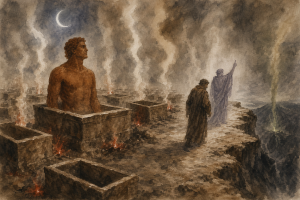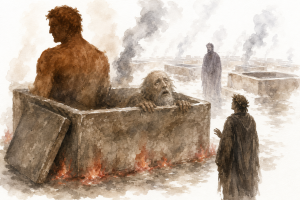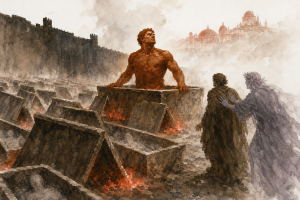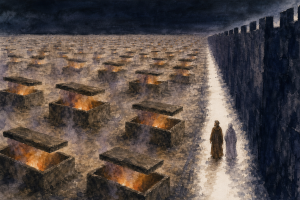
Half-way across the stagnant water, with Phlegyas’ boat still moving, a soul caked in mud stands up out of the marsh and challenges the living passenger — and instead of the courteous interview Dante has given every other shade so far, he returns insult for question, curses the soul, refuses to name him, watches him torn apart by the other sinners, and tells us that he thanks God for the sight to this day; and in the middle of it Virgil takes him by the neck, kisses his face, and blesses him in the words the Gospel crowd used of the mother of Christ.
Inferno · Canto 8 · Lines 31–66 · Scene 24
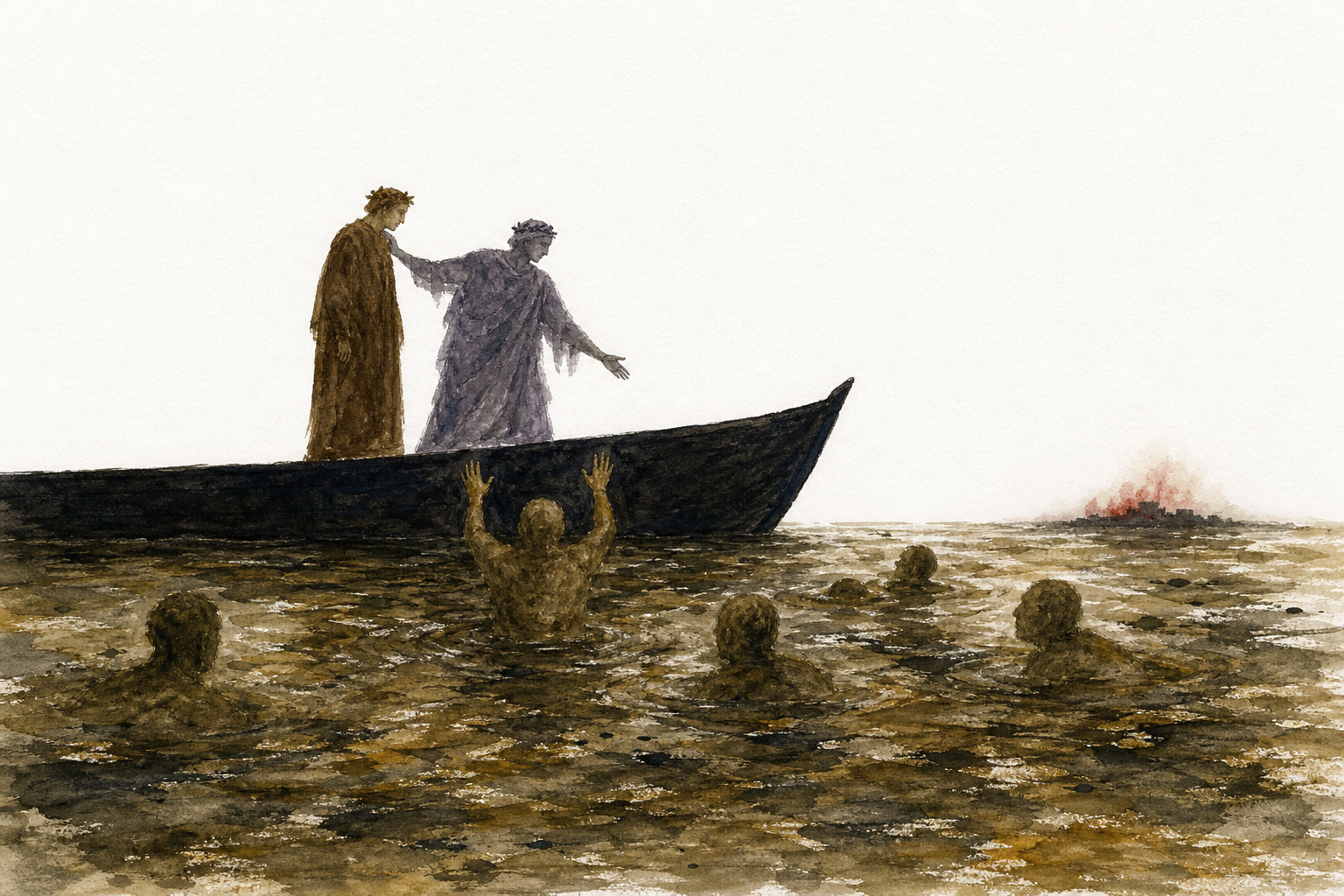
Dante and Virgil are being ferried across the marsh of the Styx in Phlegyas’ boat. The water is full of the wrathful, fighting each other on the surface, and below the surface are the sullen, who gurgle and cannot get their words out. While the boat is moving, one of the muddy souls stands up right in front of Dante and asks a rude question: who are you, coming here before your time? ‘Anzi ora’ (33) means before your hour — before you are dead.
Up to now the pilgrim has been unfailingly polite to the damned. He asked Francesca to come and talk. He called Ciacco by name. Here he does something new. He answers in five short words — ‘S’i’ vegno, non rimango’ (34), if I come, I do not stay — and throws the question back: who are you, made so filthy? The soul will not give a name. He says only ‘Vedi che son un che piango’ (36): you can see I am one who weeps. That is a bid for pity, and in Canto V it would have worked. Here it fails completely. Dante tells him to stay where he is with his weeping, calls him ‘spirito maladetto’ (38), accursed spirit, and adds the line that shows he has known all along who this is: ‘ch’i’ ti conosco, ancor sie lordo tutto’ (39) — I know you, filthy as you are. He knows the name and refuses to say it.
The soul lunges and puts both hands on the boat. Virgil shoves him off with the coarsest words he speaks in the whole poem: ‘Via costà con li altri cani!’ (42), get away there with the other dogs. Then comes the moment everyone argues about. Virgil puts his arms round Dante’s neck, kisses his face, and says: ‘Alma sdegnosa, / benedetta colei che ‘n te s’incinse!’ (44-45) — scornful soul, blessed is the woman who carried you. Those are the words a woman in the crowd shouts about the mother of Jesus in Luke’s Gospel. Virgil is blessing his pupil, in the language of the Gospel, for an act of contempt — inside the circle where anger is punished.
Virgil then explains: this man was arrogant in the world, no good deed decorates his memory, so his shade is furious here. And he widens it out. How many people up there think themselves great kings who will lie here ‘come porci in brago’ (50), like pigs in the mire, leaving nothing behind but disgust.
Dante now asks for something. He would very much like to see the man dunked in this broth before they reach the far side. Virgil promises he will be satisfied. And he is: the other muddy souls set on Filippo, and the narrator — not the young pilgrim in the boat, but the poet writing years later — says of the spectacle ‘che Dio ancor ne lodo e ne ringrazio’ (60). ‘Ancor’ means still, even now. That one word is why the episode is hard. It is not a young traveller losing his temper and being corrected later. The man holding the pen is still thanking God.
Only now do we get the name, and it does not come from Dante. The crowd shouts it: ‘A Filippo Argenti!’ (61) — at him! It is a hunting cry. Filippo Argenti was a real Florentine, from the Adimari family, on the political side that kept Dante in exile. The poem never tells us of any private quarrel; the early commentators supply one, which is not the same thing.
The last image is the strangest. Filippo, called «’l fiorentino spirito bizzarro» (62) — bizzarro in Dante’s Florence means quick-tempered, not eccentric — turns his teeth on himself: ‘in sé medesmo si volvea co’ denti’ (63). Rage that has nothing left to attack attacks its owner. Dante drops him mid-sentence — ‘Quivi il lasciammo, che più non ne narro’ (64) — and then a noise strikes his ears and he strains his eyes forward. The walls of the City of Dis are coming.
Go deeper: the college-level reading (about 1,200 words)
Quotes the Italian closely, with philological detail and cross-references.
The crossing is in motion: «Mentre noi corravam la morta gora» (31). The verb is one of speed and the noun one of stillness — a ‘gora’ is a millrace, a channel of standing or sluggish water, and ‘morta’ kills what little current the word implies. Out of that dead channel «dinanzi mi si fece un pien di fango» (32). Dante does not write ‘a soul covered in mud’; he writes a full-of-mud, a substantive built out of filth, so that the creature is grammatically a quantity of the marsh before he is a person. Compare the entrance of every other named sinner in the first circles: Ciacco identifies his city, Farinata rises to the waist and speaks Tuscan, Francesca is introduced as one of a pair. This one has no attribute but his coating.
His challenge, «Chi se’ tu che vieni anzi ora?» (33), is the fourth time the living body has been detected in Hell — Charon at III.88, Minos at V.19-20, Phlegyas twenty lines earlier in this same canto — and ‘anzi ora’ means before your hour, before death. What is new is the reply. «S’i’ vegno, non rimango» (34): five monosyllables, an antithesis, and a refusal of the question’s premise rather than an answer to it. Then Dante puts the question back with an insult inside it, «ma tu chi se’, che sì se’ fatto brutto?» (35), where ‘brutto’ is not English ‘ugly’ but befouled, made dirty — the participle ‘fatto’ insists that the state is something done to him.
The answer, «Vedi che son un che piango» (36), is a masterpiece of evasion. He refuses a name and substitutes a condition, and the condition he chooses is weeping — the currency that bought him a hearing in Canto V, where the pilgrim wept and fell. The refusal is exact and lexical: «Con piangere e con lutto, / spirito maladetto, ti rimani» (37-38). Dante takes ‘piango’ from the shade’s own mouth and hands it back as ‘piangere’; he takes ‘rimango’ from his own line 34 and turns it into the imperative ‘ti rimani’. You stay. I do not. And then the recognition: «ch’i’ ti conosco, ancor sie lordo tutto» (39), the concessive subjunctive ‘ancor sie’ conceding the mud and defeating it. He knows the man. He does not name him. That silence lasts twenty-two lines and is broken by other people.
The lunge at 40, «Allor distese al legno ambo le mani», is Virgilian: the shades on the wrong bank of Acheron stretching out their hands in longing for the far shore (Aen. VI.313-314). Here the gesture is not longing but assault, and it is met by «’l maestro accorto» — the alert, forewarned master — who «lo sospinse» with the harshest words he speaks anywhere: «Via costà con li altri cani!» (42). Virgil, whose defining epithet in this poem is courtesy, calls a soul a dog.
Then the hinge. «Lo collo poi con le braccia mi cinse; / basciommi ‘l volto e disse: ‘Alma sdegnosa, / benedetta colei che ‘n te s’incinse!’» (43-45). There is only one comparable moment of physical affection from Virgil in the Inferno, at XIX.121-124, where he gathers Dante to his breast and carries him up after the tirade against Nicholas III — that is, after the other great outburst of the pilgrim’s indignation. The blessing itself is Luke 11:27, the woman in the crowd who cries out that blessed is the womb that bore Christ. ‘Incingersi’ is a rare and physical verb, to become pregnant with; it puts the whole weight on the body of the mother. Two facts about the quotation deserve stating together. First, it is a Gospel benediction transposed to a scene of contempt in the circle of wrath. Second, in Luke the blessing is immediately corrected by Christ — rather, blessed are they that hear the word of God — and Virgil quotes the first half only. Whether the reader is meant to supply the second half is the whole question of the episode, and the poem does not say.
Virgil’s explanation, «Quei fu al mondo persona orgogliosa; / bontà non è che sua memoria fregi: / così s’è l’ombra sua qui furïosa» (46-48), is worth reading slowly, because it does not quite fit the circle. The man’s worldly sin is named as pride, not anger; anger is what he has become. ‘Fregi’ is a heraldic verb — to adorn, to emblazon — turned against a magnate for whom coats of arms were the point. And then the sermon widens past him entirely: «Quanti si tegnon or là sù gran regi / che qui staranno come porci in brago, / di sé lasciando orribili dispregi!» (49-51). ‘Regi’ generalises a Florentine street-brawler into the great of the earth; ‘porci in brago’ is the sow of 2 Peter 2:22 returning to her wallowing in the mire.
What the pilgrim does next is the part the harmonising readings must account for. He does not merely accept the lesson; he asks for a show. «molto sarei vago / di vederlo attuffare in questa broda» (52-53) — ‘vago’ is desirous, and ‘broda’ is a kitchen word, swill, the broth in the pot. Virgil’s answer supplies vocabulary that is startling here: «tu sarai sazio: / di tal disïo convien che tu goda» (56-57). Sated; and it is fitting that you should enjoy such a desire. ‘Disio’, ‘goda’, ‘sazio’ are the lexicon this poem otherwise reserves for the satisfaction of the soul in God.
The satisfaction arrives as «quello strazio» (58) — the same noun Dante will give Farinata two cantos later for the butchery that dyed the Arbia red (Inf. X.85) — performed by «le fangose genti» (59). And then line 60: «che Dio ancor ne lodo e ne ringrazio». ‘Ancor’ is the crux in a single adverb. It is not the pilgrim in the boat but the poet at his desk, years afterwards, who is still praising and still thanking. The narrator does not distance himself from the pilgrim; he ratifies him.
Only now the name, and not from Dante: «Tutti gridavano: ‘A Filippo Argenti!’» (61). The preposition makes it a hunting cry, at him, sic him. The pilgrim who withheld the name has it shouted for him by the damned, exactly as the name of Bocca degli Abati will be shouted by a fellow traitor in Cocytus (Inf. XXXII.106-108) after the pilgrim has torn at his hair. Filippo is then given his one epithet, «’l fiorentino spirito bizzarro» (62) — in Trecento Tuscan ‘bizzarro’ means quick to flare, irascible, and Boccaccio glosses it exactly so — and his last gesture: «in sé medesmo si volvea co’ denti» (63). In Canto VII the wrathful tore one another piecemeal with their teeth; here the teeth have run out of others. Wrath completes itself by consuming its owner, which is also, precisely, what the sullen under the water have already become.
The narrator then shuts the episode with a refusal: «Quivi il lasciammo, che più non ne narro» (64). And immediately «ne l’orecchie mi percosse un duolo» (65) — a grief that arrives as sound, striking the ear — and the eye is forced open, «avante l’occhio intento sbarro» (66). The gates of Dis are ahead, and within thirty lines the master who has just blessed his pupil will be shut out of them.
Go deeper still: the scholarly reading (about 1,100 words)
The commentary tradition, the sources, and what is documented versus inferred.
The trouble with this episode is not that it is cruel. Hell is cruel from the third canto onwards, and the cruelty is normally institutional: administered by Minos, by the wind, by the rain, by an architecture that the pilgrim inspects and the reader is permitted to deplore. Here the cruelty is personal, and the reader is not left standing outside it. The invitation is explicit. Virgil tells the pilgrim that his appetite will be gratified — «tu sarai sazio» (56) — and then goes further: «di tal disïo convien che tu goda» (57). Convien: it is fitting that you should take pleasure in such a desire. Three lines later the narrator, writing years after the event and with the whole poem’s authority behind him, says of the beating that followed «che Dio ancor ne lodo e ne ringrazio» (60). Ancor. Still, now, at the desk. Whatever the pilgrim did in the boat, the poet has not withdrawn it, and the reader who has been enjoying the exchange has been enjoying something the poem declines to take back.
The hinge is the embrace. Virgil puts his arms round the pilgrim’s neck, kisses his face, and says «Alma sdegnosa, / benedetta colei che ‘n te s’incinse» (44-45). The formula is from Luke 11:27, where a woman in the crowd calls out to Jesus, «Beatus venter qui te portavit, et ubera quae suxisti» — blessed the womb that bore you. It is the highest praise the Gospels put in an anonymous mouth, and Dante gives it to a pagan poet praising a Florentine for insulting a man in a swamp. Commentators have been arguing about that since the fourteenth century. What is less often pressed is the shape of the source. In Luke the blessing is not accepted: Christ deflects it, «Quinimmo beati qui audiunt verbum Dei et custodiunt illud» (11:28), blessed rather are they who hear the word of God and keep it. The formula Dante has chosen is a formula the Gospel corrects. Whether he wanted that correction audible here is not decidable from the text, and nobody should pretend otherwise; but the allusion is not a simple transfer of holiness. It arrives with a demurral attached.
The scholastic apparatus for defending the pilgrim exists and is respectable. Anger is not univocally sinful: the distinction between ira per zelum and ira per vitium is a commonplace by Dante’s time, and Aquinas treats anger’s possible rectitude at Summa Theologiae II-II q. 158. Virgil’s chosen adjective helps: he says «sdegnosa», not «irata», and sdegno — disdain, high indignation — is not obviously the same passion as the mud-fighting of the marsh. But the word cuts both ways. Contempt is exactly what Farinata will display towards Hell in the next canto but one, and the poem does not there present it as a virtue so much as a magnificence surviving damnation. Sdegno is a noble word for a movement of soul that the circle around the boat is already illustrating in its coarsest form. The defence works, but it is not free.
Consider, too, what the pilgrim actually asks for. He does not strike anyone. He says he would very much like — «molto sarei vago / di vederlo attuffare in questa broda» (52-53) — to see the man dunked before they leave the lake. It is a request for a spectacle. The act itself is performed by others: «quello strazio» (58) is done by «le fangose genti» (59), the muddy people, a mob. Virgil has already supplied the physical shove and the language to go with it, «Via costà con li altri cani!» (42). So the episode distributes its parts with some care. The guide does the pushing, the crowd does the tearing, and the pilgrim does the wanting and the watching. That is precisely the reader’s position, and it is why this passage implicates in a way that the pity of Canto V does not. Weeping over Francesca costs nothing and looks like virtue. Here we are given the pleasure and spared the deed, and then thanked for it by a narrator who prays.
The withheld name belongs to this economy. The pilgrim knows the man at line 39 and refuses to say who he is; the name is finally shouted by the mob, «A Filippo Argenti!» (61), and only then does the poem call him «’l fiorentino spirito bizzarro» (62). The identification is thus made by the collective he has offended, and by his city. Dante keeps his hands clean of the naming as he keeps them clean of the beating.
About the man himself the poem says three things: he was proud in the world, no good adorns his memory, «bontà non è che sua memoria fregi» (47), and his shade is therefore furious here. That is all. It supplies no quarrel, no injury, no grudge. Everything else — that he was a Filippo degli Adimari nicknamed Argenti for shoeing his horse in silver, that his temper was proverbial, that Adimari hands were in the confiscation of Dante’s property and in the opposition to his return — comes from Boccaccio and the early commentators, and Boccaccio also made him a comic bully in Decameron IX.8. This material may well preserve genuine Florentine memory; it may equally have grown out of these thirty-six lines. The plain statement worth making is that we cannot use it either to acquit the pilgrim (the man had it coming) or to convict the poet (he was settling a score). The poem’s silence about the motive is not an oversight to be filled in. It is the condition under which the blessing has to be judged.
And then line 63: «in sé medesmo si volvea co’ denti». He turns his teeth on himself. Whatever the mob began, wrath finishes without assistance, as it has already finished with the sullen gurgling under the surface. Which raises the sharpest question the passage leaves standing: if the sin consumes itself anyway, what was the pilgrim’s satisfaction for? Not justice, which was already in motion. The narrator shuts the file at once — «Quivi il lasciammo, che più non ne narro» (64) — and a cry of grief strikes his ear, and Dis begins. One may read that abruptness as decorum, or as the single moment when the man who thanks God for the spectacle declines to look at it any longer. The poem never returns to say the blessing was wrong. It never quite says it was right. What it does is put the question to the person holding the book, and the only honest evidence available is whether, at lines 58 to 60, you were pleased.
The Italian — Filippo Argenti in the Mud
Source: Wikisource (public domain, pre-1929 text)
Lines 31–33
31. Mentre noi corravam la morta gora,32. dinanzi mi si fece un pien di fango,33. e disse: "Chi se’ tu che vieni anzi ora?".
vocabulary: Line 31 — ‘la morta gora’ — a ‘gora’ is a millrace or feeder-channel, water that has been diverted and made to work; ‘morta’ cancels the current and leaves only the ditch. The phrase names the Styx without naming it, and the pairing with the verb ‘corravam’ is deliberately jarring: they are running across water that does not run. The register is domestic and Tuscan, the vocabulary of mills and drainage rather than of classical myth, which is the register the whole episode will keep — dogs, pigs, swill. [Model knowledge · high]
literary key: Line 32 — ‘un pien di fango’ — literally ‘a full-of-mud’. Dante does not write that a soul covered in mud rose up; he substantivises the filth, so that grammatically the thing addressing him is a quantity of the marsh. Every other named sinner in the upper circles is introduced with an attribute that belongs to a person: Ciacco names his city, Farinata rises breast and brow, Francesca arrives as one of a pair. This one is introduced as a container of mire, and the poem will withhold his name for another twenty-nine lines. [Model knowledge · high]
translation note: Line 33 — ‘che vieni anzi ora’ — who comes before the hour, i.e. before your death. It is the standard challenge to the living body in Hell: Charon makes it at Inferno III.88-93, Minos at V.19-20, and Phlegyas has just made it twenty lines earlier in this same canto. The difference is who is asking. Charon and Minos are functionaries of the place; this is a damned soul demanding credentials, and the presumption of the question is part of what the pilgrim answers. [Source: Inferno III.88-93; V.19-20; VIII.19]
Lines 34–36
34. E io a lui: "S’i’ vegno, non rimango;35. ma tu chi se’, che sì se’ fatto brutto?".36. Rispuose: "Vedi che son un che piango".
literary key: Line 34 — ‘S’i’ vegno, non rimango’ — five monosyllables, a hinged antithesis, and a refusal of the question rather than an answer to it. Set it beside the pilgrim’s other openings to the damned: the courteous summons to the two lovers in Canto V, the greeting to Ciacco, the deference to Farinata. Here he concedes nothing and offers no name of his own either. The line also plants the verb that he will fire back at the shade four lines later as an imperative, ‘ti rimani’ (38): I do not stay, you do. [Model knowledge · high]
vocabulary: Line 35 — ‘che sì se’ fatto brutto’ — ‘brutto’ here is not the modern ‘ugly’ but befouled, dirtied, made filthy, and the participle ‘fatto’ insists that the condition has been inflicted or acquired rather than possessed by nature. The insult is therefore precise rather than merely abusive: it points at what the mud has made of him. Translators who give ‘so ugly’ lose the physical sense and with it the sting, since the whole exchange turns on whether filth can hide identity — which line 39 says it cannot. [Model knowledge · high]
literary key: Line 36 — ‘Vedi che son un che piango’ — he declines to give a name and substitutes a condition, and the condition he chooses is weeping. This is the currency that bought a hearing in the second circle, where the pilgrim wept in return and fell unconscious. Commentators divide over the tone: some hear a plea, others a sullen refusal to identify himself, others a taunt. The line is deliberately underdetermined, and the pilgrim’s response treats it as a bid for pity by refusing it in exactly its own vocabulary. [Model knowledge · medium]
Lines 37–39
37. E io a lui: "Con piangere e con lutto,38. spirito maladetto, ti rimani;39. ch’i’ ti conosco, ancor sie lordo tutto".
theology: Line 38 — ‘spirito maladetto’ — the pilgrim curses a soul already under sentence. The formula belongs to the language of the Last Judgement, where the damned are addressed as ‘maledicti’ and sent into everlasting fire (Matthew 25:41). It is one of very few moments in the Inferno where the living man pronounces damnation rather than reporting it, and it is the only sinner in the upper circles whom he curses to his face. Whether this is participation in God’s sentence or usurpation of it is precisely what the following tercet forces the reader to decide. [Model knowledge · medium]
literary key: Line 39 — ‘ch’i’ ti conosco, ancor sie lordo tutto’ — ‘ancor sie’ is concessive: even though you are wholly filthy. Recognition penetrates the mud, and the name is nevertheless withheld. Filippo is one of the very few souls the pilgrim identifies without being told, and the only one whose name he then suppresses. The suppression is broken not by him but by the crowd at 61, exactly as the traitor Bocca degli Abati will be named not by the pilgrim who tears his hair but by a fellow sinner shouting it out (Inferno XXXII.106-108). [Source: Inferno XXXII.106-108]
Lines 40–42
40. Allor distese al legno ambo le mani;41. per che ‘l maestro accorto lo sospinse,42. dicendo: "Via costà con li altri cani!".
cultural ref: Line 40 — ‘distese al legno ambo le mani’ — the reaching hands are Virgilian furniture. In Aeneid VI.313-314 the unburied dead on the near bank stretch out their hands in longing for the further shore. Dante keeps the gesture and reverses its content: not longing to cross but an attempt to board and, most commentators assume, to capsize or to drag. ‘Legno’ — timber — is the poem’s usual metonymy for a boat, and here the plain word keeps Phlegyas’ skiff as unglamorous as the water it moves through. [Model knowledge · high]
literary key: Line 42 — ‘Via costà con li altri cani!’ — the harshest words Virgil speaks in the poem, and the only time the guide whose defining quality is courtesy calls anyone a dog. The insult has scriptural backing, since Revelation 22:15 places the dogs outside the city, and it will echo forward into the poem’s demonology. It also matters who speaks it: the invective at the boat’s side is Virgil’s, not Dante’s, which complicates any reading that isolates the pilgrim as the one losing control. [Model knowledge · medium]
Lines 43–45
43. Lo collo poi con le braccia mi cinse;44. basciommi ‘l volto e disse: "Alma sdegnosa,45. benedetta colei che ‘n te s’incinse!
literary key: Line 43 — ‘Lo collo poi con le braccia mi cinse; basciommi ‘l volto’ — Virgil takes hold of Dante bodily and kisses his face. There is one comparable moment in the canticle: at Inferno XIX.121-124, immediately after the pilgrim’s tirade against Nicholas III and the simoniac popes, Virgil gathers him to his breast and carries him up the rock. Both embraces follow an outburst of indignation; nowhere else does Virgil touch him in approval. The parallel is the single strongest piece of evidence that the poem treats this kind of anger as a stage of moral growth rather than a lapse. [Source: Inferno XIX.121-124]
vocabulary: Line 44 — ‘Alma sdegnosa’ — ‘sdegno’ covers disdain, scorn and indignation, and in the lyric and courtly tradition it is a term of praise: the noble soul’s refusal to stoop. Dante uses the root elsewhere with a colder edge, as when Cavalcante hears that his son held something ‘a disdegno’ (Inferno X.63). The whole difficulty of the tercet is that ‘sdegnosa’ can be construed as either an aristocratic virtue or the very disposition that put Filippo in the mud, and the Italian does not choose. [Source: Inferno X.63]
theology: Line 45 — ‘benedetta colei che ‘n te s’incinse’ — the words are Luke 11:27, where a woman in the crowd cries out that blessed is the womb that bore Christ and the breasts that nursed him. ‘Incingersi’, to become pregnant, is rare and wholly physical, keeping the emphasis on the mother’s body. Two facts should be held together: the benediction is Marian and is here transferred to a man for an act of contempt; and in Luke the exclamation is immediately corrected by Christ — rather, blessed are those who hear the word of God — a correction Virgil does not quote. [Model knowledge · high]
Lines 46–48
46. Quei fu al mondo persona orgogliosa;47. bontà non è che sua memoria fregi:48. così s’è l’ombra sua qui furïosa.
history: Line 46 — ‘Quei fu al mondo persona orgogliosa’ — the man is Filippo Argenti, of the Adimari, a magnate clan of the Cavicciuli branch, Guelf and later Black. The nickname is explained by the early commentators from his having had his horse shod with silver. Boccaccio uses him in Decameron IX.8 as a byword for ungovernable violence, and in the Esposizioni supplies an enmity with Dante; Benvenuto da Imola adds that a brother of Filippo’s took Dante’s confiscated property and opposed his recall. The poem itself alleges no private quarrel whatever. [Model knowledge · medium]
wordplay: Line 47 — ‘bontà non è che sua memoria fregi’ — ‘fregiare’ is to adorn, to emblazon, the verb of heraldic decoration, and it is aimed at a member of a family whose standing rested on arms and lineage. The only thing that can decorate a dead man’s escutcheon is goodness, and there is none. The line also states the punishment beyond the punishment: the proud are annihilated as memory, which for a poet who repeatedly grants his souls the favour of being remembered on earth is a sentence he can execute himself, and does, by not naming him. [Model knowledge · high]
theology: Line 48 — ‘così s’è l’ombra sua qui furïosa’ — Virgil diagnoses the worldly sin as pride (46) and presents the fury as its posthumous form. This does not sit flush with the moral map: the fifth circle punishes wrath, and Canto XI’s schematism nowhere makes pride its root. Commentators split between taking superbia as the trunk of which ira is the branch, and taking the fifth circle’s population as looser than the system implies — the same looseness that produces the long dispute over whether those beneath the surface are the sullen, the slothful, or both. [Source: Inferno VII.106-126; XI]
Lines 49–51
49. Quanti si tegnon or là sù gran regi50. che qui staranno come porci in brago,51. di sé lasciando orribili dispregi!".
cultural ref: Line 50 — ‘che qui staranno come porci in brago’ — the swine wallowing in the mire is 2 Peter 2:22, the washed sow returned to her wallowing, a proverb the epistle itself borrows and applies to those who have known the way of righteousness and turned back. ‘Brago’ is mire, thick dirt, a word from farmyard and road rather than from poetry. The simile lands on ‘gran regi’ in the previous line, and the effect is to strip rank of everything but the body it will end up in. [Model knowledge · medium]
Lines 52–54
52. E io: "Maestro, molto sarei vago53. di vederlo attuffare in questa broda54. prima che noi uscissimo del lago".
vocabulary: Line 53 — ‘di vederlo attuffare in questa broda’ — ‘broda’ is kitchen language: swill, the greasy liquid in the pot, and ‘attuffare’ is to plunge or dunk, the verb for dipping something into it. The pilgrim asks to see a man dunked in soup. The comic-realistic register is not accidental: it is the same lexical world as the dogs at 42 and the pigs at 50, and it will govern the demon cantos in the fifth bolgia. What is being requested is not a judgement but a spectacle. [Model knowledge · high]
Lines 55–57
55. Ed elli a me: "Avante che la proda56. ti si lasci veder, tu sarai sazio:57. di tal disïo convien che tu goda".
literary key: Line 57 — ‘di tal disïo convien che tu goda’ — Virgil promises not only that the request will be granted but that the pilgrim will be sated (‘sazio’, 56) and will enjoy the desire. ‘Disio’, ‘sazio’ and ‘godere’ belong to the poem’s vocabulary of fulfilled longing, which elsewhere describes the soul’s rest in God. Some readers take ‘convien’ as moral fittingness, so that the enjoyment is licensed; others take it as bare inevitability, Virgil merely predicting. The line is the sharpest single piece of evidence for the view that the episode implicates the pilgrim rather than certifying him. [Model knowledge · medium]
Lines 58–60
58. Dopo ciò poco vid’io quello strazio59. far di costui a le fangose genti,60. che Dio ancor ne lodo e ne ringrazio.
vocabulary: Line 58 — ‘quello strazio’ — butchery, mangling, the tearing apart of a body. The same noun returns two cantos later in Farinata’s defence of himself, where ‘lo strazio e ‘l grande scempio’ names the slaughter that dyed the Arbia red at Montaperti (Inferno X.85). Dante’s civil vocabulary is remarkably consistent: what the Florentines do to each other on the battlefield and what the damned Florentines do to each other in the marsh are given the same word, which is one reason the episode reads as political as well as personal. [Source: Inferno X.85]
literary key: Line 60 — ‘che Dio ancor ne lodo e ne ringrazio’ — ‘ancor’ means still, even now. The praise is not reported as the pilgrim’s reaction in the boat but claimed by the narrating voice at the moment of composition, years later and after Purgatory and Paradise have been seen. This single adverb blocks the tidiest reconciliation of the episode, which would make the outburst a stage of an education subsequently corrected. Whatever correction the poem administers elsewhere, it is not administered to this sentence, which stands unretracted in the poet’s own mouth. [Model knowledge · high]
Lines 61–63
61. Tutti gridavano: "A Filippo Argenti!";62. e ‘l fiorentino spirito bizzarro63. in sé medesmo si volvea co’ denti.
literary key: Line 61 — ‘Tutti gridavano: "A Filippo Argenti!"’ — the preposition makes it a cry of the hunt or the brawl: at him, get him. The name the pilgrim refused to speak is supplied by the shrieking damned, which places his silence and their shout on the same side of the action. It is also the only naming in the episode: neither pilgrim nor narrator ever pronounces it, and the poem’s one moment of identification is delegated to a mob in a swamp. [Model knowledge · high]
vocabulary: Line 62 — ‘l fiorentino spirito bizzarro’ — ‘bizzarro’ in Trecento Tuscan does not mean odd or eccentric but quick to flare, irascible; Boccaccio glosses it as said of those who run into anger suddenly and for any small cause. The epithet also names his city, and it is the only civic identification he gets: ‘the Florentine’. Dante puts nationality and temper in the same line, which readers who take the episode as a judgement on Florence’s magnate class regard as the point of the whole encounter. [Model knowledge · medium]
literary key: Line 63 — ‘in sé medesmo si volvea co’ denti’ — the verb has been construed both as gnawing and as writhing or turning upon himself with his teeth in his own flesh, and it will not settle. The direction is unambiguous. At Inferno VII.112-114 the wrathful maim one another piecemeal with their teeth; here the teeth have run out of others. Wrath finishes by consuming its owner, which is also the quiet condition of those already sunk beneath the surface, and which the poem will drive to its extreme in the teeth of Ugolino. [Source: Inferno VII.112-114; XXXII.127-XXXIII]
Lines 64–66
64. Quivi il lasciammo, che più non ne narro;65. ma ne l’orecchie mi percosse un duolo,66. per ch’io avante l’occhio intento sbarro.
literary key: Line 64 — ‘Quivi il lasciammo, che più non ne narro’ — an occupatio, the rhetorical refusal to tell. Dante uses the device often to compress, but here it falls on a man he has just watched being torn apart and whom he has never consented to name. The narrator walks away mid-scene and leaves him unfinished in the water. Read one way it is the poem’s coldest gesture of contempt; read another it is an admission that there is nothing further to be extracted from him, and the episode’s business is over. [Model knowledge · medium]
vocabulary: Line 65 — ‘ne l’orecchie mi percosse un duolo’ — ‘duolo’ is grief, but here it arrives as sound and strikes (‘percosse’) the ears, the abstract noun standing in for the wailing that produces it. The synaesthesia is deliberate and typical of the approach to Dis, where perception outruns identification. The next line has the eye forced wide open (‘sbarro’, 66), a strong verb of unbarring, so that the two senses are pushed forward together and the walls of the city arrive before any explanation of them. [Model knowledge · high]
Seven Centuries of Reading Filippo Argenti in the Mud
Who he was
The name comes only from the cries of the other souls at 61. Filippo Argenti was a Black Guelf of the powerful Adimari family, nicknamed, the early commentators say, because he had his horse shod with silver. A number of early commentators report that his brother Boccaccino took possession of Dante’s goods after the exile. If so, Hollander remarks, this is a clear case of authorial revenge. Boccaccio explains «bizzarro» (62) as Florentine for people who lose their tempers suddenly and for any reason at all. Benvenuto da Imola glossed the self-gnawing of 63 as the act of a proud man who cannot avenge an injury done him by someone more powerful.
A tenzone in the mud
Hollander reads the exchange at 31–39 as the first angry debate in the poem between the pilgrim and a sinner, cast in the manner of the tenzone, the thirteenth-century exchange of poetic insults in which the reply returns the attacker’s rhymes. Gino Casagrande found in Hugh of St Victor a gloss on Filippo’s weeping: the misery of one who, unable to avenge himself on a superior, must take satisfaction in his own tears.
The blessing that troubles readers
Virgil embraces the pilgrim and blesses the womb that bore him (44–45), echoing words spoken of Christ in Luke 11:27, and approves his harsh words. Most readers take Virgil’s approval and the pilgrim’s anger as right, a stage in his learning to harden himself against pity and fear before the damned; Sinclair cited Psalm 139: ‘I hate them with perfect hatred’. A minority has doubted it, arguing that neither Virgil’s authority nor the pilgrim’s invective should be taken at face value. Hollander names Rocco Montano, J. Stephen Russell and Christopher Kleinhenz among them, and counters that, if we cannot trust the text when guide and pilgrim are in full accord, the reader’s task becomes nearly impossible.
What remains open
Whether Filippo’s real sin is wrath or pride has been debated; Hollander answers that a sinner’s disposition need not be single. The larger question is the one the minority keeps open. Is this scene the poem’s endorsement of righteous anger, or a test of the reader that the pilgrim fails?
The Two Main Positions on Filippo Argenti in the Mud
Righteous Indignation
The scene is doctrine, not temper. Scholastic ethics distinguishes anger taken up for the good — ira per zelum — from anger as vice, and holds with Chrysostom that failing to be angry at what deserves anger is itself a fault. The pilgrim who collapsed with pity over Francesca must learn to align his affections with divine justice, and here he does it for the first time: he refuses a bid for pity (‘Vedi che son un che piango’, 36) that would once have disarmed him, and his teacher certifies the progress with an embrace and a Gospel benediction. Virgil’s speech immediately turns from the individual to ‘gran regi’ (49), which is exactly what makes the scorn impersonal and political rather than vindictive: what is despised is arrogance without goodness, wherever it sits.
Key passage: Virgil, the poem’s figure of reason, initiates the physical gesture and the blessing unprompted; the narrator does not distance himself but doubles down with ‘ancor’ (60); Virgil generalises past Filippo to the great of the earth at 49-51; the pilgrim never lays a hand on anyone, the tearing is done by the damned; and Inferno XX.28-30 will state explicitly that pity is properly dead here, making this episode part of a sustained programme rather than a lapse.
The Pilgrim in the Mud
The episode dramatises contamination. The pilgrim does not merely judge; he wants a show, asking to watch the man ducked in the ‘broda’ (53), and Virgil grants it in the language of desire fulfilled — ‘sazio’, ‘goda’ (56-57) — vocabulary that belongs to beatitude and is grotesque here. The Gospel formula is amputated exactly where Christ corrects the woman who speaks it, and the guide who speaks it is, within thirty lines, humiliated at the gate of Dis and shown to have misjudged his own authority, so his benediction cannot be taken as the poem’s seal. The closing image, a shade turning his teeth on himself, is what wrath does; the pilgrim who savours it and the poet who still thanks God for it are being placed in the frame, not exempted from it.
Key passage: The request at 52-54 is for spectacle, not justice; Virgil’s grant uses the lexicon of satisfied appetite; the Luke citation stops before its correction; Virgil’s failure at the walls follows immediately in the same canto; the name is withheld by the pilgrim and supplied by the shrieking damned, aligning his silence with their cry; and the historical target belonged to a family that opposed Dante’s return, a coincidence the poem leaves conspicuously unexplained.
What the Text Does — and What That Means (Contested)
On the page: The pilgrim states at 39 that he recognises the soul, and neither he nor the narrator names him; the name appears only in the crowd’s shout at 61. Virgil embraces and kisses the pilgrim at 43-44 and pronounces the blessing at 44-45, whose wording reproduces the formula of Luke 11:27, quoting the woman’s exclamation without the reply that follows it in the Gospel. Virgil identifies the man’s worldly sin as pride at 46 and his present state as fury at 48, and generalises at 49-51 to those who think themselves great kings. The pilgrim requests the spectacle at 52-54 and Virgil grants it at 55-57 using ‘sazio’, ‘disio’ and ‘goda’. At 60 the narrating voice, using ‘ancor’, says he praises and thanks God for it. The last image of the soul, at 63, is of him turning his teeth on himself. The blessing occurs roughly thirty lines before the devils close the gate of Dis against Virgil at the end of the same canto, after which Virgil reproaches himself and an angel is required. The poem records no cause of enmity between Dante and Filippo Argenti.
What scholars dispute: Whether Virgil’s blessing carries the poet’s authority is contested and cannot be settled from the lines themselves. Virgil is a guide who is shown failing within the same canto, which weakens any argument from his approval alone; but the narrator’s own ‘ancor’ at 60 weakens any argument that the pilgrim is being quietly exposed. The private quarrel that would make the scene personal revenge comes entirely from the commentary tradition — Boccaccio’s Esposizioni and Decameron IX.8, Benvenuto’s report about Dante’s confiscated goods — and not from the poem, which is a fact about the evidence rather than a verdict on it.
What Dante Leaves Unresolved
Whether the difference between zeal and wrath is legible from the inside. Every external marker of righteousness is present — the guide’s approval, the Gospel words, the generalising sermon, the sinner’s undoubted guilt — and every marker of the sin is present too — appetite for the spectacle, refusal of a name, relish sustained into the act of writing. The poem supplies no verdict, gives Filippo no defence and no history, and moves directly from the blessing to the gate that will not open.
The Open Question
Virgil embraces Dante, kisses his face, and blesses him in the Gospel words spoken of the mother of Christ — for having cursed a soul and refused it pity, in the circle where anger is punished. Is this the poem certifying that indignation rightly aimed is a virtue, or is it the poem letting its pilgrim, and its reader, commit the sin they are wading through and call it holiness?
Explore More
About This Article

Written by Lucy Bamboo. Lucy Bamboo has been reading the Divine Comedy for fifteen years — first in translation, then stubbornly in Medieval Tuscan with a dictionary and far too many footnotes. Reading Dante is her scene-by-scene walk through the poem: the original Italian, seven centuries of scholarly argument presented as argument rather than answer, and the human questions sitting underneath the theology. More about this site.
Verify this against a primary source
Specifics change, and your situation may differ from the one described here. These are the authorities worth checking directly:
- Digital Dante, Columbia University — text, commentary and translation apparatus
- Princeton Dante Project — the Commedia with historical commentary
- Dartmouth Dante Project — searchable commentary from 1322 onward