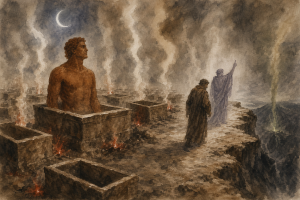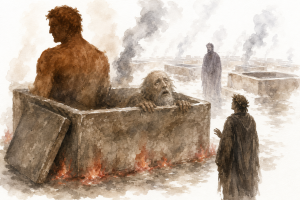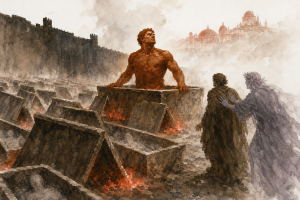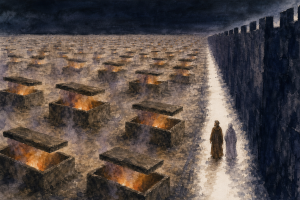
A canto that begins by going backwards — the narrator says «Io dico, seguitando» and rewinds behind the end of the previous canto to a moment when two small flames were being set on the tower’s summit and a third was answering from a distance the eye could barely hold — establishes before anything at all happens that Hell has a signalling system, that it has seen the travellers coming, and that the boat now crossing the Styx faster than any arrow has been sent for; and when its single pilot arrives shouting that he has caught a wicked soul, he is, like every gatekeeper before him, wrong.
Inferno · Canto 8 · Lines 1–30 · Scene 23
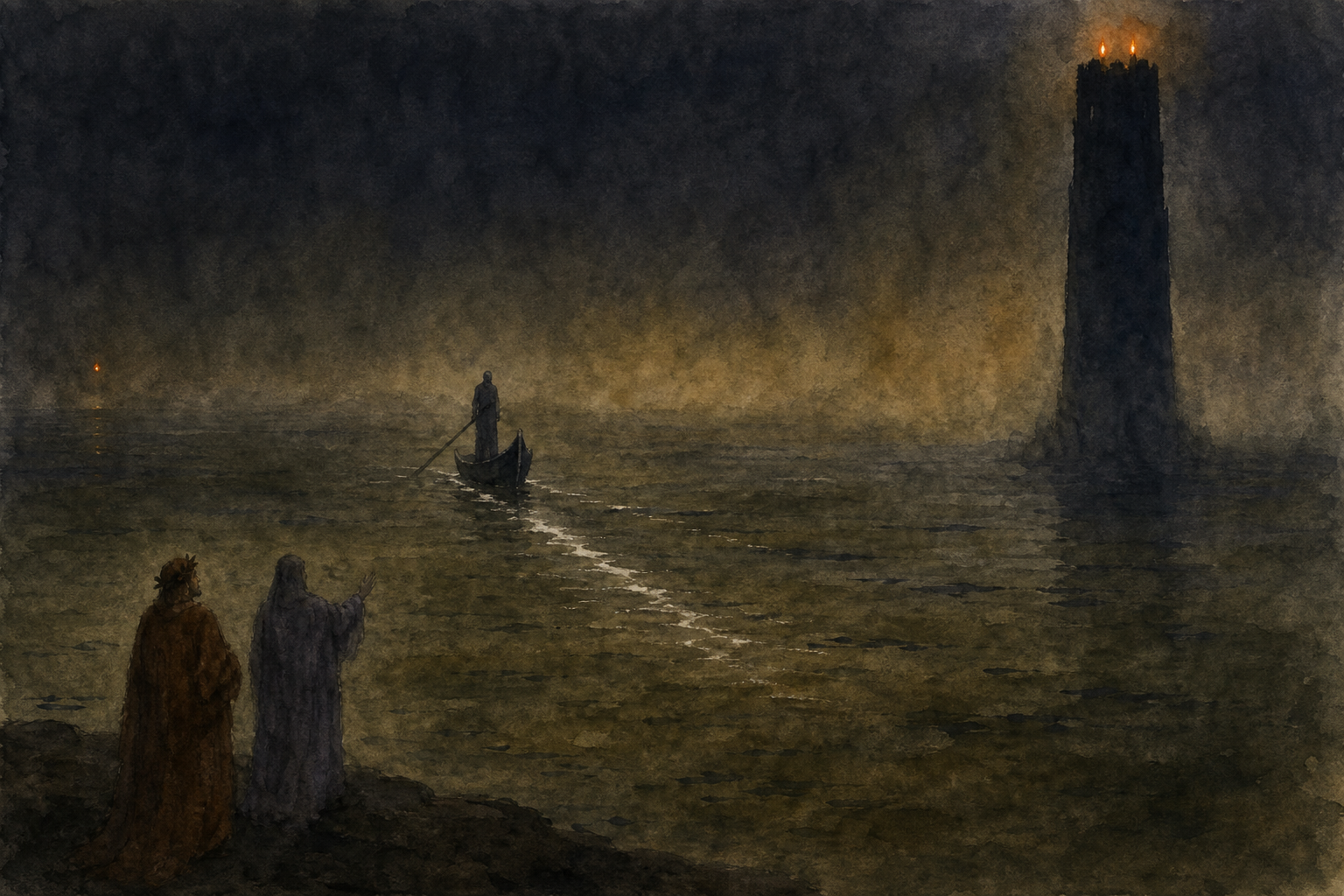
This canto does not start; it restarts. The narrator’s first words are «Io dico, seguitando» — I say, continuing — and then he does something no other canto does: he backs up. At the end of Canto VII the travellers had arrived at the foot of a tower. Now we are told that long before they got there, their eyes had already gone up to its top. The story rewinds behind its own last sentence.
Why would a poem admit to a seam like that? Boccaccio, writing about fifty years later, had an answer: Dante wrote seven cantos, was exiled, lost the pages, got them back years afterwards from a friend, and picked the poem up again with exactly this line. It is a lovely story and there is no evidence for it beyond the line itself. The phrase also works perfectly well as ordinary rhetoric — the formula a speaker uses when he takes up a thread he had let drop.
What the rewind buys is important. It puts the flames before the arrival. Two little fires are set on the tower’s summit, and a third fire far away answers with a sign, so faint the eye can hardly hold it. Somebody signalled, and somebody signalled back, and this happened while Dante and Virgil were still walking. Hell has a communications system, and it has seen them coming. This is the first time in the poem that the damned world is shown talking to itself, arranging something in advance.
Dante fires off three questions at once: what does this say, what does the other fire answer, who lit them? He calls Virgil «mar di tutto ‘l senno», the sea of all wisdom — a very large compliment, set up as if a very large explanation is coming. It does not come. Virgil tells him to look at the water: he can already make out what is expected, if the marsh smoke does not hide it. The fires are never decoded. Not in this canto, not later. We are shown a message and never told its content.
Then the boat. Dante measures it with a negative comparison: no bowstring ever drove an arrow through the air as fast as this little ship comes across the water. Charon, back in Canto III, was an old man rowing. This ferry has been sent for, and it arrives at the speed of a weapon, under the control of one man doing all the work himself.
He shouts before he lands: «Or se’ giunta, anima fella!» — now you are caught, wicked soul. He is wrong, and he is wrong in the way that everyone who guards a crossing in this poem is wrong. Charon assumed the living man would not be coming this way. Minos warned him off. Now Phlegyas assumes he has made a catch. Every threshold in Hell is staffed by someone who does not know what has been authorised above him.
Virgil’s reply is four beats long and utterly flat. He says the name twice — «Flegïàs, Flegïàs» — tells him he is shouting for nothing this time, and sets the exact term of the transaction: you will have us no longer than the crossing of the mud. Notice that he does not argue and does not explain. He simply states a limit, as if the arrangement had been made elsewhere and he is only reading it out.
And here is the strangest touch. Phlegyas, in the old myth, burned down Apollo’s temple in a rage. Dante mentions none of that. No father, no daughter, no fire, no crime. He gets a boat, a shout, and one simile: like a man who hears of some great trick played on him and then broods over it, Phlegyas gathered his anger in. He is the guardian of the wrathful, and the thing he does is swallow his wrath — which is the one thing the souls in the marsh below him cannot do.
They board, Virgil first. And the boat, which carried a shade without noticing, only looks loaded when the living body steps in. Then the ancient prow goes cutting through the water more than it is used to doing with other passengers. The proof that Dante is alive is not a speech. It is a waterline.
Go deeper: the college-level reading (about 1,200 words)
Quotes the Italian closely, with philological detail and cross-references.
The canto’s first word is «Io», and its first gesture is a correction of narrative order: «Io dico, seguitando, ch’assai prima / che noi fossimo al piè de l’alta torre, / li occhi nostri n’andar suso a la cima» (1–3). Canto VII had closed with the arrival at the foot of a tower; Canto VIII opens by placing itself «assai prima» than that arrival. The teller steps outside the told, announces that he is resuming, and then reaches back behind the seam he has just drawn attention to. Boccaccio, in the Trattatello and again in the Esposizioni, built on this line the famous story of an interrupted composition: seven cantos written before 1302, lost in the sack of Dante’s house, recovered years later and returned to the poet, who took up his pen with «Io dico, seguitando». The story is attested nowhere else and postdates the poem by half a century. Against it stands the plain fact that «dico seguitando» is a standard resumptive formula, the move of any speaker picking up a dropped thread, and that Dante’s canto-openings habitually foreground the act of narration rather than the act of walking.
What the rewind purchases is chronology. It makes the fires precede the travellers: «per due fiammette che i vedemmo porre, / e un’altra da lungi render cenno, / tanto ch’a pena il potea l’occhio tòrre» (4–6). The syntax is scrupulously agentless. Someone sets («porre») two little flames; something far off returns a sign («render cenno»); no subject is supplied for either verb. The diminutive «fiammette» keeps the scale domestic and the distance immense, and «tòrre» — to seize, to take — makes seeing an act of grasping at the edge of possibility. This is the poem’s first depiction of Hell communicating with itself. Charon and Minos and Cerberus reacted to arrivals; this apparatus anticipates them. Hell has infrastructure, and the infrastructure has already been used.
Dante’s response is three questions in a single tercet: «E io mi volsi al mar di tutto ‘l senno; / dissi: "Questo che dice? e che risponde / quell’altro foco? e chi son quei che ‘l fenno?"» (7–9). The epithet is unique in the poem and enormous — the sea of all wisdom, following on the «savio gentil, che tutto seppe» of VII.3 — and it is deployed precisely where wisdom will decline to perform. Virgil answers none of the three: «"Su per le sucide onde / già scorgere puoi quello che s’aspetta, / se ‘l fummo del pantan nol ti nasconde"» (10–12). He redirects the eyes rather than construing the sign. «Quello che s’aspetta» is impersonal and double: what is awaited, and what awaits you. The third question is answered only by implication — whoever lit the fires is sending something — and the first two are never answered at all. The message of the signal fires is withheld from the reader permanently. Whatever was ordered, we watch it arrive without knowing what was requested.
The arrival is measured negatively: «Corda non pinse mai da sé saetta / che sì corresse via per l’aere snella, / com’io vidi una nave piccioletta / venir per l’acqua verso noi in quella» (13–16). Compare the ferry of Inferno III, an ancient boatman rowing toward the bank at the pace of an old man. Here the craft comes at the speed of a released projectile because it has been summoned, and it comes «sotto ‘l governo d’un sol galeoto» (17) — one oarsman who is also the steersman, a crew of one. The word «galeoto», an oarsman of a galley, is the same form Francesca had used as a proper name three cantos earlier for the go-between of the Lancelot romance; whether the echo is designed or accidental has been argued both ways, but it is audible in the mouth.
The pilot shouts before he lands: «"Or se’ giunta, anima fella!"» (18). The participle «giunta» is feminine, agreeing with «anima», so the grammar tells us nothing about which of the two travellers is meant — and it may be a formula rather than an address. What is certain is that it is an error of expectation. The pattern is by now established at every crossing: Charon in III recognised the living man but assumed he would embark elsewhere, and had to be silenced; Minos in V warned him not to trust the wide entrance. Each functionary knows his own office and does not know the warrant. Phlegyas assumes a catch and has none.
Virgil’s reply occupies exactly one tercet: «"Flegïàs, Flegïàs, tu gridi a vòto", / disse lo mio segnore, "a questa volta: / più non ci avrai che sol passando il loto"» (19–21). The doubled vocative is the syntax of command, and «a questa volta» is a striking concession — this time you shout in vain, which grants that other times he does not. The office is real; only its application is denied. And «più non ci avrai che sol passando il loto» is a limit rather than an argument: the verb of possession is left standing, and the term of possession is simply announced. With Charon and with Minos, Virgil had invoked the will that can do what it wills; here the formula is compressed to a flat statement of duration, as though the authorisation were now tacit. Whether that compression signals Virgil’s growing confidence or the poem’s economy is not decidable from the line.
The simile that follows is domestic and psychological: «Qual è colui che grande inganno ascolta / che li sia fatto, e poi se ne rammarca, / fecesi Flegïàs ne l’ira accolta» (22–24). «Inganno» is a commercial and legal word — Phlegyas has been cheated of a cargo — and «rammarcarsi» is the slow secondary motion of grievance, resentment after the fact. «Ne l’ira accolta» has been read as gathered, pent-up, collected anger; the reflexive «fecesi» makes him become that anger rather than merely feel it. The guardian of the wrathful contains his wrath. Directly beneath his hull are souls who could not.
The boarding is brisk and the detail decisive: «Lo duca mio discese ne la barca, / e poi mi fece intrare appresso lui; / e sol quand’io fui dentro parve carca» (25–27). Guide first, pupil after; and the hull registers nothing until the body enters. The model is Aeneid VI, where Charon’s stitched skiff groans under the weight of Aeneas and ships water through its seams; Dante keeps the physics and drops the noise, and preserves the verb of appearance — «parve» — rather than asserting the fact. Then: «Tosto che ‘l duca e io nel legno fui, / segando se ne va l’antica prora / de l’acqua più che non suol con altrui» (28–30). The singular «fui» after a compound subject is a real grammatical oddity, variously explained as attraction to the nearer pronoun or as ordinary Trecento looseness. «L’antica prora» gives the craft an age it has not earned in the narrative — this is Hell’s own equipment, older than any passenger it carries — and the final phrase is genuinely disputed: does the prow cut the water more deeply than usual because it is laden, or move faster than usual because its pilot is furious? The line supports both, and the poem does not choose.
Go deeper still: the scholarly reading (about 1,100 words)
The commentary tradition, the sources, and what is documented versus inferred.
Call the anecdote first, and let it answer questions. The sole witness for the interrupted composition is Giovanni Boccaccio, who tells the story twice: in the Trattatello in laude di Dante, drafted around the early 1350s and revised thereafter, and again in the Esposizioni sopra la Comedia, the public lectures he began in Florence in 1373. The testimony runs thus: Dante had written seven cantos before his exile; the papers were left behind when his house was ransacked; years later they were found in a chest, forwarded to Moroello Malaspina, and shown to the poet, who thereupon resumed with «Io dico, seguitando» (1). In the Esposizioni Boccaccio names informants — Andrea di Leone Poggi, said to be the poet’s nephew, and Dino Perini — which is more than most fourteenth-century anecdotes offer, and less than it appears, since both men were long dead and neither can be examined.
Against the witness, four things. First, lateness: half a century separates the telling from the alleged event, and the teller is at two removes from it. Second, silence. The commentators who precede Boccaccio — Jacopo Alighieri, glossing the Inferno around 1322, Graziolo Bambaglioli in 1324, Guido da Pisa, the Ottimo, and Pietro Alighieri, the poet’s other son — are not known to tell the story at all; Boccaccio is its only source. Arguments from silence are weak in general and strong here, because one of the silent parties lived in the house. Third, internal chronology. Cantos I–VII already look back on things that had not happened by 1302: Ciacco foretells that the White party will fall «infra tre soli» and that the other will rise «con la forza di tal che testé piaggia» (Inf. VI, 68–69), which is the ordinary machinery of retrospective prophecy and awkward to explain in a text finished before the events. Fourth, motive. The story converts a conspicuous piece of narrative artifice into an accident of biography, and hinges the poet’s whole career on exile. It is exactly the anecdote a devoted biographer would either invent or believe.
Then there is the linguistic charge, which is the heaviest. «Io dico, seguitando» is not a strange thing for Dante to write. The formula belongs to the prose of exposition, the manner of the Convivio, where a writer announces that he takes up a thread laid down; and Dante’s canto-openings habitually make an event of the telling rather than of the walking, as when he counts the canto in his own hands: «e dar matera al ventesimo canto / de la prima canzon, ch’è d’i sommersi» (Inf. XX, 2–3). A line that functions perfectly as rhetoric needs no external history to account for it.
The verdict should be «not proven» rather than «false». Nothing here disproves an interruption in Dante’s work; the poem was written across years and no doubt stopped and started. What collapses is the specific narrative, with its chest and its marquis and its seven cantos. It is worth adding that the wider question of when the Inferno was begun does not depend on Boccaccio at all: Giorgio Petrocchi’s dating of the poem’s composition, arrived at on other evidence entirely, would place the early cantos considerably before the anecdote’s supposed recovery, and readers may reasonably differ about it without invoking a lost manuscript.
Acquitted of biography, the seam has to be read as construction, and what it constructs is order. The fires come before the travellers, and the earliest glossators, unwilling to leave a signal unread, tried to decode them: two flames for two arrivals, the distant answer an acknowledgement that transport is dispatched. The poem authorises none of this. What it does authorise is a change of institution. Upper Hell was staffed by monsters who reacted — Charon at his bank, Minos at his threshold, Cerberus in his mud. From the tower onwards Hell has procedure: watchmen, signals, a garrison, walls, and eventually a squad of devils under a decurion. The apparatus is efficient about the fact of arrival and useless about its nature. It has reported that two figures are coming; it cannot report what they are. That failure is what produces the ferryman’s blunder.
Phlegyas arrives with no curriculum vitae. In Virgil he is a voice in Tartarus, warning the shades — «discite iustitiam moniti et non temnere divos» (Aen. VI, 620) — and Servius supplies the reason: he burned Apollo’s temple at Delphi to avenge his daughter. Dante keeps the name, drops the story, and adds an office found in no classical source. This is his settled practice with pagan figures once they are put on the payroll; Minos loses his judicial dignity and grows a tail, Charon becomes «Caron dimonio, con occhi di bragia» (Inf. III, 109). Whether Phlegyas is warder or inmate the poem declines to say. He is given «ne l’ira accolta» (24), which is the vice of the swamp he crosses, and no visible punishment, and commentators have divided on the point since the fourteenth century without resolving it.
His cry, «Or se’ giunta, anima fella!» (18), is uttered before he has looked: a formula fired off at a soul assumed. It is the same mistake Charon made with «Guai a voi, anime prave!» (Inf. III, 84), and Dante has now built it into every crossing, so that each frontier is marked by a functionary shouting the wrong thing. Virgil corrects him not by argument but by terms: «tu gridi a vòto» (19), «a questa volta» (20), «più non ci avrai che sol passando il loto» (21). No warrant is cited; unlike «vuolsi così colà dove si puote» at III, 95, the authority is not even named, merely exercised. The grammar is proprietary — «non ci avrai» — and it limits the demon’s possession to the duration of the ferry. What follows is the passage’s oddest concession: Phlegyas is compared to a man who learns of «grande inganno» (22) done to him. Dante grants him the posture of a defrauded party, a claim recognised and then set aside.
The crossing itself is a quiet correction of Virgil. In Aeneid VI the skiff groans and leaks under a living body — «gemuit sub pondere cumba» (VI, 413). Here there is only «e sol quand’io fui dentro parve carca» (27), and a prow that cuts «più che non suol con altrui» (30). Dante replaces complaint with measurement: the living weight registers as displacement, nothing more. And the one antiquity the passage allows goes not to the mythological ferryman but to his vessel — «l’antica prora» (29), old timber in service of a new administration.
The Italian — Phlegyas and the Swift Boat
Source: Wikisource (public domain, pre-1929 text)
Lines 1–3
1. Io dico, seguitando, ch’assai prima2. che noi fossimo al piè de l’alta torre,3. li occhi nostri n’andar suso a la cima
literary key: Line 1 — «Io dico, seguitando» — I say, continuing. The poem’s most conspicuous narratorial seam, and a hapax: nowhere else does a canto open by announcing that it is resuming. Boccaccio built on it the story that Dante composed seven cantos before his exile, lost the pages when his house was sacked in 1302, and took the poem up again years later with this line. Report it as a legend: Boccaccio is the sole source, writing some fifty years afterwards, and the number seven is supplied by the seam itself. The phrase is also, quite independently, the standard resumptive formula of a speaker retrieving a dropped thread. [Model knowledge · medium]
literary key: Line 2 — «assai prima / che noi fossimo al piè de l’alta torre» — long before we were at the foot of the high tower. Canto VII had ended precisely with the arrival at that tower; this tercet therefore reverses behind the previous canto’s last line. Whatever one thinks of the compositional legend, the rewind does concrete work: it places the signal fires before the travellers’ arrival, so that Hell is shown anticipating them rather than reacting to them. The canto’s first move is a manipulation of narrative time, performed openly and flagged by the verb of telling. [Source: Inferno VII, closing lines]
Lines 4–6
4. per due fiammette che i vedemmo porre,5. e un’altra da lungi render cenno,6. tanto ch’a pena il potea l’occhio tòrre.
history: Line 4 — «due fiammette che i vedemmo porre» — two little flames that we saw set there. Fire signalling from towers was live military practice in Dante’s Italy, familiar from communal watchtowers and castle garrisons, and the early commentators read the detail literally against that background; Some proposed that the number of flames encodes information — how many are coming, or of what kind. The text neither supports nor excludes any of this. Note the agentless syntax: someone sets the flames, and the poem never says who, though Dante will ask. [Model knowledge · medium]
literary key: Line 5 — «un’altra da lungi render cenno» — another, far off, returning a sign. This is the first moment in the poem where Hell is shown communicating with itself. Charon, Minos, Cerberus and Plutus all reacted to arrivals in front of them; here two stations exchange a message across the marsh before the travellers are within reach. Hell has infrastructure, and the infrastructure has been used. «Cenno» is a nod, a signal, the minimal unit of intelligible sign — and its content is never disclosed to the reader, in this canto or any later one. [Model knowledge · high]
vocabulary: Line 6 — «tanto ch’a pena il potea l’occhio tòrre» — so far that the eye could barely take it. «Tòrre» is the syncopated form of togliere, to take or seize, used here of sight: seeing is grasping, and at this distance the grasp nearly fails. The line sets the scale of the exchange — the answering fire is at the outer limit of perception, which means the network extends further than the pilgrim can see, and further than the poem will show him. [Model knowledge · high]
Lines 7–9
7. E io mi volsi al mar di tutto ‘l senno;8. dissi: "Questo che dice? e che risponde9. quell’altro foco? e chi son quei che ‘l fenno?".
literary key: Line 7 — «mar di tutto ‘l senno» — the sea of all wisdom. A unique epithet for Virgil, and an enormous one, following the «savio gentil, che tutto seppe» of the previous canto’s third line. Its placement is pointed: the largest claim for Virgil’s knowledge in the whole Inferno introduces the one request he declines to satisfy. Of the three questions in the next tercet he answers none directly; he redirects the pilgrim’s eyes to the water instead. The reader is invited to notice the gap between the title and the performance. [Source: Inferno VII.3]
translation note: Line 9 — «e chi son quei che ‘l fenno?» — and who are they that made it? «Fenno» is the third-person plural preterite of fare (modern fecero), a standard Tuscan form. The three questions of 8–9 are hermeneutic in ascending order: what does the sign say, what does the answer say, who are the signatories. The poem answers only the last, and only by implication — whoever they are, they are sending a boat. The semantic content of the fires is permanently withheld. [Model knowledge · high]
Lines 10–12
10. Ed elli a me: "Su per le sucide onde11. già scorgere puoi quello che s’aspetta,12. se ‘l fummo del pantan nol ti nasconde".
translation note: Line 11 — «già scorgere puoi quello che s’aspetta» — you can already make out what is expected. The impersonal reflexive is deliberately two-faced: what is being awaited (the boat that the signal has summoned) and what awaits you (the pilot and his cry). English translators must choose; Italian need not. Virgil’s whole reply substitutes seeing for construing — he tells Dante where to look, not what the signal meant, which leaves the pilgrim to read the answer off the water as it arrives. [Model knowledge · high]
vocabulary: Line 12 — «se ‘l fummo del pantan nol ti nasconde» — if the marsh smoke does not hide it from you. «Pantano» is bog, «fummo» the vapour rising off it: the Styx generates its own visual interference, so that the medium of Hell’s fifth circle obstructs the reading of Hell’s own signals. Given that the marsh is the punishment of the wrathful, whose sin the tradition regularly figured as smoke rising and clouding the reason, the atmospheric detail carries a moral one without being asked to state it. [Model knowledge · medium]
Lines 13–15
13. Corda non pinse mai da sé saetta14. che sì corresse via per l’aere snella,15. com’io vidi una nave piccioletta
literary key: Line 13 — «Corda non pinse mai da sé saetta» — no bowstring ever drove an arrow from itself. A negative comparison, the rhetorical form that measures by denying any adequate measure. Set it against the arrival of Charon in Canto III, an ancient boatman rowing slowly toward the bank: that ferry had to be waited for; this one has been sent for, and comes at the velocity of a released weapon. Speed here is the visible proof that the signal fires were an order and that the order has been obeyed. [Source: Inferno III (Charon’s approach)]
wordplay: Line 15 — «una nave piccioletta» — a little ship. Within sixteen lines the same craft is called nave (15), barca (25), legno (28) and prora (29, by synecdoche). The lexical restlessness is not padding: each word carries a different register — nave the neutral vessel, barca the working boat, legno the bare timber, prora the cutting edge that will register Dante’s weight. The diminutive here is also doing scalar work against the immensity of the marsh and the distance of the answering fire. [Model knowledge · high]
Lines 16–18
16. venir per l’acqua verso noi in quella,17. sotto ‘l governo d’un sol galeoto,18. che gridava: "Or se’ giunta, anima fella!".
wordplay: Line 17 — «sotto ‘l governo d’un sol galeoto» — under the governance of a single oarsman. A galeoto is a galley hand; here he is helmsman and rower at once, a crew of one, which is part of the picture of an efficient dispatch. The word is also, in this exact form, the noun Francesca turned into a name three cantos earlier when she made the book and its author the go-between of her fall. Whether Dante intended the echo is unprovable; that a reader hears it is not. [Source: Inferno V (Francesca’s «Galeotto»)]
literary key: Line 18 — «Or se’ giunta, anima fella!» — now you are come, wicked soul. The participle is feminine because it agrees with «anima», so the grammar identifies no one; commentators have read the cry as addressed to Dante, to Virgil, or to nobody in particular, the boatman’s habitual hail. What is certain is the error of expectation. Charon in Canto III recognised the living man but assumed he would embark at another port and had to be silenced; Minos warned him not to trust the open gate. Every crossing in Hell is staffed by a functionary who knows his office and not his warrant. [Source: Inferno III and V (Charon, Minos)]
Lines 19–21
19. "Flegïàs, Flegïàs, tu gridi a vòto",20. disse lo mio segnore, "a questa volta:21. più non ci avrai che sol passando il loto".
cultural ref: Line 19 — «Flegïàs, Flegïàs» — the doubled vocative, a formula of command with a distinctly liturgical and exorcistic ring. In the myth, Phlegyas was the father of Coronis who burned Apollo’s temple at Delphi in revenge; in Aeneid VI he appears among the punished, crying out to the shades that they should learn justice and not despise the gods. Dante keeps the name and the temper and discards everything else: no father, no daughter, no arson, no admonition. No ancient source gives him a boat. The office is Dante’s invention, and it is characteristic of how the Inferno treats classical figures once they become staff. [Model knowledge · high]
literary key: Line 20 — «tu gridi a vòto … a questa volta» — you cry in vain, this time. The temporal qualifier is a striking concession: on other occasions the cry is not in vain, and the office is entirely legitimate. Virgil does not dispute Phlegyas’s function, only its application to these two passengers. It is the same move he made with Minos and Charon — the authority of the guardian is granted, and then declared irrelevant to a case decided elsewhere. [Model knowledge · high]
theology: Line 21 — «più non ci avrai che sol passando il loto» — you shall have us no longer than the crossing of the mud. A bargain stated as a fact, in the impersonal grammar of the earlier gates: with Charon and Minos, Virgil had invoked the will that can do what it wills without naming it; here the invocation is compressed to a bare term of possession. The verb «avere» is left standing — Phlegyas really will have them, briefly — which concedes the demon everything except duration. Passage is authorised above, and the demon’s consent is not among the conditions. [Source: Inferno III and V (Virgil’s formula before Charon and Minos)]
Lines 22–24
22. Qual è colui che grande inganno ascolta23. che li sia fatto, e poi se ne rammarca,24. fecesi Flegïàs ne l’ira accolta.
literary key: Line 22 — «Qual è colui che grande inganno ascolta / che li sia fatto, e poi se ne rammarca» — like one who hears of a great deceit done to him, and then broods on it. «Inganno» is a legal and mercantile word: Phlegyas has been cheated of a cargo, and the simile places him among aggrieved creditors rather than among monsters. «Rammarcarsi» names the slow secondary motion of grievance, resentment arriving after the fact — precisely the emotion Dante will anatomise below the surface of this marsh. [Model knowledge · high]
literary key: Line 24 — «fecesi Flegïàs ne l’ira accolta» — Phlegyas made himself into gathered anger. «Accolta» is anger collected, contained, held in rather than discharged; the reflexive «fecesi» suggests he becomes the emotion rather than merely feels it. The guardian of the wrathful swallows his wrath — which is the one thing the souls beneath his hull, striking each other on the surface and choking on their own sighs in the mud, are unable to do. The poem places the demonstration directly above the punishment. [Model knowledge · high]
Lines 25–27
25. Lo duca mio discese ne la barca,26. e poi mi fece intrare appresso lui;27. e sol quand’io fui dentro parve carca.
cultural ref: Line 27 — «e sol quand’io fui dentro parve carca» — and only when I was inside did it seem laden. The model is Aeneid VI, where Charon’s stitched skiff groans under the weight of the living Aeneas and takes in marsh water through its seams. Dante keeps the physics and drops the noise, and preserves the verb of appearance — «parve», it seemed — where Virgil asserted the fact. The proof that the pilgrim is alive is not a speech but a waterline, and the poem states it as an impression rather than a datum. [Model knowledge · high]
Lines 28–30
28. Tosto che ‘l duca e io nel legno fui,29. segando se ne va l’antica prora30. de l’acqua più che non suol con altrui.
vocabulary: Line 28 — «Tosto che ‘l duca e io nel legno fui» — as soon as the guide and I were in the boat. The verb is singular where the compound subject demands a plural; explanations range from syllepsis, to attraction of the verb to the adjacent «io», to ordinary Trecento looseness, and the manuscript tradition is not perfectly uniform. It is a small reminder that the text of the Commedia is an edited artefact: Petrocchi’s choices, followed in most modern printings, are choices. [Model knowledge · medium]
literary key: Line 30 — «de l’acqua più che non suol con altrui» — through the water more than it is wont with others. Genuinely disputed. The majority reading takes it as depth: the ancient prow cuts deeper because it carries a body, continuing the observation of line 27. A minority takes it as speed, the boat driven harder by a pilot in a temper. Both are grammatically available, and the poem does not choose. «Altrui» is the ordinary freight — the dead, who weigh nothing — and «l’antica prora» gives the craft an age it has not earned in the narrative: this is Hell’s own equipment, older than almost anyone it carries. [Model knowledge · medium]
Seven Centuries of Reading Phlegyas and the Swift Boat
‘Io dico, seguitando’
The canto opens by stepping back in time. Its first eighty-one lines narrate what happened between the travellers’ arrival at the Styx and their reaching the tower named in the last line of Canto VII, and the self-conscious opening, «Io dico, seguitando» (1), marks the interruption. Boccaccio was the first to read more into it. In his account, Dante had written the first seven cantos in Florence before his exile, the pages were left behind, and some six or seven years later a friend brought them to him in Lunigiana, around 1306, so that he resumed the poem here.
Most scholars do not credit the story, Hollander notes, but it has had serious defenders, notably Giovanni Ferretti (1935) and Giorgio Padoan (1993).
The signals and the boatman
The two flames on the tower and the answering flame far off (4–6) have never been fully explained, and Virgil answers none of the pilgrim’s three questions about them. They seem to summon Phlegyas. Caretti thought Phlegyas’s work was to place the wrathful in the river, not to ferry them across. Hollander finds that improbable and suggests he may round up souls who try to escape the mud. Padoan observed that Phlegyas’s boat is small, unlike Charon’s: a pursuit craft for individuals, not a ferry for crowds. He also noted that Dante associates the adjective «fella» (18), and its forms, with wrath.
Phlegyas comes from Aeneid VI, where in Tartarus he warns all the shades, «discite iustitiam moniti et non temnere divos», learn justice and do not scorn the gods. He had burned Apollo’s temple at Delphi in fury after Apollo violated his daughter. The pilgrim’s stepping into the boat, which only then seems laden, is modelled on Aeneas boarding Charon’s skiff (Aeneid VI.413–414).
What remains open
Hollander observes that the whole opening of the canto raises more questions than it answers. Who signals whom, what Phlegyas normally does, and why he believed he had been summoned to take a soul are all unresolved. So is the story of the lost cantos, which has only Boccaccio to support it.
The Two Main Positions on Phlegyas and the Swift Boat
The Interrupted Poem
The line is autobiographical residue. Dante began the Commedia in Florence, lost the work when his house was sacked after the condemnation of 1302, recovered the first seven cantos years later in exile, and resumed with a formula that says exactly what it means: I say, continuing. On this reading Canto VIII is the join between two lives, and its abrupt change of register — a Hell that now organises, signals, resists and shuts its gates, and a pilgrim who for the first time turns savage on a sinner — is what the join looks like. Giorgio Padoan is the most substantial modern defender of an early start to the poem; Boccaccio’s Trattatello and Esposizioni are the source.
Key passage: «Io dico, seguitando» is a hapax in the poem, and it is attached to the only place where the narrative reverses over its own canto-boundary; a poet in continuous command of his material has no need to reopen a scene he has already closed. The tradition preserving the story is early and Florentine, and Boccaccio elsewhere transmits information about Dante that is otherwise unrecoverable but not therefore false.
The Constructed Seam
The line is rhetoric, and the anecdote is a legend reverse-engineered from it. Dico seguitando is the ordinary formula for taking up a dropped thread, familiar from scholastic and notarial prose, and Dante’s canto-openings characteristically foreground the narrating voice. The rewind is functional rather than confessional: it is the only way to place the signal fires before the arrival at the tower, and so to establish that Hell despatched the ferry in advance. The seam, in other words, buys the canto its central discovery — that the damned world has infrastructure and had notice.
Key passage: The first seven cantos as transmitted already presuppose the exile — Ciacco in VI prophesies events of 1302 — and the accepted chronology places the Inferno’s composition after 1304. Boccaccio’s number of seven cantos is derived from the line rather than corroborating it; his details vary between redactions; and the letter of Frate Ilaro, the only other document sometimes adduced, is of disputed authenticity and survives in Boccaccio’s own notebook.
What the Text Does — and What That Means (Contested)
On the page: The phrase «Io dico, seguitando» occurs at VIII.1 and nowhere else in the poem. Canto VII ends with the arrival at the foot of a tower; VIII.1–3 situates the upward glance «assai prima / che noi fossimo al piè de l’alta torre». The agents of «porre» (4) and of «render cenno» (5) are never named, and the content of the signal is never given, in this canto or later. Dante asks three questions at 8–9; Virgil’s reply at 10–12 redirects his sight and construes nothing. Virgil is called «mar di tutto ‘l senno» (7). Phlegyas is named twice in line 19 and is supplied with no biography, no crime and no genealogy anywhere in the poem. His cry at 18 assumes an arrival he does not get. Virgil’s answer (19–21) states a term of possession without naming an authorising will. Line 27 reports that the boat «parve carca» only once Dante was inside; line 30 says the prow goes «più che non suol con altrui». The singular verb «fui» at 28 governs the compound subject «’l duca e io».
What scholars dispute: Whether the line records an actual break in composition is not decidable from the poem. The only source for the interruption is Boccaccio, writing some fifty years after Dante’s death, and the number of cantos in his account is fixed by nothing but the seam it explains. Nothing in the manuscript tradition independently corroborates it, and no argument from the poem’s internal chronology closes the case, since early drafting followed by revision cannot be excluded. Any statement about what Dante intended by the line — confession, artifice, or both — is contested and should be marked as such.
What Dante Leaves Unresolved
The message is never decoded. We are shown two flames set, a distant fire answering, and a boat arriving at the speed of an arrow, and we are never told what was said, who said it, or what was requested. Virgil, addressed as the sea of all wisdom, answers none of the three questions put to him. Readers who assume the signal summoned the resistance later mounted at the walls of Dis are supplying a connection the text withholds, and the poem’s refusal to supply it is exactly as deliberate — or as unremarkable — as one takes the seam in its first line to be.
The Open Question
The canto opens by admitting a seam: the narrator says «Io dico, seguitando» and then reverses behind the end of the previous canto. Is that seam a scar — the visible join where a real interruption in the poem’s composition was repaired — or is it engineering, a narrator deliberately exposing the act of narration in order to reset the clock so that Hell’s signal fires can be shown burning before the travellers arrive?
Explore More
About This Article

Written by Lucy Bamboo. Lucy Bamboo has been reading the Divine Comedy for fifteen years — first in translation, then stubbornly in Medieval Tuscan with a dictionary and far too many footnotes. Reading Dante is her scene-by-scene walk through the poem: the original Italian, seven centuries of scholarly argument presented as argument rather than answer, and the human questions sitting underneath the theology. More about this site.
Verify this against a primary source
Specifics change, and your situation may differ from the one described here. These are the authorities worth checking directly:
- Digital Dante, Columbia University — text, commentary and translation apparatus
- Princeton Dante Project — the Commedia with historical commentary
- Dartmouth Dante Project — searchable commentary from 1322 onward