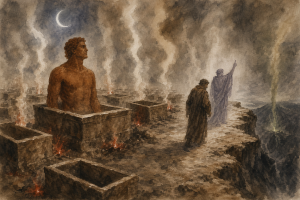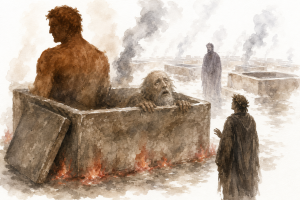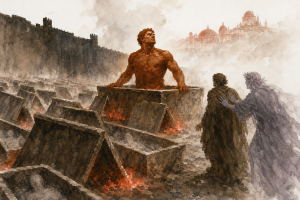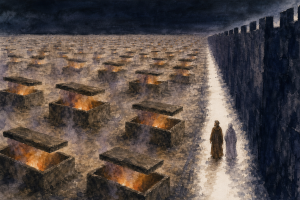
Virgil looks up at stars Dante cannot see, announces that the night is turning and that lingering is forbidden, and takes his pupil across the fourth circle to a boiling spring that has cut its own channel down into the dark; they follow the water, which is «buia assai più che persa» (103), until it flattens into the marsh called Styx, and there Dante stops to stare at naked muddy figures tearing at one another with teeth and head and chest — and is then told that the ones he can see are only half of it, that beneath the surface lies a second population whose bubbles are their speech, and whose confession, sung in the throat because they cannot form whole words, Virgil recites for them.
Inferno · Canto 7 · Lines 97–130 · Scene 22
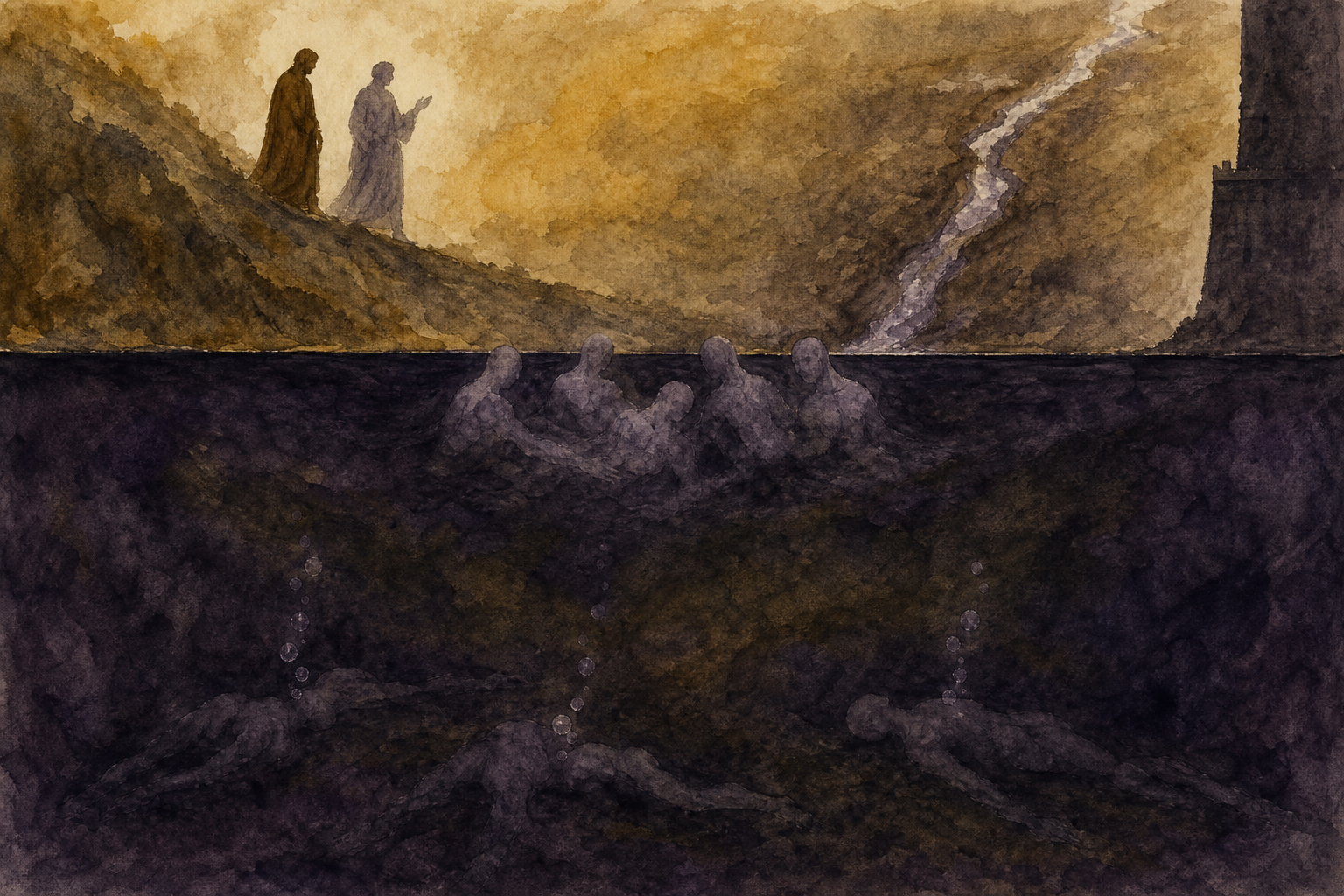
Virgil starts this passage by looking at the sky. He says every star that was rising when they set out is now going down, and that they are not allowed to stay too long. There is no sky in Hell — Dante cannot see stars from inside the earth — so this is Virgil reading a clock that only he has access to. It is one of several places in the poem where the journey is put on a schedule. The point is that the descent has a deadline, and that this is not a sightseeing trip.
They cut across the circle to the other bank. There is a spring boiling up out of the ground, and it has carved a ditch for itself, and they follow it down. Dante says the water was «buia assai più che persa» (103) — darker than perse, which is a colour word he actually defines in another of his books as a dark mix between purple and black. He is being precise, not just gloomy. The waves are «bige», dusky grey, and the path down is «diversa», strange or other, the sort of road you would not choose.
The stream flattens out into a marsh, and the marsh has a name: Styx. Dante takes the name from classical poetry, but the geography is his own invention. And here he stops and stares. He uses a phrase for himself — «io, che di mirare stava inteso» (109) — that means he was intent on looking. He does this at moments when something is about to be worse than expected.
What he sees is naked people in mud, with an angry look on them, hitting each other. Not just with hands: with the head, the chest, the feet, and then tearing pieces off each other with their teeth, «a brano a brano» (114). This is the least dignified violence in the poem so far. There is no weapon, no skill, no aim. In life anger feels like power; here it is reduced to a body flailing at other bodies in a swamp.
Then Virgil does something unusual. He identifies the visible sinners — «l’anime di color cui vinse l’ira» (116), the souls whom anger conquered — and then tells Dante to believe something he cannot see. Under the water there are more people. You can tell because the surface keeps bubbling, «come l’occhio ti dice, u’ che s’aggira» (120): wherever you look, your eye tells you. The bubbles are the evidence. This is the moment the circle turns out to have two floors.
And Virgil quotes them. Fixed in the slime, they say: we were sullen in the sweet air that the sun makes glad, carrying inside us a sluggish smoke; now we are sullen in the black mud. The word for the smoke is «accidïoso fummo» (123) — a fog you carry around in yourself. Notice the rhyme Dante builds: «fummo» meaning ‘we were’ at 121, and «fummo» meaning ‘smoke’ at 123. The same sound is their past tense and their sin.
Then the line that makes the whole passage: «Quest’inno si gorgoglian ne la strozza, / ché dir nol posson con parola integra» (125–126). This hymn they gurgle in the throat, because they cannot say it with a whole word. Two things are happening. First, he calls it a hymn — an inno, the word for a song of praise sung in church. What they are singing is a confession of self-inflicted gloom, produced as bubbles. Second, they can no longer complete a word. People who kept silent, who sulked and would not speak, have had speech taken away from them permanently. The punishment is grammatical.
Dante and Virgil then walk a great arc around the filthy pool, between the dry bank and the wet, «con li occhi vòlti a chi del fango ingozza» (129) — eyes turned on those gulping mud. And they arrive at the foot of a tower. Something is about to signal.
Go deeper: the college-level reading (about 1,200 words)
Quotes the Italian closely, with philological detail and cross-references.
The passage opens with a time-check delivered by Virgil in the same breath as a warning: «già ogne stella cade che saliva / quand’io mi mossi, e ‘l troppo star si vieta» (98–99). Every star that was ascending when Virgil set out from Limbo is now descending; roughly twelve hours have turned. The astronomical markers are structurally serious in the Inferno — compare the moon’s position reported at Inf. XX.127–129, and the double check that will get them out of Malebolge — and they perform a peculiar function here, since the pilgrim has no sky. Only Virgil knows the hour. The clause «’l troppo star si vieta» uses the impersonal reflexive that Hell reserves for divine prohibition, the grammar of «s’altri nol niega» at V.81: an authority is issuing instructions without being named. The descent runs to a schedule imposed from outside, and Virgil is the only one of the two who can read it.
«Or discendiamo omai a maggior pieta» (97) is a crux in miniature. ‘Pieta’ in Dante’s usage can be the pity felt by an observer or the pitiableness of the thing observed, and editors and translators split accordingly: greater pity for us, or greater misery for them. The word is the canto’s and the canticle’s hinge — it has been doing double duty since «io venni men così com’io morisse» closed canto V — and Dante does not disambiguate it. The comparative is what matters: the fifth circle is worse than the fourth, and the poem says so in advance.
The hydrography is exact and entirely Dante’s. «sovr’una fonte che bolle e riversa / per un fossato che da lei deriva» (101–102): a spring that boils and overflows into a ditch derived from itself. The verbs are technical — «riversa», «deriva», «fossato» — the vocabulary of irrigation and land drainage rather than of myth. Then the colour: «L’acqua era buia assai più che persa» (103). Perse is not decorative. In Convivio IV.xx.2 Dante defines ‘perso’ as a colour compounded of purple and black, with the black dominant; here the water is darker still, i.e. beyond the darkest mixed colour he has a name for. The accompanying «onde bige» (104) — dusky, greyish waves — extends the same chromatic care, and «una via diversa» (105) plays on ‘diversa’ in its Latin sense of turned-aside, other, abnormal: the same adjective family that gave «diverse lingue» to the vestibule at III.25.
«In la palude va c’ ha nome Stige» (106) is the classical name arriving after the physical description, not before it. Dante inherits the Styx from Virgil (Aen. VI) and from the whole tradition of the infernal rivers, but he re-plumbs the system: in his Hell the waters descend from a single source, the statue of the Old Man of Crete, and Styx is one stage of that single stream — a topography set out at Inf. XIV.94–120, several cantos later, so that here the reader is given the marsh before the theory. The banks are «le maligne piagge grige» (108), malignant grey slopes, with the adjective transferred from the inhabitants to the ground.
«E io, che di mirare stava inteso» (109) marks the pilgrim’s absorbed gaze — the posture he adopts before Filippo Argenti’s arm comes over the gunwale in the next canto, and before the fraudulent counsellors’ flames. What he sees is «genti fangose in quel pantano, / ignude tutte, con sembiante offeso» (110–111). ‘Sembiante offeso’ is deliberately unstable: an appearance of having been injured, or an appearance of taking offence — the face of the perpetually affronted. Both senses are live in Dante’s Italian, and the ambiguity is exactly right for wrath, which always experiences itself as the wronged party.
The violence is anatomical and inarticulate: «Queste si percotean non pur con mano, / ma con la testa e col petto e coi piedi, / troncandosi co’ denti a brano a brano» (112–114). The polysyndeton — «e… e… e…» — refuses hierarchy among the body parts; the gerund «troncandosi» makes the mutilation reciprocal and ongoing; «a brano a brano» is the poem’s reduplicative idiom for piecemeal destruction. No instrument, no target, no end.
Then the circle turns out to be stratified. Virgil names the visible: «l’anime di color cui vinse l’ira» (116) — souls whom anger conquered, the passive construction that Francesca had exploited in her own defence at V.100–106 but which Virgil here uses diagnostically rather than exculpatorily. And he requires belief in the invisible: «e anche vo’ che tu per certo credi / che sotto l’acqua è gente che sospira» (117–118). This is the only place in the Inferno where Virgil asks for assent to a population that cannot be seen, and the evidence he offers is empirical anyway: «fanno pullular quest’acqua al summo, / come l’occhio ti dice, u’ che s’aggira» (119–120). ‘Pullulare’ is a Latinism of germination and swarming; the bubbles are simultaneously a physical sign and a form of utterance.
The submerged confession is a masterpiece of phonetic economy. «Fitti nel limo dicon: ‘Tristi fummo / ne l’aere dolce che dal sol s’allegra, / portando dentro accidïoso fummo: / or ci attristiam ne la belletta negra’» (121–124). The rhyme yokes «fummo», first-person plural preterite of «essere», to «fummo», smoke: their past tense and their vice are homophones. Between them stands the loveliest line in the passage, «ne l’aere dolce che dal sol s’allegra» — the sweet air gladdened by the sun, a world whose gratuitous joy they refused. That refusal, «tristi… or ci attristiam», is the same verb in the same voice, before and after: the sin and the punishment are indistinguishable in grammar, the strongest form of contrapasso Dante has yet produced. And «accidïoso fummo» (123) carries the whole doctrinal problem of the circle in two words.
«Quest’inno si gorgoglian ne la strozza, / ché dir nol posson con parola integra» (125–126). Calling it an «inno» is startling: the technical term for liturgical praise, applied to a confession of joylessness produced as bubbles in a throat. The reflexive «si gorgoglian» makes them gurgle it to themselves, and «parola integra» — a whole, unbroken word — locates the penalty in the phonemes. Speech is the faculty Dante prizes above nearly all others; the De vulgari eloquentia founds human dignity on it. Those who withheld it are denied its integrity. Compare the giant Nimrod at Inf. XXXI.67, whose «Raphèl maì amècche zabì almi» is a whole voice producing no meaning; here the meaning is intact and the voice is destroyed.
The walkers then trace «grand’arco, tra la ripa secca e ‘l mézzo» (128) — between the dry bank and the sodden — the pilgrim’s eyes «vòlti a chi del fango ingozza» (129), fixed on those gulping mud. «Mézzo» (rotten, over-ripe, waterlogged) and «ingozza» (to gulp, to gorge) belong to a register of physical disgust that will dominate the lower circles. And the final line drops without transition: «Venimmo al piè d’una torre al da sezzo» (130). A tower, in a swamp, at the last. The signal-fires of canto VIII are already lit above them.
Go deeper still: the scholarly reading (about 1,100 words)
The commentary tradition, the sources, and what is documented versus inferred.
Upper Hell, read as a filing system, has gaps. If the circles between Limbo and the walls of Dis are meant to house the seven capital vices, then lust, gluttony, avarice and wrath are provided for and pride, envy and accidia are not. Pride and envy can be argued to pervade the lower city rather than occupy a terrace of their own; accidia has no such alibi. Either it is somewhere in this marsh, or the Inferno declines to punish one of the seven vices the Purgatorio will devote a whole terrace to purging. That is the architectural problem the passage sits inside, and it is worth saying at once that the pressure comes from readers rather than from the poem: Dante never promises that upper Hell will be organised by the Gregorian septenary. When Virgil finally sets out the plan at Inf. XI, he uses Aristotle — «incontenenza, malizia e la matta / bestialitade» (Inf. XI.82–83) — and in answering the pilgrim’s question about «quei de la palude pingue» (Inf. XI.70) he files the marsh with the incontinent, alongside the wind, the rain and the clashing weights. Whatever is in the mud, it is a failure of self-government, not of malice.
The difficulty is that the marsh is stratified, and the two strata are described in two separate gestures. Virgil names the surface population as «l’anime di color cui vinse l’ira» (116) and then, as if introducing a distinct exhibit, adds «e anche vo’ che tu per certo credi / che sotto l’acqua è gente che sospira» (117–118). The question that has divided commentators since the Trecento is whether the second tercet extends the first class or opens a new one. Read one way, the whole circle punishes anger under two species, the acute and the bitter: the classification is Aristotelian in origin — Nicomachean Ethics IV distinguishes the quick-tempered from those who nurse resentment inwardly — and was available to Dante through the scholastic discussion of the species of anger, where the bitter man’s fault is precisely that his anger does not discharge. On this reading the mud is one sin seen from two sides, outward and inward, and «accidïoso fummo» (123) means something like the sluggish smoke of an anger that never caught fire.
Read the other way, the submerged are accidiosi in the full moral sense, and the lexis is the evidence. The confession is built on a single root: «Tristi fummo» (121), «or ci attristiam ne la belletta negra» (124). Tristitia is the older name of the vice that the Gregorian tradition folded into acedia, and Dante puts it twice in the mouths of the mud before letting the word accidioso appear at all. The name of the marsh may be pulling in the same direction: the Latin commentary tradition on Virgil glossed Styx as tristitia, and if Dante knew that gloss — the probability is high, though the passage does not confirm it — then the souls’ opening words are an etymology of the water they are lying in. Against this stands the fact that Virgil, who is the only authority in the scene, has already said ira and never says accidia in his own voice; the word arrives only inside the quoted hymn, as the sinners’ self-description.
There is a further embarrassment for anyone who wants a tidy answer. In Hell, depth ordinarily tracks gravity. In Purgatorio the terrace of accidia lies above the terrace of wrath, that is, it is the lighter fault, corrected as love that runs «o per troppo o per poco di vigore» (Purg. XVII.96). If the submerged are accidiosi, they lie beneath the wrathful in a system where beneath means worse, and the two canticles disagree about the ranking. One can escape this by denying that the vertical axis within a single circle carries the same meaning as the axis between circles — that the surface-and-depth arrangement encodes direction, not degree, anger turned out and anger turned in — but that is a hypothesis about how Dante’s diagram works, not a datum, and it should be labelled as such.
What is not in doubt is that the poem has built an epistemological asymmetry into the stratification. The wrathful are seen: naked, «con sembiante offeso» (111), striking with head and chest and feet and «troncandosi co’ denti a brano a brano» (114). The sullen are not seen at all. The pilgrim’s eye is granted only a symptom — the water bubbling, «come l’occhio ti dice, u’ che s’aggira» (120) — and the class itself has to be taken on testimony: «e anche vo’ che tu per certo credi». Virgil supplies the text of a song that no one in the scene can actually hear. The second population of the fifth circle exists, for the reader, exclusively as an act of authorised classification. This is a very precise poetic consequence of the sin: a fault that consists in withholding oneself produces no evidence, and can be catalogued only from outside.
Hence the pointedness of «inno» (125). A hymn is a genre defined by function, sung praise offered in common; it is the one form of speech in which no individual voice is required and the collective is the proper speaker. The sullen get exactly that and nothing else. They are the only body of sinners in the passage to be quoted at length and the only one from which no single soul emerges — where the wrathful will yield a name and a biography within a hundred lines, when Filippo Argenti is picked out of this same water («A Filippo Argenti!», Inf. VIII.61). The contrapasso operates below the level of content, on the phonetics: «ché dir nol posson con parola integra» (126). Not that they may not speak, but that the whole word is unavailable to them; the mud has entered the throat and reduced language to its material substrate, a gurgle with a grammar behind it that never reaches the surface.
Something similar happens to the poem’s descriptive vocabulary a few lines earlier, when the water is called «buia assai più che persa» (103) — darker than the darkest compound colour Dante elsewhere troubles to define. The naming runs out at the precise point where the moral scheme does. Whether that convergence is design or coincidence cannot be settled; but a reader who wants the fifth circle to yield a clean taxonomic answer should notice that the canto keeps producing categories which can be pointed at and not quite spoken.
The Italian — The Styx and the Gurgled Hymn
Source: Wikisource (public domain, pre-1929 text)
Lines 97–99
97. Or discendiamo omai a maggior pieta;98. già ogne stella cade che saliva99. quand’io mi mossi, e ‘l troppo star si vieta".
translation note: Line 97 — ‘a maggior pieta’ is genuinely ambiguous and translators divide. ‘Pieta’ in Dante can be the observer’s pity or the object’s pitiableness, so the line reads either ‘down now to greater pity’ (what we shall feel) or ‘to greater misery’ (what they suffer). The same instability governs ‘pietà’ throughout Inferno V, where it is one of the episode’s load-bearing words. Dante does not disambiguate; the only certainty in the line is the comparative — the fifth circle is worse than the fourth, announced before it is seen. [Model knowledge · medium]
cultural ref: Line 98 — ‘già ogne stella cade che saliva’ — every star that was rising is now setting. One of the poem’s astronomical time-checks: roughly twelve hours have turned since Virgil set out. The device is structural, not decorative; compare the moon’s position at Inf. XX.127-129. Its oddity here is that the pilgrim has no sky. Underground, only Virgil can read the hour, and he does so without explaining how, which makes the schedule an authority Dante must simply accept. [Source: model_knowledge]
literary key: Line 99 — «’l troppo star si vieta» — lingering too long is forbidden. The impersonal reflexive is Hell’s standard grammar for divine prohibition: something is forbidden, by no one named. It is the same construction Dante used in his own summons to the lovers, «s’altri nol niega» (Inf. V.81), and the same evasion Virgil deploys against Charon and Minos. Authority operates throughout the Inferno as a passive verb with the agent suppressed. [Source: model_knowledge]
Lines 100–102
100. Noi ricidemmo il cerchio a l’altra riva101. sovr’una fonte che bolle e riversa102. per un fossato che da lei deriva.
vocabulary: Line 101 — ‘una fonte che bolle e riversa’ — a spring that boils and overflows. The vocabulary of this tercet is hydraulic and technical rather than mythological: ‘riversa’, ‘fossato’, ‘deriva’ belong to the language of irrigation and land drainage. Dante gives the physical mechanism of the water before he gives its classical name at 106, so that Styx arrives as the label for something already described as engineering. The whole infernal water system will be explained much later, at Inf. XIV.94-120. [Source: model_knowledge]
Lines 103–105
103. L’acqua era buia assai più che persa;104. e noi, in compagnia de l’onde bige,105. intrammo giù per una via diversa.
vocabulary: Line 103 — ‘persa’ is a precise colour term, not a poeticism. In Convivio IV.xx.2 Dante defines ‘perso’ as a compound of purple and black in which black predominates. To say the water is «buia assai più che persa» is therefore to say it exceeds the darkest mixed hue he has a name for — a chromatic statement made by exceeding a defined limit. This is the strongest single piece of evidence that Dante’s colour vocabulary in the Commedia is technical. [Model knowledge · high]
wordplay: Line 105 — ‘una via diversa’ — a strange path, but ‘diversa’ carries its Latin sense of turned-aside, other, abnormal. The adjective belongs to a family Dante uses at thresholds: the «diverse lingue» of the vestibule at Inf. III.25. Paired with «in compagnia de l’onde bige», dusky waves as travelling companions, the line makes the descent a matter of keeping company with the water — the pilgrims go down alongside the stream rather than merely following it. [Source: model_knowledge]
Lines 106–108
106. In la palude va c’ ha nome Stige107. questo tristo ruscel, quand’è disceso108. al piè de le maligne piagge grige.
cultural ref: Line 106 — Styx enters the poem as an inherited name — from Virgil’s Aeneid VI and the whole tradition of infernal rivers — but Dante’s Styx is a marsh, not a river to be poled across in the classical manner. He had already spent his Charon at Acheron in canto III; here he will need a second ferryman, and Phlegyas arrives in canto VIII. The classical furniture is redistributed rather than reproduced. [Source: model_knowledge]
literary key: Line 108 — ‘le maligne piagge grige’ — the malignant grey slopes. The adjective belongs properly to the inhabitants and has been transferred to the terrain, a habit of the Inferno’s landscape descriptions: the ground takes on the moral character of what it holds. ‘Grige’ also continues the tercet’s chromatic sequence — persa, bige, grige — three colour-words in six lines, all in the dark-grey register, each rhyming. [Model knowledge · medium]
Lines 109–111
109. E io, che di mirare stava inteso,110. vidi genti fangose in quel pantano,111. ignude tutte, con sembiante offeso.
literary key: Line 109 — ‘io, che di mirare stava inteso’ — I, who was intent on looking. Dante marks his own absorbed gaze at moments just before something worse than expected occurs. The formula recurs in the lower circles; the pilgrim’s staring is a narrative signal that the description about to follow will be sustained and unpleasant. Here it introduces the poem’s least dignified violence so far. [Model knowledge · medium]
translation note: Line 111 — ‘con sembiante offeso’ is doubly readable: an appearance of having been injured, or the look of one taking offence. Both senses are live in Dante’s Italian and commentators have taken it both ways. The ambiguity suits wrath exactly, since anger always experiences itself as the wronged party — the face of the perpetually affronted is also the face of the damaged. Nothing in the line forces a choice. [Model knowledge · medium]
Lines 112–114
112. Queste si percotean non pur con mano,113. ma con la testa e col petto e coi piedi,114. troncandosi co’ denti a brano a brano.
literary key: Line 113 — «ma con la testa e col petto e coi piedi» — the polysyndeton refuses any hierarchy among the body parts, and the absence of instruments is the point: no swords, no aim, no skill. Wrath in life presents itself as power; here it is a body flailing at other bodies in a bog. The reciprocal gerund «troncandosi» (114) makes the mutilation mutual and endless, and «a brano a brano» is the poem’s reduplicative idiom for piecemeal destruction. [Model knowledge · high]
Lines 115–117
115. Lo buon maestro disse: "Figlio, or vedi116. l’anime di color cui vinse l’ira;117. e anche vo’ che tu per certo credi
theology: Line 116 — ‘cui vinse l’ira’ — whom anger conquered. Virgil uses the passive construction diagnostically, where Francesca had used the same grammar exculpatorily at Inf. V.100-106, making Love the subject of every verb and herself the object. In Hell’s rhetoric, being overcome by a passion is either a defence or a diagnosis depending on who is speaking; the guide and the damned deploy identical syntax to opposite ends. [Source: model_knowledge]
literary key: Line 117 — «e anche vo’ che tu per certo credi» — and I want you to believe for certain. The only place in the Inferno where Virgil demands assent to a population the pilgrim cannot see. The epistemology is strange: a shade requiring faith, then immediately supplying ocular proof in the bubbles. Whether the invisibility is itself part of the punishment — the sin that hid itself stays hidden — or a narrative convenience cannot be settled from the lines. [Model knowledge · medium]
Lines 118–120
118. che sotto l’acqua è gente che sospira,119. e fanno pullular quest’acqua al summo,120. come l’occhio ti dice, u’ che s’aggira.
vocabulary: Line 119 — ‘fanno pullular quest’acqua al summo’ — they make this water swarm up at the surface. ‘Pullulare’ is a Latinism of germination and teeming, used of plants sprouting and vermin breeding. The bubbles are simultaneously a physical sign of the buried population and their only available utterance: the sighs become surface phenomena. ‘Summo’ for the top of the water is another Latinism, keeping the register technical. [Model knowledge · high]
Lines 121–123
121. Fitti nel limo dicon: "Tristi fummo122. ne l’aere dolce che dal sol s’allegra,123. portando dentro accidïoso fummo:
wordplay: Line 121 — «Tristi fummo» rhymes with «accidïoso fummo» two lines later: the preterite of ‘essere’ against the noun for smoke, identical in sound. Dante’s rime equivoche are rare and pointed, and here the coincidence functions as an etymological joke — their existence and their exhalation are the same syllable. Attempts to construe ‘fummo’ at 123 as a verb form too have not persuaded modern editors. [Model knowledge · high]
literary key: Line 122 — «ne l’aere dolce che dal sol s’allegra» — the sweet air that the sun makes glad. The loveliest verse in the passage sits inside the confession of those who refused it, and the air’s gladness is grammatically its own, a reflexive: the world rejoices by itself, without their participation. The sin, on this line’s evidence, is the rejection of gratuitous joy rather than any injury done. [Model knowledge · high]
theology: Line 123 — ‘accidïoso fummo’ is the crux of the circle. Accidia is one of the seven capital vices, treated on the fourth terrace of Purgatory (Purg. XVII-XVIII), and it has no place in the Aristotelian classification Virgil sets out at Inf. XI.79-90, which admits only lust, gluttony, avarice-prodigality and wrath among the incontinent. Either Dante has placed a sin outside his own scheme, or ‘accidïoso’ here means the sluggishness of anger that is never discharged — the scholastic ‘bitter’, who retain their rage. Commentators have divided since the trecento and the text does not adjudicate: Virgil never names a second sin. [Source: model_knowledge]
Lines 124–126
124. or ci attristiam ne la belletta negra".125. Quest’inno si gorgoglian ne la strozza,126. ché dir nol posson con parola integra".
wordplay: Line 124 — ‘or ci attristiam’ answers «Tristi fummo» at 121: the same root, the same voice, before and after death. Sin and punishment are indistinguishable in the grammar, which is the strongest form of contrapasso Dante has produced so far — no external torment has been added, only the transfer of an identical condition from the sweet air to the black mire. ‘Belletta’ is a low, concrete word for slime, deliberately unpoetic. [Model knowledge · high]
cultural ref: Line 125 — ‘inno’ is the technical term for a liturgical hymn, and Dante elsewhere uses hymn-forms with reverence — the ‘Te lucis ante’ sung in Purgatorio VIII, the ‘Te Deum’ heard through the gate of Purgatory. Applying it to gurgled bubbles is either the poem’s blackest joke or a serious claim: that even the damned produce liturgy, and theirs is praise of nothing performed on a ruined instrument. The reflexive «si gorgoglian» has them gurgling it to themselves — a hymn with no congregation and no addressee. [Source: model_knowledge]
theology: Line 126 — ‘parola integra’ — a whole, unbroken word. The contrapasso is grammatical: those who withheld speech in life are denied its integrity for ever. Dante founds human distinctiveness on the ‘locutio’, the rational sign given in sound, in the De vulgari eloquentia, which makes this a penalty at the root of the person. The inverse case is Nimrod at Inf. XXXI.67, «Raphèl maì amècche zabì almi» — a whole voice producing no meaning, where these have meaning and no voice. [Source: De vulgari eloquentia; Inf. XXXI.67]
Lines 127–129
127. Così girammo de la lorda pozza128. grand’arco, tra la ripa secca e ‘l mézzo,129. con li occhi vòlti a chi del fango ingozza.
vocabulary: Line 129 — ‘tra la ripa secca e ‘l mézzo’ (128) and ‘chi del fango ingozza’ (129) belong to a register of physical disgust that will dominate the lower circles. ‘Mézzo’ means over-ripe, rotten, waterlogged; ‘ingozzare’ is to gulp or gorge, a word for animals feeding. The pilgrims walk the dry margin with their eyes turned on the wet — the same posture of fascinated looking marked at 109, now sustained across a great arc of the shore. [Model knowledge · high]
Lines 130
130. Venimmo al piè d’una torre al da sezzo.
literary key: Line 130 — «Venimmo al piè d’una torre al da sezzo» — one of Dante’s flattest verses, with the archaic ‘al da sezzo’ for ‘at the last’, and a tower appearing in a swamp with no preparation whatever. Canto VIII will then open by informing us that the tower’s signal-fires had been burning long before the pilgrims arrived: «Io dico, seguitando», a retrospective correction that has generated its own long argument about the poem’s composition. [Source: Inferno VIII.1]
Seven Centuries of Reading The Styx and the Gurgled Hymn
Which anger?
The wrathful pose a problem of classification. Wrath is a sin of violence, yet the poem has not yet left the circles of incontinence. Hollander offers a solution from Aquinas’s commentary on Aristotle’s Ethics, which distinguishes three kinds of anger: the choleric, quick to flare and quick to pass; the bitter, held long in the heart; and the difficult, which seeks injury. On this reading the souls fighting in the mud (109–114) are the choleric, and those sunk beneath the surface, gurgling their hymn (118–126), are the bitter, who stifled their anger in a sullen smoke. The third kind, anger that seeks harm, belongs among the violent of Canto XII.
The river and the hour
The Styx has a classical history, most notably for Dante in Aeneid VI.323. Virgil’s note of the hour at 98–99 places the travellers after midnight, some six hours after they set out on Good Friday evening.
The tower
The canto ends by rounding off what it has shown and, in its last line, pointing forward to the foot of a tower, the first architecture in Hell. Hollander compares the effect to Erich Auerbach‘s description of terza rima, in Dante, Poet of the Secular World, as ‘loosing and binding’: each ending ties up one movement and starts the next.
What remains open
Whether the submerged souls are the bitter-angry, the slothful, or both, and how accidia fits the poem’s moral scheme, is discussed in the two positions below. The text gives their words only as a gurgle, and the reader has to reconstruct their sin from the sound.
The Two Main Positions on The Styx and the Gurgled Hymn
Wrath Turned Inward
The fifth circle punishes ira and nothing else. Virgil’s classification at Inf. XI is Aristotelian and admits no accidia among the incontinent; to place sloth here is to make Dante contradict his own architecture within four cantos. The scholastic tradition available to him divided anger by its manner of expression, and one recognised species — the bitter who retain and brood on their rage rather than discharging it — corresponds exactly to souls fixed in slime, sighing, refusing the sweet air. «Accidïoso» in this reading is adjectival and descriptive, the sluggishness of anger that never comes out, not the technical name of a capital vice. The stratification is then Dante’s most economical structural invention so far: the visible half of a sin above, the invisible half below, and the reader shown that anger vented and anger swallowed are the same disorder in two postures.
Key passage: Virgil never applies a second sin-name to the submerged group; he calls them only «gente che sospira» (118). The retrospect at Inf. XI.79–90 enumerates the circles passed and gives the fifth no sin but wrath. Accidia receives its own full treatment, with its own terrace and its own therapy, in Purgatorio XVII–XVIII, which would be redundant if it had already been punished as a separate condition in the Styx.
Accidia Is Here
Dante wrote «accidïoso fummo» and meant it. The souls describe a vice of the interior — a fume carried inside through a world made glad by the sun, a refusal of joy rather than a retention of rage — and the language of their confession («Tristi fummo… or ci attristiam») is the language of tristitia, the scholastic ancestor of accidia, not of anger. The verbal contrapasso confirms it: the penalty is the loss of «parola integra» (126), and inarticulacy answers a sin of withholding and withdrawal, not of violent excess. The scheme of canto XI is a retrospective summary and is demonstrably incomplete in other respects; it does not license overriding an explicit word in the text. That the marsh holds two populations is precisely the point — Dante’s Hell repeatedly places related vices in one place at different depths.
Key passage: The word «accidïoso» stands in the text at 123 and cannot be legislated away. The confession’s vocabulary is that of sadness and refused sweetness, «ne l’aere dolce che dal sol s’allegra» (122), with no reference to injury, offence or retaliation — unlike the surface souls, whose «sembiante offeso» (111) is explicitly the face of grievance. The penalty of broken speech fits silence and sullenness rather than rage.
What the Text Does — and What That Means (Contested)
On the page: Virgil names the surface population as «l’anime di color cui vinse l’ira» (116) and calls the submerged only «gente che sospira» (118); the adjective «accidïoso» (123) occurs inside the quoted speech of the submerged souls and not in Virgil’s own diagnosis. The retrospective classification of Hell at Inf. XI.79–90 invokes Aristotle’s Ethics and lists the circles of incontinence without naming a fifth-circle sin other than wrath. Accidia is treated as a distinct capital vice on the fourth terrace of Purgatory (Purg. XVII–XVIII). The submerged souls are the first population in the Inferno the pilgrim is told about but does not see; Virgil prefaces them with «e anche vo’ che tu per certo credi» (117). «Fummo» rhymes with itself at 121 and 123, once as the preterite of essere and once as the noun for smoke. Line 125 calls the submerged utterance an «inno». Line 126 gives the reason: «ché dir nol posson con parola integra».
What scholars dispute: Whether Dante meant to punish accidia here or a species of wrath has divided commentators since the trecento, and both readings require the reader to supply something the text withholds: the accidia reading must reconcile a sin absent from the scheme of canto XI, the wrath reading must explain away the word «accidïoso» in the souls’ own mouths. Any claim about Dante’s intention — including the attractive proposal that the stratification is a deliberate figure for anger’s two directions — is inference, not report. The tower at 130 is likewise unexplained until the next canto.
What Dante Leaves Unresolved
He gives the submerged souls a word for themselves and gives his guide no word for them at all, and he never returns to correct the imbalance: the classification lecture at canto XI passes over the question in silence. Nor does he explain why one half of a circle should be visible and the other half require an act of belief, or what it means that a confession of joylessness is called a hymn. The marsh is left with two floors, one name, and no ruling.
The Open Question
The fifth circle holds two populations: the wrathful thrashing on the surface, and beneath them souls who sigh, cannot complete a word, and confess to carrying an «accidïoso fummo». Is the submerged group a second sin — sloth, spiritual torpor — smuggled into a circle where Dante’s own Aristotelian scheme has no room for it? Or are they wrath itself in its other direction, anger swallowed rather than spent, so that the marsh punishes one vice in two postures?
Explore More
About This Article

Written by Lucy Bamboo. Lucy Bamboo has been reading the Divine Comedy for fifteen years — first in translation, then stubbornly in Medieval Tuscan with a dictionary and far too many footnotes. Reading Dante is her scene-by-scene walk through the poem: the original Italian, seven centuries of scholarly argument presented as argument rather than answer, and the human questions sitting underneath the theology. More about this site.
Verify this against a primary source
Specifics change, and your situation may differ from the one described here. These are the authorities worth checking directly:
- Digital Dante, Columbia University — text, commentary and translation apparatus
- Princeton Dante Project — the Commedia with historical commentary
- Dartmouth Dante Project — searchable commentary from 1322 onward