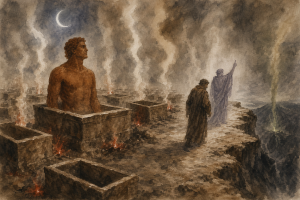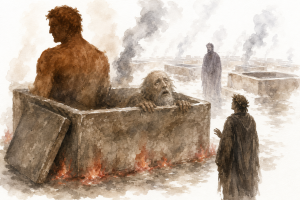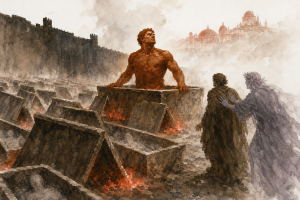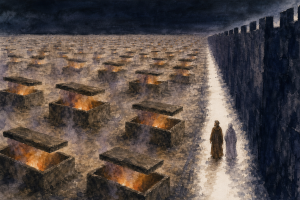
Still standing at the edge of the fourth circle, where hoarders and squanderers shove their weights at each other and will never be recognised again, the pilgrim asks one short question about a word his guide had let fall — this fortune, what is she, who holds the world’s goods in her claws? — and gets in return the longest uninterrupted lecture Virgil has yet delivered: nine tercets that take the wheel of popular iconography, the fickle mistress of Boethius’s second book, and the beast the pilgrim has just imagined, and replace all three with an angel who has an office, a sphere, and a happiness that the curses of the world cannot reach.
Inferno · Canto 7 · Lines 67–96 · Scene 21
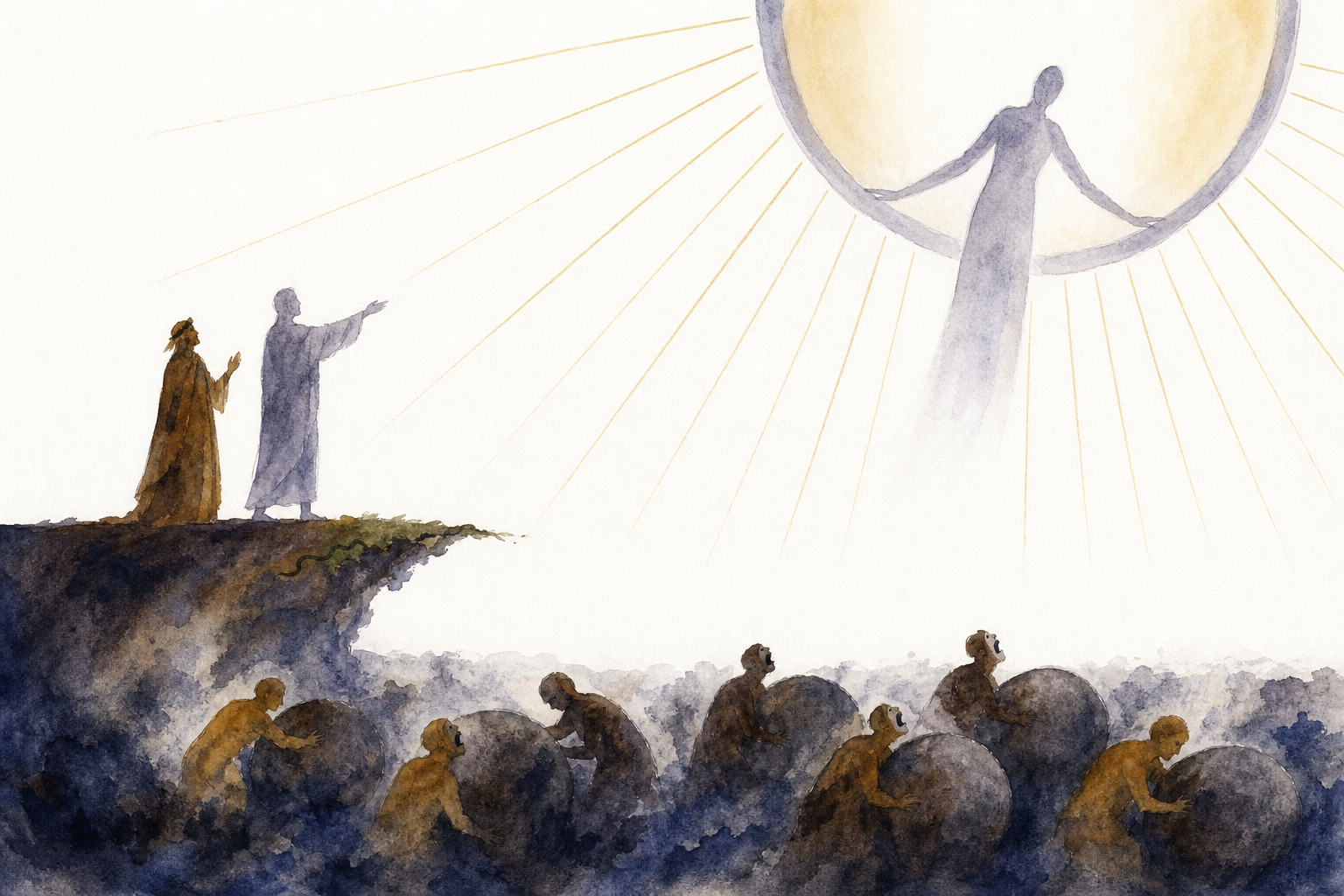
A few lines earlier Virgil had used a phrase in passing — the goods that are entrusted to fortune, and what a short-lived joke they are. Dante catches it and asks a follow-up. «Maestro mio», diss’io, «or mi dì anche: / questa fortuna di che tu mi tocche, / che è, che i ben del mondo ha sì tra branche?» (67–69). Notice the last word: branche means claws or paws. The pilgrim is picturing Fortune as an animal with the world’s wealth in its grip. That is the ordinary medieval picture — Fortune as a blind woman turning a wheel, tossing kings off the top of it, a force that grabs and drops for no reason.
Virgil does not answer gently. ‘Oh foolish creatures,’ he begins, ‘how much ignorance is it that harms you’ — and ‘you’ is plural. He is not scolding Dante only; he is scolding the human race. Then he says he will spoon-feed his doctrine into Dante’s mouth, using a verb, imboccare, that you use for a baby or a nestling. And then comes the lecture.
It starts with astronomy. God, whose knowledge exceeds everything, made the heavens and gave them guides — the angels who turn the spheres — arranging things so that every part shines to every part, distributing the light equally. Hold on to that word, equally. Then the pivot: in the same way, for earthly splendours, God appointed a single universal officer whose job is to move empty goods around, from people to people, from one bloodline to another, and no human cleverness can stop her. That is Fortune. Not a beast, not a goddess, not a wheel. A civil servant with a divine appointment.
So empires rise and other nations lie exhausted — «per ch’una gente impera e l’altra langue» (82) — following her judgement, which is hidden the way a snake is hidden in grass. That image is a private joke: it comes from Virgil’s own Eclogues, the poet quoting himself. And it is not a comfortable image. The thing being compared to a concealed serpent is God’s plan.
Then the two hardest lines. Human knowledge cannot resist her; she foresees, judges, and pursues her kingdom as the other gods do theirs. And: «necessità la fa esser veloce» (89), necessity makes her swift. This is not ‘she keeps busy’. Necessity is a technical word. Once God has decided, the execution cannot be delayed or negotiated. That is why turns come round so fast, why so many people get their moment. Fortune is not fickle at all in this account; she is the most reliable thing there is. What looks like randomness from underneath is punctuality from above.
And then Virgil turns the accusation around. This is the one, he says, who is so often nailed up — posta in croce, put on the cross — by the very people who ought to be praising her, who blame her and give her a bad name unjustly. Everybody curses their luck. Virgil says the cursing is a mistake about the universe, and it is also a kind of crucifixion, which is a startling word to use of an angel.
The last tercet is the point of the whole thing. «ma ella s’è beata e ciò non ode: / con l’altre prime creature lieta / volve sua spera e beata si gode» (94–96). She is blessed and does not hear it. Three words for joy — beata, lieta, beata — in three lines, dropped into the middle of a canto that is otherwise all mud and grunting and gurgling. The abuse does not reach her. That is what being blessed means here: not that nothing bad happens, but that nothing bad gets in.
And think about where this speech is standing. It is delivered ten yards from souls who are damned for gripping things. They are told, in effect, that the things they gripped were on loan from an angel whose entire job is to take them away again. Then Virgil looks at the stars, says the hour is late, and they go down.
Go deeper: the college-level reading (about 1,200 words)
Quotes the Italian closely, with philological detail and cross-references.
The pilgrim’s question is prompted by Virgil’s own vocabulary. A few tercets earlier the guide had spoken of the brief mockery of the goods committed to fortune (Inf. VII.61–62), and Dante now picks the word up: «questa fortuna di che tu mi tocche, / che è, che i ben del mondo ha sì tra branche?» (68–69). «Tocche» is the light verb — you touch on a subject — but «branche», claws, is not light at all. It belongs to the bestiary: it is the word for an animal’s grip, and it means that the pilgrim’s working model of Fortune is a predator holding the world’s property. Virgil’s whole answer will consist in exchanging the claw for a sphere.
The rhyme chain carries the rebuke. «Tocche» (68) rhymes with «sciocche» (70) and with «’mbocche» (72): the touching, the foolishness, and the feeding are bound in a single sound. «Oh creature sciocche, / quanta ignoranza è quella che v’offende!» (70–71): the vocative is plural and the pronoun is plural, so the addressee is not the pilgrim but the species. And the correction will be administered orally — «Or vo’ che tu mia sentenza ne ‘mbocche» (72) — with imboccare, the verb for putting food into the mouth of an infant or a fledgling. «Sentenza» is doing double duty: it is Virgil’s opinion, and it is a legal sentence, which prepares «lo giudicio di costei» (83).
The doctrine is built as a single analogy across two tercets. «Colui lo cui saver tutto trascende» (73) is God, named in Hell as always by periphrasis, and the chosen attribute is knowledge — apt, because the speech will twice insist on the failure of human knowing («i senni umani», 81; «Vostro saver», 85). He «fece li cieli e diè lor chi conduce» (74): the heavens were given their conductors, the angelic movers, exactly as the Convivio describes them and as Paradiso XXVIII–XXIX will systematise them. Their result is mutual illumination, «sì, ch’ogne parte ad ogne parte splende, / distribuendo igualmente la luce» (75–76). Then «Similemente a li splendor mondani / ordinò general ministra e duce» (77–78). The «Similemente» is doing more work than it admits. Celestial light is distributed «igualmente» and permanently; earthly splendour is «permutasse a tempo» (79), permuted in time, and never equally at any given moment. The analogy holds at the level of appointment — both are offices under God — and breaks at the level of experience, which is precisely why the office is misunderstood from below.
«General ministra e duce» is worth pausing on. «General» means universal jurisdiction, not local. «Ministra» is a servant, an officer; «duce» is the very title Dante gives Virgil himself throughout the poem. Fortune is thus a guide, feminine, in an administration. And her matter is declared worthless before her function is described: «li ben vani» (79). The permutation runs «di gente in gente e d’uno in altro sangue» (80) — the two axes of medieval politics, the passage of empire between peoples and the passage of property between bloodlines — and it runs «oltre la difension d’i senni umani» (81), beyond the defence human intelligences can mount. «Difension» is a military and legal noun: what is being described is not the absence of resistance but its futility. Note carefully what is beyond defence: external goods, dominion, wealth. The will is not mentioned, and the poem will later be emphatic that the heavens do not compel it (Purg. XVI.67–81; Par. IV.49–63). Virgil’s speech does not say so, and the omission is one of the places where readers divide.
«per ch’una gente impera e l’altra langue» (82) is the political payoff, written by an exile who had watched a city change hands. «Langue» is a body’s word — languishing, going slack — set against the hard verb «impera». Both follow «lo giudicio di costei, / che è occulto come in erba l’angue» (83–84), and here Virgil quotes Virgil: «latet anguis in herba», Eclogues III.93. The self-citation is charming and the image is not. The vehicle of the simile is only supposed to supply hiddenness, but a serpent in the grass carries venom and, in a Christian poem, carries Eden. Divine judgement is figured by the thing that is most dangerous when least visible. Commentators have generally declined to press this; the text does not stop us pressing it.
Then the two claims that do the philosophical work. «Vostro saver non ha contasto a lei» (85) — «contasto», the older form of contrasto, means resistance, a legal contest; there is no appeal. «questa provede, giudica, e persegue / suo regno come il loro li altri dèi» (86–87). The three verbs are the vocabulary of providence itself — providet, iudicat — delegated wholesale to a creature. And «li altri dèi» is the scandal of the passage: the movers of the spheres called gods, in the mouth of a pagan, inside a Christian angelology. Whether this is dramatic decorum, a Platonising usage licensed by the Timaeus tradition, or an inconsistency Dante did not trouble to smooth, has never been settled.
«Le sue permutazion non hanno triegue: / necessità la fa esser veloce» (88–89). Triegua is a truce, another word from war; there is no armistice in the redistribution of goods. And «necessità» must not be softened into ‘she is always busy’. It is a scholastic term. What is decreed eternally is executed without deliberation, hesitation, or delay, because a secondary cause obeying an eternal decree has no interval in which to weigh alternatives. Fortune is fast for the same reason a proof is fast: nothing in her is contingent. The tercet closes «sì spesso vien chi vicenda consegue» (90) — so often there comes one who obtains his turn — a line whose syntax translators handle very differently, and whose «vicenda», turn or alternation, is the last trace of the wheel.
«Quest’è colei ch’è tanto posta in croce / pur da color che le dovrien dar lode» (91–92). «Posta in croce»: crucified. The word for what humanity does to Fortune is the word for what humanity did to God, and it is applied to an angel who is being cursed for doing her job. The remedy prescribed is not indifference but «lode», praise — and that single noun is where Dante parts company with the Consolation, whose cure for Fortune is contempt of her. Then the close: «ma ella s’è beata e ciò non ode: / con l’altre prime creature lieta / volve sua spera e beata si gode» (94–96). The pleonastic reflexive «s’è beata» seals her inside her own condition; «beata» frames the tercet, with «lieta» in the middle, three joy-words in a canto of mud. «Prime creature» are the angels, made first. And she has a «spera» — which the cosmology of the poem does not otherwise provide her. The wheel of the illuminators has been promoted to a heaven, or metaphorically retained; either reading leaves a residue.
The pilgrim says nothing. Virgil closes the subject himself at 97 by observing that the stars have moved and they must not linger — the only doctrinal exposition in the «Inferno» terminated by the clock rather than by a question.
Go deeper still: the scholarly reading (about 1,100 words)
The commentary tradition, the sources, and what is documented versus inferred.
Boethius gave the Middle Ages its Fortune, and he gave it twice over. In the second book of the Consolation he lets her speak — a prosopopoeia so successful that it escaped its author and became the property of every schoolroom and cathedral porch. «Rotam volubili orbe versamus», she says: we turn the wheel on its spinning rim, and we delight to bring the lowest to the top and the top to the bottom. She is arrogant, garrulous, and unanswerable in her own terms, because her defence is that inconstancy is precisely what she promised. Then, in the fourth book, Philosophy takes it all back. What looks from below like caprice is, from above, providence unfolded into time: providence is the divine reason itself, resting in the highest ruler and disposing all things, while fate is that same disposition seen as it inheres in mobile things and strings them along their sequences. Fortune, on this account, is not a power at all. She is an optical effect produced by our position inside the series.
So the subordination of Fortune to providence is not Dante’s invention. It is his inheritance, and it had been reinforced from another direction by the recovery of Aristotle: in Physics II chance is a cause per accidens, real but parasitic, and Aquinas duly folded it into a providence that governs contingents contingently. What the scholastics never did was give the accident a face. Their fortune is a mode of causation, not an officer. Boethius’s Fortune had a face, but she was a rhetorical figure whom the argument existed to dissolve. Between the two, the iconographic tradition ran on unchecked: the blindfold, the wheel, the four kings labelled regno, regnavi, sum sine regno, regnabo, the «O Fortuna velut luna» of the Carmina Burana. That is the picture the pilgrim brings to the question, and «branche» (69) is its residue.
Virgil’s answer does not correct the picture by dissolving it. It corrects it by promoting her. The two moves that constitute Dante’s revision are both audible in the vocabulary. The first is the analogy of office: God «fece li cieli e diè lor chi conduce» (74), and «Similemente» (77) he appointed for earthly splendours a «general ministra e duce» (78). The comparison is not decorative. It installs Fortune in the same administrative rank as the angelic movers, and line 95 says so without hedging — «con l’altre prime creature lieta». Prime creature are the intelligences created before the visible heavens; the adjective «altre» does the whole work of the argument, since it makes her one of them rather than something like them. The economy of worldly goods is thereby assimilated to celestial mechanics. What the spheres do with light, distributing it «igualmente» (76), she does with «li ben vani» (79) — not equally, but by permutation, which is the temporal analogue of an equal distribution.
The second move is lexical theft. «Questa provede, giudica, e persegue / suo regno come il loro li altri dèi» (86–87). Providere is the verb Boethius reserved for the summit; fate, in his scheme, executes but does not foresee. Dante hands it to Fortune. And he calls the intelligences «dèi», which is bold even granting the precedent of the Convivio, where he notes that the Gentiles gave the name of gods to the separate substances that move the heavens. The line converts a pagan error into a technically defensible shorthand, which is the sort of operation Dante liked; it also, quietly, makes Fortune’s deification no longer a mistake but an approximation.
Then «necessità la fa esser veloce» (89). Boethius spent his fifth book defusing this word, distinguishing the simple necessity of what must be from the conditional necessity of what must be given that it is. Dante uses it unglossed, of an angel. The point is not that Fortune is harried but that her permutations belong to an order that admits no exception — «Le sue permutazion non hanno triegue» (88) uses the language of warfare, truce, and denies it. Against that, «Vostro saver non ha contasto a lei» (85) is not a complaint about her cunning; it is a statement about the difference between a first-order agent and the creatures whose «senni umani» (81) cannot mount a defence.
The pivot at line 91 is where the genealogy turns into polemic. «Quest’è colei ch’è tanto posta in croce / pur da color che le dovrien dar lode» (91–92). Boethius’s sufferer curses Fortune and is taught to see past her; Dante’s speaker says the cursing is simply a misdirected debt of praise, and offers no therapy at all — the passage contains no consolation, only a rebuke delivered to the species. And the object of the rebuke cannot receive it: «ma ella s’è beata e ciò non ode» (94). This is the strangest line in the speech and the most philosophically exact. Beatitude is defined here negatively, by what fails to arrive: blasphemy directed at a blessed intelligence does not reach it, not because the intelligence forgives but because the acoustic channel does not exist. Boethius’s Fortune answers back. Dante’s is deaf, and the deafness is her blessedness.
That the doctrine is set in the fourth circle is itself an argument. To the sin of clutching, the answer is not moderation but a demonstration that nothing clutched was ever held — the goods pass «di gente in gente e d’uno in altro sangue» (80), and the hoarders and squanderers rolling their weights are enacting the permutation they thought they were resisting.
Two questions remain properly open. One is whether this speech revises Dante’s own earlier position: the fourth book of the Convivio treats riches and their distribution with a severity that some readers find hard to reconcile with a providential ministra, and the alternatives — development, or a change of register between treatise and poem — have both been argued without settlement. The other is how much precedent Dante had. Vincenzo Cioffari’s study of fortune and fate in Dante (1940), Gianluigi Toja’s article on Fortune (1965), and Padoan’s commentary remain the standard discussions of how far the figure is inherited and how far it is Dante’s own. And there is the standing awkwardness that a pagan poet is expounding angelology, which the poem elsewhere does not pretend to resolve.
One detail suggests Dante knew exactly whose ground he was on. The rhymes that close the speech are «lode» (92), «ode» (94), «gode» (96). In Paradiso X, introducing Boethius among the lights of the Sun, he writes of the soul that «’l mondo fallace / fa manifesto a chi di lei ben ode», and rhymes it with «gode» and with «lode». The same three sounds, given back to the man he had rewritten.
The Italian — Fortune, the Blessed Intelligence
Source: Wikisource (public domain, pre-1929 text)
Lines 67–69
67. "Maestro mio", diss’io, "or mi dì anche:68. questa fortuna di che tu mi tocche,69. che è, che i ben del mondo ha sì tra branche?".
vocabulary: Line 68 — «di che tu mi tocche» — that you touch on to me. «Toccare» here is the light conversational verb: to broach, to mention in passing. The pilgrim is picking up a word Virgil had let fall a few tercets earlier, when he spoke of the short-lived mockery of the goods committed to fortune (Inf. VII.61–62). The question is therefore not an interruption but a piece of good scholastic manners — a term has been used without definition, and the student asks for the definition. Virgil’s answer will treat the request as urgent enough to justify nine tercets and an insult. [Source: Inferno VII.61–62]
wordplay: Line 69 — «ha sì tra branche» — holds so in her claws. «Branche» are an animal’s paws or talons, a word from the bestiary rather than from theology, and it exposes the pilgrim’s working picture of Fortune: a predator with humanity’s property in its grip. Virgil’s entire reply consists in dismantling that image. The claw is replaced by an office, the grip by a permutation, and by line 96 the beast has become an intelligence turning a sphere. Nothing in the answer refutes the claw directly; the refutation is the substitution. [Model knowledge · medium]
Lines 70–72
70. E quelli a me: "Oh creature sciocche,71. quanta ignoranza è quella che v’offende!72. Or vo’ che tu mia sentenza ne ‘mbocche.
literary key: Line 70 — «Oh creature sciocche» — the vocative is plural and so is the pronoun in the next line, «che v’offende». Virgil is not scolding his pupil; he is scolding the species over his pupil’s head, and this is the only moment in the canticle where he addresses humanity at large. The rhyme fastens the rebuke to the question: «tocche» (68), «sciocche» (70), «’mbocche» (72) — the touching-on, the foolishness, and the spoon-feeding chime, so that the sound of the tercets makes the pilgrim’s innocent enquiry an instance of the ignorance being corrected. [Model knowledge · medium]
vocabulary: Line 72 — «Or vo’ che tu mia sentenza ne ‘mbocche» — now I want you to take my judgement into your mouth. «Imboccare» is what you do for an infant or a nestling: put the food in. The verb is startlingly physical for an act of instruction, and it sets the tone of the whole speech, which is delivered without a single concession to dialogue. «Sentenza» is also doing double work — Virgil’s opinion, and a sentence in the juridical sense, which prepares «lo giudicio di costei» at 83 and the courtroom vocabulary of «difension» (81) and «contasto» (85). [Model knowledge · high]
Lines 73–75
73. Colui lo cui saver tutto trascende,74. fece li cieli e diè lor chi conduce75. sì, ch’ogne parte ad ogne parte splende,
theology: Line 73 — «Colui lo cui saver tutto trascende» — He whose knowledge transcends all things. God is never named inside Hell, and the periphrasis follows the practice established in the earlier circles, where the authorising will is invoked with a pronoun (Virgil’s «altri» at Inf. V.81, the formulas used against Charon and Minos). What matters here is which attribute is selected. Not power, not goodness, but knowledge — because the argument to come turns twice on the failure of human cognition, «i senni umani» (81) and «Vostro saver» (85). The definition of God is chosen to match the diagnosis of the error. [Source: Inferno V.81]
theology: Line 74 — «fece li cieli e diè lor chi conduce» — He made the heavens and gave them those who conduct them. These are the angelic movers of the spheres, a standard scholastic doctrine that Dante had already set out in the Convivio and will dramatise at length in Paradiso XXVIII–XXIX, where the orders of angels are correlated with the heavens they turn. The line is the hinge of the whole speech: once the heavens are administered by intelligences, an intelligence administering earthly goods is not an innovation but an extension, and Fortune joins an existing bureaucracy rather than founding one. [Model knowledge · high]
Lines 76–78
76. distribuendo igualmente la luce.77. Similemente a li splendor mondani78. ordinò general ministra e duce
literary key: Line 76 — «distribuendo igualmente la luce» — distributing the light equally. Hold this adverb against what follows. Celestial light is shared out equally and permanently; earthly goods are «permutasse a tempo» (79), shifted about in time and never equal at any given moment. The «Similemente» of 77 therefore claims more than it can carry: the two administrations are alike in being appointed by God and unlike in every observable effect. That gap is where the human error lives. From below, the heavens look orderly and Fortune looks arbitrary; the speech asserts that the difference is in the looking. [Model knowledge · medium]
vocabulary: Line 78 — «ordinò general ministra e duce» — appointed a universal minister and guide. Every word is administrative. «General» means her jurisdiction is universal, not local: there is no province exempt. «Ministra» is a servant holding office, the feminine of the term used of God’s agents. «Duce» is the very title Dante gives Virgil himself throughout the poem, so the guide is describing a fellow guide. The cumulative effect is to strip Fortune of both divinity and caprice in a single line: she is neither a goddess nor a wheel but a functionary, and functionaries do not improvise. [Model knowledge · high]
Lines 79–81
79. che permutasse a tempo li ben vani80. di gente in gente e d’uno in altro sangue,81. oltre la difension d’i senni umani;
vocabulary: Line 79 — «che permutasse a tempo li ben vani» — that she should permute in time the vain goods. «Permutare» is a commercial and legal verb, exchange or barter, which is pointed diction in the circle where goods are punished. «A tempo» carries both ‘from time to time’ and ‘at the proper moment’, and the ambiguity is useful: the redistribution is periodic and it is punctual. Note also that Virgil calls the goods «vani», empty, before he has described what is done with them — the evaluation precedes the mechanism, and the shades grunting nearby have staked eternity on the emptiness. [Model knowledge · high]
history: Line 80 — «di gente in gente e d’uno in altro sangue» — from people to people and from one blood to another. The two axes are the two great medieval theories of change: translatio imperii, the migration of dominion from Troy to Greece to Rome and onward, and dynastic succession, the passage of property through bloodlines. Dante, writing in exile from a city that had changed hands under him, is describing something he had lived. His political works make the transfer of empire providential; here the same claim is made in a single line, without argument, as the ordinary business of an angel. [Model knowledge · medium]
vocabulary: Line 81 — «oltre la difension d’i senni umani» — beyond the defence of human wits. «Difension» is military and legal, a defence mounted rather than merely absent: the point is not that no one resists but that resistance is void. Notice precisely what cannot be defended, however — external goods and dominion. The will is not mentioned. Purgatorio XVI.67–81 and Paradiso IV–V will insist that the heavens do not determine the will, which is the corrective this speech does not supply; whether the omission is Virgil’s limitation or simply the fact that nobody has yet asked is disputed. [Source: Purgatorio XVI.67–81]
Lines 82–84
82. per ch’una gente impera e l’altra langue,83. seguendo lo giudicio di costei,84. che è occulto come in erba l’angue.
history: Line 82 — «per ch’una gente impera e l’altra langue» — whereby one people rules and another languishes. The verbs are chosen against each other: «imperare» is public and juridical, «languire» is a body’s word, going slack, wasting. Empire is an act; decline is a symptom. The line makes the rise and exhaustion of nations a single administrative event with two faces, and it does so with no evaluative language at all — neither people is said to deserve its condition. That silence is one of the reasons readers argue about how far the poem stands behind the speech. [Model knowledge · medium]
cultural ref: Line 84 — «che è occulto come in erba l’angue» — hidden as the snake in the grass. Virgil is quoting Virgil: latet anguis in herba, Eclogues III.93. The self-citation is a nice courtesy of Dante’s to his character, but the image is not comfortable. The simile’s business is only to supply hiddenness, yet the vehicle brings venom with it, and in a Christian poem a concealed serpent brings Eden. The thing being compared to it is God’s judgement. Most commentators pass over the friction; the text does not oblige us to. [Model knowledge · high]
Lines 85–87
85. Vostro saver non ha contasto a lei:86. questa provede, giudica, e persegue87. suo regno come il loro li altri dèi.
vocabulary: Line 85 — «Vostro saver non ha contasto a lei» — your knowledge has no resistance against her. «Contasto» is the older form of contrasto, and it means both physical resistance and a legal contest: there is no opposition to be mounted and no appeal to be lodged. Coupled with «difension» in 81, it completes a pair of juridical negations bracketing the political tercet. The pronoun is again plural, «vostro»: Virgil is still addressing the human race, and he has not once in nine tercets said ‘you’ to Dante alone. [Model knowledge · medium]
theology: Line 86 — «questa provede, giudica, e persegue» — she foresees, judges, and pursues. Three verbs, and the first two are providence’s own: providet, iudicat. The scholastic framework licenses this — Aquinas holds that what is fortuitous relative to a particular agent is ordered relative to a higher cause, so nothing escapes providence though much escapes prediction — but the boldness of the line is that the vocabulary is handed over wholesale to a creature. Fortune does not merely execute foresight; she has it, within her office. «Persegue», pursues or prosecutes, keeps the administrative register to the end. [Model knowledge · medium]
literary key: Line 87 — «suo regno come il loro li altri dèi» — her kingdom as the other gods theirs. This plural has never been settled. It has been read as dramatic decorum, a pagan speaker using the only word he has for the celestial intelligences; as a Platonising usage transmitted through the Timaeus and its Latin commentators, which Dante handles with conspicuous care at Paradiso IV.49–63; and, less charitably, as a lapse. Early commentators tend to gloss «dèi» silently as «angeli», which is itself evidence that they felt something needed smoothing over. The line is one of the poem’s clearest points of friction between Virgil as reason and Virgil as Augustan. [Source: Paradiso IV.49–63]
Lines 88–90
88. Le sue permutazion non hanno triegue:89. necessità la fa esser veloce;90. sì spesso vien chi vicenda consegue.
vocabulary: Line 88 — «Le sue permutazion non hanno triegue» — her permutations have no truce. Triegua is a term of war: a negotiated suspension of hostilities. The metaphor makes the redistribution of goods a campaign in which no armistice can be arranged, which is precisely how it feels to the party being dispossessed. The word also completes the military strand running through «difension» (81) and «contasto» (85), so that by this point Virgil has described Fortune’s office three times in the language of a war that cannot be fought. [Model knowledge · medium]
theology: Line 89 — «necessità la fa esser veloce» — necessity makes her swift. This must not be softened into ‘she is always busy’. «Necessità» is scholastic vocabulary: what is eternally decreed is executed without deliberation, hesitation or interval, because a secondary cause carrying out an eternal ordinance has no alternatives to weigh. Fortune is fast for the same reason a valid inference is fast — nothing in her is contingent. The line therefore contains the passage’s sharpest paradox: the being universally accused of caprice is the least free agent described anywhere in the poem. [Model knowledge · high]
translation note: Line 90 — «sì spesso vien chi vicenda consegue» — so often there comes one who obtains his turn. The syntax is genuinely knotted and translators diverge: «chi» may be the person arriving at fortune or the person whose reversal arrives, and «vicenda» may be the alternation itself or an individual’s share in it. Editors punctuate the line differently and no rendering has become canonical. «Vicenda» is also the last surviving trace of the wheel in the passage — turn-taking without a rim — before the sphere replaces it at 96. [Model knowledge · low]
Lines 91–93
91. Quest’è colei ch’è tanto posta in croce92. pur da color che le dovrien dar lode,93. dandole biasmo a torto e mala voce;
literary key: Line 91 — «Quest’è colei ch’è tanto posta in croce» — this is she who is so often put on the cross. The verb of ordinary blasphemy against one’s luck is the verb of the Passion, and Dante applies it to an angel being abused for performing her assigned office. The transfer is either brilliantly audacious — the world crucifies its benefactors as a matter of habit — or a sign that Virgil is speaking a Christian idiom he has not earned. The commentary tradition has largely declined to choose, and mostly declines to notice. [Model knowledge · medium]
Lines 94–96
94. ma ella s’è beata e ciò non ode:95. con l’altre prime creature lieta96. volve sua spera e beata si gode.
theology: Line 94 — «ma ella s’è beata e ciò non ode» — but she is blessed and does not hear it. The pleonastic reflexive «s’è» seals her inside her own state; the blasphemy simply fails to arrive. This is beatitude defined by immunity, and the poem has already used the same definition once: in Inferno II Beatrice tells Virgil that she has been so made by God that the misery of Hell does not touch her and its flames do not assail her. Whether that immunity is the consolation of the passage or its coldest moment, Dante does not say. [Source: Inferno II.91–93]
theology: Line 95 — «con l’altre prime creature lieta» — happy with the other first creatures. The standard gloss takes «prime creature» as the angels, created before the material universe, and this is the line on which Fortune’s promotion to an angelic intelligence rests: she is not compared to them but numbered among them. A minority reading extends the phrase to the first creations generally, the heavens and prime matter included, which would make her rather less personal. The identification with the angels is now dominant in modern commentary, but the phrase is compressed enough that the older latitude survives. [Source: Paradiso XXIX (creation of the angels)]
literary key: Line 96 — «volve sua spera e beata si gode» — she turns her sphere and rejoices in blessedness. The cosmology of the Commedia has no sphere of Fortune, which leaves a choice: either the wheel of the illuminators has been dignified into an astronomical body, or «spera» means jurisdiction rather than orb, her revolving domain being the sublunary world. Neither reading is forced. Note too that the poem does not retire the older iconography elsewhere — Brunetto Latini still speaks of Fortune’s rota at Inf. XV.95, without correction from anyone. [Source: Inferno XV.95]
Seven Centuries of Reading Fortune, the Blessed Intelligence
Boethius and the change of mind
The standard citation for Virgil’s discourse on Fortune (62–96) has always been Boethius, whose Consolation teaches that sufferers blame fortune for misplacing their hopes in fleeting goods. Hollander notes what Dante adds: calm, even glad acceptance. Charles Grandgent’s phrase for this Fortune, ‘the Angel of Earth’, has stuck. She is one of the heavenly intelligences, turning her sphere «e beata si gode» (96), and nothing she does is wrong.
The change from Dante’s earlier view is clear. In the Convivio (IV.xi) the unequal distribution of goods is a defect of Fortune’s agency, random and blind. Here she foresees, judges and pursues her realm «come il loro li altri dèi» (87), the other gods being the other orders of angels. In the Monarchia (II.ix) Dante says that the force which the pagans attributed to their gods, distributing victory and defeat, we more properly call divine providence.
Sources and studies
Fortune’s judgment, «occulto come in erba l’angue» (84), hidden like the snake in the grass, has been read since at least the sixteenth century as a translation of Virgil’s «latet anguis in herba» (Eclogues III.93). The Casini-Barbi commentary summarized the turning of Fortune’s wheel as a ride through eight points, from humility through peace, riches and pride to war and poverty, ending where it began. Vincenzo Cioffari’s study of fortune and fate in Dante (1940), Gianluigi Toja’s article on Fortune (1965), and Padoan’s commentary remain the standard discussions.
What remains open
The poem never explains how an angelic Fortune who cannot err relates to the grief she causes, and the pilgrim asks no further question. Virgil’s tone has struck readers as unusually sunny for Hell. Whether that serenity is the poem’s own position or the limited view of a pagan guide is a question the text leaves open.
The Two Main Positions on Fortune, the Blessed Intelligence
The Doctrine Is the Poem’s
Virgil is teaching straight, and what he teaches is Dante’s own considered angelology. Fortune has been lifted out of iconography and mythology altogether and installed among the «prime creature», an intelligence with a divinely assigned office, ranked with the movers of the spheres and enjoying their beatitude. Read this way the passage is one of the boldest constructive acts in the Inferno: the popular wheel is not debunked but promoted, and the complaint against luck is diagnosed as a category error committed by beings who cannot see the whole. Its placement in the circle of avarice is a deliberate polemic rather than an irony — the sin of gripping is answered by the revelation that an angel is employed full-time to prise things loose.
Key passage: The technical vocabulary is unmistakably doctrinal and consistent with Dante’s other work: the movers given to the heavens (74) as in the Convivio and Paradiso XXVIII–XXIX; «provede, giudica, e persegue» (86) transferring providence-verbs to a creature exactly as scholastic secondary causality requires; «necessità» (89) in its precise technical sense; «prime creature» (95) for the angels. The passage is never withdrawn, qualified or mocked anywhere in the poem, and Virgil’s other great exposition, the moral architecture of Hell in Inferno XI, is likewise treated as authoritative. The three joy-words of the final tercet are the poem’s own vocabulary of blessedness, unavailable to a speaker being set up for correction.
The Speech Is Framed
The lecture is placed, and placement is argument. It is spoken by a soul who cannot see God, who calls the angelic movers «li altri dèi», who figures divine judgement as a concealed serpent, and who quotes his own pastoral poetry for the emblem. It explains with total confidence how goods pass and says nothing whatever about why they pass to the wicked, nothing about desert, and nothing about the one thing Fortune cannot touch — the will. Its conclusion is not consolation but immunity: she is blessed and cannot hear us. On this reading the tercets are true as far as reason reaches and stop precisely where reason stops, which is why the pilgrim has no reply and why Virgil has to end the subject by pointing at the stars.
Key passage: «oltre la difension d’i senni umani» (81) and «Vostro saver non ha contasto a lei» (85) frame the speech’s centre with two declarations of human impotence, and no counterweight is offered; the doctrine that the heavens do not determine the will arrives only in Purgatorio XVI.67–81 and Paradiso IV–V, in other mouths. «Li altri dèi» (87) is a pagan’s plural inside a Christian system. «tanto posta in croce» (91) transfers the Passion’s verb to an angel, a strain the tradition has never comfortably explained. The exposition is terminated by the hour rather than by the pupil’s assent, the only doctrinal speech in the Inferno closed that way.
What the Text Does — and What That Means (Contested)
On the page: The exposition runs from 70 to 96, nine tercets, the longest uninterrupted speech Virgil has delivered in the poem to this point. Fortune is titled «general ministra e duce» (78) and placed «con l’altre prime creature» (95). The verbs «provede, giudica, e persegue» (86) are applied to her, and the angelic movers are called «li altri dèi» (87). The word «necessità» stands at 89. The word «lode» stands at 92, and «beata» occurs twice within 94–96 with «lieta» between them. God is named only by periphrasis, «Colui lo cui saver tutto trascende» (73). The simile at 84 reproduces a phrase from Virgil’s own Eclogues III.93. The speech is delivered by a soul confined to Limbo (Inf. IV). It is set in the fourth circle, between the punishment of the avaricious and prodigal and the descent to the Styx. The pilgrim puts no further question about Fortune in the canto; the topic is closed by Virgil’s reference to the hour in the tercet immediately following. Fortune is not personified again anywhere in the Commedia, though the word recurs, as in Brunetto’s «rota» at Inf. XV.95.
What scholars dispute: Whether Dante-poet stands wholly behind Virgil here is contested, and the contest is not about a detail but about how the poem’s doctrinal speeches work. The passage’s philosophical sources — Boethius II and IV, the Aristotelian-Thomist account of chance as a per accidens cause ordered by providence — are secure; the poet’s attitude to his own speaker is not. Nothing in the Commedia later corrects the speech, and nothing in it later confirms the speech either. The reading that treats the omission of free will as a deficiency of the speaker, and the reading that treats it as simple economy because the subject has not yet arisen, are both defensible and both go beyond what the lines state.
What Dante Leaves Unresolved
Whether «ma ella s’è beata e ciò non ode» (94) is the passage’s comfort or its cold centre. If beatitude is defined by what cannot reach it, then the being who administers every human loss is constitutionally deaf to the people losing — and Dante gives no line indicating whether that deafness should be envied, praised, or merely accepted. He also leaves «sua spera» (96) unlocated in a cosmology that has no sphere for her, and leaves the demand for «lode» (92) standing without a single example, in the poem or anywhere else, of a human being who has managed it.
The Open Question
Virgil’s Fortune is an angel with an office, cursed by the world for doing exactly what God appointed her to do, and blessed in a way that makes the curses inaudible to her. Is this speech the poem’s settled teaching — providence explained, the complaint against luck exposed as ignorance — or is it a lecture the poem deliberately frames and limits, a pagan’s confident account of the mechanism of loss that never once touches the question of justice?
Explore More
About This Article

Written by Lucy Bamboo. Lucy Bamboo has been reading the Divine Comedy for fifteen years — first in translation, then stubbornly in Medieval Tuscan with a dictionary and far too many footnotes. Reading Dante is her scene-by-scene walk through the poem: the original Italian, seven centuries of scholarly argument presented as argument rather than answer, and the human questions sitting underneath the theology. More about this site.
Verify this against a primary source
Specifics change, and your situation may differ from the one described here. These are the authorities worth checking directly:
- Digital Dante, Columbia University — text, commentary and translation apparatus
- Princeton Dante Project — the Commedia with historical commentary
- Dartmouth Dante Project — searchable commentary from 1322 onward