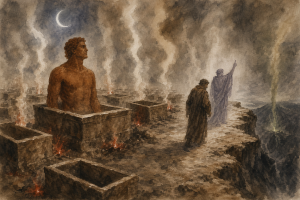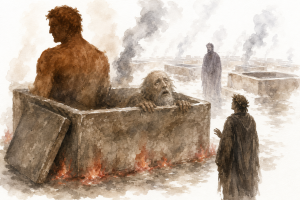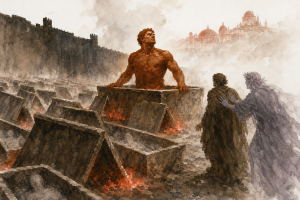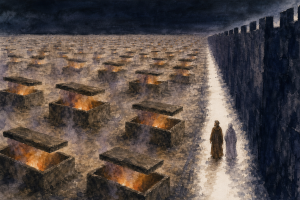
A guardian opens the canto with five words that no reader in seven hundred years has been able to construe, Virgil answers not the sense but the tone — quiet, cursed wolf, eat yourself with your own rage — and the creature collapses like a sail when the mast snaps; and beyond him lies the most crowded place Dante has yet seen, where two half-circles of souls shove enormous boulders round against each other by main force, crash at the meeting points, shout three words each, turn, and start again, and where the pilgrim’s request to recognise somebody is refused on the ground that there is no longer anybody there to recognise.
Inferno · Canto 7 · Lines 1–66 · Scene 20
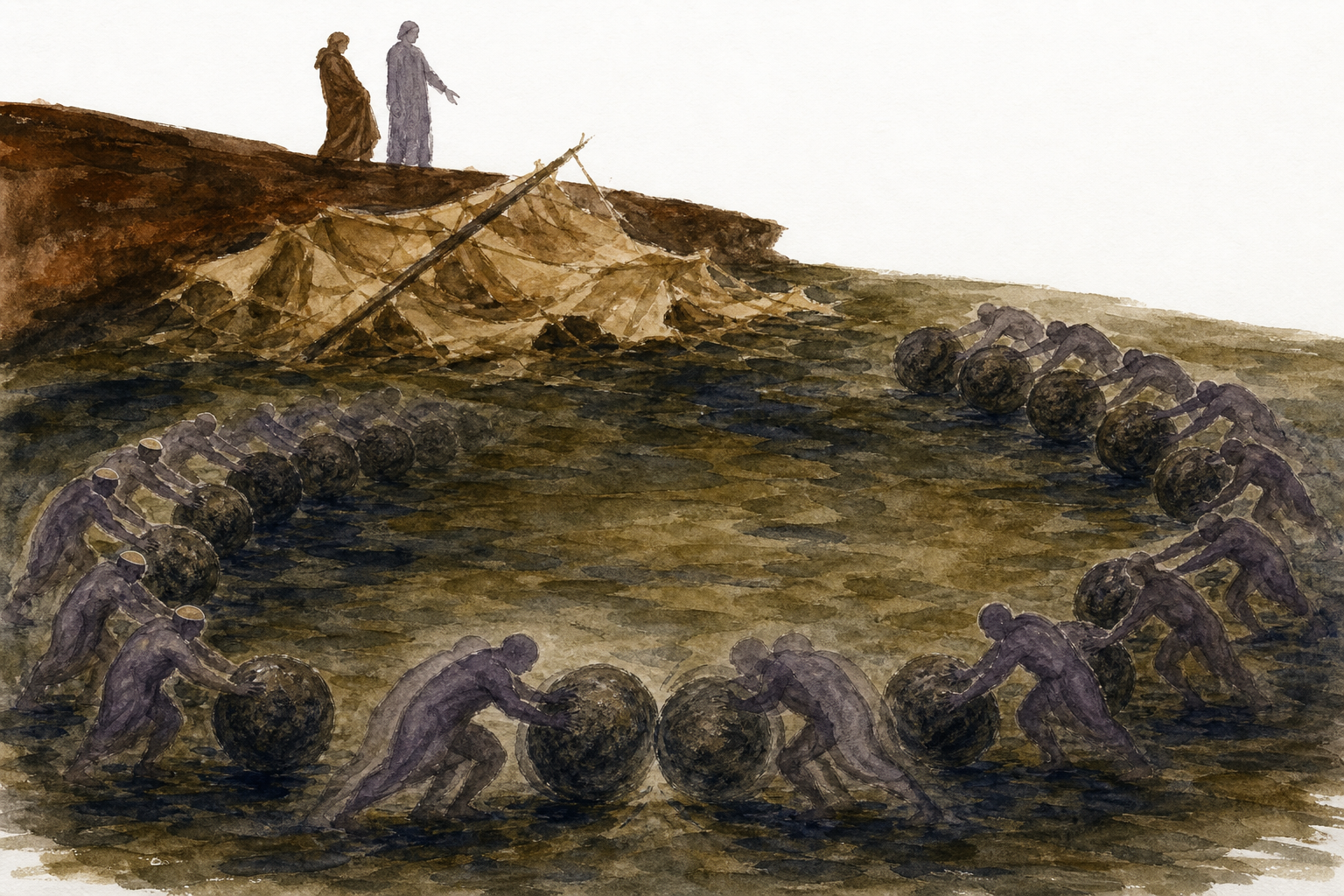
The canto opens with a shout that nobody understands: «Pape Satàn, pape Satàn aleppe!» (1). This is not a puzzle you are meant to solve. Scholars have been proposing answers for seven hundred years — Latin, Hebrew, Greek, French, some mixture — and none of the answers has convinced anyone else. What matters is the effect. Dante has just fainted at the end of the last canto and comes to in a new place, and the first thing that happens is that something screams at him in no language at all.
Virgil does not translate it. He tells Dante not to let fear damage him — whatever power this creature has, it will not stop them from climbing down. Then he turns to the swollen face and speaks: «Taci, maladetto lupo!» (8). Quiet, cursed wolf. Eat yourself up inside with your own rage. That word ‘wolf’ is not casual. In Canto I a she-wolf drove Dante back down the hill and would not let him pass; she was the beast of greed, and now, in the circle where greed is punished, the guardian is called a wolf. The poem is stitching itself together.
Then Virgil gives the reason the journey cannot be blocked: it is willed on high, «là dove Michele / fé la vendetta del superbo strupo» (11–12) — where Michael took vengeance on the proud rebellion. This is the only time the archangel Michael is named in the Inferno. Twice before, at the river and at the second circle, Virgil has silenced a guardian by saying the trip is willed above. This time he says who did the silencing the first time, when the angels rebelled and lost. The creature drops immediately, and Dante gives him a beautiful simile: sails full of wind that fall in a tangled heap when the mast snaps (13–15).
Down in the fourth circle there are more people than Dante has seen anywhere yet. They are pushing huge weights with their chests, in two half-circles going opposite ways round the ring. Where the two crowds meet they smash into each other, and each soul turns round on the spot and shoves its weight back the way it came, shouting one of two things: «Perché tieni?» and «Perché burli?» (30) — why do you hold on? why do you throw away? Then they run the whole half-circle again and collide at the other side, for ever.
Dante notices that some of them are tonsured — clergy have their heads shaved in a ring — and asks whether they are all churchmen. Virgil says yes, and adds popes and cardinals, and says all of them were «guerci / sì de la mente» (40–41), squint-eyed in the mind, so that nothing they spent was spent in measure. Notice what he has done: hoarders and spenders get the same diagnosis. They are not opposites with a good middle they missed; they are two ways of not seeing straight about money.
Then Dante asks the question he always asks: surely I should recognise some of these. And for once the answer is no. «Vano pensiero aduni» (52) — you are gathering an empty thought. «la sconoscente vita che i fé sozzi, / ad ogne conoscenza or li fa bruni» (53–54): the life that failed to recognise anything made them filthy, and now makes them too dark to be recognised. One canto ago Ciacco begged Dante to keep his name alive in the world. Here there are no names at all, and the loss of them is the punishment.
Virgil finishes with two images and a sum. At the resurrection these souls will rise from the tomb marked by their sin — one crowd with fists clenched, the other with hair shorn. And all the gold under the moon, and all the gold there ever was, could not buy one of these tired souls a single moment’s rest. That is the fourth circle: enormous effort, total exhaustion, no names, and nothing bought.
Go deeper: the college-level reading (about 1,300 words)
Quotes the Italian closely, with philological detail and cross-references.
Canto VII begins in a language that does not exist. «Pape Satàn, pape Satàn aleppe!» (1) is a regular hendecasyllable — it scans, it takes the accents Italian verse requires — and it means nothing that anyone has been able to establish. The commentary tradition has offered Latin interjections, Hebrew letters, Greek exclamations, a French sentence, and various hybrids; none has displaced the others. The prudent position is that the line’s opacity is a working part of the poem, not a defect to be repaired, and Dante will do the same thing once more, with Nimrod’s «Raphèl maì amècche zabì almi» at Inf. XXXI.67, where Virgil says plainly that no one understands the speaker’s speech. Here Virgil does not even bother to say it. The «voce chioccia» (2) — hoarse, clucking — belongs to the poem’s harsh register; the same adjective returns in the celebrated opening of Inf. XXXII.1, where the poet wishes for «rime aspre e chiocce» adequate to the bottom of the universe.
The epithet Dante gives Virgil in line 3, «e quel savio gentil, che tutto seppe», arrives one verse after the poem’s most unintelligible utterance, and the juxtaposition has been read both ways: as straightforward reverence, and as a fine dry joke at the expense of the all-knowing guide who declines to gloss the line. What Virgil does instead is diagnostic. He treats the cry as noise made by rage, and answers the rage: «Taci, maladetto lupo! / consuma dentro te con la tua rabbia» (8–9). Consume yourself with your own anger — a curse that is also a definition of the sin below, since avarice is precisely a hunger that feeds on its possessor. The wolf is not a stray insult. It reaches back to the «lupa» of Inf. I.49–51, the beast «che di tutte brame / sembiava carca ne la sua magrezza», which drove the pilgrim «là dove ‘l sol tace»; and it reaches forward to Purg. XX.10–12, «Maladetta sie tu, antica lupa, / che più che tutte l’altre bestie hai preda / per la tua fame sanza fine cupa». The she-wolf is the structural thread of the poem’s economics, and here, at the circle of hoarding and squandering, it surfaces as the guardian’s name.
Virgil’s authorisation formula has now been used three times, and each time it is compressed differently. To Charon: «vuolsi così colà dove si puote / ciò che si vuole» (Inf. III.95–96). To Minos: the same words again (V.23–24). To Plutus: «vuolsi ne l’alto, là dove Michele / fé la vendetta del superbo strupo» (11–12). The formula acquires a history. The will above is not merely a will; it is the will that already put down one rebellion, and the archangel who executed that judgment (Apocalypse 12:7–9) is named here and nowhere else in the Inferno. ‘Strupo’ at 12 is a textual and lexical crux: the reading printed by Petrocchi is generally glossed from Latin stuprum as violation or outrage, while other manuscripts and other editors have taken it as ‘troop’, the proud band. The sense of the tercet survives either way.
The collapse is given the canto’s one wholly graceful image: «Quali dal vento le gonfiate vele / caggiono avvolte, poi che l’alber fiacca, / tal cadde a terra la fiera crudele» (13–15). ‘Gonfiate’ answers ‘nfiata labbia’ at 7 — the swollen face and the swollen sails — so that the simile completes a figure already begun. Deflation is the whole action of the tercet.
The descent lands in «la quarta lacca» (16), lacca being a hollow or basin (compare «la rotta lacca» of Inf. XII.11), reached by taking more of «la dolente ripa / che ‘l mal de l’universo tutto insacca» (17–18). ‘Insacca’ — bags up, sacks — is deliberately coarse, and it registers Hell as a container into which the universe’s evil is stuffed. Then the narrator’s own voice breaks in: «Ahi giustizia di Dio! tante chi stipa / nove travaglie e pene quant’io viddi? / e perché nostra colpa sì ne scipa?» (19–21). Note ‘nostra’. The apostrophe does not stand outside the crowd it looks at.
The machinery is described with a marine simile from the Aeneid’s geography: «Come fa l’onda là sovra Cariddi, / che si frange con quella in cui s’intoppa» (22–23). Wave meets counter-wave in the strait and both are shattered; «così convien che qui la gente riddi» (24), where ‘riddi’ comes from ridda, a round dance — the damned perform a dance figure. Dante will keep the vocabulary of festivity going: «l’altra giostra» (35), the other joust, and «ontoso metro» (33), the shameful measure or refrain they hurl at each other. The souls push «per forza di poppa» (27), by force of the chest, the whole body converted into an instrument for shifting mass. And the entire content of their speech is six words in two questions: «Perché tieni?» and «Perché burli?» (30). Each accuses the other of the vice each lacks, which is why neither accusation ever ends the argument.
Dante’s question at 37–39 is characteristically empirical: what people are these, and were all the tonsured ones on our left clergy? Virgil’s answer sets the doctrine. «Tutti quanti fuor guerci / sì de la mente in la vita primaia, / che con misura nullo spendio ferci» (40–42): squint-eyed in the mind, so that they made no expenditure with measure. ‘Misura’ is the Aristotelian mean of Nicomachean Ethics IV, filtered through Aquinas, and it is the hinge of the crux this circle poses. Line 45 says the two crowds are divided by «colpa contraria», contrary guilt — Dante does not pretend the two acts are identical. But the diagnosis at 41 is single: a defect of vision about goods, of which holding and throwing are the two symptoms. That is why one circle holds both, and why in Purgatorio the fifth terrace purges avarice and prodigality together, with Statius confessing prodigality at Purg. XXII.34–45. «Assai la voce lor chiaro l’abbaia» (43) — their voice barks it clearly: a canine verb, four lines after the wolf.
Then the indictment: «Questi fuor cherci, che non han coperchio / piloso al capo, e papi e cardinali» (46–47). The tonsure is a ‘hairy lid’ they lack. Popes and cardinals are placed here by category, with no name attached, and the request for names is refused: «Vano pensiero aduni: / la sconoscente vita che i fé sozzi, / ad ogne conoscenza or li fa bruni» (52–54). The chiasmus of ‘sconoscente’ and ‘conoscenza’ makes the sentence do its own work — a life of not-recognising has produced un-recognisability. One canto earlier, Ciacco had asked «priegoti ch’a la mente altrui mi rechi» (Inf. VI.89). Here nobody asks, because there is nobody left to ask for.
Virgil closes with the resurrection: «questi resurgeranno del sepulcro / col pugno chiuso, e questi coi crin mozzi» (56–57) — the misers rising with their fists shut, the spenders shorn. The bodies will carry the signs, as Inf. VI.94–99 has already promised that the resurrected flesh will sharpen every sentence. Then «parole non ci appulcro» (60), a coinage from Latin pulchrum meaning roughly ‘I add no beautification’, delivered inside one of the rarest and ugliest rhymes in the poem, pulcro / sepulcro / appulcro. Virgil refuses ornament in a verse that is conspicuously artificial. And the summation, «tutto l’oro ch’è sotto la luna / e che già fu, di quest’anime stanche / non poterebbe farne posare una» (64–66): all the gold there is and ever was could not buy one of these exhausted souls a single rest. The moon marks the boundary of the changeable world, and the next thing Virgil will do — the discourse on Fortune at 67–96 — is explain who administers everything under it.
Go deeper still: the scholarly reading (about 1,100 words)
The commentary tradition, the sources, and what is documented versus inferred.
«Pape Satàn, pape Satàn aleppe!» (1) is printed here with two grave accents, an exclamation mark, a comma, and four word-divisions, and not one of those marks is in the manuscripts. Fourteenth-century copyists gave the line as a string of letters with the usual unhelpful spacing, and what variation the tradition offers concerns spelling and division rather than sense: scribes could not corrupt a reading they were not construing, so they transmitted a shape. Every modern editor — Petrocchi in the Edizione Nazionale of 1966–67, Sanguineti in 2001 working from a different manuscript base — must therefore decide where the stresses fall before the line can be set, because the verse has to scan as a hendecasyllable, and it does. The accents on «Satàn» and the flat ending of «aleppe» are a metrical hypothesis wearing the costume of orthography. Before any question of meaning arises, the editor has already told the reader how to say it.
The proposals themselves are a small library. Latin interjection («papae»), Hebrew («aleph» as first letter, hence beginning or chief), Greek, Aramaic, and the celebrated French reading — Benvenuto Cellini, in his autobiography, recalls hearing a Parisian court usher cry something like «Paix, paix, Satan, allez, paix!» and concluded that Dante had heard the same. None of these has displaced the others in seven hundred years, and the honest editorial position is that the line is not corrupt: there is nothing to emend towards. It is worth registering that the same difficulty recurs exactly once, at Nimrod’s «Raphèl maì amècche zabì almi» (Inf. XXXI.67), and that there too editors disagree over accentuation while agreeing on the letters. Dante wrote two lines that force his editors to make prosodic decisions in the absence of semantic ones. That is a deliberate condition, not an accident of transmission.
The speaker’s name carries its own quiet instability. «Pluto» is the form Dante uses, both here and at the close of the preceding canto — «Quivi trovammo Pluto, il gran nemico» (Inf. VI.115) — and medieval Latin had long since blurred Plutus, god of wealth, into Pluto, god of the underworld. Editors print the name; they cannot print the distinction. Whether the guardian of the fourth circle is riches personified or a displaced infernal sovereign is a question the orthography declines to settle, and Virgil’s answer sidesteps it entirely by giving the creature a third name: «maladetto lupo!» (8).
Here the text is firm and the interest lies in what the rhyme is doing. «Lupo» (8) is bound to «cupo» (10) and to «strupo» (12): the wolf, the depth of the descent, and the primal rebellion locked into a single rhyme-cell. «Strupo» is the crux. Some early commentators took it as a metathesised «stupro», Latin «stuprum», violation or outrage — so that Michael’s vengeance falls upon a proud defilement; others glossed it as a collective, a proud troop or rout, the rebel host itself. The rhyme constrains the argument more than the manuscripts do: whatever Dante intended, the word had to end in -upo, and an editor tempted to normalise to «stupro» destroys the terzina. The referent is not in doubt — «là dove Michele / fé la vendetta del superbo strupo» (11–12) is Apocalypse 12, and it is the only place in the Inferno where the archangel is named — but the grammar decides whether rebellion is here called a crowd or a rape. In a canto about the misuse of created goods, the second reading is not decorative.
The nautical simile that follows contains a smaller, sharper ambiguity of the same kind. «poi che l’alber fiacca» (14): is the mast the subject, snapping of itself, or the object, snapped by the wind? Editors punctuate the line identically and gloss it in both directions. Either way «tal cadde a terra la fiera crudele» (15), and the guardian is finished in a verse and a half.
What follows is textually placid and metrically peculiar. The rhyme at «e poscia pur lì» (28) works only as a compound — «urli» (26), «pur lì», «burli» (30) — a rima composta that some readers have found harsh enough to suspect, though no better text has ever been produced; the accent on «lì» is again editorial. «Burli» itself is a lexical crux, generally taken as to fling or hurl away, so that the two collided shouts «Perché tieni?» and «Perché burli?» (30) state the whole circle in five words. Line 33, «gridandosi anche loro ontoso metro», invites and has received several punctuations, none decisive.
The doctrine is unusually explicit, and Virgil states it in a way that forbids the obvious misreading. The two crowds are not opposites: «Tutti quanti fuor guerci / sì de la mente in la vita primaia, / che con misura nullo spendio ferci» (40–42). The fault is squinting judgement about measure, and hoarding and squandering are its two profiles, which is why they must meet and rebound where «colpa contraria li dispaia» (45). Their voices, tellingly, keep the register Virgil used on Plutus: «Assai la voce lor chiaro l’abbaia» (43) — the wolf’s idiom has propagated from the guardian to the punished.
Then the tonsures. «Questi fuor cherci, che non han coperchio / piloso al capo, e papi e cardinali» (46–47) indicts a class by its haircut. Dante habitually names; here he names an institution and no member of it, and there is no textual reason to think anything has dropped out. The refusal is structural, and Virgil supplies the rationale in the two lines that are the moral centre of the segment: «la sconoscente vita che i fé sozzi, / ad ogne conoscenza or li fa bruni» (53–54). The pun is untranslatable and unemendable — «sconoscente» against «conoscenza» — and its consequence is that one canto after Ciacco begged to be brought back to the minds of the living, the poem produces a circle where nobody can be recognised at all. Nomination is withheld as a penalty.
The passage closes with a coinage. Rhyming on «sepulcro» (56) and «pulcro» (58), Latinate spellings that editors preserve precisely because the rhyme requires them, Dante manufactures a verb: «parole non ci appulcro» (60). I add no fine words to it. A canto that opens with a line nobody can read arrives, sixty verses later, at a word nobody had written before. The apparatus records both, and can explain neither away.
The Italian — Plutus and the Rolling Weights
Source: Wikisource (public domain, pre-1929 text)
Lines 1–3
1. "Pape Satàn, pape Satàn aleppe!",2. cominciò Pluto con la voce chioccia;3. e quel savio gentil, che tutto seppe,
literary key: Line 1 — «Pape Satàn, pape Satàn aleppe!» has resisted construal for seven centuries. Early commentators read «pape» as the Latin interjection papae (Greek παπαί), an exclamation of astonishment, and «aleppe» as Hebrew aleph, hence ‘chief’ or ‘first’. Guerri in 1908 argued that all the words are learned Latin interjections; a French reading, ‘Paix, paix, Satan, allez’, has circulated since the nineteenth century; Greek, Hebrew and Arabic reconstructions have each had defenders. None commands agreement. What is certain is that the verse is a perfectly regular hendecasyllable, and that Virgil never translates it — he answers its rage, not its sense. [Model knowledge · medium]
cultural ref: Line 2 — Dante writes «Pluto», and the ancient homonymy is unresolved in the text. Greek Πλοῦτος is wealth personified — blind, in Aristophanes’ comedy — while Πλούτων is the lord of the dead, Latin Dis. Medieval mythography had long conflated the two. The circle argues for the god of riches; Boccaccio calls him «Plutone», the name of the infernal king. Nothing in classical sources makes either a gatekeeper: the guard post is Dante’s invention. His «voce chioccia» — hoarse, clucking — belongs to the poem’s harshest register; compare the «rime aspre e chiocce» wished for at Inf. XXXII.1. [Source: Inferno XXXII.1; classical mythography]
literary key: Line 3 — «quel savio gentil, che tutto seppe» — the wise and noble one who knew everything. The epithet lands one line after the poem’s least intelligible verse, and readers have taken it both ways: as unqualified reverence for the guide, or as a dry joke, since Virgil pointedly does not gloss what has just been shouted at them. He behaves the same way with the poem’s other stretch of gibberish, Nimrod’s «Raphèl maì amècche zabì almi», where at Inf. XXXI.79–81 he declares outright that no one understands the speaker and moves on. [Source: Inferno XXXI.67, 79–81]
Lines 4–6
4. disse per confortarmi: "Non ti noccia5. la tua paura; ché, poder ch’elli abbia,6. non ci torrà lo scender questa roccia".
Lines 7–9
7. Poi si rivolse a quella ‘nfiata labbia,8. e disse: "Taci, maladetto lupo!9. consuma dentro te con la tua rabbia.
literary key: Line 8 — «Taci, maladetto lupo!» — the guardian of the avaricious is called a wolf, and the word reaches back to the «lupa» of Inf. I.49–51, the beast loaded with all cravings in her leanness, who drove the pilgrim back down towards where the sun is silent. It reaches forward too: at Purg. XX.10–12 Dante cries «Maladetta sie tu, antica lupa, / che più che tutte l’altre bestie hai preda / per la tua fame sanza fine cupa». The she-wolf is the poem’s standing figure for cupidity, and here she surfaces as a name flung at a demon. [Source: Inferno I.49–51; Purgatorio XX.10–12]
literary key: Line 9 — «consuma dentro te con la tua rabbia» — eat yourself up inside with your own rage. The curse is also a definition. Avarice in the medieval moral tradition is a hunger that never reaches its object and therefore feeds on its possessor, and Virgil’s instruction to the wolf is exactly the condition of the souls below, who spend everything they have on moving weights that go nowhere. The verb ‘consumare’ is precise: to use up, to exhaust. It anticipates «quest’anime stanche» at 65. [Model knowledge · high]
Lines 10–12
10. Non è sanza cagion l’andare al cupo:11. vuolsi ne l’alto, là dove Michele12. fé la vendetta del superbo strupo".
theology: Line 11 — «vuolsi ne l’alto, là dove Michele / fé la vendetta del superbo strupo» — the third use of Virgil’s authorisation formula, and the only one with a precedent attached. To Charon he said «vuolsi così colà dove si puote / ciò che si vuole» (Inf. III.95–96); to Minos the identical words (V.23–24). Here the will above is identified by an act: the archangel Michael’s defeat of the rebel angels (Apocalypse 12:7–9). This is the only naming of Michael in the Inferno, and it makes the descent an extension of the first judgment ever passed in the universe. [Source: Inferno III.95–96; V.23–24; Apocalypse 12:7–9]
translation note: Line 12 — «superbo strupo» is a genuine textual and lexical crux. Petrocchi’s critical text prints strupo, generally derived from Latin stuprum and glossed as violation or outrage — the proud outrage of the rebellion. A competing manuscript tradition supports a reading meaning ‘troop’, which would make the phrase the proud band whom Michael defeated. Editors and commentators have gone both ways, and translations quietly choose. The theological content of the tercet is the same under either reading, which is presumably why the dispute has never been urgent enough to settle. [Model knowledge · medium]
Lines 13–15
13. Quali dal vento le gonfiate vele14. caggiono avvolte, poi che l’alber fiacca,15. tal cadde a terra la fiera crudele.
literary key: Line 14 — «caggiono avvolte, poi che l’alber fiacca» — the sails fall tangled once the mast snaps. The simile completes a figure begun seven lines earlier: Virgil turned to «quella ‘nfiata labbia» (7), the swollen face, and the sails are «gonfiate» (13). Swelling and collapse, inflation and deflation, are the whole action of the passage, and they are also the shape of the sin below, where goods are pumped up into an object of desire and then prove to weigh nothing. Nautical similes recur at the poem’s transitions; this one is unusually beautiful for what it describes. [Model knowledge · high]
Lines 16–18
16. Così scendemmo ne la quarta lacca,17. pigliando più de la dolente ripa18. che ‘l mal de l’universo tutto insacca.
vocabulary: Line 16 — «la quarta lacca» — lacca is a hollow or basin, a word from the vocabulary of terrain rather than architecture; Dante uses it again of the broken slope at Inf. XII.11, «in su la punta de la rotta lacca». Its presence here matters because the poem is still describing Hell as landscape, not yet as engineered city. Two cantos later the walls of Dis will arrive and the geological vocabulary will give way to gates, towers and ramparts. [Source: Inferno XII.11]
vocabulary: Line 18 — «’l mal de l’universo tutto insacca» — the evil of the whole universe is bagged up here. ‘Insaccare’ is a coarse, physical verb, used of stuffing a sack, and it gives the funnel of Hell a domestic and slightly disgusting shape at the exact moment the pilgrim reaches the circle of goods and their misuse. Dante’s Hell is repeatedly described as a container, and the word chosen for it here belongs to a granary or a butcher’s shop rather than to cosmology. [Model knowledge · high]
Lines 19–21
19. Ahi giustizia di Dio! tante chi stipa20. nove travaglie e pene quant’io viddi?21. e perché nostra colpa sì ne scipa?
literary key: Line 19 — «Ahi giustizia di Dio!» — one of the narrator’s rare apostrophes, and it does not end in praise. The tercet asks two questions: who crams together so many strange labours and pains, and «perché nostra colpa sì ne scipa?», why does our guilt so ruin us? The pronoun is first person plural. The narrator does not station himself outside the crowd he is describing, and ‘nostra’ quietly makes avarice the common human sin rather than someone else’s — which is consistent with line 25, where this is the most populous place he has seen. [Model knowledge · high]
Lines 22–24
22. Come fa l’onda là sovra Cariddi,23. che si frange con quella in cui s’intoppa,24. così convien che qui la gente riddi.
cultural ref: Line 22 — «l’onda là sovra Cariddi, / che si frange con quella in cui s’intoppa» — Charybdis, the whirlpool of the Straits of Messina, familiar to Dante above all from the Aeneid (III.420ff.), where Helenus warns Aeneas away from it. What Dante extracts is not the monster but the hydraulics: two waters running against each other and shattering at the meeting. The simile is exactly the geometry of the punishment, two counter-rotating crowds destroying their own momentum, and it supplies the circle with a natural rather than a demonic model. [Model knowledge · high]
wordplay: Line 24 — «così convien che qui la gente riddi» — ‘riddare’ is to dance the ridda, a round dance in which the participants circle and change direction. Dante keeps the register going: «l’altra giostra» (35), the other joust, and «ontoso metro» (33), the shameful measure. The fourth circle is thus described throughout in the vocabulary of festivity — dance, tournament, refrain — applied to an activity consisting entirely of shoving rocks and shouting three-word insults. The irony is structural rather than decorative: what these souls do for eternity is a parody of communal celebration. [Model knowledge · high]
Lines 25–27
25. Qui vid’i’ gente più ch’altrove troppa,26. e d’una parte e d’altra, con grand’urli,27. voltando pesi per forza di poppa.
translation note: Line 27 — «voltando pesi per forza di poppa» — rolling weights by force of the chest. ‘Poppa’ here is the breast, and the phrase means that the souls shove with the whole trunk of the body rather than with hands. A minority of readers, tempted by the sail simile eleven lines earlier, have heard the nautical ‘poppa’, the stern; the standard gloss is anatomical. Either way the point is that the labour is entirely somatic: no tools, no leverage, nothing but body against mass, for ever. [Model knowledge · medium]
Lines 28–30
28. Percotëansi ‘ncontro; e poscia pur lì29. si rivolgea ciascun, voltando a retro,30. gridando: "Perché tieni?" e "Perché burli?".
wordplay: Line 30 — «Perché tieni?» e «Perché burli?» — why do you hold on, and why do you fling away. ‘Burlare’ means to throw off or squander, with an undertone of making sport of something. These six words are the entire speech of the fourth circle: no name, no story, no plea. Each group accuses the other of the vice it does not have, which guarantees that neither accusation can ever land, and the two shouts are therefore not a dialogue but the verbal component of the collision — sound produced by impact. [Model knowledge · high]
Lines 31–33
31. Così tornavan per lo cerchio tetro32. da ogne mano a l’opposito punto,33. gridandosi anche loro ontoso metro;
vocabulary: Line 33 — «gridandosi anche loro ontoso metro» — shouting their shameful measure at one another. ‘Metro’ means a metrical refrain, so the insults are figured as a song sung antiphonally by two choirs. Dante declines to quote it, having already given the two questions at line 30, and the refusal is characteristic of this canto: the crowd is granted a form of utterance but denied content. Compare the eloquence lavished on individual sinners in the cantos on either side of this one. [Model knowledge · high]
Lines 34–36
34. poi si volgea ciascun, quand’era giunto,35. per lo suo mezzo cerchio a l’altra giostra.36. E io, ch’avea lo cor quasi compunto,
Lines 37–39
37. dissi: "Maestro mio, or mi dimostra38. che gente è questa, e se tutti fuor cherci39. questi chercuti a la sinistra nostra".
history: Line 39 — «questi chercuti a la sinistra nostra» — the tonsured ones on our left. The clerical tonsure, a shaved ring or crown, was the visible mark of anyone in orders, and it is the only identifying feature available anywhere in this circle: the pilgrim can read a class but not a face. That the group carrying it is on the left is not neutral in a poem where sinistra keeps its Latin sense, and it prepares the answer at 46–48 that these are the avaricious, with popes and cardinals among them. [Model knowledge · high]
Lines 40–42
40. Ed elli a me: "Tutti quanti fuor guerci41. sì de la mente in la vita primaia,42. che con misura nullo spendio ferci.
vocabulary: Line 41 — «Tutti quanti fuor guerci / sì de la mente» — all of them were squint-eyed in the mind. ‘Guercio’ means cross-eyed or one-eyed, a physical defect transferred to the intellect: these souls did not see goods straight. The diagnosis is single and covers both crowds, which is the doctrinal foundation for housing hoarders and spenders in one circle. It leads directly to «con misura nullo spendio ferci» (42), the vernacular form of the Aristotelian mean of Nicomachean Ethics IV, where liberality stands between prodigality and illiberality. [Model knowledge · high]
Lines 43–45
43. Assai la voce lor chiaro l’abbaia,44. quando vegnono a’ due punti del cerchio45. dove colpa contraria li dispaia.
theology: Line 45 — «dove colpa contraria li dispaia» — where contrary guilt unpairs them. Note the resistance this offers to the neat formula that hoarding and squandering are simply one sin: Dante calls the guilt contrary and builds the punishment so that the two crowds exist only in order to collide. What is single is the defect of vision at 40–41; what is double is the act. The pairing is not local: Purgatorio purges avarice and prodigality on one terrace, and Statius confesses himself a prodigal at Purg. XXII.34–45. [Source: Purgatorio XXII.34–45]
Lines 46–48
46. Questi fuor cherci, che non han coperchio47. piloso al capo, e papi e cardinali,48. in cui usa avarizia il suo soperchio".
Lines 49–51
49. E io: "Maestro, tra questi cotali50. dovre’ io ben riconoscere alcuni51. che furo immondi di cotesti mali".
Lines 52–54
52. Ed elli a me: "Vano pensiero aduni:53. la sconoscente vita che i fé sozzi,54. ad ogne conoscenza or li fa bruni.
literary key: Line 53 — «la sconoscente vita che i fé sozzi, / ad ogne conoscenza or li fa bruni» — the unrecognising life that made them filthy now makes them dark to all recognition. The chiasmus does the theology: a life spent not discerning has produced a state of being indiscernible. One canto earlier Ciacco had begged «priegoti ch’a la mente altrui mi rechi» (Inf. VI.89), and Dante had promised. Here the promise cannot even be requested. Anonymity is the punishment, and it is the exact inverse of the currency the rest of the Inferno runs on. [Source: Inferno VI.88–89]
Lines 55–57
55. In etterno verranno a li due cozzi:56. questi resurgeranno del sepulcro57. col pugno chiuso, e questi coi crin mozzi.
theology: Line 57 — «col pugno chiuso, e questi coi crin mozzi» — at the general resurrection the misers will rise with fists clenched, the prodigals shorn. The closed fist is transparent; the cropped hair is glossed variously, most often as a proverbial sign of having stripped oneself bare. The doctrine behind the image was stated in the previous canto, where Virgil explains that the recovered flesh will make every sentence more perfect (Inf. VI.94–99). Here the recovered bodies do not merely feel more; they display the sin as a permanent bodily attribute. [Source: Inferno VI.94–99]
Lines 58–60
58. Mal dare e mal tener lo mondo pulcro59. ha tolto loro, e posti a questa zuffa:60. qual ella sia, parole non ci appulcro.
wordplay: Line 60 — «parole non ci appulcro» — I add no beautifying words. ‘Appulcrare’ is a Dantean coinage from Latin pulchrum, and it appears in one of the rarest rhymes in the poem: pulcro / sepulcro / appulcro. Virgil disclaims ornament in a verse that has just manufactured a word in order to complete an ostentatiously difficult rhyme. Whether this is irony at the guide’s expense, or simply Dante taking pleasure in a hard technical problem while pretending to plainness, is not decidable from the text. [Model knowledge · medium]
Lines 61–63
61. Or puoi, figliuol, veder la corta buffa62. d’i ben che son commessi a la fortuna,63. per che l’umana gente si rabuffa;
literary key: Line 62 — «la corta buffa / d’i ben che son commessi a la fortuna» — the brief mockery of the goods entrusted to Fortune. ‘Buffa’ is a jest or a taunt, and the phrase converts the whole economy of the world into a joke of short duration. This is the hinge of the canto: within four lines Dante will ask who this Fortune is, and Virgil will answer with the discourse at 67–96 that makes her an angelic intelligence administering the goods beneath the moon. The crowd of weight-pushers exists in part to raise that question. [Source: Inferno VII.67–96]
Lines 64–66
64. ché tutto l’oro ch’è sotto la luna65. e che già fu, di quest’anime stanche66. non poterebbe farne posare una".
Seven Centuries of Reading Plutus and the Rolling Weights
Five words
«Pape Satàn, pape Satàn aleppe!» (1) has been argued over for centuries: whether it belongs to any language, whether it means anything, whether it invokes Satan’s power against the intruder or simply expresses surprise. Hollander reports that many early commentators took «pape» as the Latin interjection of wonder, «papae», and some heard the word for pope. «Satàn» is Satan, and «aleppe», as some of the first commentators noticed, is the Hebrew aleph, the first letter of the alphabet, as in God’s self-description as alpha and omega. Hollander’s own proposal reads these five garbled words, and Nimrod’s five at XXXI.67, as parodies of the five words of clear speech that Paul preferred to ten thousand in tongues (I Corinthians 14:19). Lorenzo Renzi connected the phrase to the glossolalia of pagan gods in medieval French plays.
Strupo
Virgil’s reply recalls the war in heaven and the «superbo strupo» (12) that Michael avenged. The word is used only here, and its carnal sense, rape, seemed out of place to readers. Boccaccio made the connection explicit: Lucifer is called «strupo», a violator, because his proud thought attempted against the divine power what ravishers attempt against virgins. Benvenuto da Imola gave the same explanation, Lucifer wishing to violate a light and glory not his own, and added a note on the form: the word should be «stupro», but Dante wrote it as it was commonly pronounced, and for the rhyme.
Hollander observes that Virgil is never more commanding than here, and that a rereader should be jarred by his confidence, since in the next two cantos the fallen angels will stop him at the walls of Dis.
The circle of the hoarders and the wasters
Dante built the circle from two details in the Sibyl’s account of Tartarus in Aeneid VI: the multitude who loved riches, and the stone Sisyphus rolls. He added what Virgil lacks, the opposite vice: prodigality is punished with avarice, an instance, Hollander notes, of the Aristotelian mean at work, confirmed by «con misura» at 42. The clergy are singled out only among the avaricious, and the plural «papi» at 47 leaves the number of popes to the reader. Hollander counts at least five popes certainly damned in the poem and suggests Dante meant readers to believe that more popes were damned than saved.
What remains open
No individual among these souls is named; their lives, Virgil says, have made them unrecognizable. Hollander observes that, seen from above, their circling traces a perfect circle and adds up to zero. Whether Plutus’s cry means anything at all, and whether Virgil really understood it, as line 3 implies, is still open.
The Two Main Positions on Plutus and the Rolling Weights
The Contrapasso Completes Itself
The namelessness is doctrine made visible. Avarice and prodigality are disorders of relation to things, and a person defined by his relation to things has, at the end, no self left to be named; so the poem stages exactly that, refusing the pilgrim the recognition he asks for and grounding the refusal in a line whose grammar performs it, «la sconoscente vita che i fé sozzi, / ad ogne conoscenza or li fa bruni» (53–54). Read this way, Canto VII is not thin but exact, and the reader’s disappointment at finding no Francesca here is the effect Dante engineered one canto after granting Ciacco his memory.
Key passage: The chiasmus at 53–54 makes unrecognisability an explicit consequence of the life, not a mere circumstance of the punishment; the entire crowd is allotted six words of speech and no faces; Virgil’s «Vano pensiero aduni» (52) formally cancels the poem’s standard procedure at the moment the pilgrim reaches for it; the sequence with Ciacco’s plea in the preceding canto is deliberate and adjacent; and the diagnosis at 40–41 locates the sin in the mind’s vision rather than in any nameable deed.
A Chosen Blur, With Costs
Dante names avaricious churchmen when he decides to — Nicholas III speaks from his hole in Inferno XIX — so the generic indictment here is a rhetorical choice, not a necessity. Attacking «papi e cardinali» (47) as a category is the more damaging move against an institution whose corruption Dante regarded as systemic rather than personal, and it protects the polemic from being answered by the defence of any single reputation. But the choice has a price: the canto surrenders the poem’s own instrument, and the long tradition of readers who find the fourth circle inert is registering something real, not merely failing to appreciate structure.
Key passage: The poem demonstrably can name and dramatise a simoniac pope (Inf. XIX), which proves anonymity here is optional; the indictment is delivered by category and rank in a single tercet (46–48) with no individuation whatsoever; the doctrinal payload of the canto arrives immediately afterwards in Virgil’s Fortune discourse, suggesting the crowd exists partly to set up an argument; and the critical devaluation of the canto since Croce’s separation of «poesia» from «struttura» reflects an experience of the text that has been widely shared for two centuries.
What the Text Does — and What That Means (Contested)
On the page: No soul in the fourth circle is named, and none is given a speech; the only words attributed to them are «Perché tieni?» and «Perché burli?» (30) and the unquoted «ontoso metro» (33). The pilgrim asks at 49–51 whether he might recognise some of them and receives «Vano pensiero aduni» (52). The clergy are identified by tonsure and rank at 46–48, «e papi e cardinali», with no individual named. In Inferno XIX, by contrast, a pope is identified and speaks. Line 45 calls the two groups’ guilt «colpa contraria», while line 41 gives both a single diagnosis, «guerci / sì de la mente». Michele is named at 11 and nowhere else in the Inferno. The immediately preceding canto contains Ciacco’s request to be kept in others’ memory (Inf. VI.88–89). Line 1 is a metrically regular hendecasyllable that Virgil does not construe.
What scholars dispute: Whether the anonymity is a discovered consequence of the sin or a chosen rhetorical strategy cannot be settled from the text, since Dante nowhere comments on his own procedure here; the two readings are compatible in principle and are usually argued as alternatives because of what each implies about the canto’s artistic standing. Judgements of that standing are themselves contested and have shifted with critical fashion, sharply so since Croce. Line 1 remains unconstrued, and no proposal about it commands agreement.
What Dante Leaves Unresolved
He never says whether the two crowds are one sin or two. Line 41 gives them a single mental defect and line 45 calls their guilt contrary, and the punishment machinery insists on both at once: they share a circle, and they exist only in order to collide. Nor does he adjudicate the anonymity. Virgil declares recognition impossible and immediately turns to Fortune, and the narrator adds nothing — no comment on the tonsures, no name withheld with a flourish, not even the usual regret. And the canto’s first line stands unglossed by the guide who «tutto seppe» (3), so that the reader is left holding two unreadable things at once: a demon’s speech and a crowd of faces gone dark.
The Open Question
Dante’s whole method is names: he gets them, he trades on them, he lets the dead bargain with their reputations. In the fourth circle he asks for names and is told there are none left to give. Is that anonymity the sharpest judgment the poem can pass — avarice as the sin that dissolves the person, so that the poem’s refusal to individuate is the contrapasso completing itself — or is it a deliberate blur, a way of indicting popes and cardinals as a class while naming no one, with the poetry paying the price?
Explore More
About This Article

Written by Lucy Bamboo. Lucy Bamboo has been reading the Divine Comedy for fifteen years — first in translation, then stubbornly in Medieval Tuscan with a dictionary and far too many footnotes. Reading Dante is her scene-by-scene walk through the poem: the original Italian, seven centuries of scholarly argument presented as argument rather than answer, and the human questions sitting underneath the theology. More about this site.
Verify this against a primary source
Specifics change, and your situation may differ from the one described here. These are the authorities worth checking directly:
- Digital Dante, Columbia University — text, commentary and translation apparatus
- Princeton Dante Project — the Commedia with historical commentary
- Dartmouth Dante Project — searchable commentary from 1322 onward