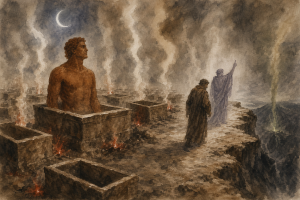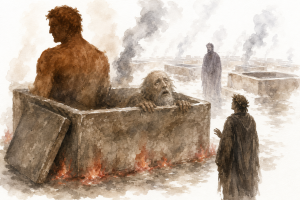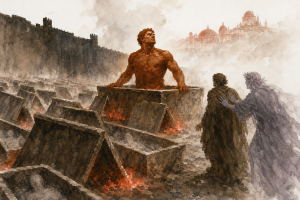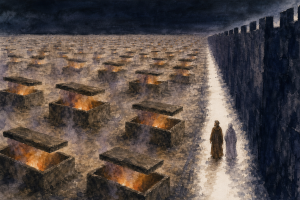
The Florentine who has just finished prophesying the ruin of his city crosses his eyes, drops his head and sinks back into the slush with the other blind souls, and Virgil — who has barely spoken for a hundred lines — chooses that moment to deliver the coldest piece of information in the third circle: the sleeper will not wake before the angel’s trumpet, and when he does he will find his tomb, take back his flesh and his face, and hear the sentence that goes on booming forever; and when the pilgrim asks whether the pain will then be greater, the answer is yes, and the authority cited is not Scripture but Aristotle.
Inferno · Canto 6 · Lines 94–115 · Scene 19
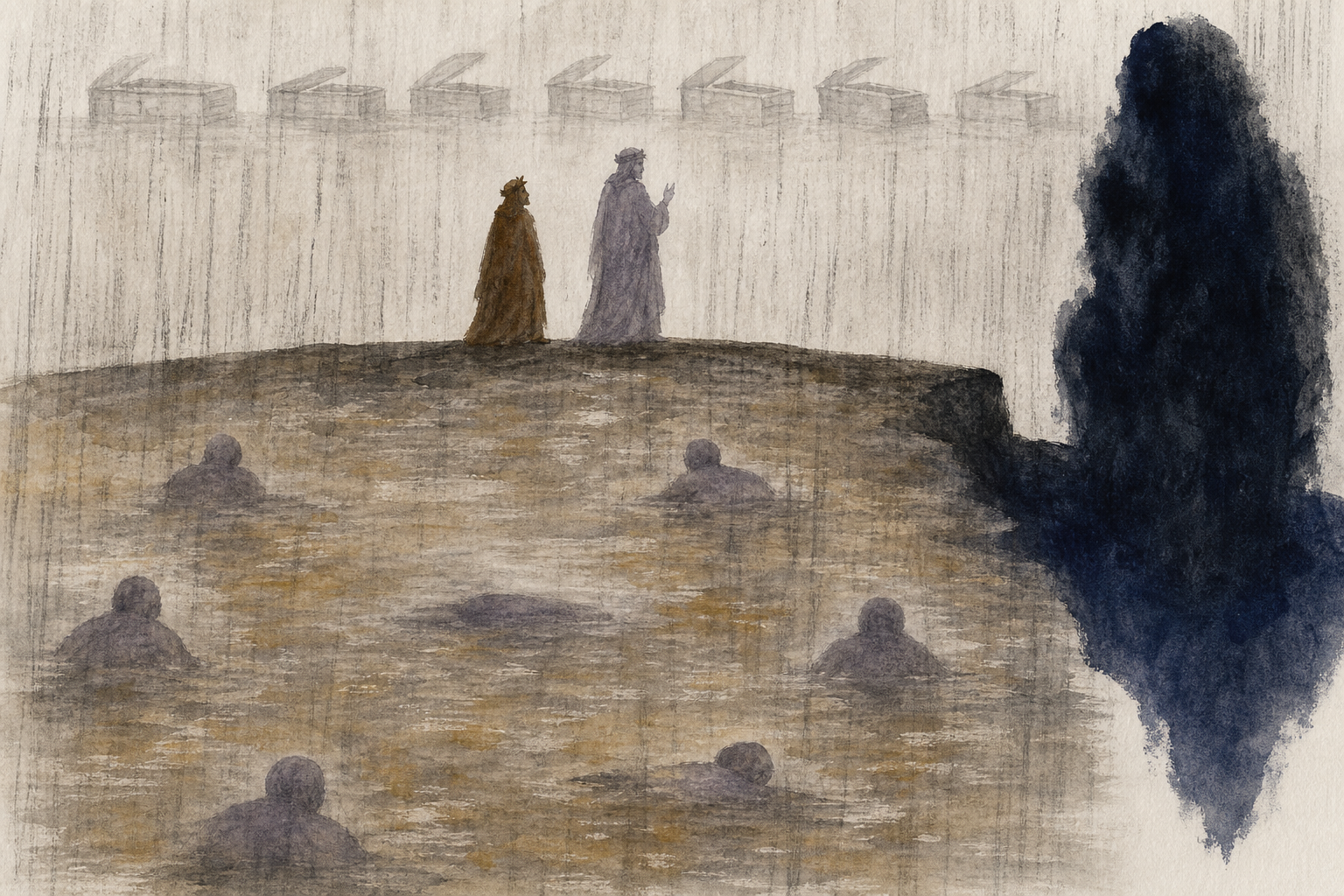
Ciacco has just told Dante what is going to happen to Florence, and then his eyes have gone crooked; he stares at the pilgrim for a moment, bows his head, and falls back into the mud with the other blind souls. It is natural to wait for him to get up. Virgil says he will not. «Più non si desta» (94) — he does not wake again — not on this side of the angel’s trumpet.
Notice the metaphor. Damnation is being described as sleep, which is a biblical way of talking about the dead: they sleep until the last day. But here the usual comfort is turned inside out. Waking will not be a rescue. Waking is the catastrophe. When the trumpet sounds, «la nimica podesta» (96), the hostile power, will come. That is Christ, arriving as judge, and Virgil does not use his name — nobody names Christ in Hell. He calls him the enemy, because for these particular souls that is what he is.
Then three verbs, one to a line: each soul «rivederà la trista tomba, / ripiglierà sua carne e sua figura, / udirà quel ch’in etterno rimbomba» (97–99). He will see his sad tomb again, pick his flesh and his shape back up, and hear the thing that echoes forever. Read the line-ends aloud: tromba, tomba, rimbomba — trumpet, tomb, boom. The rhyme sound is the noise the passage is about.
The two travellers walk on, slowly, through what Dante calls «sozza mistura / de l’ombre e de la pioggia» (100–101), the filthy mixture of shades and rain — the souls and the sleet have blended into one substance. They are talking about the life to come, and the pilgrim asks the obvious question: after the great sentence, will these torments get bigger, or smaller, or stay exactly as scalding as they are?
Virgil’s answer is the doctrinal heart of the canto, and it is startling because of where it comes from. «Ritorna a tua scïenza» (106): go back to your philosophy. The principle is Aristotle’s, as the Middle Ages received him — the more perfect a thing is, the more it feels, both pleasure and pain. Now apply it. A soul without a body is not a whole person; it is a person missing something. At the resurrection the missing part comes back. The damned become more complete, and more complete means more capable of sensation, and more capable of sensation, down here, means more capable of agony.
So Hell gets worse at the end of time. That is the plain content of «di là più che di qua essere aspetta» (111) — they expect to be more, over there, than they are here. And there is a knot in the middle of it that Dante does not untie: «questa gente maladetta / in vera perfezion già mai non vada» (109–110), this cursed people never arrives at true perfection. They will be more perfect and they will never be perfect. Both statements stand in the same sentence.
What is missing from the answer is as interesting as what is in it. The pilgrim asked about the Last Judgment, which is a matter of revelation, and Virgil replied with a proposition from natural philosophy. He mentions no Judge, no grace, no reason why the bodies should come back at all — only the mechanics of what happens once they do. He answers what reason can answer.
Then the road curves. «parlando più assai ch’i’ non ridico» (113): they said much more than the poet is going to repeat, which is the narrator admitting he has cut the conversation short. They come to the place where the ground steps down, «venimmo al punto dove si digrada» (114) — and there is Plutus.
And that is the end of the canto. The great enemy gets a name, an epithet, and not one word of description: no face, no size, no shape. Every other guardian so far has been drawn in detail. This one is simply there, at the edge of a step down, and the reader has to wait. The next canto opens with the noise he makes.
Go deeper: the college-level reading (about 1,200 words)
Quotes the Italian closely, with philological detail and cross-references.
The passage begins with Virgil pre-empting a question. Ciacco has fallen back among the blind, and Virgil says «Più non si desta / di qua dal suon de l’angelica tromba, / quando verrà la nimica podesta» (94–96). Two idioms are worth pausing over. «Si desta» makes damnation a sleep, the scriptural idiom for the dead awaiting the last trumpet (1 Corinthians 15:52; 1 Thessalonians 4:16); but the scriptural consolation is inverted, since for these souls waking is the disaster. And «di qua dal suon» is spatial grammar applied to time — this side of a sound — the sort of construction Dante uses when he wants an eschatological boundary to feel like a wall the pilgrim could walk into.
«La nimica podesta» is the poem’s third or fourth circumlocution for the same person. In Limbo Virgil described the Harrower as a mighty one crowned with the sign of victory and never gave a name (Inf. IV.53–54); here Christ returns as an office rather than a person, and the office is a civic one. The podestà of a thirteenth-century Italian commune was the chief magistrate, typically imported from another city precisely so that he would owe nobody anything, and his central function was judicial. A Florentine hearing «podesta» at the end of time hears a courtroom. The vocabulary holds: «la gran sentenza» (104), the great verdict, follows twelve lines later.
Lines 97–99 are a tricolon of futures, one verb per line, without conjunctions: «ciascun rivederà la trista tomba, / ripiglierà sua carne e sua figura, / udirà quel ch’in etterno rimbomba». Place, body, sentence — restored in that order. «Rivederà» is quietly terrible: the tomb is something one sees again, like a house. «Sua carne e sua figura» insists on the numerical identity of the risen body, which was the doctrinal point at issue: not a body but this one, the same flesh and the same visible form. Compare the suicides of Inferno XIII.103–108, who will go to Jehoshaphat with everyone else and fetch their bodies but will never put them back on, hanging them instead on their own thorn-trees — the single exception that proves how literally Dante means the rule. Compare too Inferno X.10–12, where the heretics’ sepulchres stand open and will be shut for good once the bodies return from the valley of judgment.
The rhyme-word chain of these tercets is doing work: tromba (95), tomba (97), rimbomba (99). Trumpet, tomb, and the verb of reverberation, which contains the other two sounds inside it. What exactly «quel ch’in etterno rimbomba» is has never been settled; most commentators take it as the sentence of the Judge, the discedite a me maledicti of Matthew 25:41, echoing without end, and Virgil’s own «gente maladetta» (109) may be a quotation of that verdict in advance. Others hear the undifferentiated roar of Hell itself, the noise the pilgrim met at the entrance to the second circle.
The transition is one of the poem’s finest small effects. «Sì trapassammo per sozza mistura / de l’ombre e de la pioggia, a passi lenti, / toccando un poco la vita futura» (100–102). Three lines after the reunion of flesh and form, the travellers wade through a bad mixture — the shades and the sleet have become one indistinguishable matter — while discussing the good one. «A passi lenti» gives a philosophical conversation the pace of a philosopher’s walk; it is the only gait specified in a canto that has otherwise contained a three-throated dog and men lying prone. «Toccando» is technical: to touch on a topic, tractare breviter, and «un poco» concedes that this is a summary.
The question, when it comes, is trifold and exact: «esti tormenti / crescerann’ei dopo la gran sentenza, / o fier minori, o saran sì cocenti?» (103–105). «Esti» is an apocopated form of questi, and «fier» is the future of essere. The oddity is «cocenti», scalding, in a circle whose torment is cold rain, hail and dirty snow; some read it as a dead metaphor for sharp pain, others as a real dissonance, the pilgrim reaching instinctively for fire in a place that has none.
Virgil’s reply is the doctrinal centre: «Ritorna a tua scïenza, / che vuol, quanto la cosa è più perfetta, / più senta il bene, e così la doglienza» (106–108). The diaeresis on scïenza gives the word three syllables and a slight formality of delivery. «Tua» is pointed — the philosophy the pilgrim already possesses, Aristotle as read in the schools — and the imperative «ritorna» treats the answer as retrieval rather than revelation. The axiom itself is a scholastic commonplace: perfection increases the capacity for sensation, and therefore for pleasure and for pain alike, indifferently. Applied to the resurrection it yields a conclusion the poem states without cushioning. A separated soul is not a whole human being; the reunion with the body completes the person; the completed person feels more; and in Hell feeling more means suffering more.
Then the concessive: «Tutto che questa gente maladetta / in vera perfezion già mai non vada, / di là più che di qua essere aspetta» (109–111). «Tutto che» is ‘although’. The sentence asserts two things at once and reconciles them nowhere: these souls never arrive at true perfection, and they will nevertheless have more being after the Judgment than before. The usual resolution distinguishes perfection of nature — the restored composite of soul and flesh — from perfection simpliciter, which is the attainment of the last end and forever closed to them; but Dante leaves the two clauses jammed against each other in three lines and moves on. «Essere» stands as a noun: what they await is more existence. And «aspetta» is the same posture as Inferno III.124–126, where divine justice so spurs the damned that their fear turns into desire.
The identical axiom returns, inverted, in Paradiso XIV.43–60, where Solomon explains that when the glorified flesh is resumed the person will be more complete, and therefore the vision will grow, and the ardour, and the ray. Heaven and Hell run on one physics. The mathematics that will increase beatitude is the mathematics that will increase torment, and the pilgrim is told it first in the mud.
The closing tercet accelerates: «Noi aggirammo a tondo quella strada, / parlando più assai ch’i’ non ridico; / venimmo al punto dove si digrada» (112–114). «Aggirammo a tondo» is redundant on purpose — they circled the circle. «Parlando più assai ch’i’ non ridico» is a reticence formula of the kind Dante used among the poets of Limbo, where he declined to report what was said; it admits that the doctrine just given is an excerpt. «Si digrada» is the architecture of the pit as a staircase.
And then the last line, standing alone: «quivi trovammo Pluto, il gran nemico» (115). A name, an epithet, and nothing else. Charon, Minos and Cerberus were all painted in detail; this guardian receives no face, no size, no attribute. The canto simply stops at the top of a step, and the description is deferred to the noise with which the next canto opens.
Go deeper still: the scholarly reading (about 1,100 words)
The commentary tradition, the sources, and what is documented versus inferred.
Whether the punishment of the damned increases after the resurrection of the body: the question is put in the schools in almost these words, and Dante puts it here in the mouth of the pilgrim, who has been walking through sleet and thinking about the end of time. «Esti tormenti / crescerann’ei dopo la gran sentenza, / o fier minori, o saran sì cocenti?» (103–105). Three branches — more, less, the same — which is the correct form for a question submitted to a master. The stakes are not small. If Hell can worsen, then the sentence pronounced at the general judgment is not merely a ratification of what is already in force; something is added after the verdict, and the damnation the pilgrim is looking at is not yet the final state of anything. If Hell cannot worsen, then the resurrection of the flesh is, for the reprobate, a doctrinal formality with no consequences — and Dante’s whole architecture of embodied pain becomes a metaphor after all.
It might seem that the punishment cannot increase. Hell is already, by definition, the privation of the last end; nothing worse than the loss of God can be lost. And the resurrection is a perfection, a restoration of the human composite to its natural integrity; it seems repugnant that a good should be conferred on the damned in order to make them worse. Against this, the answer given at 106–108, which does not argue from Scripture at all: «Ritorna a tua scïenza, / che vuol, quanto la cosa è più perfetta, / più senta il bene, e così la doglienza».
Note the disputational manoeuvre before the content. «Ritorna» — go back — treats the major premise as something the pupil has already conceded elsewhere and has merely failed to bring to bear. «Tua scïenza» is possessive: the philosophy Dante owns, has studied, cannot now disown. Virgil is not teaching a new doctrine; he is holding his pupil to one. The axiom itself is Peripatetic in temper — the more actual a thing is, the greater its capacity for sensation, and therefore for delight and for grief — and the early commentators reach for different texts to anchor it, some to the Ethics, some to the De anima, some simply to «the Philosopher» as filtered through the schools; the identification remains open, and probably ought to. What matters is not the chapter and verse but the shape: perfection is here a quantity of being, not a moral commendation. A more perfect thing is a thing more fully in act. The axiom is morally neutral, which is precisely why it can be turned against those who possess it.
The middle term is the human composite. On the Aristotelian account which the schools had made their own, the separated soul is not the man; it is a substantial form deprived of that which it is naturally the form of, and it persists in a condition that is, in the technical sense, violent — incomplete, straining towards the body it informs. Aquinas puts it with unusual bluntness in his exposition of 1 Corinthians 15: «anima mea non est ego», my soul is not I. Reunion with the flesh therefore restores something real. The risen damned are more themselves than the shades the pilgrim is walking through. And by the axiom, a being more fully in act senses more — «più senta il bene, e così la doglienza» — so that the very completion of their nature is the instrument of their increase in pain. Hell gets worse at the end of time not because God adds fuel but because the sufferers are enlarged.
Then the qualification, and it is the hardest sentence in the passage: «Tutto che questa gente maladetta / in vera perfezion già mai non vada, / di là più che di qua essere aspetta» (109–111). The damned will never arrive at true perfection — the perfection that is the possession of the good, perfection simpliciter — and yet they expect to be more on the far side of judgment than on this. The distinction being drawn is between perfection as beatitude and perfection as sheer completeness of nature, and Dante refuses to collapse them or to soften the collision. The verb carries it. Virgil does not say they expect to suffer more; he says «essere aspetta» — they expect to be more. Being is the increase; the suffering is the inference, and Dante leaves the reader to supply the minor premise and close the syllogism. This is why the terzina reads as a paradox rather than a consolation: growth in esse without any approach to the end for which esse exists. They will be more complete and no nearer.
The same axiom governs the poem’s other end, with the sign reversed. In the heaven of the Sun, Solomon explains what the resurrection will do for the blessed: «Come la carne glorïosa e santa / fia rivestita, la nostra persona / più grata fia per esser tutta quanta» (Par. XIV.43–45) — more pleasing for being entire, «tutta quanta», the whole of it. One principle, two destinies. Whether the schools were as untroubled as Virgil sounds is another matter: the distinction between the pain of loss and the pain of sense allowed some to argue that the increase after judgment is extensive rather than intensive, the body newly implicated in a grief the soul already suffered in full. Virgil declines the distinction and argues from being alone, which is either a simplification for a pupil in the rain or a considered position; the text does not say.
It is worth registering what kind of authority is being exercised. The resurrection itself Virgil cannot prove; he takes it from the trumpet, which is to say from revelation, and states it flatly at 94–99 without argument. What he can do is draw the consequence, and the consequence is drawn by natural reason from a pagan axiom. Reason is competent to say what follows from the article of faith, not to establish it. Virgil is being exactly what he is, and the division of labour is the point.
The canto then stops arguing and walks. «Parlando più assai ch’i’ non ridico» (113) — the disputation continues off the page, as disputations do — and the descent arrives at «Pluto, il gran nemico» (115). The epithet echoes «la nimica podesta» (96) at the head of the passage, and the echo is not decorative: the same word has named Christ-as-judge and now names a demon, because enmity in this poem is always someone’s, always relative to the party using the term. Plutus gets no description whatever, only the name and the threshold, his voice held over until the first line of Inferno VII: «Pape Satàn, pape Satàn aleppe!». The argument ends; the noise begins.
The Italian — What the Trumpet Will Restore
Source: Wikisource (public domain, pre-1929 text)
Lines 94–96
94. E ‘l duca disse a me: "Più non si desta95. di qua dal suon de l’angelica tromba,96. quando verrà la nimica podesta:
literary key: Line 94 — «Più non si desta» — he does not wake again. Virgil answers a question the pilgrim has not asked: Ciacco has just slumped back among the blind souls, and the natural expectation is that he will rise. The verb makes damnation a sleep, which is scriptural idiom for the dead awaiting the last day, but the usual consolation is inverted — waking will be the catastrophe rather than the release. The line also closes the Florentine conversation with a door: no more will be got from him, and the canto’s political matter is finished. [Model knowledge · high]
cultural ref: Line 95 — «l’angelica tromba» — the trumpet of Matthew 24:31 and of 1 Corinthians 15:52, where at the last trumpet the dead rise incorruptible, and of 1 Thessalonians 4:16. The medieval imagination had it fixed liturgically: the Dies irae sequence, thirteenth-century and attributed to Thomas of Celano, rhymes the wondrous trumpet with the tombs of every region, herding all before the throne. Dante’s own rhyme chain does the same work in Italian — tromba (95), tomba (97), rimbomba (99) — so that the sound of the passage is the noise the passage is about. [Model knowledge · high]
history: Line 96 — «la nimica podesta» — the hostile power. Christ returning as judge, designated by office rather than name, since no one in Hell speaks the name. The podestà of a thirteenth-century Italian commune was the chief magistrate, hired from another city precisely so that he owed no local faction anything, and his principal function was judicial. A Florentine hearing this word hears a courtroom, and the vocabulary holds twelve lines later at «la gran sentenza» (104). ‘Nimica’ is relative, not absolute: enemy to these souls, in this aspect, on that day. [Model knowledge · medium]
Lines 97–99
97. ciascun rivederà la trista tomba,98. ripiglierà sua carne e sua figura,99. udirà quel ch’in etterno rimbomba".
theology: Line 97 — «rivederà la trista tomba» — will see its sad tomb again. The verb treats the grave as a place one returns to, almost domestically. Compare Inferno X.10–12, where Virgil explains that the heretics’ sepulchres stand open and will be shut for ever once their occupants come back from the valley of Jehoshaphat with the bodies that are still above ground. The two passages assume the same choreography of the last day: bodies fetched from tombs, judgment, and then a closing that is permanent. [Source: Inferno X.10-12]
theology: Line 98 — «ripiglierà sua carne e sua figura» — will take back its flesh and its form. The doctrine defined at the Fourth Lateran Council of 1215 was that all rise in their own proper bodies, numerically the same, not merely in bodies of the same kind; the possessive ‘sua’, twice, carries that insistence. ‘Figura’ is the visible shape, the recognisable person. The exception that proves the rule comes in Inferno XIII.103–108, where the suicides will go and fetch their bodies like everyone else but will never wear them again, hanging them instead on their own thorn-trees. [Source: Inferno XIII.103-108; Fourth Lateran Council (1215)]
literary key: Line 99 — «udirà quel ch’in etterno rimbomba» — will hear what resounds eternally. What resounds has never been fixed. Most commentators take it as the sentence of the Judge, the discedite a me maledicti of Matthew 25:41, echoing without end; others hear the undifferentiated roar of Hell itself, of the kind the pilgrim met descending into the second circle. If the first reading is right, Virgil quotes the verdict in advance at 109 when he calls them «questa gente maladetta». The verb contains, phonically, both the trumpet and the tomb. [Model knowledge · medium]
Lines 100–102
100. Sì trapassammo per sozza mistura101. de l’ombre e de la pioggia, a passi lenti,102. toccando un poco la vita futura;
vocabulary: Line 100 — «sozza mistura» — filthy mixture. The shades and the sleet have blended into a single indistinguishable substance, which is the physical state of this circle: nothing here keeps its edges. The placement is exact. Three lines after a tercet about flesh and form being rejoined to soul — the good mixture, the human composite — the travellers wade through the bad one. Whether the juxtaposition is designed or fortunate is unprovable, but the poem rarely puts its worst noun next to its highest doctrine by accident. [Model knowledge · medium]
literary key: Line 101 — «a passi lenti» — with slow steps. This is the only walking pace specified in the canto, and it belongs to a philosophical conversation: a peripatetic gait for a peripatetic subject. The contrast is with everything else in Inferno VI, which has contained a three-throated dog snapping, a soul sitting bolt upright and dropping flat, and rain that never varies. The pace also gives the exchange its texture — this is a tutorial conducted on the move, not a set-piece delivered from a standing position. [Model knowledge · medium]
translation note: Line 102 — «toccando un poco la vita futura» — touching a little on the life to come. ‘Toccare’ is used here in its technical sense, to treat a topic briefly, corresponding to the Latin attingere in scholastic usage; ‘un poco’ underlines the brevity, and ‘la vita futura’ is the standard phrase for existence after the resurrection rather than for the afterlife in general. The line is the narrator conceding in advance that what follows is a summary — a concession he will repeat, more openly, at 113. [Model knowledge · high]
Lines 103–105
103. per ch’io dissi: "Maestro, esti tormenti104. crescerann’ei dopo la gran sentenza,105. o fier minori, o saran sì cocenti?".
vocabulary: Line 103 — «esti tormenti» — these torments. ‘Esti’ is an apocopated form of questi, current in older Tuscan and printed here in Petrocchi’s text; modern readers routinely mis-hear it as a typographical oddity rather than as ordinary thirteenth-century speech. Note also the address «Maestro», which is the pilgrim’s habitual vocative when he is asking Virgil for doctrine rather than for direction — the schoolroom title, used at exactly the moment the exchange turns into a quaestio. [Model knowledge · medium]
wordplay: Line 105 — «o saran sì cocenti» — or will they be as scalding. ‘Cocente’ is a heat word, from cuocere, to cook or burn, and the third circle has no fire in it whatever: the punishment is cold rain, hail and dirty snow falling on souls lying in slush. Some read the adjective as a dead metaphor, simply meaning sharp or searing pain; others hear a genuine dissonance, the pilgrim instinctively reaching for a fire that is not there because fire is what he expects Hell to be. The commentary tradition has never had to decide, and has not. [Model knowledge · low]
Lines 106–108
106. Ed elli a me: "Ritorna a tua scïenza,107. che vuol, quanto la cosa è più perfetta,108. più senta il bene, e così la doglienza.
literary key: Line 106 — «Ritorna a tua scïenza» — go back to your philosophy. The diaeresis gives scïenza three syllables and a certain formality of delivery. Two things are pointed. ‘Tua’: the learning the pilgrim already owns, Aristotle as received in the schools, not a revelation being handed down. And ‘ritorna’: the imperative treats the answer as retrieval rather than instruction, which is what a teacher says when the student already has what he needs. Virgil answers a question about the Last Judgment by sending Dante to his own bookshelf. [Model knowledge · high]
theology: Line 107 — «quanto la cosa è più perfetta, / più senta il bene, e così la doglienza» — the axiom that perfection increases the capacity for feeling, indifferently for good and for pain. It is a scholastic commonplace, and the conclusion drawn from it — that the punishment of the damned will be greater after the resurrection than before — is argued in the Supplementum to the Summa theologiae, q. 98, itself a posthumous compilation from Aquinas’s earlier commentary on the Sentences. No verbatim Aristotelian source has ever been securely identified; commentators have pointed to the De anima and to the Ethics without agreement. [Model knowledge · medium]
theology: Line 108 — «più senta il bene, e così la doglienza» — the good and, likewise, the grief. The axiom is symmetrical, and Dante means it to be. Paradiso XIV.43–60 gives Solomon the identical principle running upward: when the glorified flesh is resumed the person will be more complete, and therefore the vision will grow, the ardour that is kindled from it will grow, and the ray that comes from the ardour will grow. Heaven and Hell operate on one physics. The arithmetic that will enlarge beatitude is the arithmetic that enlarges torment, and the pilgrim is taught it first standing in slush. [Source: Paradiso XIV.43-60]
Lines 109–111
109. Tutto che questa gente maladetta110. in vera perfezion già mai non vada,111. di là più che di qua essere aspetta".
cultural ref: Line 109 — «questa gente maladetta» — this cursed people. The adjective is the vocabulary of the sentence itself: maledicti, in the verdict of Matthew 25:41 that separates the goats and consigns them to eternal fire. If the thing that «in etterno rimbomba» at 99 is that verdict, then Virgil is here using the Judge’s own word for them, ten lines in advance of the day on which it will be pronounced. It is also, in its ordinary sense, simply the standard periphrasis for the damned, and the two readings do not exclude each other. [Model knowledge · medium]
theology: Line 110 — «in vera perfezion già mai non vada» — never goes on to true perfection. The standard resolution of the paradox distinguishes perfection of nature, the integrity of a human being as soul and body restored, which the damned will possess, from perfection in the absolute sense, the possession of the last end, which they never will. Early commentators supply the distinction readily. What none can supply is a reason why Dante buries it in a concessive clause and changes the subject: the sentence holds both halves of the contradiction and moves on within three lines. [Model knowledge · medium]
literary key: Line 111 — «di là più che di qua essere aspetta» — it expects to be, over there, more than here. ‘Essere’ stands as a noun: what is awaited is more being. The balance of «di là» against «di qua» reprises the temporal-spatial idiom of 95. ‘Aspetta’ can mean awaits, with the certainty of fact, or expects, with the openness of an opinion held by the subject; the first is standard and doctrinally correct, but the grammar permits the second, and Inferno III.124–126 has already shown the damned pressing toward judgment with fear turned into desire. [Source: Inferno III.124-126]
Lines 112–114
112. Noi aggirammo a tondo quella strada,113. parlando più assai ch’i’ non ridico;114. venimmo al punto dove si digrada:
vocabulary: Line 112 — «Noi aggirammo a tondo quella strada» — we circled that road round. The phrase is deliberately redundant: aggirare already contains the turning, and ‘a tondo’ adds the circle again. Dante uses this doubling when he wants the reader to feel the geometry as labour rather than as diagram — the travellers are walking an arc of a ring, and the arc is long enough for a conversation the poet then declines to report in full. The circular movement ends, as it always does in Hell, at a place where the ground fails. [Model knowledge · medium]
literary key: Line 113 — «parlando più assai ch’i’ non ridico» — talking of far more than I retell. A reticence formula, of the kind used among the poets of Limbo, where the narrator states that they spoke of things it is as well to keep silent about (Inf. IV.104). Here the effect is different: not decorum but abridgement. The doctrine just delivered is an excerpt from a longer tutorial, and the admission comes two lines before the canto refuses to describe its own final figure. Twice in four lines the text announces that it is withholding. [Source: Inferno IV.104]
vocabulary: Line 114 — «venimmo al punto dove si digrada» — we came to the point where it steps down. ‘Digradare’ derives from grado, a step or degree: the architecture of the pit understood as a staircase, each circle a tread. The impersonal reflexive makes the descent a property of the place rather than an action of the travellers. Note that the canto ends at the top of the step and not at the bottom: the poem stops on the threshold, which is where it has chosen to leave the reader. [Model knowledge · high]
Lines 115
115. quivi trovammo Pluto, il gran nemico.
cultural ref: Line 115 — «quivi trovammo Pluto, il gran nemico» — a name, an epithet, and nothing else. The form of the name is that of the classical lord of the underworld, but the function — guarding the circle of avarice and prodigality — belongs to Plutus, god of wealth, a different figure with whom he was already being confused in late antiquity. Early commentators split, and the tradition has never converged; some treat the ambiguity as deliberate. ‘Il gran nemico’ is equally unfixed: enemy of God, of humankind, or of this journey. Every previous guardian was described in detail. This one is not, and the deferral holds through the opening of the next canto, which begins with a cry no reader has confidently construed. [Model knowledge · medium]
Seven Centuries of Reading What the Trumpet Will Restore
The enemy and the sentence
Virgil’s account of the Last Judgment (94–99) calls Christ «la nimica podesta», the hostile power. André Pézard argued that the enemy must be damnation, since Christ is no one’s enemy. Nearly all readers disagree, and Padoan pointed out that Dante calls God «l’avversario d’ogne male» at II.16. Benvenuto da Imola heard in the judgment that resounds eternally the words of Christ in Matthew 25:41, «Discedite a me, maledicti, in ignem aeternum». Singleton connected the angelic trumpet with Paul’s account of the resurrection in I Corinthians 15.
Which ‘scienza’?
When Virgil tells the pilgrim to return to his «scïenza» (106) for the principle that a more perfect thing feels more, commentators disagreed about which book was meant. Mazzoni showed that the principle comes from Aquinas’s commentary on Aristotle’s De anima: the more perfect the soul, the more numerous and perfect its operations. The science is the De anima, not the Physics or the Ethics.
Hollander draws out the grim logic of 109–111. A soul united with its body is better, ontologically, than a soul alone, so the damned will be more perfect after the resurrection, and in Hell more perfection means more capacity for pain.
Plutus, not Pluto
The «gran nemico» waiting at the end of the canto (115) is Plutus, the classical god of wealth, not Pluto, god of the underworld. Hollander sets him against the «nimica podesta» of 96: the canto names two enemies, Christ coming in judgment and the demon of the next circle.
What remains open
Dante the narrator says the travellers spoke of more than he will report (113). Hollander takes this as a realistic touch, the narrator as editor of his own material, and sees no hidden meaning behind it. The larger question the scene leaves is the one Virgil answers only formally: what a resurrection of the body can mean for souls whose eternity is punishment.
The Two Main Positions on What the Trumpet Will Restore
Reason Reaches This Far
The passage is straightforward doctrine, correctly stated by the guide who exists in the poem to state it. The increase of infernal pain after the resurrection is orthodox theology, argued in the same terms in the Thomist tradition; the axiom about perfection and sensation is a school commonplace that no Christian authority contested; and Dante confirms his commitment to it by building the whole of Solomon’s discourse on glorified flesh in Paradiso XIV out of the identical principle, running in the opposite direction. Heaven and Hell operate on one physics, and the poem says so twice. Virgil’s appeal to philosophy rather than Scripture is not a limitation but a demonstration: on this particular point, the consequences of the resurrection once granted, unaided reason genuinely does arrive at the truth, and Dante the philosopher — the Dante whose Aristotelianism Bruno Nardi insisted on treating as his own and not as borrowed Thomism — believed exactly that. The compression at 109–111 is economy, not embarrassment; the distinction between natural perfection and perfection in the absolute sense was so familiar that stating it would have been pedantry.
Key passage: Paradiso XIV.43–60 applies the same axiom to the blessed and treats it as certain; Virgil’s proposition is doctrinally correct by the standards of every school Dante knew; and the poem never corrects it, in Purgatorio XXV’s long discourse on the aerial body or anywhere else.
The Guide at His Ceiling
The scene is arranged to show reason answering an eschatological question in the only vocabulary it owns. Virgil describes the return of Christ as a hostile magistracy and cannot say the name, exactly as he could not say it in Limbo; he grounds a doctrine of resurrection in an axiom about sensation, saying nothing of grace, of the reason bodies are restored, or of the justice of restoring them for punishment; and the sentence he produces contains an unreconciled contradiction — never perfect, yet more perfect — which he neither notices nor resolves. Then the poem does something structural: it tells us the conversation was longer than reported, walks the pair to a step down, and confronts them with a guardian it declines to describe, whose first utterance in the next canto is an unintelligible noise that Virgil will have to talk past rather than translate. On this reading, the passage is the last stretch of ground where philosophy is adequate, and the canto ends by walking off it.
Key passage: Christ is unnamed at 96 as at Inferno IV.53–54; the authority cited at 106 is the pilgrim’s own learning and nothing else; the paradox at 109–110 is stated and dropped; and the canto closes on a named guardian given no description at all, in a poem that had described every previous one.
What the Text Does — and What That Means (Contested)
On the page: Christ is designated by an office and an adjective, «la nimica podesta» (96), and is not named. Virgil’s authority for his answer is «tua scïenza» (106) — the pilgrim’s own philosophical learning — and no scriptural or ecclesiastical authority is cited anywhere in the passage. Lines 109–111 contain both the assertion that the damned never reach true perfection and the assertion that they await more being after the Judgment, joined by the concessive «Tutto che», with no distinction drawn between senses of perfection. The same axiom about perfection and capacity governs Solomon’s speech on the glorified flesh at Paradiso XIV.43–60. Inferno XIII.103–108 makes the suicides an explicit exception to the rule stated here at 98. Line 113 states that the conversation reported is an abridgement. Line 115 names Plutus and gives him no described attribute; the immediately preceding guardians of Inferno III, V and VI each receive physical description.
What scholars dispute: Whether Virgil functions here as a fully authoritative expositor or as a guide operating at the limit of his competence is contested and has been since at least the mid-twentieth century; the reading of «tua scïenza» as an endorsement of natural reason’s reach and the reading of it as a demonstration of its ceiling are both defensible from the same eleven lines. The Aristotelian source of the axiom has never been securely identified, so calling it ‘Aristotle’ is already an interpretative act. The construction of «aspetta» (111) as certain futurity rather than as the damned’s own expectation is standard but not compelled by the grammar.
What Dante Leaves Unresolved
How the damned can be more perfect and never truly perfect at once, and whether the increase they await is a fact of the poem’s cosmology or a state of mind belonging to «questa gente maladetta»; whether Virgil’s recourse to philosophy in the absence of any named Judge is the poem’s endorsement of reason or its demonstration of what reason cannot say; and what Plutus is, since the text gives a name and an epithet and refuses, at the moment of maximum expectation, to give anything else.
The Open Question
The pilgrim asks what will happen to the torments of Hell at the Last Judgment — a question about revelation, about the return of Christ and the raising of the dead — and Virgil answers with a proposition from natural philosophy, never naming the Judge and never explaining why the bodies return at all. Is that the poem speaking its own settled doctrine, confident that reason reaches this far unaided? Or is it the moment when reason is shown handling a revealed mystery with instruments not built for it, four lines before it arrives at something on the road it cannot even describe?
Explore More
About This Article

Written by Lucy Bamboo. Lucy Bamboo has been reading the Divine Comedy for fifteen years — first in translation, then stubbornly in Medieval Tuscan with a dictionary and far too many footnotes. Reading Dante is her scene-by-scene walk through the poem: the original Italian, seven centuries of scholarly argument presented as argument rather than answer, and the human questions sitting underneath the theology. More about this site.
Verify this against a primary source
Specifics change, and your situation may differ from the one described here. These are the authorities worth checking directly:
- Digital Dante, Columbia University — text, commentary and translation apparatus
- Princeton Dante Project — the Commedia with historical commentary
- Dartmouth Dante Project — searchable commentary from 1322 onward