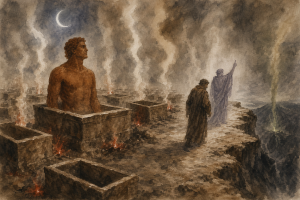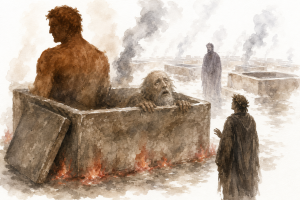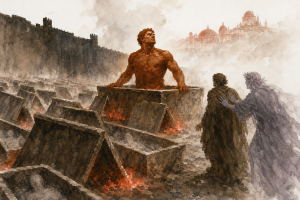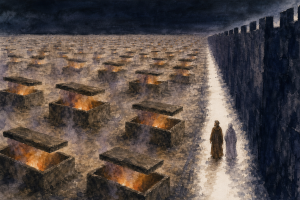
Under a rain that beats the shades flat, the two travellers walk across bodies that are not bodies, and out of the whole prone field one soul hoists itself upright and demands to be recognised — and this glutton, whose sin never comes up again after four lines, is the mouth Dante chooses for the poem’s first political prophecy: he names the coming bloodshed in Florence, the fall of the party the poet himself belonged to, the pope who is currently hugging the shore, the two just men nobody listens to, and five old Florentine names that turn out to be a table of contents for the rest of Hell, before asking to be remembered and dropping back into the mud among the blind.
Inferno · Canto 6 · Lines 34–93 · Scene 18
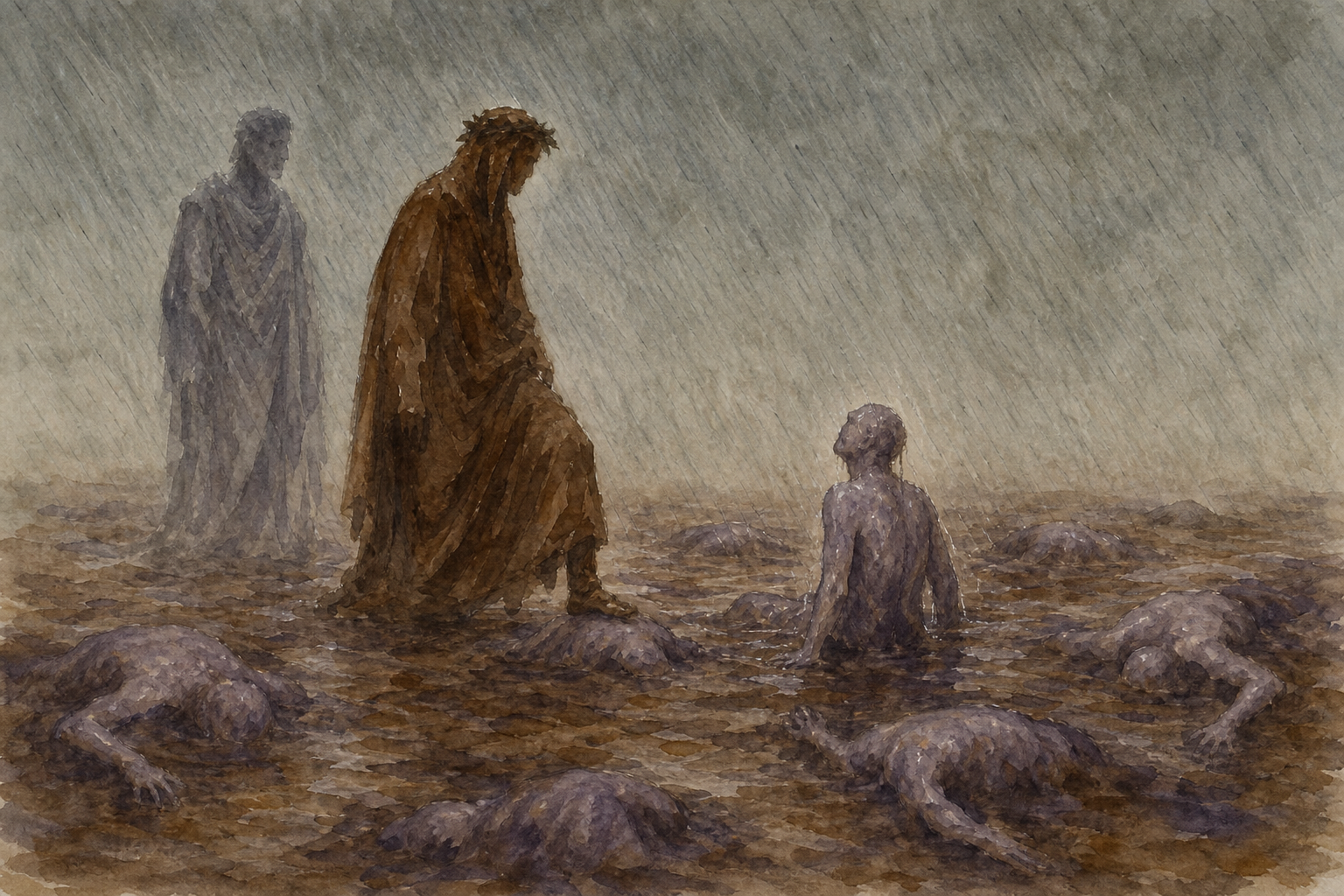
The rain has not stopped. Dante and Virgil are crossing the third circle on foot, and the poem makes a point of what that means: «ponavam le piante / sovra lor vanità che par persona» (35–36). They are putting their feet down on emptiness that looks like people. The souls here lie flat, all of them, «tutte quante» — and then one exception. A shade sits up as they pass. That single change of posture is the whole engine of the scene. In this canto lying down is what damnation looks like, so getting up, even halfway, is the most a soul here can do.
He does not introduce himself. He says: recognise me if you can — «riconoscimi, se sai» — and then gives a clue instead of a name: «tu fosti, prima ch’io disfatto, fatto» (42). You were made before I was unmade. The Italian crosses the two words over each other, unmade then made, so that Dante’s birth and this man’s death lock together like two halves of one motion. It is also a piece of information: he died after 1265, when Dante was born, so they overlapped in the same city. Dante still cannot place him, and says so politely — perhaps your suffering has pulled you out of my memory (43–45), which is a courteous lie or an honest observation, since misery here disfigures.
When the shade finally speaks, notice what he leads with. Not his sin, not his name: his city. «La tua città, ch’è piena / d’invidia sì che già trabocca il sacco» (49–50) — your city, so full of envy that the sack is already spilling over. Florence is never named in this canto; it is always ‘your city’. Only after that does he say the Florentines called him Ciacco, and that gluttony put him here, and that he is not alone — everyone around him is here for the same thing. Then: «E più non fé parola» (57). He stops. He has said all he intends to say about himself in six lines.
Dante weeps for him, and then asks about politics. Three questions: what will happen to the citizens of the divided city, is there anyone just left in it, and why has so much discord attacked it (60–63). And Ciacco answers with the first prophecy in the Commedia. It is deliberately hard to follow. After long quarrelling they will come to blood; the ‘wild party’ will drive the other out with much offence; then within three suns that party must fall and the other rise, «con la forza di tal che testé piaggia» (69) — with the strength of one who is at present hugging the shore, that is, temporising. The wild party is the Whites, Dante’s own; the temporiser is Pope Boniface VIII; the three suns are three years, from 1300 to 1302, when the Whites were driven out and Dante with them. Dante’s first readers knew all of this had already happened. The prophecy is a prediction only inside the fiction; outside it, it is memory. That double time is one of the poem’s permanent instruments.
The answer to the second question is one line: «Giusti son due, e non vi sono intesi» (73). Two just men, and nobody heeds them. Who they are has never been settled and probably cannot be. The answer to the third is a triad: pride, envy and avarice are the three sparks that have set the hearts alight (74–75).
Then Dante asks for names — Farinata, Tegghiaio, Iacopo Rusticucci, Arrigo, Mosca, men who ‘set their minds on doing good’ — and wants to know whether heaven sweetens them or Hell poisons them (79–84). Ciacco’s reply is flat: they are among the blacker souls, further down, and if you descend that far you will see them. It is a reading list. Dante will meet Farinata in canto X, Tegghiaio and Rusticucci in XVI, Mosca in XXVIII. Arrigo never appears again, and nobody has explained why.
Last, he asks for the only thing a shade can want: when you are back in the sweet world, bring me to other people’s minds (88–89). More than that I will not say. Then his straight eyes twist sideways, his head goes down, and he falls with it «a par de li altri ciechi» (93) — level with the other blind. The request was granted, of course. The poem is the granting.
Go deeper: the college-level reading (about 1,400 words)
Quotes the Italian closely, with philological detail and cross-references.
The scene opens on a physical detail that will not recur in this form: the pilgrims walk over the damned. «Noi passavam su per l’ombre che adona / la greve pioggia, e ponavam le piante / sovra lor vanità che par persona» (34–36). ‘Adona’ is rare — it means beats down, subdues, flattens — and ‘vanità che par persona’ is a small treatise in four words: what the foot rests on is emptiness that has the appearance of a person. The Comedy will worry at the ontology of the shade-body repeatedly, most systematically when Statius explains the aerial body in Purgatorio XXV, and the pilgrim’s hands will pass three times through Casella at the shore of Purgatory. Here the problem is solved by not being raised: the feet go down and the poem moves on.
Against that horizontal field — «Elle giacean per terra tutte quante» (37) — one soul sits up: «fuor d’una ch’a seder si levò, ratto / ch’ella ci vide passarsi davante» (38–39). The vertical is scarce in the Inferno and Dante spends it carefully. Farinata will rise from his tomb in canto X in a movement so charged that Dante’s Virgil corrects the pilgrim’s posture for him; Ciacco’s half-rise is the milder ancestor of that gesture, and it is prompted by nothing more than being seen walked past.
His opening is a riddle, and it is delivered with complete confidence in his own memorability: «riconoscimi, se sai: / tu fosti, prima ch’io disfatto, fatto» (41–42). The verse is a chiasmus — the participles cross, ‘disfatto’ before ‘fatto’, in reverse of the chronology they describe — so that unmaking is spoken first and making second, and the two lives are hinged on the caesura. It also functions as data: Ciacco died after Dante’s birth in 1265, in a Florence they shared. Dante’s failure is answered with tact rather than confession: «L’angoscia che tu hai / forse ti tira fuor de la mia mente, / sì che non par ch’i’ ti vedessi mai» (43–45). Anguish disfigures; the same principle governs the terrace of gluttony in Purgatorio XXIII, where the penitents are so wasted that Dante recognises Forese Donati only when he speaks. The pairing is worth holding: gluttony in Hell is a nameless slop of anonymous shades with one talker; gluttony in Purgatory is Dante’s own friend, thin, singing, and named.
Dante’s question at 46–48 ends oddly: «hai sì fatta pena, / che, s’altra è maggio, nulla è sì spiacente». If another punishment is greater, none is so revolting. The pilgrim is grading, and the criterion is disgust rather than severity — a distinction the canto needs, since the physical squalor here is extreme while the sin is, in the scheme, among the mildest.
Ciacco’s self-presentation puts the city first and himself second: «La tua città, ch’è piena / d’invidia sì che già trabocca il sacco, / seco mi tenne in la vita serena» (49–51). Florence is not named in canto VI, only possessed — ‘la tua città’ — and the sack overflowing is mercantile household idiom of exactly the sort a Florentine would reach for. ‘La vita serena’ is his single note of nostalgia, matched later by «nel dolce mondo» (88): two epithets for the world above, both in the mouth of a soul lying in filth. Then the name, and the crucial fact that it is other people’s: «Voi Cittadini mi chiamaste Ciacco» (52). He was given it; whether it is a hypocoristic of Iacopo or the Florentine word for hog has been argued since the earliest commentaries, and the poem does not adjudicate. Four lines cover the sin — «per la dannosa colpa de la gola» (53), «a la pioggia mi fiacco» (54) — and then a striking act of self-effacement: he is not alone, all these shades are here for a similar fault under a similar punishment (55–56). «E più non fé parola» (57). He has finished with the subject of himself.
Dante’s response is the canto’s hinge. He weeps — «il tuo affanno / mi pesa sì, ch’a lagrimar mi ‘nvita» (58–59) — and then asks three political questions in three clauses: «a che verranno / li cittadin de la città partita; / s’alcun v’è giusto; e dimmi la cagione / per che l’ha tanta discordia assalita» (60–63). ‘Città partita’ turns on ‘parte’, the technical word for a faction: the divided city is the city of parties, and Dante will use the same lexicon of ‘parte’ throughout the Florentine cantos. This is the first of the great civic interrogations, and it establishes the pattern by which the sixth canto of each canticle widens the frame — Florence here, Italy in Purgatorio VI, the Empire in Paradiso VI.
The prophecy (64–72) is calculatedly opaque. «Dopo lunga tencione / verranno al sangue» — the long wrangling of 1300 and the street violence; «la parte selvaggia / caccerà l’altra con molta offensione» — the Whites, called ‘selvaggia’ probably for the rural origins of the Cerchi in the Val di Sieve, with the secondary charge of ‘uncouth’ or ‘savage’, expelling the Blacks in 1301; «infra tre soli» (68) — three years, so by 1302; «con la forza di tal che testé piaggia» (69) — with the force of one who at present tacks and hugs the shore. ‘Piaggiare’ is nautical and moral at once, and the temporiser is read, all but universally, as Boniface VIII, publicly neutral in 1300 while working the Florentine crisis. The Blacks will hold their heads high a long time, keeping the others under heavy burdens, «come che di ciò pianga o che n’aonti» (72) — however much the beaten party weeps or is shamed. Dante, prior of Florence for two months in 1300, was in the beaten party. The prophecy is dated to a fictional present in which it is future and written in a real present in which it is history: the pilgrim receives an oracle, the reader recognises a fact. Farinata in X, Brunetto in XV and Vanni Fucci in XXIV will each add a piece, and only Cacciaguida in Paradiso XVII will finally say it plainly.
The second question gets one line: «Giusti son due, e non vi sono intesi» (73). The proposals run from Dante and a named friend to a Scriptural echo of the bargaining over Sodom to a plain idiom for ‘next to nobody’; none has ever prevailed, and the line’s force may lie precisely in the arithmetic being unverifiable. The third question gets a triad — «superbia, invidia e avarizia sono / le tre faville c’hanno i cuori accesi» (74–75) — the same three vices Brunetto Latini will fling at the Florentines in canto XV, and, for many readers, the beasts of canto I in another form.
Then the roll-call. Dante asks after «Farinata e ‘l Tegghiaio, che fuor sì degni, / Iacopo Rusticucci, Arrigo e ‘l Mosca / e li altri ch’a ben far puoser li ‘ngegni» (79–81), and asks it with the appetite that will get him into trouble later: «gran disio mi stringe di savere / se ‘l ciel li addolcia o lo ‘nferno li attosca» (83–84). The answer is brutally economical: «Ei son tra l’anime più nere; / diverse colpe giù li grava al fondo: / se tanto scendi, là i potrai vedere» (85–87). Men remembered for setting their minds on doing good are further down for various sins. It is also a schedule: Farinata in X, Tegghiaio and Rusticucci in XVI, Mosca in XXVIII. Arrigo alone is never met, and the commentaries have produced candidates without producing an explanation.
The last thing Ciacco wants is the first version of a request the Inferno will hear again and again: «priegoti ch’a la mente altrui mi rechi: / più non ti dico e più non ti rispondo» (89–90). Bring me back into other people’s minds. He then closes the interview himself, and the closing is physical: «Li diritti occhi torse allora in biechi; / guardommi un poco e poi chinò la testa: / cadde con essa a par de li altri ciechi» (91–93). The straight eyes go askew, the head bows, the body follows the head down to the level of ‘li altri ciechi’. He had the only upright posture in the circle for sixty lines, and he loses it in a line and a half.
Go deeper still: the scholarly reading (about 1,100 words)
The commentary tradition, the sources, and what is documented versus inferred.
On 1 May 1300 a scuffle broke out among young men of the Cerchi and Donati households in the Piazza di Santa Trinita, and Ricoverino de’ Cerchi lost part of his nose to a sword. Dino Compagni, who was in the city and in office, treats the incident as the point at which a family quarrel became a constitutional crisis. Six weeks later Dante entered the priorate — he served from 15 June to 15 August 1300 — and the college of priors took the extraordinary step of confining the ringleaders of both factions: the Blacks to Castel della Pieve, the Whites to Sarzana, among them Guido Cavalcanti, who came back ill and died in August. The measure failed. Boniface VIII, whose jubilee had filled Rome that same year and whose designs on Tuscany were not disguised, sent Charles of Valois as peacemaker; Charles entered Florence on 1 November 1301, Corso Donati returned, and within days the Whites had lost the city. On 27 January 1302 Dante was sentenced in absentia on charges of barratry by the podestà Cante de’ Gabrielli; on 10 March the sentence was raised to death by fire should he be taken. Behind all of this lay the older sediment the chroniclers never let alone: the murder of Buondelmonte de’ Buondelmonti at the Ponte Vecchio in 1216, which Villani made the origin of the parties; Montaperti in 1260; the collapse of Ghibelline Florence after Benevento in 1266; the Ordinamenti di Giustizia of 1293, which locked the magnate houses out of the priorate and obliged Dante to enrol in the Arte dei Medici e Speziali in 1295 to hold office at all.
The poem arrives afterwards, and pretends not to have. Its action is set at Easter 1300, some weeks before Dante took office and eighteen months before the city fell to Charles; its composition belongs to the years after 1302, probably after 1306. Everything Ciacco says about the future is a report on the past, and the poem’s first prophecy is therefore also its first act of dissimulation. «Dopo lunga tencione / verranno al sangue» (64–65) — the long wrangling and then the blood; «la parte selvaggia / caccerà l’altra con molta offensione» (65–66). Selvaggia because the Cerchi came in from the Val di Sieve and were still thought countrified by the older houses; Then «infra tre soli» (68) the Whites fall, and the Blacks rise «con la forza di tal che testé piaggia» (69). To «piaggiare» is to hug the shore, to tack, to keep one’s options open — and the man temporising in the spring of 1300 while the Cerchi and the Donati destroyed each other is, on almost every reading since the earliest commentaries, Boniface. A minority has preferred Charles of Valois; the verb fits the pope better, since Charles had not yet been sent. The arithmetic of «tre soli» is loose — Easter 1300 to November 1301 is not three years unless one counts inclusively, or counts summers — and the looseness is presumably deliberate, since a prophecy that got the calendar exactly right would advertise its own retrospection.
What deserves more notice than the accuracy is the mouth it is put into. Dante had at his disposal, for this office, a magistrate, a chronicler, a party captain. He chose a scrounger. The speaker announces himself by the name the city gave him — «Voi Cittadini mi chiamaste Ciacco» (52) — and by the sin, «la dannosa colpa de la gola» (53). Whether Ciacco was a real byname or simply the Florentine word for hog has been argued since the fourteenth century and cannot be settled; Boccaccio, who put a Ciacco into Decameron IX.8 as a celebrated parasite and wrote about him again in the Esposizioni, is our fullest source and also the least independent one, since he is reading Dante. Either way the pun works, and either way the man has no standing. He is a client of tables, someone who knew every household because he ate in them. That is precisely the qualification: gossip is a form of political intelligence, and the person who eats in both the Cerchi and the Donati houses knows what is coming before the priors do.
His claim on the pilgrim’s attention is likewise social rather than moral. «Tu fosti, prima ch’io disfatto, fatto» (42) is a dating device — he died after Dante’s birth in 1265 — but its force is the assumption behind it: in a walled city of perhaps a hundred thousand, a man of Ciacco’s reputation expects to be known by sight. His diagnosis is standard Florentine moralism, sharpened: «superbia, invidia e avarizia sono / le tre faville c’hanno i cuori accesi» (74–75). Brunetto Latini gives the same triad in Inferno XV, where the Florentines are «gent’ è avara, invidiosa e superba», and Dante himself will cry out in Inferno XVI that «La gente nuova e i sùbiti guadagni» have bred pride and excess. Ciacco’s last movement, when he «cadde con essa a par de li altri ciechi» (93), rhymes with Brunetto’s report that the world of old calls the Florentines blind.
«Giusti son due, e non vi sono intesi» (73) has never been resolved and should not be tidied. Candidates have included Dante with Guido Cavalcanti, Dante with Dino Compagni, Barduccio and Giovanni; others take the number as a biblical idiom on the model of the righteous men sought in Sodom, meaning effectively none, and some read it as an ironic answer to the pilgrim’s own «s’alcun v’è giusto» (62). The disagreement is old and the evidence for any single pair is nil.
The catalogue at 79–81 is a roll of the generation before the split: Farinata degli Uberti, dead in 1264, the Ghibelline who saved the city at the council after Montaperti; Tegghiaio Aldobrandi, who according to Villani advised against the campaign that ended there; Iacopo Rusticucci; Mosca dei Lamberti, whose «Capo ha cosa fatta» in Inferno XXVIII settled the Buondelmonte killing of 1216; and Arrigo. Dante asks «se ‘l ciel li addolcia o lo ‘nferno li attosca» (84) and is told «Ei son tra l’anime più nere» (85). Three of the five keep the appointment — Farinata in X, Tegghiaio and Rusticucci in XVI, Mosca in XXVIII. Arrigo does not, and no commentator has explained why; identifications with one or another of the 1216 conspirators remain guesses.
Then «a la mente altrui mi rechi» (89), the Inferno’s first request to be remembered above. It is granted in the only way available. Whatever Ciacco was in the streets where he begged his dinners, he survives because a man he may never have met put him in a poem and made him the first to speak the city’s future in the past tense.
The Italian — Ciacco Sits Up in the Rain
Source: Wikisource (public domain, pre-1929 text)
Lines 34–36
34. Noi passavam su per l’ombre che adona35. la greve pioggia, e ponavam le piante36. sovra lor vanità che par persona.
vocabulary: Line 34 — ‘adona’ — beats down, subdues, flattens. A rare verb, probably of Provençal derivation, and the only one of its kind in the poem; the heavy rain does not merely fall on the shades, it presses them into submission. The word sets the canto’s governing geometry: everything in the third circle is horizontal, and the sinner who will speak is defined entirely by briefly resisting that horizontality. Note that the grammatical subject of the flattening is ‘la greve pioggia’ — the punishment acts, the punished do not. [Model knowledge · medium]
theology: Line 36 — ‘sovra lor vanità che par persona’ — on their emptiness which seems a person. Four words on the ontology of the shade: what the pilgrim’s foot rests on has the appearance of a body and none of the substance. The Comedy handles this problem seriously later — Statius’ explanation of the aerial body in Purgatorio XXV, the pilgrim’s arms closing three times on nothing when he tries to embrace Casella in Purgatorio II — but here it is stated and dropped. The shades of gluttony are walked over, which is a punishment of a peculiarly humiliating and physical kind for beings without physics. [Source: Purgatorio XXV; Purgatorio II]
Lines 37–39
37. Elle giacean per terra tutte quante,38. fuor d’una ch’a seder si levò, ratto39. ch’ella ci vide passarsi davante.
literary key: Line 38 — ‘fuor d’una ch’a seder si levò’ — except one who raised himself to sitting. Verticality is scarce currency in Hell and Dante spends it deliberately. Farinata will rise from his burning tomb in canto X in a movement that dominates its canto and requires Virgil to correct the pilgrim’s own posture; Ciacco’s half-rise is the milder first instance, and he does not stand. What triggers it is nothing said or asked: he sees living men walking past and hoists himself into the only position from which he can be spoken to. [Source: Inferno X]
Lines 40–42
40. "O tu che se’ per questo ‘nferno tratto",41. mi disse, "riconoscimi, se sai:42. tu fosti, prima ch’io disfatto, fatto".
literary key: Line 41 — ‘riconoscimi, se sai’ — recognise me, if you can. He does not give his name; he demands to be identified, which presumes he was worth knowing. This inverts the usual infernal exchange, in which the pilgrim asks and the soul may refuse (Farinata is asked, Ulysses is approached through Virgil, Bocca degli Abati has to have his hair pulled out before he is named). Ciacco is the first soul in the poem to make his own recognisability the opening move, and the failure of the request — Dante does not know him — is the small humiliation the rest of the speech works to repair. [Model knowledge · high]
wordplay: Line 42 — ‘tu fosti, prima ch’io disfatto, fatto’ — you were made before I was unmade. A chiasmus in which the participles cross the caesura in reverse of their chronology: ‘disfatto’ (his death) is spoken first, ‘fatto’ (Dante’s birth) last, so that the line reads backwards through the two lives it hinges together. It is also information. Dante was born in 1265, so the speaker died between then and 1300 and the two overlapped in one city. The verse claims kinship, chronology and a shared Florence in eleven syllables, which is why it, rather than the name, is the line by which the episode is remembered. [Model knowledge · high]
Lines 43–45
43. E io a lui: "L’angoscia che tu hai44. forse ti tira fuor de la mia mente,45. sì che non par ch’i’ ti vedessi mai.
translation note: Line 44 — ‘forse ti tira fuor de la mia mente’ — perhaps draws you out of my memory. Politeness and doctrine at once: suffering deforms, so failure to recognise is the sufferer’s misfortune rather than the observer’s rudeness. The principle is stated at full length on the terrace of gluttony in Purgatorio XXIII, where the penitents are so wasted that Dante identifies Forese Donati only when he speaks, and where the word for the emaciated face becomes legible as script. The comparison is instructive: gluttony in Hell is an anonymous mass with a single talker; in Purgatory it is Dante’s own friend, named, thin, and singing. [Source: Purgatorio XXIII]
Lines 46–48
46. Ma dimmi chi tu se’ che ‘n sì dolente47. loco se’ messo, e hai sì fatta pena,48. che, s’altra è maggio, nulla è sì spiacente".
literary key: Line 48 — ‘s’altra è maggio, nulla è sì spiacente’ — if another is greater, none is so displeasing. The pilgrim is grading punishments, and his criterion is disgust rather than severity. The distinction matters structurally: gluttony sits high in Hell, so its pain cannot be the worst, yet the squalor of the circle is among the poem’s most repellent inventions. Dante’s formula preserves both facts, and it registers a moral aesthetics that will recur — the deeper sins are often less physically nauseating than this one, and the poem keeps disgust and gravity on separate scales. [Model knowledge · medium]
Lines 49–51
49. Ed elli a me: "La tua città, ch’è piena50. d’invidia sì che già trabocca il sacco,51. seco mi tenne in la vita serena.
cultural ref: Line 50 — ‘d’invidia sì che già trabocca il sacco’ — with envy, so that the sack already overflows. Household and mercantile idiom, exactly what a Florentine reaches for: the city is a container filled past its capacity. Note that the shade names ‘invidia’ as Florence’s defining vice before he names his own, and that Florence itself is never named in this canto — it is only ‘la tua città’, possessed by the pilgrim and disowned by the speaker. Envy will return at 74 as the middle of the three sparks, and the whole triad will be flung at the Florentines again by Brunetto Latini in canto XV. [Source: Inferno XV]
vocabulary: Line 51 — ‘in la vita serena’ — in the serene life, meaning simply mortal life. The epithet is startling from a soul lying in freezing slop, and it is paired later in the same speech with ‘nel dolce mondo’ (88): the world above is serene and sweet, and both adjectives are supplied by the damned rather than by the narrator. Dante repeatedly lets the lost describe earth in terms no living speaker in the poem uses, which is one of the quieter mechanisms by which Hell’s nostalgia becomes persuasive. [Model knowledge · medium]
Lines 52–54
52. Voi Cittadini mi chiamaste Ciacco53. per la dannosa colpa de la gola,54. come tu vedi, a la pioggia mi fiacco.
wordplay: Line 52 — ‘Voi Cittadini mi chiamaste Ciacco’ — you citizens called me Ciacco. The name is presented as conferred, not owned. Its sense has been disputed since the earliest commentaries: either a Tuscan hypocoristic of Iacopo/Giacomo, hence an ordinary nickname, or the Florentine word for hog. The pun works either way — if it means pig, his fellow-citizens named him his sin; if it does not, Dante has placed a man whose harmless nickname sounds like his sin in the circle of that sin. Boccaccio makes him a witty parasite in Decameron IX.8 and glosses him similarly in the Esposizioni, but there is no way to tell whether he knew anything beyond these lines. [Model knowledge · medium]
vocabulary: Line 54 — ‘a la pioggia mi fiacco’ — in the rain I am broken down. ‘Fiaccare’ is to snap, crush, wear out; the reflexive makes him the site of his own dissolution rather than merely a victim of weather. Set beside ‘adona’ at line 34 it completes the circle’s vocabulary of collapse: the rain subdues, the body breaks, the posture falls. Note the brevity of the whole confession — two lines for the sin, ‘la dannosa colpa de la gola’, with no anecdote, no excuse and no narrative, which is precisely the opposite procedure from Francesca’s in the preceding canto. [Model knowledge · high]
Lines 55–57
55. E io anima trista non son sola,56. ché tutte queste a simil pena stanno57. per simil colpa". E più non fé parola.
literary key: Line 57 — ‘E più non fé parola’ — and he made no further word. Ciacco stops of his own accord after six lines about himself, and he will close the second interview himself too (‘più non ti dico e più non ti rispondo’, 90). The episode is therefore bracketed by the shade’s own decisions to fall silent, with the pilgrim having to prompt in between. In a canticle full of souls who cannot stop talking, this control over the length of one’s own speech is unusual, and it is one reason readers have found the figure dignified rather than merely squalid. [Model knowledge · high]
Lines 58–60
58. Io li rispuosi: "Ciacco, il tuo affanno59. mi pesa sì, ch’a lagrimar mi ‘nvita;60. ma dimmi, se tu sai, a che verranno
Lines 61–63
61. li cittadin de la città partita;62. s’alcun v’è giusto; e dimmi la cagione63. per che l’ ha tanta discordia assalita".
wordplay: Line 61 — ‘li cittadin de la città partita’ — the citizens of the divided city. ‘Partita’ turns on ‘parte’, the technical term for a political faction: the split city is the city of parties, and the noun and the participle rhyme the disease with its name. This is the first of the poem’s great civic interrogations and it establishes a widening pattern often noticed in the tradition — the sixth canto of the Inferno takes Florence, that of the Purgatorio takes Italy, that of the Paradiso takes the Empire. [Source: Purgatorio VI; Paradiso VI]
Lines 64–66
64. E quelli a me: "Dopo lunga tencione65. verranno al sangue, e la parte selvaggia66. caccerà l’altra con molta offensione.
history: Line 65 — ‘la parte selvaggia’ — the wild party: the Whites, led by the Cerchi, who expelled the leading Blacks from Florence in 1301. The epithet is usually explained by the Cerchi’s provenance from the Val di Sieve, making them rustic incomers by the standards of the old urban families, with the further charge of coarseness or savagery; Dino Compagni’s Cronica, written by a White contemporary, describes them in comparably unflattering terms. Dante was himself of the White party and had served as one of the six priors of Florence for the term of mid-June to mid-August 1300, which is to say that the prophecy begins with a slur on his own side. [Model knowledge · medium]
Lines 67–69
67. Poi appresso convien che questa caggia68. infra tre soli, e che l’altra sormonti69. con la forza di tal che testé piaggia.
history: Line 68 — ‘infra tre soli’ — within three suns, that is three years, counted from the fictional present of Easter 1300. The Blacks returned with Charles of Valois in late 1301 and the Whites were expelled early in 1302; Dante was condemned in absentia in January 1302 and never re-entered the city. The reckoning by ‘soli’ rather than years keeps the prophetic register while giving a date any Florentine reader could check — and by the time the canto circulated, the reader could check it against memory rather than against expectation. [Model knowledge · high]
history: Line 69 — ‘con la forza di tal che testé piaggia’ — with the strength of one who at present hugs the shore. ‘Piaggiare’ is nautical before it is moral: to coast, to tack, hence to temporise or sit on the fence. The temporiser is read, virtually without dissent from the early commentators to the modern ones, as Boniface VIII, publicly neutral in the Florentine crisis of 1300 while working both sides, and the mover behind the mission of Charles of Valois. Boniface is never named in the Inferno by a soul who has met him; he is designated by periphrasis here and by prophecy at Inferno XIX, where his place in the ditch of the simonists is already prepared. [Source: Inferno XIX]
Lines 70–72
70. Alte terrà lungo tempo le fronti,71. tenendo l’altra sotto gravi pesi,72. come che di ciò pianga o che n’aonti.
Lines 73–75
73. Giusti son due, e non vi sono intesi;74. superbia, invidia e avarizia sono75. le tre faville c’ hanno i cuori accesi".
literary key: Line 73 — ‘Giusti son due, e non vi sono intesi’ — there are two just men, and they are not heeded. The most durable crux in the canto. Candidates proposed over seven centuries include Dante himself with a friend (Guido Cavalcanti and Dino Compagni are the usual partners), an echo of the bargaining over the just men of Sodom in Genesis 18, and ‘two’ as a colloquial cipher for ‘next to nobody’. None has prevailed and none can be excluded. The second clause may matter more than the first: even the two are not listened to, so the arithmetic changes nothing. [Model knowledge · low]
cultural ref: Line 75 — ‘le tre faville c’hanno i cuori accesi’ — the three sparks that have set the hearts alight. Pride, envy and avarice, the triad Dante attributes to Florence repeatedly: Brunetto Latini will name the same three vices of the Florentine populace in canto XV, and many readers since the earliest commentaries have mapped the triad onto the three beasts that block the pilgrim’s path in canto I. The image of sparks in hearts belongs to the diagnostic mode of the whole prophecy: the discord is not an accident of politics but a combustion inside individual citizens. [Source: Inferno XV; Inferno I]
Lines 76–78
76. Qui puose fine al lagrimabil suono.77. E io a lui: "Ancor vo’ che mi ‘nsegni78. e che di più parlar mi facci dono.
Lines 79–81
79. Farinata e ‘l Tegghiaio, che fuor sì degni,80. Iacopo Rusticucci, Arrigo e ‘l Mosca81. e li altri ch’a ben far puoser li ‘ngegni,
history: Line 79 — Farinata degli Uberti, the Ghibelline captain associated with the victory at Montaperti in 1260, died in 1264 and was condemned posthumously for heresy in 1283; he appears among the Epicureans in canto X. Tegghiaio Aldobrandi degli Adimari, whose counsel against the Sienese campaign was ignored according to the chroniclers, appears with Iacopo Rusticucci in canto XVI. Note the terms of Dante’s question — men ‘che fuor sì degni’ who ‘a ben far puoser li ‘ngegni’ — and note that the answer he gets flatly denies the premise: they are further down, among blacker souls. [Source: Inferno X; Inferno XVI]
history: Line 80 — Mosca dei Lamberti, whose counsel is traditionally credited with precipitating the murder of Buondelmonte in 1216 and thus the Guelph-Ghibelline split in Florence, appears mutilated among the sowers of discord in canto XXVIII. Arrigo is named here and never appears again anywhere in the poem. Commentators have offered candidates — an Arrigo dei Fifanti, one of the conspirators alongside Mosca, is the most attractive simply because of the proximity of the two names in this line — but no explanation of the disappearance has ever satisfied, and proposals range from an abandoned intention to plain oversight. [Source: Inferno XXVIII; commentary tradition]
Lines 82–84
82. dimmi ove sono e fa ch’io li conosca;83. ché gran disio mi stringe di savere84. se ‘l ciel li addolcia o lo ‘nferno li attosca".
literary key: Line 84 — ‘se ‘l ciel li addolcia o lo ‘nferno li attosca’ — whether heaven sweetens them or Hell poisons them. The antithesis is gustatory, sweetening against envenoming, which is a striking register in the circle of the throat: the pilgrim’s question about salvation is phrased in the vocabulary of taste. It is also driven by appetite — ‘gran disio mi stringe di savere’ (83) — and the verb ‘savere’ sits one letter from savouring. Whether the pun is designed or ambient, the canto is full of eating words used for non-eating things. [Model knowledge · medium]
Lines 85–87
85. E quelli: "Ei son tra l’anime più nere;86. diverse colpe giù li grava al fondo:87. se tanto scendi, là i potrai vedere.
Lines 88–90
88. Ma quando tu sarai nel dolce mondo,89. priegoti ch’a la mente altrui mi rechi:90. più non ti dico e più non ti rispondo".
literary key: Line 89 — ‘priegoti ch’a la mente altrui mi rechi’ — I beg you to bring me back to other men’s minds. The first appeal in the Inferno to be remembered on earth, and the beginning of a series whose terms keep shifting: Brunetto commending his book in XV, Guido da Montefeltro speaking only because he believes no one returns in XXVII, Bocca degli Abati fighting not to be named in XXXII. Textual note: the critical text reads as printed here, while a variant of the type ‘ricordimi a la mente altrui’ circulates in the older printed tradition and is still sometimes quoted; the sense is unchanged. The request is granted by the existence of the poem that records it. [Source: Inferno XV; Inferno XXVII; Inferno XXXII]
Lines 91–93
91. Li diritti occhi torse allora in biechi;92. guardommi un poco e poi chinò la testa:93. cadde con essa a par de li altri ciechi.
literary key: Line 93 — ‘cadde con essa a par de li altri ciechi’ — he fell with it, level with the other blind. The exit is choreographed in three stages across two lines: the straight eyes twist askew (‘torse allora in biechi’), the head bows, the body follows the head down. ‘Biechi’ and ‘ciechi’ rhyme the crooked with the sightless, and the shade who alone had a vertical posture and a voice rejoins the undifferentiated mass. Note that Dante calls the gluttons ‘ciechi’ without having said so before: the epithet arrives only at the moment Ciacco stops being distinguishable from them. [Model knowledge · high]
Seven Centuries of Reading Ciacco Sits Up in the Rain
Who was Ciacco?
The identity of the first Florentine in the poem has been argued since the fourteenth century. Isidoro Del Lungo’s attractive identification with the thirteenth-century poet Ciacco dell’Anguillara has, as Hollander says, not a shred of evidence behind it. Some fourteenth-century commentators, most notably Francesco da Buti, explained the name as Tuscan for hog. None of the earliest commentators reports this, and there is no confirming record. André Pézard proposed that the nickname described a flattened nose. Michele Barbi read «Voi cittadini mi chiamaste Ciacco» (52) as a man who feels he has lost even his name among the blind.
The prophecy and the scales
Ciacco’s prophecy is the first of the personal prophecies that run through the poem; Emilio Pasquini counted nine, ending with Cacciaguida’s. It concerns events only weeks after the fictional date: the Whites, «la parte selvaggia», will drive out the Blacks, and «infra tre soli» the Blacks will return with the help of one who «testé piaggia», Boniface VIII. Mazzoni pointed out that the three verbs ending the tercet 67–69 are all drawn from the action of a pair of scales, one pan falling as the other rises while Boniface hangs in the balance.
Two just men, or two laws?
«Giusti son due, e non vi sono intesi» (73) has produced the sharpest quarrel in the canto. Pietro Alighieri took the phrase to mean not two men but two laws, natural and positive, and Jacopo della Lana had offered something similar. John of Serravalle answered with a flourish: «filius Dantis, volens hic glossare patrem, dicit multa minus bene dicta et minus vera», Dante’s son, wishing to gloss his father here, says many things less than well and less than true. Serravalle named Dante and Guido Cavalcanti, the usual answer until the nineteenth century, when Raffaello Andreoli substituted Dino Compagni.
Mazzoni revived Pietro’s reading, citing Aquinas on Aristotle’s twofold justice and Dante’s own charge in Epistle VI that the Florentines broke laws divine and human. Hollander finds the revival vulnerable. If «giusto» in the pilgrim’s question at 62 is an adjective, as Mazzoni concedes, then the answer at 73 is almost certainly about just men, echoing the righteous men sought in Sodom (Genesis 18). Barbi’s minimal reading is that one of the two is surely Dante himself.
What remains open
Arrigo, named at 80 among the Florentines who set their minds on doing good, never appears in Hell, and the many candidates proposed since the fourteenth century remain guesses. Ciacco’s collapse into the mud at 91–93 has been read by Padoan as a second death and by Singleton as the hebetude theologians associated with gluttony. Why gluttony should be the circle in which the poem first speaks of Florentine politics, no commentator, Hollander says, has convincingly explained.
The Two Main Positions on Ciacco Sits Up in the Rain
The Civic Witness
Ciacco tells the truth and the poem needs him to. The diagnosis of Florence he delivers — envy overflowing the sack, a city of parties, pride, envy and avarice as the sparks, two just men unheeded — is the diagnosis Dante repeats in his own voice and in the mouths of the blessed from Inferno XV and XVI through Purgatorio VI to Cacciaguida’s Florence in Paradiso XV–XVII. Damnation for gluttony does not impair civic sight; it is precisely because the sin is minor and the man is a fellow-citizen of the ‘vita serena’ that he can be trusted as a witness to a shared past. On this reading the pilgrim’s tears are the correct response and the granting of the memory-request is not complicity but a poetics: Dante’s poem is the memory of a city that has stopped remembering, and Ciacco is its first beneficiary. Auerbach’s account of the damned as figures who retain, and even intensify, their earthly historical individuality supports this line, as does the long De Sanctis-descended tradition that reads the encounter as the human dignity Dante grants his Florentines even in filth.
Key passage: The prophecy is factually right, down to the sequence of expulsions and the papal intervention; nothing in it is corrected later. The three vices at 74–75 are flung at Florence again by Brunetto in XV, a soul whom Dante treats with reverence, and the lament for old Florentine worth is repeated in XVI by Iacopo Rusticucci and in Paradiso XV by Cacciaguida, who is beatified. Virgil, who elsewhere interrupts and rebukes, does not intervene once.
The Mouth Is the Message
The choice of speaker is an argument. A poem this economical does not put its first oracle in the mouth of a soul lying in slop by accident: the political wisdom of Florence has become something spoken by a hog in the rain, and the pilgrim’s decorous weeping for a glutton, immediately followed by a request for gossip about five aristocrats, is the same misdirected appetite the canto’s sin embodies. On this reading ‘gran disio mi stringe di savere’ (83) is a warning label, and Ciacco’s own answer detonates the nostalgia in the question: the men who ‘a ben far puoser li ‘ngegni’ are among ‘l’anime più nere’. The prophecy is deliberately unfalsifiable inside the fiction and useless to the pilgrim — obscure where Cacciaguida will be plain — and the episode ends not in illumination but with the speaker’s eyes going crooked and his head dropping back to the level of the blind. Barolini’s method of supplying a doctrinal frame and then testing whether the reader can hold on to it fits here as it does in canto V; Hollander’s insistence that the damned are never disinterested informants pushes the same way.
Key passage: Ciacco volunteers the city before his sin, spends nine lines on politics and four on gluttony, closes the interview himself, and refuses further speech: he manages the exchange. His answer at 85–87 flatly contradicts the premise of Dante’s own question. He asks for earthly fame, a currency the Inferno repeatedly exposes — Brunetto’s book, Guido da Montefeltro’s misplaced confidence, Bocca degli Abati’s terror of being named — and the scene ends with a collapse and no comment, exactly as the swoon at the end of canto V ends that one.
What the Text Does — and What That Means (Contested)
On the page: Florence is never named in the canto; the shade calls it ‘la tua città’ (49). The sin of the circle occupies four lines of Ciacco’s speech (52–56) and the politics occupy nine (64–72) plus the answers at 73 and 74–75. The prophecy’s contents correspond to Florentine events of 1300–1302, which precede the poem’s likely composition and follow its fictional date of 1300. Dante held the priorate of Florence in 1300 and was condemned in absentia in January 1302. Of the five men named at 79–81, Farinata appears in Inferno X, Tegghiaio and Iacopo Rusticucci in XVI, Mosca in XXVIII; Arrigo does not appear again in the poem. Virgil speaks no word between lines 34 and 93. The request at 89 is the first appeal in the Inferno to be remembered among the living, and the soul’s name is recorded in the text.
What scholars dispute: Whether Dante-poet underwrites Ciacco’s account of Florence, or stages it in order to test the pilgrim’s appetite for it, is contested and turns on evidence that cuts both ways: the prophecy is accurate (which supports reliability) but obscure and delivered by the damned (which the poem elsewhere treats as a reason for caution); the pilgrim’s tears are recorded without comment, as is the collapse that ends the scene. Nothing in the canto adjudicates. The identity of the ‘due’ at 73, the etymology of ‘Ciacco’, and the disappearance of Arrigo are all genuinely unsettled.
What Dante Leaves Unresolved
The canto never tells us whether the tears at 59 are a virtue or a symptom, and it never rates Ciacco’s testimony. It withholds the identity of the two just men, so the one consoling item in the diagnosis is also the one item that cannot be checked. It lets Dante praise five Florentines as worthy and lets a damned soul answer that they are deeper in Hell, without deciding whose valuation stands. And it names Arrigo among men the pilgrim will supposedly find, and then never finds him — an unclosed loop the poem neither explains nor apologises for, so that the reading list Ciacco supplies is both the canto’s proof of design and, in one name, its visible failure of design.
The Open Question
Dante gives the Comedy’s first political prophecy to a glutton lying in filth, weeps for him, calls him by his nickname, asks him about the fate of Florence and about five men of the old civic aristocracy, and then honours his request to be remembered by writing him down. Is Ciacco a reliable civic witness — damned for appetite but sound on the city, so that his diagnosis of Florence is substantially the poem’s own — or is the choice of mouth itself the point, a degradation of political discourse in which the pilgrim’s tears, his nostalgia and his ‘gran disio’ of knowing are being examined rather than endorsed?
Explore More
About This Article

Written by Lucy Bamboo. Lucy Bamboo has been reading the Divine Comedy for fifteen years — first in translation, then stubbornly in Medieval Tuscan with a dictionary and far too many footnotes. Reading Dante is her scene-by-scene walk through the poem: the original Italian, seven centuries of scholarly argument presented as argument rather than answer, and the human questions sitting underneath the theology. More about this site.
Verify this against a primary source
Specifics change, and your situation may differ from the one described here. These are the authorities worth checking directly:
- Digital Dante, Columbia University — text, commentary and translation apparatus
- Princeton Dante Project — the Commedia with historical commentary
- Dartmouth Dante Project — searchable commentary from 1322 onward