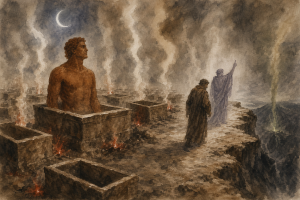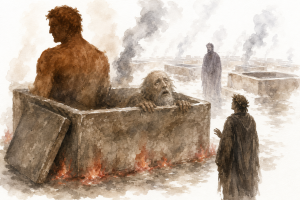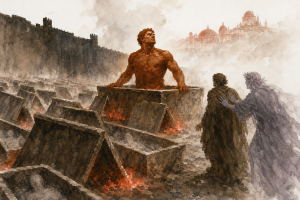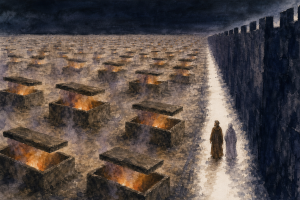
He comes back to himself already somewhere else — the poem never shows the descent — and what greets the returning mind is not a soul but a climate: eternal, cursed, cold, heavy rain, hail and dirty snow tipping through black air onto ground that stinks, and only after fifteen lines of weather do the gluttons appear, lying submerged in it, howling like dogs and rolling one flank over to shield the other, while a three-throated beast with red eyes, a greasy black beard and human hands claws them, flays them and quarters them until Virgil bends, fills both fists with the filthy earth, and throws it down his gullets.
Inferno · Canto 6 · Lines 1–33 · Scene 17
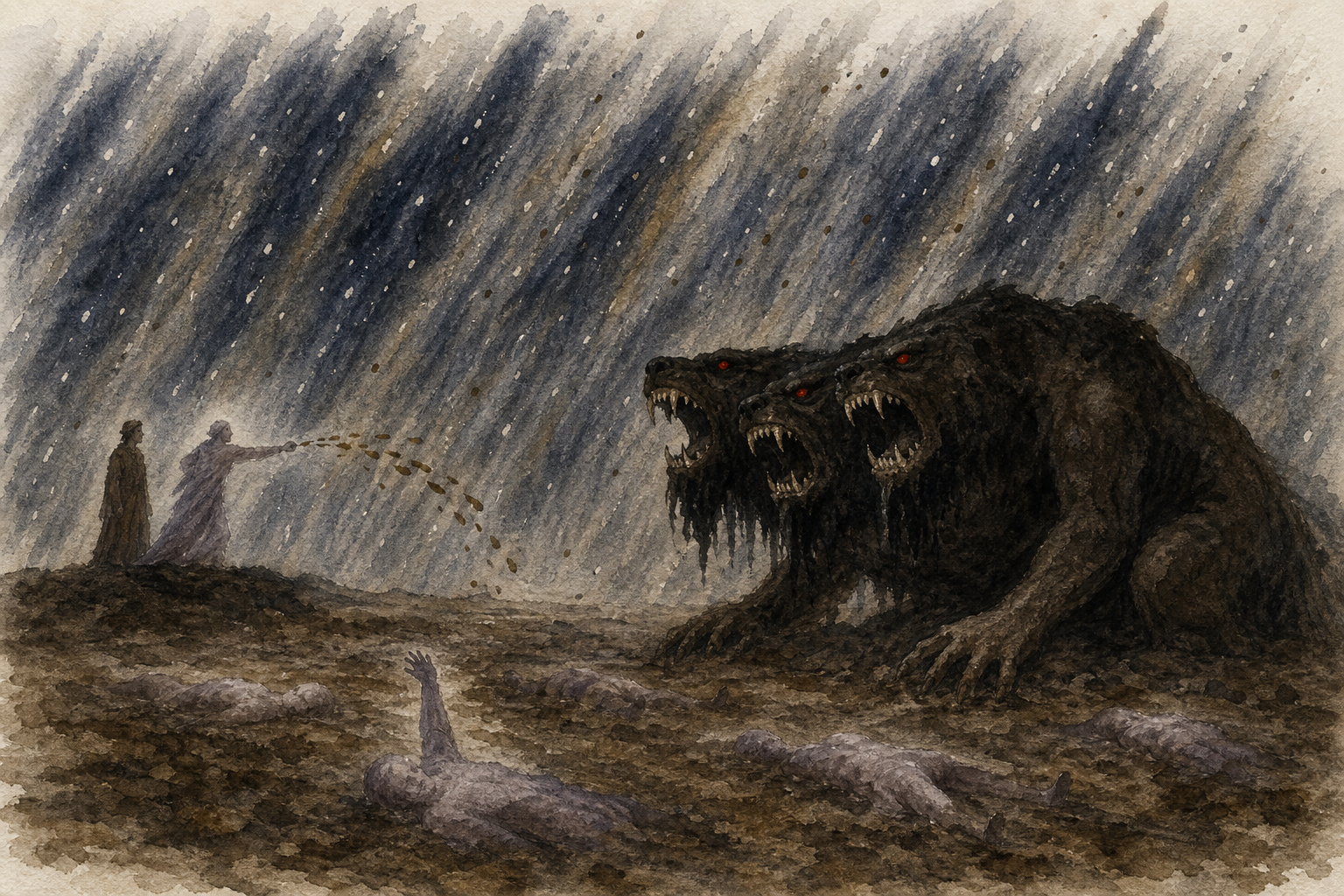
Canto V ended with Dante fainting. Canto VI begins with him waking up — and the first thing to notice is that the poem never shows him travelling. One moment he is unconscious on the floor of the second circle, the next he is standing in the third. Dante had already done this once, at the river Acheron, and these are the only two times in Hell it happens. Both times he loses consciousness at a moment of moral pressure, and both times he wakes up further down.
The opening sentence looks backwards before it looks around: his mind ‘closed’ before ‘la pietà d’i due cognati’ (2), the pity of the two in-laws. That word, cognati, is a legal term for relatives by marriage. Canto V never used it. Francesca never called Paolo her brother-in-law. The new canto opens by supplying, in one cold word, the family relation that the beautiful speech had left out.
Then he looks round, and what he describes first is not people. It is weather. The rain is ‘etterna, maladetta, fredda e greve’ (8) — eternal, cursed, cold, heavy: four adjectives stacked up with no verb to break them, which is exactly what falling rain feels like when it never stops. Its ‘rule and quality’ never change (9): same fall, same cold, for ever. Coarse hail, filthy water and snow pour through the dark air, and the ground that receives all this stinks (12). Fifteen lines pass before a single sinner appears, and when they do appear they are not individuals but ‘la gente che quivi è sommersa’ (15) — the people submerged there. They lie in it. That is the punishment. People whose sin was to consume are now lying in the muck being consumed.
Cerberus arrives in the middle of the description of the weather, as though he were part of it. Three throats, barking ‘caninamente’ (14) — doggishly; red eyes, a greasy black beard, a wide belly, and clawed hands. Hands, not paws. He claws the souls, skins them and quarters them: butcher’s verbs. Dante calls him ‘il gran vermo’ (22), the great worm, and he will use that same word once more in the whole poem — for Satan, frozen at the very bottom. The guard-dog of the gluttons is quietly attached to the lowest thing in the universe.
The souls, meanwhile, do nothing. The rain makes them howl ‘come cani’ (19), like dogs, so they have become the same animal as their torturer. They turn one side over to shelter the other — which is useless, since it rains on both. They turn constantly. Notice that Dante used the same verb of himself a few lines earlier, when he turned to look about him (6).
Then Virgil acts. He spreads his hands, scoops up the earth, and throws fistfuls of it into the beast’s ‘bramose canne’ (27), its greedy gullets. This is a rewriting, and Dante expected his readers to catch it. In Book VI of the Aeneid — written by the man now standing here — the Sibyl gets past Cerberus by tossing him a cake soaked in honey and drugged with sleeping herbs. Dante’s Virgil throws dirt. No magic, no drug, no charm: the cheapest substance in the place, and, since the ground here is the stinking ground of line 12, quite possibly the filth the gluttons are lying in. The demon is bought off with mud.
And the reason it works is given as a simile any reader has seen in the street: a dog that barks and strains with longing goes quiet the moment it gets its teeth into the food, because now it is fighting only to swallow (28–30). That is the whole diagnosis of gluttony in three lines. The appetite does not want anything in particular. It wants to be filled. Give it earth and it will stop barking.
The passage ends on noise. The three foul faces belong to ‘lo demonio Cerbero’ (32), whose racket deafens the souls so badly that they wish they had no hearing at all. The first thing anyone in this circle is said to want is to lose a sense.
Go deeper: the college-level reading (about 1,100 words)
Quotes the Italian closely, with philological detail and cross-references.
Canto V ended with a body falling; Canto VI opens inside a subordinate clause, on the machinery of a mind coming back: «Al tornar de la mente, che si chiuse / dinanzi a la pietà d’i due cognati, / che di trestizia tutto mi confuse» (1–3). The verb for the faint is «si chiuse», closed itself, as of a shutter — consciousness treated as an aperture — and the pity is given, at last, an object with a name from canon law. «Cognati» are relations by marriage: brother-in-law and sister-in-law. Canto V, which had ninety lines of Francesca’s voice, never used a kinship term at all; the affinity that made the adultery what it was is stated only here, retrospectively, by the narrator, in one word, after the swoon.
Between the last line of V and the first of VI there is no descent. The poem does the same thing at the Acheron, where the pilgrim falls «come l’uom cui sonno piglia» at the end of Inf. III and wakes on the far bank at the opening of IV; these are the only two syncopes in Hell, and both cover a transition the pilgrim is not shown making. Whether that is narrative economy or a pattern is a genuine question, and the text gives no gloss either time.
Waking is rendered as saturation: «novi tormenti e novi tormentati / mi veggio intorno» (4–5), a polyptoton binding the sufferings to the sufferers in a single root, followed by three concessives — «come ch’io mi mova / e ch’io mi volga, e come che io guati» (5–6): however I move, however I turn, however I look. There is no direction in which the place is not the case. Then the tense changes: «Io sono al terzo cerchio» (7), present indicative, the narrator standing inside his own past for the length of the description.
What that description gives, for fifteen lines, is meteorology. «de la piova / etterna, maladetta, fredda e greve» (7–8): four adjectives in a row with no verb between them, an accumulation that behaves like the thing it names. «regola e qualità mai non l’è nova» (9) is technical language — regola for the manner and measure of the fall, qualità for its cold and its weight, the vocabulary of scholastic natural philosophy applied to a rainstorm that will never be revised. Then the mixture: «Grandine grossa, acqua tinta e neve / per l’aere tenebroso si riversa» (10–11). Hail, dyed or dirtied water, snow: not one weather but all of them at once, dumped rather than falling, «si riversa». And the tercet’s last verb is a stench: «pute la terra che questo riceve» (12).
Only at line 15 does a sinner appear, and then as a mass noun submerged in the terrain: «la gente che quivi è sommersa». Nothing in the third circle is done by the damned. They howl, and even the howling is done to them — «Urlar li fa la pioggia come cani» (19), the rain makes them howl like dogs, the simile handing them the nature of their own guard. They shelter one flank behind the other, «de l’un de’ lati fanno a l’altro schermo» (20), the only industry available and a perfectly futile one, since the rain falls on both. And they turn: «volgonsi spesso i miseri profani» (21) — the same verb, volgersi, that the pilgrim had used of himself at line 6. «Profani» is a strong word, the Latin profanus, outside the temple; readers since the early commentaries have heard behind it the Sibyl’s cry in Aeneid VI.258, «procul o procul este, profani», which is spoken precisely at the threshold Dante is here rewriting.
Cerberus enters at 13 as though he were part of the weather: «fiera crudele e diversa, / con tre gole caninamente latra» (13–14). «Diversa» is not ‘different’ but monstrous, off the scale of kind; «caninamente» is a heavy adverb doing what Virgil’s «latratu… trifauci» does in Aen. VI.417. From line 16 the portrait leaves the Latin behind: «Li occhi ha vermigli, la barba unta e atra, / e ‘l ventre largo, e unghiate le mani» (16–17). Virgil’s Cerberus has no beard, no red eyes and no hands. Dante’s has a greasy black beard and clawed human hands, which is the iconography of a medieval devil grafted onto a classical hound, and the verbs that follow are a butcher’s: «graffia li spirti ed iscoia ed isquatra» (18), claws, flays, quarters, the prosthetic i- of iscoia and isquatra making the line grind.
Then the name that matters: «Quando ci scorse Cerbero, il gran vermo» (22). Vermo, worm — a word Dante will use once more, of Lucifer, at Inf. XXXIV.108. The guardian of the gluttons and the thing at the centre of the earth are labelled with the same noun, and nothing in the text draws attention to it.
Virgil’s response is the passage’s crux. «E ‘l duca mio distese le sue spanne, / prese la terra, e con piene le pugna / la gittò dentro a le bramose canne» (25–27). Spanne are hand-spans; the gesture is measured out in the body. In Aeneid VI.420 the Sibyl throws «melle soporatam et medicatis frugibus offam», a cake steeped in honey and drugged with soporific meal, and the beast sleeps. Dante’s Virgil throws dirt. There is no drug and no charm; and since «la terra» here is the same noun used at line 12 for the ground that stinks because it receives the filth, what is stuffed into the gullets is plausibly the muck the gluttons are lying in. The reason the substitution works is then supplied as a piece of ordinary observation: «Qual è quel cane ch’abbaiando agogna, / e si racqueta poi che ‘l pasto morde, / ché solo a divorarlo intende e pugna» (28–30). The dog stops barking not because it is drugged but because it is busy. Note that «pugna» at 30 — third person of pugnare, to fight — rhymes with «le pugna» at 26, the fists: a rima equivoca that puts Virgil’s clenched hands and the beast’s swallowing struggle on the same sound. An appetite with no object will fight just as hard for earth.
The passage closes in noise rather than in silence: «cotai si fecer quelle facce lorde / de lo demonio Cerbero, che ‘ntrona / l’anime sì, ch’esser vorrebber sorde» (31–33). Facce lorde, filthy faces; demonio, the Christian demotion of a classical monster, as with Charon at Inf. III.109; ‘ntrona, a thundering, concussive verb. And the first desire anyone in this circle is credited with is the desire to be without a faculty: to be deaf. Ciacco, and Florence, are still three lines away.
Go deeper still: the scholarly reading (about 1,100 words)
The commentary tradition, the sources, and what is documented versus inferred.
Aeneid VI.417–425 is the passage to have open on the desk. Aeneas and the Sibyl come up the near bank and find the porter: «Cerberus haec ingens latratu regna trifauci / personat adverso recubans immanis in antro.» The Sibyl sees the snakes bristling on his necks and acts — «melle soporatam et medicatis frugibus offam / obicit» — a sop steeped in honey and drugged meal. «Ille fame rabida tria guttura pandens / corripit obiectam», and the huge back relaxes, «fusus humi», stretched the length of the cave. Then the famous half-line: «occupat Aeneas aditum custode sepulto». The guardian is buried in sleep, or buried outright — Latin lets the ambiguity stand — and the way is open.
Almost every element of Dante’s tercets is in those nine lines, and almost every one has been shifted. The three throats survive: «tria guttura» becomes «con tre gole caninamente latra» (14), with an adverb that appears to be Dante’s own coinage and that does work the Latin does not, since «latratu» in Virgil is simply what a dog-monster emits, whereas «caninamente» insists that the manner is doglike — as though the beast might have barked in some other way. The gaping survives: «tria guttura pandens» becomes «le bocche aperse e mostrocci le sanne» (23). The ravenousness survives, «fame rabida» reappearing as «le bramose canne» (27), throats that are themselves greedy. What does not survive is the function. Virgil’s Cerberus is a «ianitor», a doorkeeper lying across an entrance; he exists to be got past. Dante’s has been carried inside and set over the punished: he barks «sovra la gente che quivi è sommersa» (15), and his occupation is not custody but butchery — «graffia li spirti ed iscoia ed isquatra» (18), scratches, flays, quarters, three verbs from the trade of the slaughterhouse. The porter has been promoted to executioner. Nothing in the Latin authorises this; the third circle needs a tormentor, and the nearest available monster is repurposed.
The mud has moved as well, and moved only a line. At Aeneid VI.416 Charon sets Aeneas down «informi limo glaucaque … in ulva», in shapeless slime among grey sedge; at 417 Cerberus begins. Dante has taken the slime off the bank and spread it under the whole circle, where it receives the storm and reeks: «pute la terra che questo riceve» (12). This matters for what follows, because when Virgil intervenes he does not reach into a scrip for a prepared cake. He «distese le sue spanne» (25) — spreads his palms — and «prese la terra, e con piene le pugna / la gittò dentro a le bramose canne» (26–27). The noun is the same noun as at line 12. What goes down Cerberus’s throats is the floor of the third circle: rain-soaked, hail-battered, stinking earth, taken by the fistful from under the bodies of the gluttons.
The substitution is the argument of the passage. The Sibyl’s offa is a pharmaceutical object; it works because it has been compounded, honeyed and drugged, and its effect is sopor, an artificial oblivion that removes the guardian from the scene. Dante’s Virgil compounds nothing. He supplies matter of no value whatever, and it works — not because it is soporific but because the appetite it meets is indifferent to what fills it. The dog quiets the moment the mouth is occupied: «e si racqueta poi che ‘l pasto morde, / ché solo a divorarlo intende e pugna» (29–30). Note that «pasto» is a courtesy; the thing bitten is dirt. Where Virgil’s episode demonstrates the Sibyl’s expertise, Dante’s demonstrates the cheapness of gluttony, which can be bought off at no cost because it is not directed at any good, only at filling. The result also differs in kind. «Custode sepulto»: Virgil’s beast is subtracted from the poem. Dante’s is merely interrupted; the present tense of «che ‘ntrona / l’anime sì, ch’esser vorrebber sorde» (32–33) reports a permanent din, and the handful of earth buys a silence measured in the length of a swallow.
The same downward substitution governs the description. Virgil gives snakes at the necks; Dante drops them and gives «la barba unta e atra» (16), a greasy black beard, plus «e ‘l ventre largo, e unghiate le mani» (17) — a paunch and clawed hands, not paws. He calls the creature «fiera crudele e diversa» (13), monstrous in the sense of unnatural, yet the details are not fabulous but squalid: the warder of the gluttons has the gluttons’ own greasy beard and slack belly. Where the Latin reaches for the mythological, Dante reaches for the physical and slightly disgusting. The simile at 28–31 completes the descent: the epic «ianitor» of Tartarus is glossed by «Qual è quel cane ch’abbaiando agogna» (28), a dog in a yard, and the three faces are «quelle facce lorde» (31), dirty faces, adjective drawn from the same register as the mud.
One term stands outside the Virgilian repertoire altogether. At 22 Cerberus is «il gran vermo», the great worm — a word with no classical warrant here, belonging rather to the medieval bestiary of the serpent and the grave. The same noun returns at the bottom of the poem, where Virgil speaks of the descent «al pel del vermo reo che ‘l mondo fóra» (Inf. XXXIV.108). Whether the earlier use anticipates the later, so that the guardian of the gluttons is a small foretaste of Satan, or whether «vermo» is simply Dante’s general word for a large loathsome creature, is not settled by anything in the text, and readers differ; the recurrence is certain, the intention inferred.
What the reworking leaves the souls is nothing to do. Virgil’s Cerberus at least has an antagonist. Dante’s damned only lie there — «sommersa» (15), submerged, prone — and their sole recorded activities are to turn one flank into a shield for the other, «de l’un de’ lati fanno a l’altro schermo» (20), and to keep turning: «volgonsi spesso i miseri profani» (21). «Profani» is a hard word, sacral in origin, and glosses vary between the merely unhallowed and the actively defiling. Either way it is a description, not an act. In the Aeneid it is the monster who ends up «fusus humi», poured out on the ground; here the monster stands and the sinners lie. That inversion, more than any verbal echo, marks the distance the passage has travelled out of its source.
The Italian — Cerberus and the Third Circle
Source: Wikisource (public domain, pre-1929 text)
Lines 1–3
1. Al tornar de la mente, che si chiuse2. dinanzi a la pietà d’i due cognati,3. che di trestizia tutto mi confuse,
literary key: Line 1 — ‘Al tornar de la mente, che si chiuse’ — at the return of the mind, which had closed. The faint at the end of Inf. V is described with a shutter-verb, si chiuse, as though consciousness were an aperture. Dante loses consciousness twice in Hell and only twice: at the end of Inf. III, falling ‘come l’uom cui sonno piglia’, and here. Both syncopes conceal a transition — across Acheron in the first case, from the second circle to the third in this one. The poem shows neither descent. [Source: Inferno III.136 and Inferno IV.1–3]
vocabulary: Line 2 — ‘d’i due cognati’ — of the two in-laws. Cognato is the technical term for a relation by marriage: Paolo was Francesca’s husband’s brother. Canto V, for all its ninety lines of speech, never uses a kinship word for the pair; the affinity that gave the adultery its aggravated character under canon law is supplied here, in one cold noun, by the narrator, after the swoon and outside the reach of Francesca’s voice. [Model knowledge · high]
Lines 4–6
4. novi tormenti e novi tormentati5. mi veggio intorno, come ch’io mi mova6. e ch’io mi volga, e come che io guati.
literary key: Line 4 — ‘novi tormenti e novi tormentati’ — new torments and new tormented. A polyptoton: the suffering and the sufferers share a root, so that the grammar itself refuses to separate the punished from the punishment. It is the formula by which the poem announces a change of circle without describing an arrival, and it is followed immediately by three concessive clauses (5–6) covering movement, turning and looking: there is no orientation from which the place is not the case. [Model knowledge · high]
literary key: Line 6 — ‘e ch’io mi volga’ — and however I turn. The verb returns fifteen lines later for the damned: ‘volgonsi spesso i miseri profani’ (21). The pilgrim turns to take the place in; the gluttons turn because rolling over is the only action left to them. The same motion is investigation in one body and futility in the other, and Dante gives no signal that the repetition is deliberate — which is how his verbal echoes usually work. [Source: Inferno VI.21]
Lines 7–9
7. Io sono al terzo cerchio, de la piova8. etterna, maladetta, fredda e greve;9. regola e qualità mai non l’è nova.
literary key: Line 7 — ‘Io sono al terzo cerchio’ — I am in the third circle. The narrator switches to the present indicative and stays there through the description of the weather, standing inside his own past. Structurally, this is the second of the circles of incontinence: the ordering — lust, gluttony, avarice and prodigality, wrath — is expounded later by Virgil in Inf. XI, which supplies the Aristotelian architecture retrospectively, after the pilgrim has already walked through most of it. [Source: Inferno XI.76–90]
literary key: Line 8 — ‘etterna, maladetta, fredda e greve’ — eternal, cursed, cold and heavy. Four adjectives in a row with no verb to break them; the syntax accumulates the way the rain does. Note the order: two theological terms (unending, under curse) followed by two physical ones (cold, heavy), so that the moral condition of the storm is stated before its temperature. Nothing in the tercet says the rain falls. It simply is, and goes on being. [Model knowledge · high]
vocabulary: Line 9 — ‘regola e qualità mai non l’è nova’ — its rule and quality are never new to it. The vocabulary is scholastic natural philosophy: regola for the measure and manner of the fall, qualità for the sensible properties, cold and weight, of the falling matter. Applied to weather, the terms produce a meteorology that will never be revised. Hell’s climate has no seasons because it has no time; the technical register makes the eternity sound administrative rather than dramatic. [Model knowledge · medium]
Lines 10–12
10. Grandine grossa, acqua tinta e neve11. per l’aere tenebroso si riversa;12. pute la terra che questo riceve.
translation note: Line 10 — ‘Grandine grossa, acqua tinta e neve’ — coarse hail, discoloured water, snow. Tinta means dyed or stained: not clean rain but water that has taken colour from what it has passed through. The three forms of precipitation arrive together, which no real storm does; the verb at 11, ‘si riversa’, is a pouring-out or tipping-over rather than a falling. This is weather without meteorological logic, assembled from the unpleasant properties of each of its ingredients. [Model knowledge · high]
literary key: Line 12 — ‘pute la terra che questo riceve’ — the ground that receives this stinks. The only verb of the tercet is a stench. Hell’s third circle is the first place in the poem to be given a smell, and the sense engaged is the one closest to appetite. Keep this noun, terra, in view: it recurs at 26 as the substance Virgil scoops up and throws into Cerberus’s throats, and nothing in the syntax distinguishes the two. [Source: Inferno VI.26]
Lines 13–15
13. Cerbero, fiera crudele e diversa,14. con tre gole caninamente latra15. sovra la gente che quivi è sommersa.
vocabulary: Line 13 — ‘fiera crudele e diversa’ — a cruel and monstrous beast. Diversa here does not mean ‘different’ but abnormal, off the scale of kind, outside nature: the adjective Dante uses for creatures that have no proper species. The word arrives before the description does, so that we are told the beast is a category violation before we are told he has three throats, a beard, or hands. [Model knowledge · medium]
cultural ref: Line 14 — ‘con tre gole caninamente latra’ — with three throats he barks doggishly. The heavy adverb does the work of Virgil’s compound at Aeneid VI.417–18, ‘Cerberus haec ingens latratu regna trifauci / personat’: the three-throated barking that fills the kingdom. Dante keeps the throats and the noise and will discard nearly everything else. Latrare is also the verb of Hell’s other bestial officials; the guardians of the upper circles all make animal sound rather than speech. [Model knowledge · high]
literary key: Line 15 — ‘sovra la gente che quivi è sommersa’ — over the people submerged there. Fifteen lines pass before a single sinner is mentioned, and when they arrive it is as a collective noun in a passive participle. Sommersa makes them part of the terrain rather than inhabitants of it. Throughout 15–21 the gluttons are the grammatical object of every verb applied to them: they are barked over, made to howl, clawed, flayed, quartered. The circle’s inhabitants perform no action at all. [Model knowledge · high]
Lines 16–18
16. Li occhi ha vermigli, la barba unta e atra,17. e ‘l ventre largo, e unghiate le mani;18. graffia li spirti ed iscoia ed isquatra.
cultural ref: Line 16 — ‘Li occhi ha vermigli, la barba unta e atra’ — his eyes are vermilion, his beard greasy and black. Virgil’s Cerberus has neither. The red eyes align him with Charon, ‘con occhi di bragia’ at Inf. III.109, and the greasy black beard is the iconography of the medieval devil rather than of the classical hound. The greasiness is also diagnostic: the guardian of the gluttons is smeared with the residue of eating. [Source: Inferno III.109]
literary key: Line 17 — ‘e unghiate le mani’ — and his hands are clawed. Hands, not paws. The detail is not in the Aeneid and it changes the creature’s category: a dog that grips. It is also what makes the next line’s butchery possible, since flaying and quartering require something to hold with. Dante’s Cerberus is a compound — canine throats, a devil’s beard, human hands — and the poem never resolves him into one kind of thing. [Model knowledge · high]
vocabulary: Line 18 — ‘graffia li spirti ed iscoia ed isquatra’ — he claws the spirits, skins them and quarters them. Three verbs from the slaughterhouse, the last two carrying the prosthetic i- that Italian used to ease consonant clusters, which makes the line grind audibly. Squartare is the butcher’s or the executioner’s word for dividing a carcass. The souls, who cannot be killed, are processed like meat — the sin’s own operation performed upon its agents. [Model knowledge · high]
Lines 19–21
19. Urlar li fa la pioggia come cani;20. de l’un de’ lati fanno a l’altro schermo;21. volgonsi spesso i miseri profani.
literary key: Line 19 — ‘Urlar li fa la pioggia come cani’ — the rain makes them howl like dogs. Two things at once: the howling is not theirs but done to them by the weather, and the simile assimilates the punished to the punisher, since the being barking over them is a dog with three throats. In the third circle sinner and guardian converge on the same animal, which is not true of the circles above or immediately below. [Model knowledge · high]
cultural ref: Line 21 — ‘volgonsi spesso i miseri profani’ — the wretched profane turn over often. Profano is the Latin profanus, one outside the temple, excluded from the sacred. Readers have long heard behind it the Sibyl’s cry clearing the threshold of the underworld at Aeneid VI.258, ‘procul o procul este, profani’ — placed, that is, at exactly the door Dante is here rewriting. The allusion is audible rather than demonstrable, and commentators differ on whether it is intended. [Model knowledge · medium]
Lines 22–24
22. Quando ci scorse Cerbero, il gran vermo,23. le bocche aperse e mostrocci le sanne;24. non avea membro che tenesse fermo.
literary key: Line 22 — ‘Cerbero, il gran vermo’ — Cerberus, the great worm. Vermo for a monster of this size is deliberately incongruous, and it returns just once in the canticle: for Lucifer, at Inf. XXXIV.108. The guardian of the gluttons and the thing frozen at the centre of the earth share a noun, which quietly filiates this beast to the bottom of the pit rather than to any classical genealogy. Modern readers notice the link constantly; the trecento glossators rarely did. [Source: Inferno XXXIV.108]
translation note: Line 24 — ‘non avea membro che tenesse fermo’ — he had not a limb he could hold still. The trembling is usually read as eagerness rather than rage, and it prepares the dog simile at 28–30: this is a body wholly given over to wanting, unable to compose itself in the presence of something to eat. Note that what excites him is the arrival of two travellers, not of food; appetite here does not distinguish its objects, which is the passage’s argument in miniature. [Model knowledge · medium]
Lines 25–27
25. E ‘l duca mio distese le sue spanne,26. prese la terra, e con piene le pugna27. la gittò dentro a le bramose canne.
cultural ref: Line 26 — ‘prese la terra, e con piene le pugna’ — he took the earth, and with his fists full. In Aeneid VI.420 the Sibyl throws Cerberus ‘melle soporatam et medicatis frugibus offam’, a cake steeped in honey and drugged with soporific meal, and the beast sleeps. Dante’s Virgil throws dirt: no drug, no charm, no word spoken. And since terra at 12 is the ground that stinks from what it receives, the substance stuffed into the gullets may well be the filth the gluttons lie in. The poem never says. [Model knowledge · high]
vocabulary: Line 27 — ‘dentro a le bramose canne’ — into the craving gullets. Canna is the windpipe or throat, from the reed; bramoso is the adjective of raw longing, brama. The two words together define the beast as a passage rather than a will: not a mind that wants something but a tube that craves filling. It is the most economical definition of gluttony in the canto, and it is applied to the guardian, not to the guarded. [Model knowledge · high]
Lines 28–30
28. Qual è quel cane ch’abbaiando agogna,29. e si racqueta poi che ‘l pasto morde,30. ché solo a divorarlo intende e pugna,
wordplay: Line 30 — ‘ché solo a divorarlo intende e pugna’ — for it strains and fights only to devour it. Pugna here is the verb, to fight; at line 26 ‘le pugna’ was the noun, the fists. The two stand in the same rhyme position four lines apart — a rima equivoca binding Virgil’s clenched hands to the beast’s struggle to swallow. The simile’s logic is that the barking stops not because the dog is drugged but because its mouth is occupied: appetite is quieted by activity, not by satisfaction. [Model knowledge · high]
Lines 31–33
31. cotai si fecer quelle facce lorde32. de lo demonio Cerbero, che ‘ntrona33. l’anime sì, ch’esser vorrebber sorde.
literary key: Line 33 — ‘l’anime sì, ch’esser vorrebber sorde’ — the souls so, that they would wish to be deaf. The first desire attributed to anyone in this circle is a wish to lose a faculty. In a place that punishes the misuse of the senses, the only remaining appetite is negative: not to perceive. Compare the closing note of the circle above, where the pilgrim faints; here it is the damned themselves who want the input to stop, and it does not. [Model knowledge · medium]
Seven Centuries of Reading Cerberus and the Third Circle
Earth for honey
The central detail of the scene is a substitution. In Virgil the Sibyl quiets Cerberus with a drugged honey-cake (Aeneid VI.419–422); here Virgil throws earth into the three gullets (25–27). Christopher Kleinhenz pointed out the biblical resonance: God’s curse on the serpent in Genesis 3:14 ends «terram comedes cunctis diebus vitae tuae», dust shalt thou eat all the days of thy life. The tempter’s punishment for urging Eve to eat becomes the gatekeeper’s diet.
Hollander notes that Dante’s Cerberus is unique among versions of the monster in having human attributes. Barbara Spaggiari suggested the Old French Roman d’Enéas as a possible influence. The rain itself has been read, by Robert Dombrowski, as an antithesis of the manna God promised to rain from heaven in Exodus 16:4.
Single words, long arguments
Line 18 shows how much an editor’s choice can matter. Most manuscripts read that Cerberus claws, «ingoia» (swallows) and quarters the souls. Michele Barbi made a strong case for «iscoia», flays: the sequence claw, swallow, quarter verges on the ridiculous, Cerberus is barking continuously, and the text never shows him eating anyone. Petrocchi and Mazzoni followed Barbi. Hollander calls the case a good illustration of how often the minority view is right.
Federico Sanguineti argued for «bocca» in place of «barba» at line 16 as part of his new account of the manuscript tradition, which produced his 2001 edition of the poem. Giorgio Padoan connected «profani» (21), used only here in the poem, with gluttony through Esau, who sold his birthright for food, and Ovid’s self-devouring Erysichthon.
The first readers and the only simile
Boccaccio heard the barking of Cerberus as the antithesis of the music played at banquets, the setting of gluttony in the world above. Padoan noted that the effect of the barking on the souls (32) mirrors Virgil’s huge gatekeeper, who terrifies the bloodless shades with his endless howling. Hollander observes that this is the only simile in what was, to this point, the shortest canto. It is the first of the poem’s similes from daily life.
What remains open
Why Dante chose plain earth over Virgil’s drugged cake, whether as Christian correction, biblical allusion, or a calculated downgrade of the monster, is suggested by the sources and stated by none. The canto also moves the pilgrim from the second circle to the third without saying how, and unlike the crossing of Acheron, Hollander notes, that silence has never troubled anyone.
The Two Main Positions on Cerberus and the Third Circle
The Moral-Allegorical Reading
The earth is the meaning. Gluttony is an appetite without a proper object, and Virgil — reason — demonstrates this by feeding it the most worthless matter available, whereupon it is perfectly content. The lesson is not that the beast can be tricked but that it cannot tell the difference: what the craving wants is to be filled. On this reading the substitution for the honey-cake is not a slight to Virgil but a sharpening of the scene’s sense, and the fact that the earth is very possibly the stinking mire of line 12 makes the point exact, since the gluttons lie in the same substance that satisfies their guard.
Key passage: The simile at 28–30 supplies the explanation in the poem’s own voice and locates the satisfaction entirely in the act of consuming: «ché solo a divorarlo intende e pugna». No sleep, no drug, no diminished capacity — only a mouth occupied. The rima equivoca of «le pugna» (26) and «pugna» (30) links Virgil’s fists to the beast’s struggle to swallow. The repetition of «terra» at 12 and 26 makes filth and food the same noun. Every trecento commentator who glosses the passage reads it in some version of this way.
The Intertextual Reading
The gesture’s charge is literary before it is moral. Dante has staged the one scene where Virgil the guide must repeat, in front of us, an episode Virgil the poet wrote — and has him do it wrong on purpose. The Sibyl’s soporific offering, a small piece of pagan enchantment, becomes a fistful of dirt. Nothing magical survives the transfer into a Christian Hell, where guardians are demons, monsters are ‘vermi’, and no charm is required because the beast has no dignity to defend. The earth is chosen for its cheapness, and the point is what it costs, not what it means.
Key passage: The systematic demotion of the classical guardians across the early cantos: Charon is ‘dimonio’ at III.109, Cerberus ‘lo demonio Cerbero’ at 32, with a devil’s beard and clawed human hands found nowhere in Aeneid VI. Line 21’s «profani» sits in audible relation to the Sibyl’s «procul o procul este, profani» at Aen. VI.258, marking the intertext at the threshold. Virgil is given no speech at all in the encounter, which suppresses precisely the authority his own poem exercised there; and the naming of Cerberus as ‘gran vermo’ quietly filiates him to Lucifer rather than to any classical genealogy.
What the Text Does — and What That Means (Contested)
On the page: The Aeneid VI.417–425 places a drugged sop in the Sibyl’s hands; Dante’s line 26 reads «prese la terra». The noun terra occurs at 12 for the ground that stinks and again at 26 for what Virgil scoops. Virgil speaks no words during the encounter; there is no charm, gesture of authority, or invocation, unlike the confrontations with Charon (Inf. III), Minos (Inf. V) and Plutus (Inf. VII). The explanatory simile at 28–30 attributes the quieting to the act of biting and swallowing, not to sleep. Cerberus is called ‘vermo’ at 22; the same noun is used of Lucifer at Inf. XXXIV.108. The souls of this circle are the grammatical objects of every verb applied to them in 15–21. The narrator offers no interpretation of the earth.
What scholars dispute: Whether the gesture is allegorical, polemical, both or neither is contested, and has been since the trecento glossators, who allegorised it, parted company with modern intertextual criticism, which historicises it. Neither reading can appeal to an authorial statement, because the poem supplies none; the only internal explanation offered is the dog simile, which explains the mechanism and is silent on the meaning of the substance. Attributions of intent on either side are inference.
What Dante Leaves Unresolved
The poem never says what the earth is for, and never says whether it is the same stinking earth the gluttons lie in. It also never tells us how the pilgrim reached the third circle, or what he made of Virgil’s gesture — he does not react to it, ask about it, or mention it again. The one interpretive aid supplied, the dog simile, explains why the beast falls quiet and says nothing about why the substance is dirt. Readers who want the gesture to mean something must supply the meaning; readers who want it to be a literary manoeuvre must supply the motive.
The Open Question
Virgil silences Cerberus by filling his fists with the ground and throwing it down the beast’s three gullets, where the Aeneid had used a cake drugged with honey and sleeping herbs. Is the handful of earth a moral demonstration — appetite exposed as something that wants filling rather than food, satisfied by worthless matter — or is it primarily a literary act, Dante stripping his master’s underworld of its enchantment and buying off a classical monster with the cheapest substance in the place?
Explore More
About This Article

Written by Lucy Bamboo. Lucy Bamboo has been reading the Divine Comedy for fifteen years — first in translation, then stubbornly in Medieval Tuscan with a dictionary and far too many footnotes. Reading Dante is her scene-by-scene walk through the poem: the original Italian, seven centuries of scholarly argument presented as argument rather than answer, and the human questions sitting underneath the theology. More about this site.
Verify this against a primary source
Specifics change, and your situation may differ from the one described here. These are the authorities worth checking directly:
- Digital Dante, Columbia University — text, commentary and translation apparatus
- Princeton Dante Project — the Commedia with historical commentary
- Dartmouth Dante Project — searchable commentary from 1322 onward