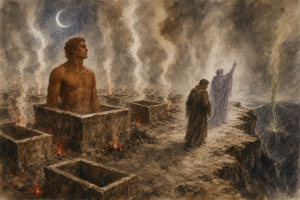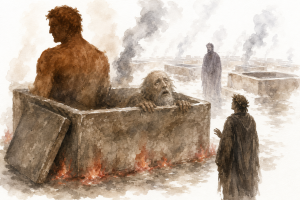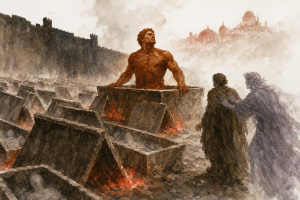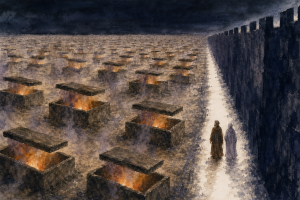
Out of a storm full of the anonymous dead, Dante picks two who are travelling together and calls them over — and what comes back is the most persuasive speech in Hell: a woman who never once says she chose anything, who assigns the blame in turn to Love, to a book, to the man who wrote it, and to her husband, and who tells the story of a single afternoon’s reading so well that the pilgrim listening to her stops asking questions, starts weeping, and falls down unconscious on the floor of the second circle.
Inferno · Canto 5 · Lines 73–142 · Scene 16
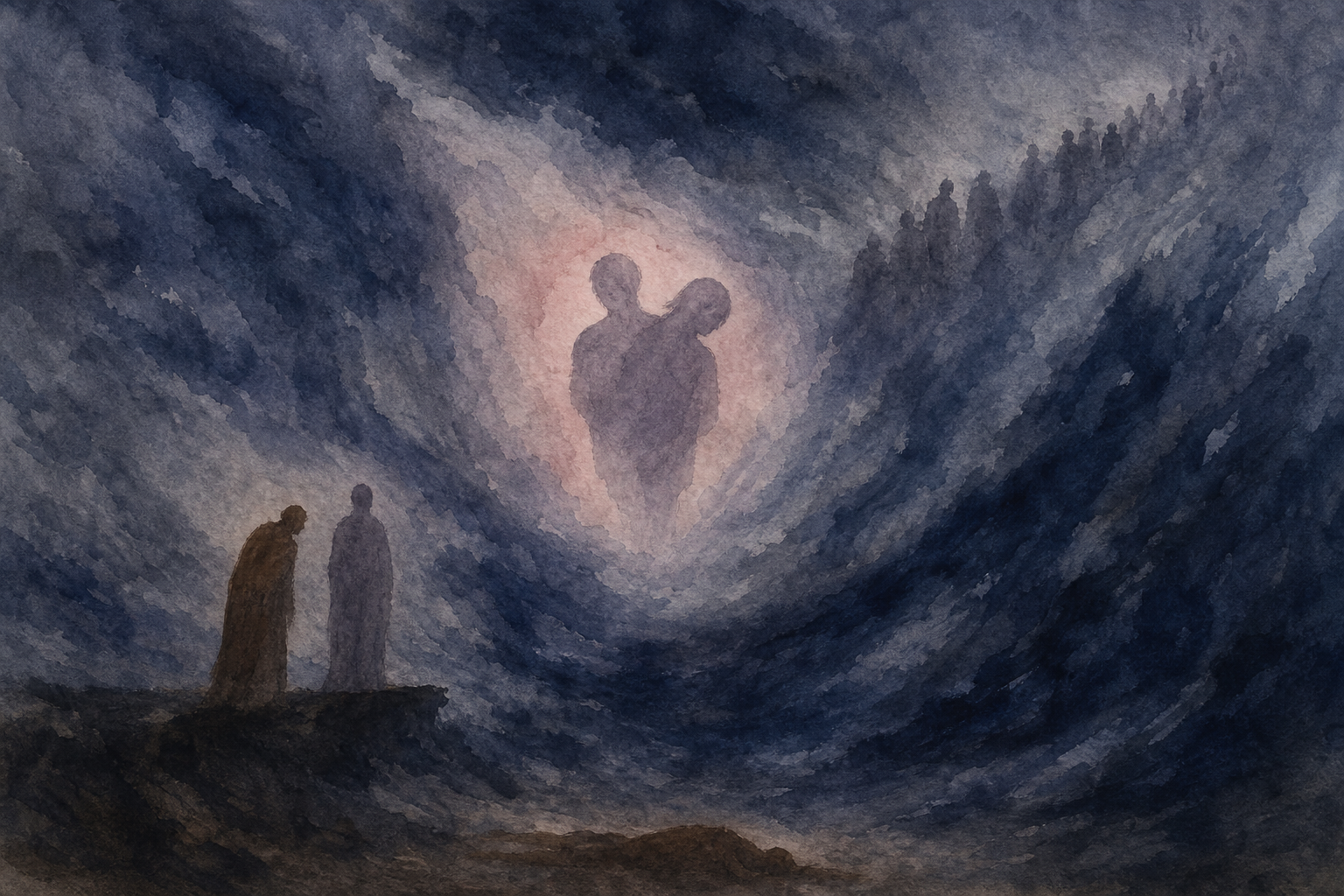
Dante has just heard a thousand names and been overwhelmed by pity. Now he sees two souls who are not alone like the rest — they are moving together, and they look light on the wind. He tells Virgil he wants to speak to them. Virgil says to wait until they come closer, and then to ask them by the love that drives them, and they will come. So Dante calls out to the two exhausted souls and asks them to come and talk, if nobody forbids it. They come like doves called home by desire, gliding down through the ugly air, and that is the first sign of how this scene is going to work: everyone else in this circle is being thrown around, and these two arrive gracefully because a living man asked them nicely. Then the woman speaks, and she is extraordinarily good at it. She opens by flattering him — you gracious and kind creature, visiting us who stained the world with blood — and says that if the king of the universe were a friend to them, they would pray for Dante’s peace, since he has pity on them. Notice what she has done in three lines: God has turned away, Dante has not, and so Dante is on their side. She tells him where she was born, on the coast where the Po comes down to rest, and then she explains what happened to her in three sentences that each begin with the same word: Love. Love took hold of the man, because of her beauty. Love allowed her no choice but to love him back. Love led them both to one death. She never says the word ‘I’ as the one doing anything. In her account, Love does everything and she is the object it does it to. Then she adds one hard sentence: Caina, the pit for people who murder their family, is waiting for the man who killed us. Dante drops his head and stares at the ground so long that Virgil finally asks him what he is thinking. And instead of thinking, Dante bursts out — how many sweet thoughts, how much desire, brought these two to this. Then he turns to her, calls her by name, tells her that her suffering makes him weep, and asks the question he has been holding: back then, how did love let you know what you wanted? She warns him it is the worst kind of pain to remember happy times in misery. Then she tells him. They were reading a book, alone, with no suspicion of anything — a romance about Lancelot and how love took hold of him. The reading kept making their eyes meet, and their faces went pale. But one moment beat them. When they read about the kiss, the man beside her, who she says will never be parted from her, kissed her mouth, trembling all over. And she finishes with a line that has been quoted for seven hundred years: the book was a pander, and so was the man who wrote it — we read no further that day. All this time the other soul has said nothing at all. He simply weeps while she talks, and the sound of it finishes Dante. Pity takes him the way fainting takes a dying man, and the canto ends with him hitting the ground — and the poem gives the fall its own line, standing alone: and I fell as a dead body falls.
Go deeper: the college-level reading (about 1,200 words)
Quotes the Italian closely, with philological detail and cross-references.
The scene begins with the pilgrim choosing: «Poeta, volontieri / parlerei a quei due che ‘nsieme vanno, / e paion sì al vento esser leggeri» (73–75). Two things are established before anyone speaks. These souls «’nsieme vanno», go together — in a circle whose punishment is being carried helplessly through crowds, they are the exception that stays paired — and they seem «leggeri», light, on the wind. That adjective is the first of the episode’s deliberately unstable words: it can mean they ride the storm with a grace the others lack, or that they weigh so little the wind has them worse. Virgil’s reply, «per quello amor che i mena, ed ei verranno» (78), is his only complete tercet in the whole second half of the canto, and it hands Dante an instrument: summon them by the love that drives them. ‘Mena’ is the storm’s own verb from line 43, so the force being invoked to bring them over is the force flinging them around. Dante’s call names them «anime affannate» (80) — labouring, breathless souls — the adjective he had used of himself at Inf. I.22, escaping the water with «lena affannata». He adds a condition, «s’altri nol niega» (81), if another does not forbid it, where ‘altri’ is God, unnamed as always inside Hell. Then the third bird simile: «Quali colombe dal disio chiamate / con l’ali alzate e ferme al dolce nido / vegnon per l’aere, dal voler portate» (82–84). The doves are called by ‘disio’ and carried by ‘voler’ — desire and will, precisely the two faculties the canto’s definition of lust put in the wrong order — and they come «de la schiera ov’è Dido» (85). The name withheld through the whole catalogue arrives here, and it arrives attached to these two. Francesca’s first words are a textbook captatio benevolentiae: «O animal grazïoso e benigno» (88), gracious and kindly creature, followed by the offer that «se fosse amico il re de l’universo, / noi pregheremmo lui de la tua pace, / poi c’ hai pietà del nostro mal perverso» (91–93). In three lines she has arranged the moral universe: God is not her friend, Dante has pity, and therefore Dante and God are on opposite sides of her case. ‘Pietà’ is one of the canto’s two key words — it recurs at 72, 93, 117 and 140 — and she has put it in Dante’s mouth before he uses it himself. Her account of her origin is pure periphrasis, «Siede la terra dove nata fui / su la marina dove ‘l Po discende / per aver pace co’ seguaci sui» (97–99): the land is Ravenna, never named, and even the river is granted the ‘pace’ she cannot have. Then the three tercets that have carried the episode for seven centuries, each opening on the same word, with ‘Amor’ the grammatical subject of every verb: «Amor, ch’al cor gentil ratto s’apprende» (100), «Amor, ch’a nullo amato amar perdona» (103), «Amor condusse noi ad una morte» (106). Love seizes Paolo; Love compels her to return it; Love conducts them both to a single death. Francesca appears nowhere in these sentences as an agent — she is the object of the verbs throughout — and the doctrine she is reciting is the courtly creed that love cannot be resisted. The first line echoes Guinizzelli’s canzone on love and the noble heart, the creed of Dante’s own poetic youth. The third contains a pun visible only on the page: AMOR condusse noi ad unA MORte. Her final sentence turns cold: «Caina attende chi a vita ci spense» (107) — Caina, the ice reserved for those who kill their kin, awaits the man who put out our life. The poem lets this stand without confirming it, and it is worth noticing that it cannot be confirmed: her husband was still alive in 1300. Dante’s reaction occupies nine verses that hold the drama of the canto in miniature. He drops his gaze and keeps it down (109–110) until Virgil breaks in with «Che pense?» (111) — two words, the entirety of his speech from Francesca’s arrival to the end. What comes back is not thought but exclamation: «quanti dolci pensier, quanto disio / menò costoro al doloroso passo!» (113–114), where Dante reaches for ‘menò’, her verb and the storm’s, and adopts her framing whole. Then he turns and names her: «Francesca, i tuoi martìri / a lagrimar mi fanno tristo e pio» (116–117). ‘Martìri’ is the word for a martyr’s sufferings. She has won. His question — «a che e come concedette amore / che conosceste i dubbiosi disiri?» (119–120) — is the question a confessor asks to establish the nature of a sin, put by a man who is behaving as a priest of the religion of Love. Her answer opens on Boethius, almost translated: «Nessun maggior dolore / che ricordarsi del tempo felice / ne la miseria» (121–123), and closes the sentence with «ciò sa ‘l tuo dottore», which your teacher knows — a phrase whose referent, Boethius or the silent Virgil beside him, readers have never agreed on. And then the reading scene, where the abstraction drops away and the verse becomes domestic: «Noi leggiavamo un giorno per diletto / di Lancialotto come amor lo strinse; / soli eravamo e sanza alcun sospetto» (127–129). Alone, for pleasure, without suspicion. «Per più fïate li occhi ci sospinse / quella lettura, e scolorocci il viso; / ma solo un punto fu quel che ci vinse» (130–132) — the reading pushed their eyes together repeatedly and drained the colour from their faces, and then one point defeated them. «Quando leggemmo il disïato riso / esser basciato da cotanto amante, / questi, che mai da me non fia diviso, / la bocca mi basciò tutto tremante» (133–136). In the French romance they are reading, the queen kisses Lancelot; here the man kisses the woman, and Dante has quietly moved the initiative from the book to the room. Then the accusation: «Galeotto fu ‘l libro e chi lo scrisse» (137) — the book was a Galehaut, and so was its author. Galehaut is the character who arranged the kiss she has just described reading about, and his name had become the ordinary word for a go-between. Her last blame goes to a text and a writer, and «quel giorno più non vi leggemmo avante» (138) closes her speech on the sentence everyone remembers. Throughout all of it the other soul has said nothing: «Mentre che l’uno spirto questo disse, / l’altro piangëa» (139–140). Paolo weeps and never speaks, in the poem’s first use of a device it will repeat with Ulysses and with Ugolino. And the weeping, not the speech, is what finishes the pilgrim — «sì che di pietade / io venni men così com’io morisse» (140–141), I fainted as though I were dying. The canto’s last verse stands alone outside any tercet, which is where terza rima leaves it: «E caddi come corpo morto cade» (142).
Go deeper still: the scholarly reading (about 1000 words)
The commentary tradition, the sources, and what is documented versus inferred.
Almost everything a modern reader believes about Francesca da Rimini comes from a commentary, and the distinction matters. No version of this story is known to exist before the Comedy, and no contemporary document confirms the love affair at all. What is documented is thin: Francesca was a daughter of Guido da Polenta, lord of Ravenna, and her husband Gianciotto Malatesta killed her and his brother Paolo around 1283. The familiar narrative — the political marriage, the handsome younger brother sent to stand in at the wedding, the bride waking to discover she had been given to the lame one — appears first in Boccaccio’s Esposizioni, delivered some seventy years after Dante wrote, and it is Boccaccio’s elaboration, drawn perhaps on family tradition and perhaps on the poem itself. The text in front of us is far more reticent. It gives no wedding, no deception, no description of the husband, and no scene of the killing; Francesca supplies only «Caina attende chi a vita ci spense» (107). That verse is itself a claim the poem declines to underwrite. Gianciotto lived until 1304, four years past the journey’s fictional date, so his shade could not have been seen in the ice; Dante elsewhere confirms such predictions when he wants them credited, and here he does not, which leaves a reasonable reading of the line as a wish delivered in the grammar of fact. Teodolinda Barolini’s account of the episode turns on what Dante had already told us. The definition of lust arrives in the narrator’s own voice at 38–39, and then, she argues, the poem stages a performance designed to make the reader lose hold of it — the method Dante uses repeatedly, supplying information and then testing whether we can keep it. Francesca’s speech is built from two prestige genres: the love lyric, which supplies the abstract and stylized first half, and Arthurian prose romance, which supplies the intimate detail of the second. In the three ‘Amor’ tercets, ‘Amor’ is the grammatical subject of every verb and Francesca is the object, so the syntax itself performs the doctrine she is reciting — that love is a force arriving from outside which cannot be withstood. The sharpest point in Barolini’s reading is autobiographical: Dante had written exactly this poetry. In the sonnet «Io sono stato con Amore insieme», dateable to the years just before the Comedy, he states that within love’s domain free will was never free. The mature correction comes in the moral canzone «Doglia mi reca», where he attacks those who dignify «appetito di fera», bestial appetite, with the name of love, believing love lives outside the garden of reason. Francesca’s whole vocabulary is the position Dante is arguing against, and he had held it. The same word measures the distance: «amor mi mosse, che mi fa parlare» is Beatrice in Inferno II, love aligned with reason and moving toward rescue; «Amor condusse noi ad una morte» (106) is the same noun with reason removed. The literary sources are unusually well established. The doves of 82–84 rework a Virgilian simile with the nest-seeking detail sharpened; «Nessun maggior dolore» (121) comes so close to Boethius, Consolation II prose 4 — among fortune’s adversities the unhappiest kind is to have been happy — that early readers described it as translation. The reading scene draws on the French prose Lancelot, in which Galehaut brokers the first kiss between Lancelot and the queen, and where the queen is the one who kisses; Dante reverses the initiative at line 136 and gives it to Paolo. And a connection first proposed in the 1960s has become part of the standard account: Francesca is an inversion of Augustine. In the Confessions, Augustine is converted by opening a book of St Paul and reading a passage against the lusts of the flesh, and he records that he did not wish to read further; Francesca is converted to lust by a book, in the company of a man named Paolo, and reports «quel giorno più non vi leggemmo avante» (138). Whether Dante intended the parallel cannot be settled, though the canto’s sustained interest in confession — the souls who «tutta si confessa» before Minos, and Dante’s own confessor-like question at 118–120 — gives it a context. On the central question the tradition has never agreed, and the disagreement is old and unusually sharp. De Sanctis gave the Romantic reading its enduring form, arguing that Francesca deserves pity because she was destroyed struggling against an obstacle to her love, even though the obstacle was morality. Against that stands a moralizing tradition running through Busnelli and Montano to Anthony Cassell and to Robert Hollander, whose position is that pity is itself the fault on display: Francesca’s aim throughout is to secure Dante’s compassion, she succeeds completely, and a reader watching her succeed should hesitate before joining him — sympathy for the damned in the Inferno being a reliable sign of a wavering moral sense, and the medieval commonplace, stated by Guido da Pisa, holding that the time for mercy is this world while the next is the time for justice. Mazzoni, no sentimentalist, still took pains to separate himself from what he considered rigid moralizing, and Ignazio Baldelli attacked the moralizers directly, arguing that Dante everywhere accepts the overwhelming force of passionate love. The formulation that has proved most durable belongs to Renato Poggioli, whose 1957 essay on precisely these lines concluded that the romance becomes in Dante’s hands an antiromance, or rather both things at once, able to express and to judge romantic love in the same gesture. One further angle has changed the conversation more recently. Barolini has also read Francesca historically, as a dynastic wife and political instrument attempting to exert agency in a world that allowed her almost none — and on that account the striking fact is less that Dante put her in Hell than that he preserved her from oblivion, becoming, in the absence of any other record, Francesca’s historian.
The Italian — Francesca da Rimini
Source: Wikisource (public domain, pre-1929 text)
Lines 73–75
73. I’ cominciai: «Poeta, volontieri74. parlerei a quei due che ‘nsieme vanno,75. e paion sì al vento esser leggeri».
literary key: Line 74 — ‘quei due che ‘nsieme vanno’ — those two who go together. In a circle whose entire punishment consists of being swept along in crowds, these two have stayed paired, and that is what makes Dante single them out. It is also the only companionship anywhere in Hell that the poem presents as intact. [Model knowledge · high]
literary key: Line 75 — ‘paion sì al vento esser leggeri’ — they seem so light upon the wind. The adjective is unstable by design, and readers have taken it both ways: a lightness that reads as grace, the two riding the storm better than the rest; or a weightlessness that means the wind has them worse than anyone. This is the first of a chain of phrasings in the episode that will not resolve. [Model knowledge · medium]
Lines 76–78
76. Ed elli a me: «Vedrai quando saranno77. più presso a noi; e tu allor li priega78. per quello amor che i mena, ed ei verranno».
literary key: Line 78 — ‘per quello amor che i mena’ — by that love which drives them. ‘Mena’ is the storm’s own verb, used of the wind driving the spirits at line 43; Virgil instructs Dante to summon the lovers in the name of the force that is punishing them, and it works. This is also Virgil’s only complete tercet in the entire second half of the canto — after it he speaks two words and nothing more. [Model knowledge · high]
Lines 79–81
79. Sì tosto come il vento a noi li piega,80. mossi la voce: «O anime affannate,81. venite a noi parlar, s’altri nol niega!».
vocabulary: Line 80 — ‘anime affannate’ — labouring, breathless souls. Dante had used the same adjective of himself in the poem’s opening simile, the man who escapes the water ‘con lena affannata’ and turns to look back at it. Applying it now to the damned quietly binds his own near-drowning to their condition. [Source: Inferno I.22 (‘con lena affannata’)]
literary key: Line 81 — ‘s’altri nol niega’ — if another does not forbid it. ‘Altri’ is God, and the circumlocution follows Hell’s consistent practice of never speaking the name: the same impersonal grammar that Virgil used against Charon and Minos, where the will that authorizes everything is referred to without ever being identified. [Model knowledge · medium]
Lines 82–84
82. Quali colombe dal disio chiamate83. con l’ali alzate e ferme al dolce nido84. vegnon per l’aere, dal voler portate;
cultural ref: Line 82 — ‘Quali colombe dal disio chiamate’ — as doves called by desire. The third and last bird simile of the canto, and the only gentle one: after starlings and cranes, doves, the birds of Venus, gliding home to ‘il dolce nido’. The model is Virgilian, with the sweet nest sharpened from the Georgics. [Model knowledge · high]
literary key: Line 84 — ‘dal voler portate’ — carried by will. The tercet moves the doves by ‘disio’ and ‘voler’ in the space of three lines, desire and will, which are exactly the two faculties this canto’s definition of lust described as wrongly ordered. The most beautiful image in the circle is built out of its two technical terms. [Model knowledge · medium]
Lines 85–87
85. cotali uscir de la schiera ov’è Dido,86. a noi venendo per l’aere maligno,87. sì forte fu l’affettüoso grido.
literary key: Line 85 — ‘la schiera ov’è Dido’ — the troop where Dido is. Here the name finally lands. Virgil’s catalogue described her at length without naming her — ‘colei che s’ancise amorosa’, she who killed herself for love — and the poem has held the word back until this moment, attaching it to the flock these two are leaving. [Source: Inferno V.61–62 (the unnamed suicide of the catalogue)]
vocabulary: Line 87 — ‘l’affettüoso grido’ — the affectionate cry. What draws them across is the warmth of Dante’s call, and the poem says so explicitly: ‘sì forte’, so strong was it. No authority is invoked and no command is given; the lovers respond to feeling, which is the only currency this scene will trade in. [Model knowledge · medium]
Lines 88–90
88. «O animal grazïoso e benigno89. che visitando vai per l’aere perso90. noi che tignemmo il mondo di sanguigno,
cultural ref: Line 88 — ‘O animal grazïoso e benigno’ — gracious and kindly creature. Francesca opens with a captatio benevolentiae, the standard rhetorical move of securing the listener’s goodwill before making the case. The whole speech is built to classical specification, and this is its first move; compare Beatrice’s opening address to Virgil in Inferno II, where the same technique is used honestly. [Source: Inferno II.58–60 (Beatrice’s address to Virgil)]
vocabulary: Line 90 — ‘noi che tignemmo il mondo di sanguigno’ — we who stained the world blood-red. The murder is admitted immediately and obliquely, in a phrase that keeps the blood without naming the killing or the killer. She will come back to him only at the end of her speech. [Model knowledge · medium]
Lines 91–93
91. se fosse amico il re de l’universo,92. noi pregheremmo lui de la tua pace,93. poi c’ hai pietà del nostro mal perverso.
literary key: Line 91 — ‘se fosse amico il re de l’universo’ — if the king of the universe were a friend to us. In a single conditional Francesca arranges the moral field of the scene: God has turned away from them, Dante has not, and the pity he has shown places him on the opposite side from the authority that damned her. The manoeuvre is complete before she has said anything about herself. [Model knowledge · high]
vocabulary: Line 93 — ‘poi c’ hai pietà’ — since you have pity. ‘Pietà’ is one of the two words the canto is built on, alongside ‘amore’; it marks the pilgrim at 72, here at 93, again at 117, and finally at 140 when it knocks him down. Francesca names his pity for him before he has named it himself. [Model knowledge · high]
Lines 94–96
94. Di quel che udire e che parlar vi piace,95. noi udiremo e parleremo a voi,96. mentre che ‘l vento, come fa, ci tace.
vocabulary: Line 96 — ‘mentre che ‘l vento, come fa, ci tace’ — while the wind, as it does, is silent for us. The manuscript tradition is divided between ‘ci tace’ and ‘si tace’, and the sense shifts with it: the wind grows quiet here, where the travellers stand, or simply falls silent. Either way the storm that defines the circle pauses for the length of one conversation. [Model knowledge · medium]
Lines 97–99
97. Siede la terra dove nata fui98. su la marina dove ‘l Po discende99. per aver pace co’ seguaci sui.
cultural ref: Line 97 — ‘Siede la terra dove nata fui’ — the land where I was born sits. Ravenna, described and never named, in the same withholding style Virgil used for Dido. The historical record behind this scene is far thinner than its fame: Francesca was a daughter of Guido da Polenta of Ravenna, and her husband killed her and his brother around 1283, but no account of the affair survives from before the poem, and no contemporary document attests it. The famous story of the wedding by proxy comes from Boccaccio’s commentary, written some seventy years later. [Model knowledge · high]
vocabulary: Line 99 — ‘per aver pace co’ seguaci sui’ — to have peace with its followers. The Po comes down to the sea to find rest, and the word given to the river is ‘pace’ — the one thing denied to everyone in this circle, where no soul may hope even for ‘posa’. Francesca’s first sentence about herself gives peace to a river. [Model knowledge · medium]
Lines 100–102
100. Amor, ch’al cor gentil ratto s’apprende,101. prese costui de la bella persona102. che mi fu tolta; e ‘l modo ancor m’offende.
cultural ref: Line 100 — ‘Amor, ch’al cor gentil ratto s’apprende’ — Love, which is swiftly kindled in the noble heart. The line quotes the creed of the Italian love lyric, and specifically Guinizzelli’s canzone on love and the gentle heart, the poetic faith of Dante’s own youth. Francesca’s authority is literary, and the literature is his. [Model knowledge · high]
literary key: Line 102 — ‘e ‘l modo ancor m’offende’ — and the manner still wounds me. One of the most disputed phrases in the canto. It has been read as the manner of her death, as the manner in which she was made to fall in love, and as the sheer measure or force of Paolo’s love, which still overpowers her. The words support all three, and the poem provides nothing to decide between them. [Model knowledge · high]
Lines 103–105
103. Amor, ch’a nullo amato amar perdona,104. mi prese del costui piacer sì forte,105. che, come vedi, ancor non m’abbandona.
cultural ref: Line 103 — ‘Amor, ch’a nullo amato amar perdona’ — Love, which absolves no one loved from loving in return. The courtly axiom in its hardest form, treating reciprocity as a law with no exemption; the doctrine is close to Andreas Capellanus, that love can deny love nothing. A nearly identical line survives in the poetry of Cino da Pistoia, and which poet had it first is not known. [Model knowledge · high]
vocabulary: Line 104 — ‘del costui piacer’ — by his beauty. ‘Piacer’ is used here for the quality of pleasing, physical attractiveness, and the sense has been argued over since the fourteenth century; most modern commentators take it as Paolo’s beauty. Note the symmetry Francesca constructs: he was seized by her ‘bella persona’, she by his ‘piacer’. [Model knowledge · medium]
Lines 106–108
106. Amor condusse noi ad una morte.107. Caina attende chi a vita ci spense».108. Queste parole da lor ci fuor porte.
literary key: Line 106 — ‘Amor condusse noi ad una morte’ — Love led us to a single death. The third and last of the anaphoric tercets, and the pattern is now complete: three sentences, each opening on ‘Amor’, with Love the grammatical subject of every verb and Francesca the object of all of them. The line also carries a pun that only the page can show — AMOR condusse noi ad unA MORte. Set it against the other great use of the word, ‘amor mi mosse, che mi fa parlare’, where love moved Beatrice to rescue: the same noun with reason left in. [Source: Inferno II.72 (‘amor mi mosse, che mi fa parlare’)]
literary key: Line 107 — ‘Caina attende chi a vita ci spense’ — Caina awaits him who quenched our life. Caina is the region of the ninth circle reserved for those who murder their kin. The poem never confirms the prediction, and could not have shown it: her husband was still alive in 1300, the year of the journey. Dante elsewhere endorses such forecasts when he means them to be believed, which leaves this one standing as a wish delivered in the grammar of a fact. [Model knowledge · high]
Lines 109–111
109. Quand’io intesi quell’anime offense,110. china’ il viso, e tanto il tenni basso,111. fin che ‘l poeta mi disse: «Che pense?».
literary key: Line 111 — ‘Che pense?’ — what are you thinking? Two words, and they are the whole of Virgil’s speech from Francesca’s arrival to the end of the canto. The poet of the Aeneid, who had written the destruction of Dido by love, watches his pupil be overcome by a version of the same story and says almost nothing; whether that silence is restraint, helplessness, or a test is left entirely open. [Model knowledge · high]
Lines 112–114
112. Quando rispuosi, cominciai: «Oh lasso,113. quanti dolci pensier, quanto disio114. menò costoro al doloroso passo!».
literary key: Line 113 — ‘quanti dolci pensier, quanto disio / menò costoro’ — how many sweet thoughts, how much desire led them. Asked what he is thinking, Dante produces an exclamation instead of a thought, and he reaches for ‘menò’ — the verb of the wind and of Virgil’s instruction at line 78. He has adopted Francesca’s account of what happened to her, in her vocabulary, within two lines of hearing it. [Model knowledge · high]
vocabulary: Line 114 — ‘al doloroso passo’ — to the woeful pass. The phrase has been read as their damnation, as the moment of death, and as all of it at once — the sin, the killing, and the sentence compressed into one step. ‘Doloroso’ also picks up the ‘dolenti note’ that opened the circle at line 25. [Model knowledge · medium]
Lines 115–117
115. Poi mi rivolsi a loro e parla’ io,116. e cominciai: «Francesca, i tuoi martìri117. a lagrimar mi fanno tristo e pio.
literary key: Line 116 — ‘Francesca, i tuoi martìri’ — Francesca, your torments. The name arrives for the first and only time, spoken by Dante and never by her; she has told him where she was born and how she died without ever identifying herself. ‘Martìri’ is the noun used for the sufferings of martyrs, and it is the pilgrim’s own choice of word for a damned soul’s punishment. [Model knowledge · high]
vocabulary: Line 117 — ‘tristo e pio’ — sorrowful and full of pity. ‘Pio’ carries the sense of dutiful compassion, and it is the adjective Virgil’s own tradition attached to Aeneas. Dante applies it to his response to a woman in Hell, and the canto’s third instance of ‘pietà’ lands here. [Model knowledge · medium]
Lines 118–120
118. Ma dimmi: al tempo d’i dolci sospiri,119. a che e come concedette amore120. che conosceste i dubbiosi disiri?».
literary key: Line 119 — ‘a che e come concedette amore’ — by what and how did love grant it. The question asks for the circumstances and the mechanism of the sin, which is precisely the form a confessor’s questioning took when establishing what had been done. Dante is putting the question of the confessional, while acting as a priest of the religion of Love; the canto has already shown every soul in Hell confessing everything unprompted before Minos. [Source: Inferno V.8 (‘tutta si confessa’)]
vocabulary: Line 120 — ‘i dubbiosi disiri’ — the uncertain desires. ‘Dubbiosi’ holds both doubt and danger: desires not yet acknowledged, and desires whose outcome is unsafe. The phrase describes the interval before anything was said aloud, which is exactly the interval Francesca is about to narrate. [Model knowledge · medium]
Lines 121–123
121. E quella a me: «Nessun maggior dolore122. che ricordarsi del tempo felice123. ne la miseria; e ciò sa ‘l tuo dottore.
cultural ref: Line 121 — ‘Nessun maggior dolore / che ricordarsi del tempo felice / ne la miseria’ — no greater sorrow than to recall a happy time in misery. The lines come so close to Boethius, in the Consolation of Philosophy, that early readers described them as a translation: among fortune’s adversities, the unhappiest kind of misfortune is to have once been happy. [Model knowledge · high]
literary key: Line 123 — ‘ciò sa ‘l tuo dottore’ — your teacher knows this. Who is meant has never been settled. Boethius is the source of the thought; Virgil is the man standing there, and Dante called him ‘l mio dottore’ fifty lines earlier in this same canto. Each reading costs something — the first requires Francesca to know a book Dante elsewhere calls little read, the second requires her to recognize Virgil without introduction. [Source: Inferno V.70 (‘Poscia ch’io ebbi ‘l mio dottore udito’)]
Lines 124–126
124. Ma s’a conoscer la prima radice125. del nostro amor tu hai cotanto affetto,126. dirò come colui che piange e dice.
vocabulary: Line 126 — ‘dirò come colui che piange e dice’ — I will speak as one who weeps and speaks at once. Francesca announces the manner of her own performance before delivering it, telling her listener in advance that he is about to watch someone cry while talking. The most affecting passage in the canto opens with its stage direction stated aloud. [Model knowledge · medium]
Lines 127–129
127. Noi leggiavamo un giorno per diletto128. di Lancialotto come amor lo strinse;129. soli eravamo e sanza alcun sospetto.
cultural ref: Line 128 — ‘di Lancialotto come amor lo strinse’ — of Lancelot, how love constrained him. The book is the French prose Lancelot, which circulated widely in Italy in Dante’s lifetime. The style of Francesca’s speech changes here: the abstract lyric doctrine of the ‘Amor’ tercets gives way to the concrete detail of romance — a day, a room, a page. [Model knowledge · high]
literary key: Line 129 — ‘soli eravamo e sanza alcun sospetto’ — we were alone and without any suspicion. Every word of the line is a defence. They were unaccompanied, and they suspected nothing — of the book, of each other, of themselves. The claim of innocence is made in the same breath that establishes the opportunity. [Model knowledge · medium]
Lines 130–132
130. Per più fïate li occhi ci sospinse131. quella lettura, e scolorocci il viso;132. ma solo un punto fu quel che ci vinse.
literary key: Line 132 — ‘ma solo un punto fu quel che ci vinse’ — but one point alone was what conquered us. A ‘punto’ is both a moment in time and a point in a text, and the ambiguity is the line’s whole power: the passage they were reading and the instant they stopped reading are the same thing. Dante returns to the phrase at the summit of the Paradiso, where a ‘punto’ overcomes him too — the difference being what the point contains. [Model knowledge · medium]
vocabulary: Line 131 — ‘scolorocci il viso’ — drained the colour from our faces. The physiological sign of love-sickness in the medieval lyric, reported here as something the reading did to them repeatedly before anything happened. The book is being described as an agent working on their bodies. [Model knowledge · medium]
Lines 133–135
133. Quando leggemmo il disïato riso134. esser basciato da cotanto amante,135. questi, che mai da me non fia diviso,
cultural ref: Line 133 — ‘il disïato riso / esser basciato da cotanto amante’ — the longed-for smile being kissed by so great a lover. This is the scene in the romance where Galehaut brings Lancelot and Guinevere together. In the book, the queen kisses Lancelot; the initiative belongs to the woman on the page. [Model knowledge · high]
literary key: Line 135 — ‘questi, che mai da me non fia diviso’ — he, who will never be divided from me. Said of a man who has not spoken and will not speak. In the middle of an eternal punishment, Francesca states their permanent union as though it were the consolation and not the sentence. [Model knowledge · medium]
Lines 136–138
136. la bocca mi basciò tutto tremante.137. Galeotto fu ‘l libro e chi lo scrisse:138. quel giorno più non vi leggemmo avante».
literary key: Line 136 — ‘la bocca mi basciò tutto tremante’ — he kissed my mouth, all trembling. The reversal is exact and quiet: in the romance they are reading, the queen kisses the knight; here the man kisses the woman. Dante has moved the initiative off the page and onto Paolo, and Francesca reports it in a sentence where she is again the one things happen to. [Model knowledge · high]
cultural ref: Line 137 — ‘Galeotto fu ‘l libro e chi lo scrisse’ — a Galehaut was the book, and he who wrote it. Galehaut is the character who arranges the kiss they have just read about, and his name had already become an ordinary word for a go-between. Francesca’s last act of attribution hands the blame to a text and an author, completing a sequence that has run through Love, Paolo’s beauty, and her husband. [Model knowledge · high]
cultural ref: Line 138 — ‘quel giorno più non vi leggemmo avante’ — that day we read no further in it. A connection now standard in the criticism reads Francesca as an inversion of Augustine, who in the Confessions is converted by opening a book of St Paul at a passage against the lusts of the flesh, and who records that he wished to read no further. Francesca is converted by a book to lust, in the company of a man named Paolo, and stops reading at the same point in the sentence. Whether Dante built the parallel deliberately cannot be established. [Model knowledge · medium]
Lines 139–141
139. Mentre che l’uno spirto questo disse,140. l’altro piangëa; sì che di pietade141. io venni men così com’io morisse.
literary key: Line 140 — ‘l’altro piangëa’ — the other was weeping. Paolo has been present since the two came down out of the storm at line 85, and in all that time he has not said a word — nor will he. Dante uses this arrangement twice more in the Inferno, pairing Ulysses with a silent Diomedes and Ugolino with a silent Ruggieri; the effect here is that the only account of the affair belongs to the person with an interest in how it sounds. [Model knowledge · high]
literary key: Line 141 — ‘di pietade / io venni men così com’io morisse’ — from pity I fainted as though I were dying. What overcomes the pilgrim is the weeping, and the cause is named as ‘pietade’, the word that has tracked him since line 72. The circle whose sin is reason surrendered to feeling ends with the visitor losing consciousness from feeling. [Model knowledge · high]
Lines 142
142. E caddi come corpo morto cade.
literary key: Line 142 — ‘E caddi come corpo morto cade’ — and I fell as a dead body falls. Terza rima leaves the canto’s last verse standing alone, without a tercet, and Dante gives that isolated line to his own collapse. The commentator Torraca appears to have been the first to trace the phrasing to the Italian Arthurian prose, where Tristan falls ‘come corpo morto’ at the death of Isolde — so the pilgrim’s faint is described in the language of the very romances that brought Francesca here. [Model knowledge · medium]
literary key: Line 142 — This is Dante’s second collapse in the descent. He had fallen once before, at the earthquake beyond Acheron, where the cause was terror; here it is pity, and the two faints bracket everything between the river and the second circle. The poem attaches no judgment to either, and the next canto simply opens with him coming to. [Source: Inferno III.136 (the first faint, at the crossing)]
Seven Centuries of Reading Francesca da Rimini
What the first readers knew, and what they added
No version of this story is known before the Comedy, and no surviving document attests the love affair. What is documented is thin: Francesca was a daughter of Guido da Polenta of Ravenna, and her husband Gianciotto Malatesta killed her and his brother Paolo around 1283. The familiar narrative appears first in Boccaccio’s Esposizioni, some seventy years after Dante wrote: the political match, the handsome brother sent to stand in at the wedding, the bride discovering the substitution too late. It should be read as Boccaccio’s elaboration, not as testimony.
Benvenuto and Boccaccio both insist that Francesca speaks for both lovers, against a modern minority view that line 107 is Paolo’s. Francesco da Buti read «al doloroso passo» (114) as the sin, the death and the damnation at once, a reading Anna Maria Chiavacci Leonardi later revived.
Sources the tradition has secured
«Nessun maggior dolore / che ricordarsi del tempo felice / ne la miseria» (121–123) translates Boethius almost literally (Consolation II, prose 4). Line 100 echoes Guinizzelli’s canzone on love and the noble heart. Line 103 has a near twin in a verse of Cino da Pistoia, though Hollander cautions that we do not know who echoed whom. The reading scene draws on the French prose Lancelot, in which the queen kisses Lancelot; Dante gives the kiss to Paolo (136). Francesco Torraca was perhaps the first to find the source of the canto’s last line in the Tavola ritonda, where Tristan falls at Isolde’s death «sì come corpo morto».
T. K. Swing noticed in 1962 that Francesca’s conversion inverts Augustine’s. Augustine was converted by reading Paul and did not wish to read further. Francesca, beside a man named Paolo, is converted to lust by a book, and «quel giorno più non vi leggemmo avante» (138).
The argument over pity
Francesco De Sanctis gave the Romantic reading its classic form: Francesca deserves pity because she was destroyed struggling against an obstacle to her love, even though the obstacle was morality. A moralizing line, running through Busnelli and Montano to Anthony Cassell and Robert Hollander, holds that pity itself is the fault on display. Francesca’s aim is to win Dante’s compassion, and she succeeds. Guido da Pisa supplies the medieval commonplace: the time for mercy is this world, and in the next it is time only for justice. Renato Poggioli’s 1957 essay concluded that the romance becomes in Dante’s hands an antiromance, or both at once, able to express and judge romantic love together. Ignazio Baldelli attacked the moralizers outright.
Barolini’s reading turns on Dante’s own past. In the sonnet «Io sono stato con Amore insieme» he had denied that free will is free within love’s domain. In the canzone «Doglia mi reca» he attacked those who call bestial appetite love. Francesca speaks the doctrine Dante once held and later rejected. Barolini has also read her historically, as a dynastic wife seeking agency, and on that view Dante became, in the absence of any other record, Francesca’s historian.
What remains open
Whether the poet endorses the pilgrim’s pity is the question this canto has never let go of. Several smaller questions stay with it. Is «Caina attende» (107) prophecy or wish? Gianciotto was alive in 1300. Does «’l modo ancor m’offende» (102) mean the manner of her death or the force of Paolo’s love? Is «’l tuo dottore» (123) Boethius or Virgil? And why does Paolo never speak?
The Two Main Positions on Francesca da Rimini
The Poem Mourns Her
The pity is real, and it is the poem’s. Dante gives Francesca the finest verse in the canticle, lets her speak at length without interruption, calls her by name, weeps, and faints — and Virgil, who is standing right there and who spent a book of the Aeneid on love’s destruction of Dido, says nothing to stop any of it. De Sanctis gave this reading its lasting shape: she deserves pity because she was broken struggling against an obstacle to her love, and the obstacle happened to be morality. Ignazio Baldelli pressed the case further, arguing that Dante everywhere acknowledges the overwhelming force of passionate love and does not pretend it can simply be refused. The collapse at the end therefore reads as the only honest response available to a man who understands what he is looking at — the poem’s own verdict, delivered in the body of its narrator. And there is a modern extension of the sympathy: read historically, Francesca is a dynastic wife and political instrument who was allowed almost no agency, and the remarkable thing is that Dante rescued her from a silence that would otherwise have been total.
Key passage: «Francesca, i tuoi martìri / a lagrimar mi fanno tristo e pio» (116–117) — the pilgrim names her, and the word he chooses for her sufferings, ‘martìri’, belongs to martyrdom; the poem then closes on «E caddi come corpo morto cade» (142), giving the collapse a whole verse to itself and no correcting comment.
The Poem Judges Her
The speech is a performance, and the reader is its second target. Dante had already stated, in his own voice, that this circle holds those who put reason under appetite — and then he built a sinner capable of making us forget it. Francesca’s rhetoric never once locates a decision in herself: Love seized Paolo, Love compelled her, Love conducted them to death, the book was a pander, its author was a pander, her husband is bound for Caina. Every sentence relocates the agency. The syntax makes the argument for her, since ‘Amor’ is the grammatical subject of all three of her famous tercets and she is the object of every verb in them. Her opening is a textbook captatio benevolentiae, aimed precisely at the pity she then receives in full — and a reader who watches her set the trap and still walks into it beside the pilgrim has been shown something about their own judgment. Guido da Pisa put the underlying principle in its medieval form: mercy belongs to this world, and justice to the next.
Key passage: The three anaphoric tercets at 100–108, in which «Amor» opens each sentence and governs each verb while Francesca appears only as an object — set against the narrator’s own definition at 38–39, «i peccator carnali, / che la ragion sommettono al talento», which was delivered before she spoke and is never retracted.
What the Text Does — and What That Means (Contested)
On the page: The narrator defined the sin of this circle at 38–39 before any soul in it had spoken, and never withdraws the definition; Francesca is the only sinner Dante addresses by name in the canto; Virgil, who wrote the destruction of Dido by love, speaks two words during the entire episode and never rebukes his pupil; the poem does not confirm the prediction at 107, and could not have — Gianciotto was alive in 1300; Paolo is given no words at all; and the swoon at 141–142 is reported with no comment attached to it.
What scholars dispute: The episode’s factual base is far thinner than its fame suggests: no version of the story predates the poem, no contemporary document attests the affair, and the familiar narrative of the proxy wedding comes from Boccaccio’s commentary some seventy years later. Whether Dante-poet endorses Dante-pilgrim’s pity has divided readers since the nineteenth century, and the line between compassion and complicity is the disagreement itself rather than a detail inside it.
What Dante Leaves Unresolved
The poem never says whether the pilgrim’s collapse is a failure of judgment or the right response, and the narrator who reports it adds nothing. Francesca’s prediction that Caina awaits her husband is left unconfirmed, and cannot have been witnessed, so it stands as either prophecy or wish. Her «e ‘l modo ancor m’offende» (102) has resisted agreement for centuries — the manner of her death, the manner of her falling in love, or the sheer force of Paolo’s love still overwhelming her. The ‘dottore’ who knows about remembered happiness (123) may be Boethius or may be the Virgil standing silently beside them, and each reading requires an awkward assumption. And Paolo, who shares the punishment and the blame equally, is given no words at all, so that the only account of what happened between them is the account of the one who has an interest in how it sounds.
The Open Question
Francesca gives the most beautiful speech in Hell, and every sentence of it moves the blame somewhere else — onto Love, onto a book, onto the man who wrote it, onto her husband. Dante listens, weeps, and collapses. Is his pity the poem’s own judgment, the humane response the episode was built to produce — or is the pity the thing being examined, and the reader who shares it the one being caught?
Explore More
About This Article

Written by Lucy Bamboo. Lucy Bamboo has been reading the Divine Comedy for fifteen years — first in translation, then stubbornly in Medieval Tuscan with a dictionary and far too many footnotes. Reading Dante is her scene-by-scene walk through the poem: the original Italian, seven centuries of scholarly argument presented as argument rather than answer, and the human questions sitting underneath the theology. More about this site.
Verify this against a primary source
Specifics change, and your situation may differ from the one described here. These are the authorities worth checking directly:
- Digital Dante, Columbia University — text, commentary and translation apparatus
- Princeton Dante Project — the Commedia with historical commentary
- Dartmouth Dante Project — searchable commentary from 1322 onward