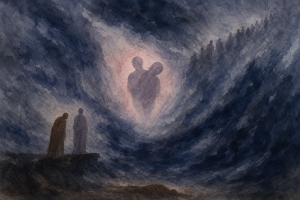
Past the judge, the second circle announces itself first as noise — wailing that arrives before anything is visible — and then as a wind that never stops, a black storm carrying the souls of the lustful in flocks the way winter carries starlings; and while Dante watches, Virgil points into the gale and names the famous dead one by one, empresses and queens and the heroes of Troy, until the pilgrim who came down here to look at justice finds that what has actually happened to him is pity.
Inferno · Canto 5 · Lines 25–72 · Scene 15
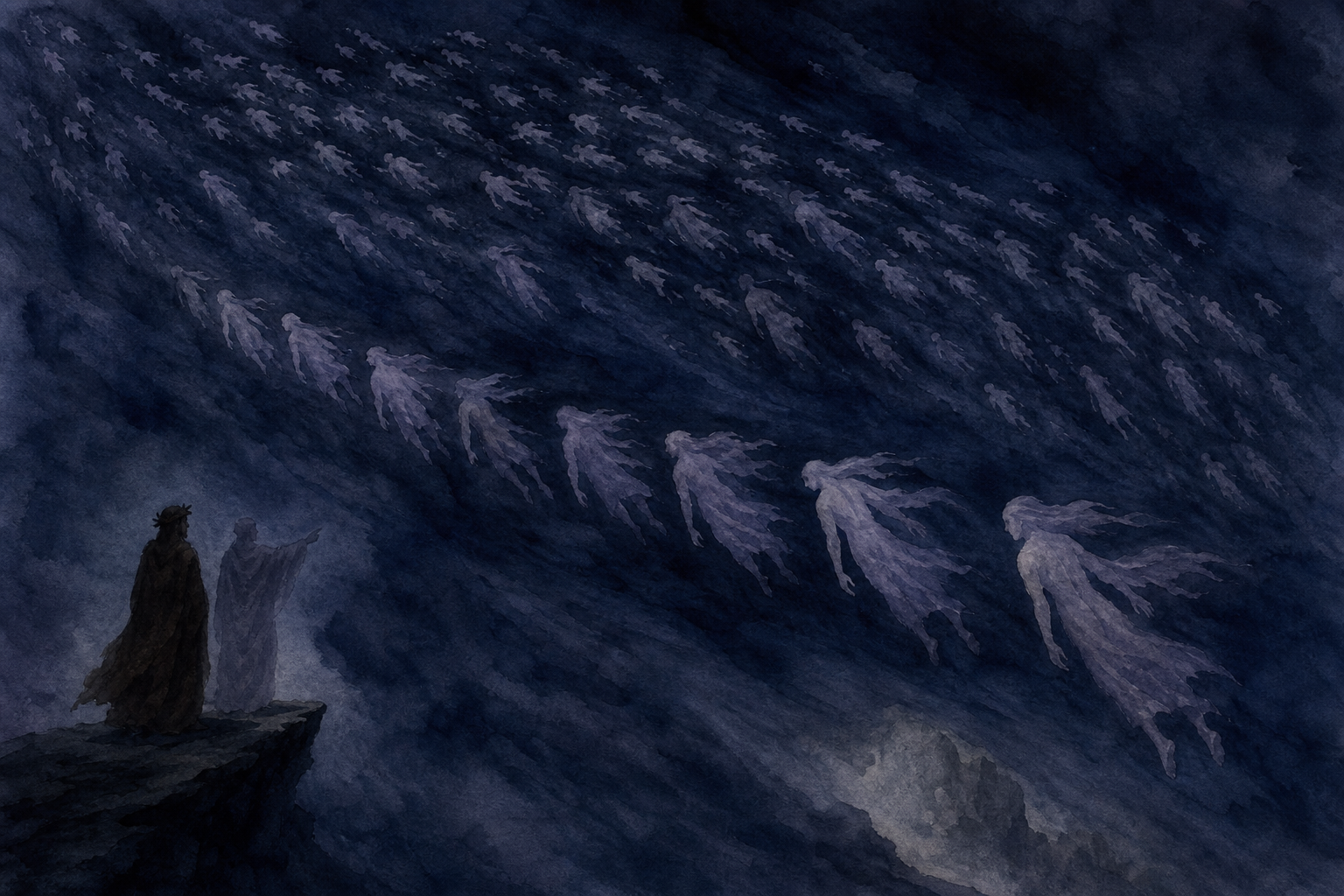
The judge is behind them. Dante steps down into the second circle, and the first thing that changes is the sound: wailing reaches him before he can see anything at all. Then he arrives somewhere strange — a place he describes as silent of all light, which is a deliberately impossible way to put it, and which bellows like a sea in a storm when opposing winds fight over it. That is the second circle. A black wind blows here and never stops, and it carries the souls of the lustful with it, spinning them, striking them, giving them nothing to hold on to. When they come to a certain place, the screaming and lamenting rises, and they curse the power of God. Then Dante tells us plainly what these people did to deserve it, and the definition is worth slowing down for: these are the carnal sinners, the ones who put reason underneath appetite. Not people who wanted things — people who let wanting do the steering. Dante gives us two pictures of what the crowd looks like. First, starlings: the way a huge flock gets carried on their own wings in the cold season, wide and full, that is how the wind takes the ordinary lustful, this way and that, up and down, with no hope of rest and not even the hope of a smaller pain. Then, cranes: the way cranes fly in a long line singing their sad songs, that is how the famous ones come, drawn out in a row, wailing as they pass. Dante asks who they are, and Virgil starts naming. The first was an empress who ruled many languages, so broken by lust that she wrote her own desires into law to keep from being blamed for them — Semiramis. Then a woman Virgil will not name, who killed herself for love and broke faith with her dead husband’s ashes. Then Cleopatra. Then Helen, who cost the world so many terrible years; then Achilles, who fought with love at the end and lost; then Paris, then Tristan. Virgil points into the wind and names more than a thousand, all of them people love drove out of life. And here the scene turns away from them and onto Dante. He has just listened to his teacher recite the ladies and knights of the old world like a roll call of the dead — and what happens to him is not horror at their punishment. Pity takes him, and he says he was nearly lost. That last word is the same one he used for himself at the very beginning of the poem, in the dark wood. Something has gone wrong with the pilgrim, and the two souls he is about to speak to have not even opened their mouths yet.
Go deeper: the college-level reading (about 900 words)
Quotes the Italian closely, with philological detail and cross-references.
The canto’s second movement opens on the ear before the eye: «Or incomincian le dolenti note / a farmisi sentire» (25–26) — now the notes of grief begin to make themselves heard. ‘Note’ is a musical word, and it sets the terms for everything that follows in this circle, where the damned will be characterized by the sounds they make. What arrives is not described as heard so much as suffered: «molto pianto mi percuote» (27), much weeping strikes me — the verb of a blow, sound with physical force, anticipating a wind that will do the same thing to bodies. Then the place itself, in a formulation that has occupied commentators for centuries: «Io venni in loco d’ogne luce muto» (28), I came into a place mute of all light. Light is given the property of speech and then denied it. Dante had done this once already, at «dove ‘l sol tace» (Inf. I.60), where the sun was silent; the device returns here scaled up from a single line to an entire region. The place «mugghia come fa mar per tempesta, / se da contrari venti è combattuto» (29–30) — bellows as the sea does in storm when contrary winds fight over it. ‘Mugghia’ is a beast’s noise, and the simile’s engine is contrariety: winds working against each other, motion without direction. Line 31 names the punishment: «La bufera infernal, che mai non resta» — the infernal squall, which never rests. The relative clause carries the theological weight. What defines this wind is not violence but sleeplessness, and the poem returns to that idea twenty lines later from the sinners’ side: «nulla speranza li conforta mai, / non che di posa, ma di minor pena» (44–45) — no hope ever comforts them, neither of rest nor of lesser pain. ‘Posa’ is the word that matters; the second circle is built as the permanent withholding of it. Line 34 contains the canto’s hardest crux — «Quando giungon davanti a la ruina» — where ‘la ruina’ has never been satisfactorily explained, and around it the souls do something the poem records without comment: «bestemmian quivi la virtù divina» (36), there they blaspheme the divine power. Then, before a single soul has spoken, Dante supplies the definition: «Intesi ch’a così fatto tormento / enno dannati i peccator carnali, / che la ragion sommettono al talento» (37–39) — the carnal sinners, who subject reason to appetite. The formulation is philosophical, not anatomical. Nothing is said about bodies or acts; the sin is a misordering of faculties, appetite installed above reason, and ‘talento’ is the technical word for the appetite in question. Two similes then give the circle its population. The first is a mass: «E come li stornei ne portan l’ali / nel freddo tempo, a schiera larga e piena» (40–41) — as their wings carry starlings in the cold season, in a wide full troop — and the wind takes the spirits «di qua, di là, di giù, di sù» (43), a line whose four monosyllabic directions enact aimlessness by refusing to settle on one. The second is a select company: «E come i gru van cantando lor lai, / faccendo in aere di sé lunga riga» (46–47) — as cranes go singing their lais, making of themselves a long line in the air. The shift from a scattered flock to a single file is functional; a row can be reviewed and named, and naming is what happens next. ‘Lai’ is a term from the French love-lyric, and it rhymes with ‘guai’ (48), the wails the souls draw as they come — their love-songs and their howls made into the same sound. Virgil’s catalogue then runs from 52 to 67, and it is built on withholding. The first is «imperadrice di molte favelle» (54), empress of many tongues, «A vizio di lussuria fu sì rotta, / che libito fé licito in sua legge» (55–56) — so broken to the vice of lust that she made the permitted out of the desired, in her own law. The pun is the point: ‘libito’ and ‘licito’ differ by a letter, and legislation is shown collapsing into appetite. Only at line 58 does the name arrive, «Ell’è Semiramìs». The next figure is never named at all: «L’altra è colei che s’ancise amorosa, / e ruppe fede al cener di Sicheo» (61–62), she who killed herself for love and broke faith with Sichaeus’ ashes. Every reader supplies ‘Dido,’ and the poem lets them do the work; it will not say the name until line 85, in the scene that follows. After Cleopatra, Helen, Achilles «che con amore al fine combatteo» (66), Paris and Tristan, Virgil points out «più di mille / ombre» (67–68), «ch’amor di nostra vita dipartille» (69) — whom love parted from our life. ‘Nostra vita’ is the poem’s opening phrase returning inside a list of the dead. And then the scene closes on the listener rather than the listed: «Poscia ch’io ebbi ‘l mio dottore udito / nomar le donne antiche e ‘ cavalieri, / pietà mi giunse, e fui quasi smarrito» (70–72). ‘Donne antiche e cavalieri’ dresses classical antiquity in medieval court costume, erasing the distance the catalogue has just travelled. And ‘smarrito’ is the word from the poem’s third line. Dante came into the second circle to see justice administered; what has arrived is pity, and it has left him where he was at the start.
Go deeper still: the scholarly reading (about 800 words)
The commentary tradition, the sources, and what is documented versus inferred.
The second circle’s wind has been read as an image almost since the poem began circulating. The fourteenth-century commentator Guido da Pisa glossed it as the condition of the lustful in this life — moved by every wind of temptation, their souls in continual motion and continual tempest — and anchored the reading in Isaiah’s figure of the wicked heart as a sea that cannot rest, ‘quod quiescere non potest.’ That gloss aligns the punishment with a long Augustinian account of desire as motion without repose, the restless heart of the Confessions set against the stillness of God, and the poem seems to invite it: «la bufera infernal, che mai non resta» (31) defines the storm by its sleeplessness, and «non che di posa, ma di minor pena» (45) denies the souls the very ‘posa’ that Augustinian desire is looking for. A second line of reading, developed by Teodolinda Barolini, proposes a source that sharpens the whole scene into an argument. In Nicomachean Ethics 3.1, Aristotle distinguishes voluntary from involuntary action and offers, as his example of a compulsion that removes responsibility, a person carried off by a wind. Dante has built his contrapasso out of the philosopher’s textbook case of an excuse — and then placed, three lines after the storm, a definition that revokes it: «i peccator carnali, / che la ragion sommettono al talento» (38–39). Barolini also emphasizes what the circle conspicuously lacks. The vision literature Dante knew, and the contemporary painting of hell, punished lust on the body: the visionary tradition and Giotto’s Last Judgment in the Scrovegni Chapel are full of tortures aimed at genitals. There is no sexualized torment anywhere in Dante’s poem. The sin has been relocated from the body to the ordering of the faculties, which is why the definition at 38–39 mentions reason and appetite and nothing else. Line 34 remains the canto’s unsolved problem. Nicolò Mineo counted six distinct schools of interpretation for «la ruina», and no proposal has survived scrutiny intact. The most attractive to English-speaking readers is Singleton’s, which treats the noun as deliberately withheld until Inferno XII.32–41, where ‘questa ruina’ names the fissure opened in hell’s rock by the earthquake at the Crucifixion; the difficulty is that Dante would nowhere else in the poem defer a word’s plain sense by seven cantos. Mazzoni argued instead for a secondary sense — fury, violence — taking the antecedent from ‘bufera’ in the preceding tercet, while Padoan read the arriving souls as a flashback to the crowd at Minos. Each solution buys clarity somewhere and pays for it grammatically, and Robert Hollander’s summary of the state of play is simply that no optimal solution exists. The similes are the canto’s most securely traced material. The starlings descend from Aeneid VI.311–312, the cranes from Aeneid X.264–266 with a further model in Statius’ Thebaid V.11–16, and the pairing does structural work: an anonymous mass, then a reviewable line of the famous. Padoan proposed that the second group is punished more heavily, having died violently; Hollander finds no warrant for that in the text. The catalogue itself has invited a reading as translatio, the medieval habit of tracing an idea’s movement through time and place — three triads carrying the scene from the queens of the African coast through the lovers of Troy to Tristan in Cornwall, arriving at Rimini and the present day. Ernst Robert Curtius noticed that the seven named here plus Francesca and Paolo make nine, Beatrice’s number, and suggested the group stands against her by opposition. Two details in the catalogue require care. Semiramis’ epitaph is borrowed: «che libito fé licito in sua legge» (56) renders a phrase from Orosius’ Historia, and the geography in the following lines is confused — «la terra che ‘l Soldan corregge» (60) places her realm in Egypt, Dante having taken her Babylon for the Egyptian city. Achilles is a subtler case. Dante had no Greek and had not read Homer, who reached Latin only later in the fourteenth century; the figure who «con amore al fine combatteo» (66) is the warrior-lover of Statius and the medieval Troy books, killed by treachery in a temple over a woman, and that story has no source in the Iliad. Dido, meanwhile, raises a question of Dante’s moral architecture: she killed herself, yet she is here and not among the suicides of Inferno XIII. The poem appears to sort souls by the impulse that drove the act, and hers was «s’ancise amorosa» (61) — she died of wanting Aeneas, and the suicide is treated as the expression of that appetite. Cleopatra, also a suicide, is placed on the same principle. What the scene does not do is tell us how to take its ending. «pietà mi giunse» (72) is reported and left there, unendorsed and uncorrected, and the reader arrives at the next scene already holding it.
The Italian — Tempest of the Lustful
Source: Wikisource (public domain, pre-1929 text)
Lines 25–27
25. Or incomincian le dolenti note26. a farmisi sentire; or son venuto27. là dove molto pianto mi percuote.
literary key: Line 25 — ‘le dolenti note’ — the notes of grief. ‘Note’ is a word for musical notes, and it opens the circle on the ear before the eye: this is the first region of Hell whose inhabitants are introduced by the sound they make. The canto that ends in a poem about reading begins by treating suffering as music. [Model knowledge · high]
vocabulary: Line 27 — ‘mi percuote’ — strikes me. The verb belongs to blows, not to hearing. Weeping is given physical force against the pilgrim’s body, which prepares the wind that will shortly be doing the same thing to everyone else in the circle. [Model knowledge · medium]
Lines 28–30
28. Io venni in loco d’ogne luce muto,29. che mugghia come fa mar per tempesta,30. se da contrari venti è combattuto.
literary key: Line 28 — ‘loco d’ogne luce muto’ — a place mute of all light. Light is granted the power of speech and then denied it. Dante had used the figure once before, at ‘dove ‘l sol tace’ — where the sun is silent — and here he expands it from one line into a whole region. Modern criticism often calls this synaesthesia; the term was coined centuries later, and the rhetoric Dante himself would have recognized is catachresis, a deliberately improper comparison. [Source: Inferno I.60 (‘dove ‘l sol tace’)]
vocabulary: Line 29 — ‘mugghia’ — bellows. The verb is used of cattle, and it keeps the animal register that entered the canto with Minos’ snarl. The comparison that follows turns on contrariety: a sea fought over by opposing winds, motion with no direction in it. [Model knowledge · medium]
Lines 31–33
31. La bufera infernal, che mai non resta,32. mena li spirti con la sua rapina;33. voltando e percotendo li molesta.
literary key: Line 31 — ‘La bufera infernal, che mai non resta’ — the infernal squall, which never rests. The punishment of this circle, named at last, and defined by the clause attached to it: what makes the storm infernal is that it does not stop. The fourteenth-century commentator Guido da Pisa read it as the lustful soul’s condition in life, blown by every wind of temptation and never at rest, citing Isaiah on the wicked heart as a sea that cannot be quiet. [Model knowledge · high]
vocabulary: Line 32 — ‘con la sua rapina’ — with its seizing. ‘Rapina’ is the noun of snatching and carrying off, the same root that gives ‘rapture’ and ‘rape’; it makes the wind an agent that takes hold rather than a weather condition the souls are merely standing in. [Model knowledge · medium]
Lines 34–36
34. Quando giungon davanti a la ruina,35. quivi le strida, il compianto, il lamento;36. bestemmian quivi la virtù divina.
literary key: Line 34 — ‘davanti a la ruina’ — before the ruin. This is the hardest word in the canto and it has never been solved. Six separate schools of interpretation have been counted. The most attractive to English readers treats it as the fissure opened in Hell’s rock by the earthquake at the Crucifixion, named openly only at Inferno XII; the objection is that Dante would nowhere else make a word wait seven cantos for its sense. Others read ‘ruina’ in a secondary sense as fury or violence, taking the storm itself as the antecedent. Each reading costs something in grammar. [Model knowledge · high]
literary key: Line 36 — ‘bestemmian quivi la virtù divina’ — there they blaspheme the divine power. Reported flat, with no comment. The souls of this circle curse the authority that placed them, and the narrator neither rebukes them nor treats the curse as evidence; it is simply part of the noise the place makes. [Model knowledge · high]
Lines 37–39
37. Intesi ch’a così fatto tormento38. enno dannati i peccator carnali,39. che la ragion sommettono al talento.
literary key: Line 38 — ‘i peccator carnali, / che la ragion sommettono al talento’ — the carnal sinners, who subject reason to appetite. Dante’s definition of lust, and it works entirely at the level of the faculties: no act is named, no body part is punished. The sin is an inversion of the faculties, appetite installed above reason. Nothing in the Comedy inflicts sexualized torture, which sets the poem sharply apart from the vision literature and the painted Last Judgments of Dante’s own day. [Model knowledge · high]
vocabulary: Line 39 — ‘talento’ — appetite, the wanting faculty, not talent in the modern sense. The word carries the technical weight of the definition: what is condemned is the arrangement in which ‘talento’ gives the orders. A likely model is Brunetto Latini’s Tresor, whose chapter on chastity describes reason left underneath desire in whoever lets himself be conquered. [Model knowledge · medium]
Lines 40–42
40. E come li stornei ne portan l’ali41. nel freddo tempo, a schiera larga e piena,42. così quel fiato li spiriti mali
cultural ref: Line 40 — ‘li stornei’ — the starlings. The first of the canto’s three bird similes, and its model is Virgilian: the massed flights of Aeneid VI. The starling flock supplies anonymity and scale, a crowd with no individuals in it, and the choice of birds carries an old assumption that lust belongs to creatures below the human. [Model knowledge · high]
Lines 43–45
43. di qua, di là, di giù, di sù li mena;44. nulla speranza li conforta mai,45. non che di posa, ma di minor pena.
literary key: Line 43 — ‘di qua, di là, di giù, di sù’ — this way, that way, down, up. Four monosyllabic directions in a single line, each cancelling the last. The verse performs aimlessness by refusing to resolve toward any one of them, and the verb it finally reaches, ‘mena’ — drives, leads — will become the canto’s key word for what love does to people. [Model knowledge · high]
literary key: Line 45 — ‘non che di posa, ma di minor pena’ — neither of rest, nor even of lesser pain. ‘Posa’ is the crucial noun. The storm was defined at line 31 as what never rests, and the souls are defined here by being denied rest, which places the whole circle inside the Augustinian account of desire as a heart in motion that cannot find quiet. [Model knowledge · medium]
Lines 46–48
46. E come i gru van cantando lor lai,47. faccendo in aere di sé lunga riga,48. così vid’io venir, traendo guai,
cultural ref: Line 46 — ‘i gru van cantando lor lai’ — the cranes go singing their lais. The ‘lai’ is a form of the French love-lyric, and the word was used by the Provençal poets for the laments of amorous birds; the famous lovers arrive singing love-songs. Cranes in formation come from Virgil and from Statius, and the shift from the starlings’ scattered flock to ‘lunga riga’, a long line, is functional — a row can be reviewed and named, which is what Virgil is about to do. [Model knowledge · high]
vocabulary: Line 48 — ‘traendo guai’ — drawing out wails. ‘Guai’ rhymes with ‘lai’ two lines above, binding the love-song to the howl: the sound these souls make is both at once. The word already opened the canto at line 3, where the narrower circle ‘punge a guaio’, goads to wailing. [Model knowledge · medium]
Lines 49–51
49. ombre portate da la detta briga;50. per ch’i’ dissi: «Maestro, chi son quelle51. genti che l’aura nera sì gastiga?».
vocabulary: Line 51 — ‘l’aura nera’ — the black air. ‘Aura’ is a soft word, the breeze of love poetry, and Dante blackens it. The question it carries is the pilgrim’s first act in this circle: he asks for names, and the request is what produces the catalogue. [Model knowledge · medium]
Lines 52–54
52. «La prima di color di cui novelle53. tu vuo’ saper», mi disse quelli allotta,54. «fu imperadrice di molte favelle.
vocabulary: Line 54 — ‘imperadrice di molte favelle’ — empress of many tongues. The periphrasis measures an empire by the number of languages it swallowed, and it withholds the name for four more lines. Virgil’s catalogue works by delay throughout: the description arrives first and the reader is left to supply, or wait for, the person. [Model knowledge · medium]
Lines 55–57
55. A vizio di lussuria fu sì rotta,56. che libito fé licito in sua legge,57. per tòrre il biasmo in che era condotta.
cultural ref: Line 56 — ‘che libito fé licito in sua legge’ — who made the permitted out of the desired, in her own law. The line renders a phrase from Orosius’ Historia, one of Dante’s standard sources for ancient history, and the Italian sharpens it into a pun: ‘libito’ and ‘licito’ differ by a single letter. Legislation collapses into appetite, and the motive given is public relations — ‘per tòrre il biasmo’, to remove the blame she had incurred. [Model knowledge · high]
Lines 58–60
58. Ell’è Semiramìs, di cui si legge59. che succedette a Nino e fu sua sposa:60. tenne la terra che ‘l Soldan corregge.
cultural ref: Line 58 — ‘Ell’è Semiramìs’ — she is Semiramis, the legendary queen of Assyria, who in the medieval accounts legalized incest to cover her liaison with her own son. ‘Di cui si legge’, of whom one reads, is Virgil’s careful phrasing: the charge arrives with its source attached, a thing the books carry. [Model knowledge · high]
cultural ref: Line 60 — ‘la terra che ‘l Soldan corregge’ — the land the Sultan rules, meaning Egypt. This is a geographical slip: Semiramis reigned in Assyria, and Dante appears to have taken her capital, Babylon, for the Egyptian city of the same name, relocating her empire by several hundred miles. [Model knowledge · medium]
Lines 61–63
61. L’altra è colei che s’ancise amorosa,62. e ruppe fede al cener di Sicheo;63. poi è Cleopatràs lussurïosa.
literary key: Line 61 — ‘colei che s’ancise amorosa’ — she who killed herself for love. Dido is described and not named, and the poem will withhold the name until line 85, in the scene that follows. The technique flatters the reader into completing the identification, and it makes the eventual naming land harder. [Model knowledge · high]
literary key: Line 62 — ‘ruppe fede al cener di Sicheo’ — she broke faith with the ashes of Sichaeus, her dead husband; the charge condenses a line of the Aeneid. Dido’s presence here raises a question about Hell’s architecture, since she died by her own hand and the suicides are punished in Inferno XIII. The poem appears to sort souls by the impulse driving the act: she dies out of wanting Aeneas, so the wanting is what she is judged on. Cleopatra, also a suicide, is placed on the same principle. [Model knowledge · medium]
Lines 64–66
64. Elena vedi, per cui tanto reo65. tempo si volse, e vedi ‘l grande Achille,66. che con amore al fine combatteo.
cultural ref: Line 64 — ‘Elena vedi, per cui tanto reo / tempo si volse’ — see Helen, for whom so evil a time revolved. The tradition standing behind this is the medieval Troy books, which assign Helen the blame for the war and everything that followed from it. The line measures her in years of ruin, and says nothing at all about beauty. [Model knowledge · medium]
cultural ref: Line 65 — ‘l grande Achille, / che con amore al fine combatteo’ — great Achilles, who fought with love at the end. Dante knew no Greek and had not read Homer, who reached Latin translation only later in the fourteenth century; his Achilles comes from Statius and the medieval Troy tradition, in which the hero is lured to a temple by the promise of marriage to Polyxena and killed there. Nothing in the Iliad supports the line, and it needs that other story to make sense. [Model knowledge · high]
Lines 67–69
67. Vedi Parìs, Tristano»; e più di mille68. ombre mostrommi e nominommi a dito,69. ch’amor di nostra vita dipartille.
vocabulary: Line 68 — ‘nominommi a dito’ — named them to me with his finger. Virgil identifies the dead by pointing, and the catalogue ends by refusing to continue: ‘più di mille’, more than a thousand, closes the list by declaring it unfinishable. [Model knowledge · medium]
literary key: Line 69 — ‘ch’amor di nostra vita dipartille’ — whom love parted from our life. ‘Nostra vita’ is the phrase that opens the entire poem, ‘Nel mezzo del cammin di nostra vita’, returning here inside a roll call of the dead. The pilgrim who was lost in the middle of our life is being shown a thousand people whom love took out of it. [Source: Inferno I.1 (‘Nel mezzo del cammin di nostra vita’)]
Lines 70–72
70. Poscia ch’io ebbi ‘l mio dottore udito71. nomar le donne antiche e ‘ cavalieri,72. pietà mi giunse, e fui quasi smarrito.
literary key: Line 71 — ‘le donne antiche e ‘ cavalieri’ — the ancient ladies and the knights. Classical antiquity is dressed in the costume of a medieval court, and the anachronism erases the distance the catalogue has just travelled from Assyria to Cornwall. Semiramis and Helen are made contemporaries of Tristan, which is precisely the flattening the next scene will exploit. [Model knowledge · medium]
literary key: Line 72 — ‘pietà mi giunse, e fui quasi smarrito’ — pity reached me, and I was almost lost. ‘Smarrito’ is the word Dante used of himself in the poem’s third line, where the straight way was lost; hearing the roll call has returned him to his opening condition. The narrator supplies no judgment on this — whether the pity is a fault, a qualification, or simply what listening does — and the scene ends on it, one line before the pilgrim asks to speak to the two who go together. [Source: Inferno I.3 (‘ché la diritta via era smarrita’)]
Seven Centuries of Reading Tempest of the Lustful
The wind as an image
The fourteenth-century commentator Guido da Pisa read the infernal wind as the condition of the lustful in this life: moved by every wind of temptation, their souls are in continual motion and continual tempest. He anchored the reading in Isaiah’s figure of the wicked heart as a raging sea, «quod quiescere non potest», that cannot rest. The poem invites the gloss. The storm is defined by its sleeplessness, «la bufera infernal, che mai non resta» (31), and the souls are denied «posa» (45), rest.
The definition at 38–39, «i peccator carnali, / che la ragion sommettono al talento», has a probable source that Mazzoni identified in Brunetto Latini’s Trésor, where the man who lets himself be overcome is said to leave reason beneath desire. Singleton glossed «talento» as carnal appetite.
Barolini’s Aristotle
Teodolinda Barolini proposed a source that turns the punishment into an argument. In the Nicomachean Ethics (3.1) Aristotle’s example of involuntary action, which removes responsibility, is a man carried off by a wind. Dante builds his punishment from the philosopher’s textbook excuse, and three lines later supplies the definition that revokes it. She also stresses what the circle lacks. The vision literature and contemporary painting punished lust on the body, as in Giotto’s Last Judgment in the Scrovegni Chapel. Dante’s poem has no sexualized torment anywhere: the sin is located in the ordering of reason and desire.
La ruina and the catalogue
Line 34 remains unsolved. Nicolò Mineo counted six schools of interpretation for «la ruina». Singleton’s attractive solution refers it to the fissure opened by the earthquake at the Crucifixion, revealed only at Inferno XII; Mazzoni read it as fury or violence; Padoan read the arriving souls as a flashback to the crowd before Minos. Hollander concludes that no optimal solution exists.
The bird similes come from Virgil: the starlings from Aeneid VI and the cranes from Aeneid X, with Statius’s Thebaid behind them. Hollander rejects Padoan’s suggestion that the second group is distinguished on moral grounds. Ernst Robert Curtius observed that the seven named lovers, with Francesca and Paolo, make nine, Beatrice’s number, and suggested the group stands against her by opposition. Semiramis’s epitaph, «che libito fé licito in sua legge» (56), translates a phrase from Orosius.
What remains open
The scene ends on «pietà mi giunse, e fui quasi smarrito» (72), pity unendorsed and uncorrected. Whether the poet shares the pilgrim’s response is the question the next scene makes unavoidable.
The Two Main Positions on Tempest of the Lustful
The Storm as Mirror
The wind shows the sinners what their desire always was. This is the oldest reading and the one the early commentary tradition supplies: Guido da Pisa glossed the storm as the state of the lustful in life, blown by every wind of temptation, their souls in perpetual tempest, and read it through Isaiah’s wicked heart that cannot rest. The punishment is therefore descriptive. It fixes the souls permanently in a motion they entered voluntarily and never wished to leave, and the poem’s insistence on the missing ‘posa’ makes the point in Augustinian terms — desire that refused rest is granted an eternity without it. Nothing in the wind compels; it only continues.
Key passage: «la bufera infernal, che mai non resta» (31) paired with «nulla speranza li conforta mai, / non che di posa, ma di minor pena» (44–45) — the storm is defined by sleeplessness and the sinners by the denial of rest, exactly the Augustinian restlessness of desire made into a landscape.
The Storm as Argument
The wind is chosen because it is the standard excuse, and the canto is constructed to take it apart. In the Nicomachean Ethics, a person carried off by a wind is the philosopher’s example of an action so compelled that responsibility does not attach to it. Dante makes that image the punishment, and then, before any soul can plead it, states in his own voice that these are people who put reason underneath appetite. The souls in this circle can now say they were driven — the scenery agrees with them — while the definition already on the page says the driving was something they arranged. The courtly doctrine that love is an irresistible external force is being given its most flattering possible setting and refuted inside it.
Key passage: The placement of «Intesi ch’a così fatto tormento / enno dannati i peccator carnali, / che la ragion sommettono al talento» (37–39) — a verdict in the narrator’s own voice, delivered immediately after the storm is described and before a single sinner has spoken, so that every subsequent plea in this circle is heard against it.
What the Text Does — and What That Means (Contested)
On the page: The sin is defined at 38–39 entirely in terms of faculties, reason subjected to appetite, and the poem describes no bodily punishment of the sexual organs anywhere; the storm is never said to compel the souls to anything, only to carry them after the fact; the souls blaspheme the divine power at 36 and the narrator neither corrects nor endorses them; the definition arrives before any soul in this circle has spoken a word; and the pity that arrives at 72 is reported without comment.
What scholars dispute: Whether the wind is a descriptive image of what passion feels like or a precisely aimed philosophical trap depends on whether Aristotle’s example of involuntary motion stands behind it — a source proposed in modern criticism rather than identified by the early commentators. The meaning of ‘la ruina’ at line 34 has resisted six distinct schools of interpretation and remains genuinely unsettled.
What Dante Leaves Unresolved
What ‘la ruina’ at line 34 is has never been settled; six schools of interpretation have been counted and each fails somewhere on grammar or on distance from its antecedent. The blasphemy at line 36 is recorded as bare fact, with no indication whether the poem regards the souls’ curse as an additional sin or simply as what damnation sounds like. And the scene ends without judging its own last event: «pietà mi giunse, e fui quasi smarrito» (72) uses the word Dante applied to himself in the poem’s third line, so the pity that has just arrived is marked as a return to his opening condition — but the narrator does not say whether that is a failure, a qualification for what follows, or merely what happens to anyone who listens to the roll call.
The Open Question
Dante builds the punishment of lust out of a wind — and a wind is precisely the example philosophers used for a force that carries a person off against their will, making the action involuntary. So does the second circle stage the sin as something its victims genuinely could not resist, or does it hand them the perfect excuse in order to show that it fails?
Explore More
About This Article

Written by Lucy Bamboo. Lucy Bamboo has been reading the Divine Comedy for fifteen years — first in translation, then stubbornly in Medieval Tuscan with a dictionary and far too many footnotes. Reading Dante is her scene-by-scene walk through the poem: the original Italian, seven centuries of scholarly argument presented as argument rather than answer, and the human questions sitting underneath the theology. More about this site.
Verify this against a primary source
Specifics change, and your situation may differ from the one described here. These are the authorities worth checking directly:
- Digital Dante, Columbia University — text, commentary and translation apparatus
- Princeton Dante Project — the Commedia with historical commentary
- Dartmouth Dante Project — searchable commentary from 1322 onward