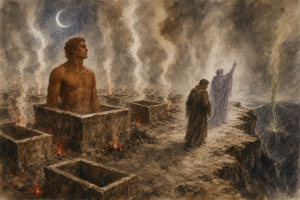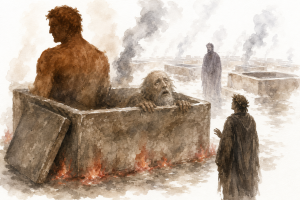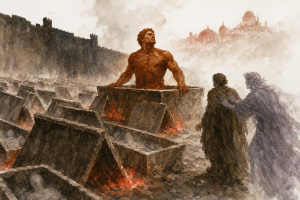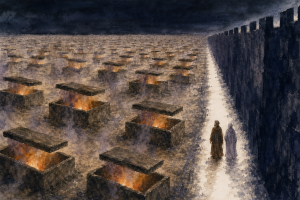
One step down from Limbo’s quiet, in a tighter ring holding louder pain, Dante meets the machine that sorts all of Hell: Minos — the ancient judge of the dead, reimagined with a snarl and an enormous coiling tail — before whom every damned soul confesses everything unprompted and is flung to its circle; and the first thing the judge does on seeing a living man is halt the whole apparatus to warn him about the width of the door.
Inferno · Canto 5 · Lines 1–24 · Scene 14
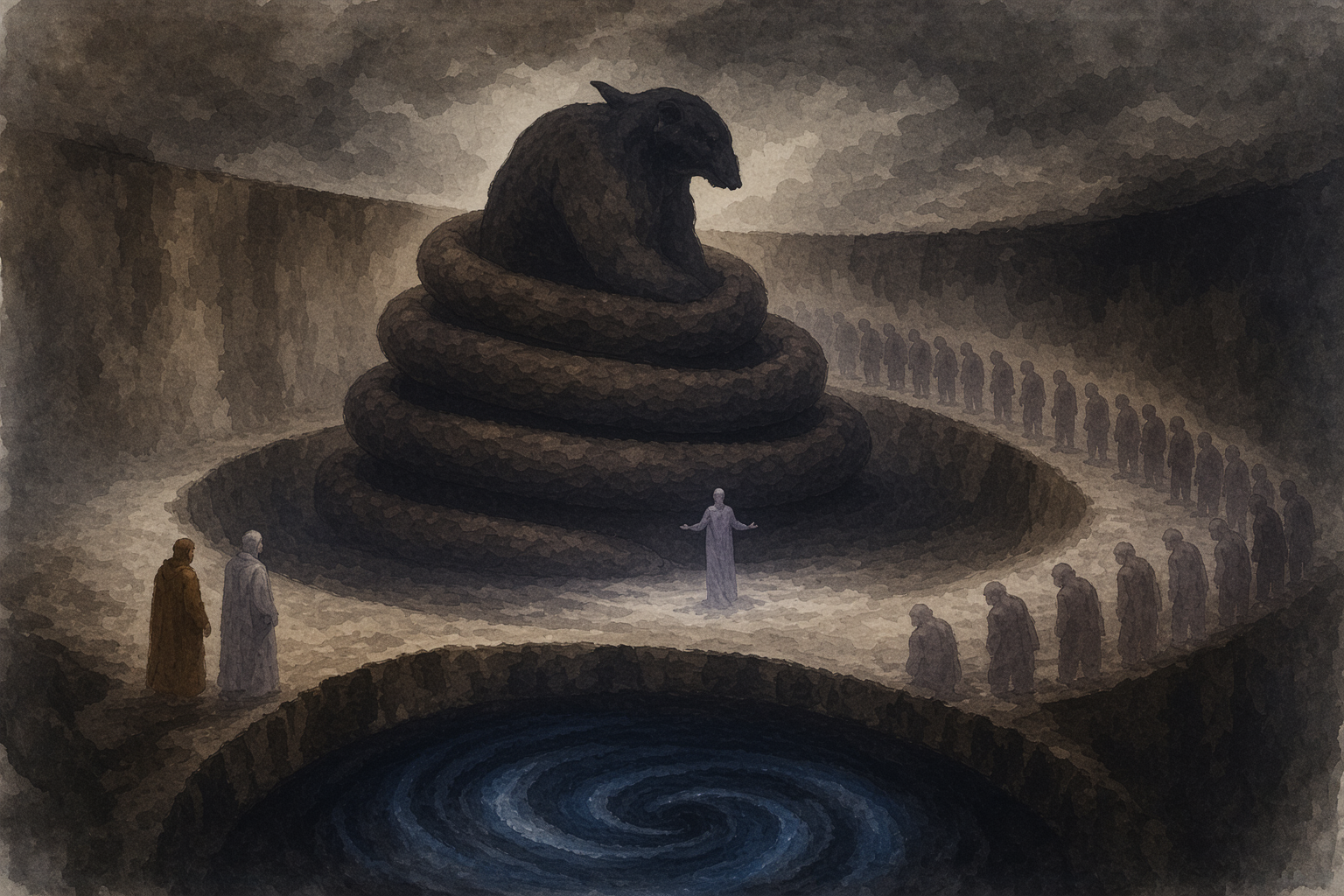
Leaving the strange quiet of Limbo, Dante climbs down from the first circle into the second — and immediately gives us the rule that shapes all of Hell: each circle is smaller than the one above it, and holds greater pain. Standing at the entrance is Minos, and he is horrible: he snarls like a dog, examines the sins of every soul that arrives, and passes sentence with his own body — he wraps his huge tail around himself, and however many times he winds it, that’s how many circles down the soul must go. The strangest part is what the souls themselves do. Every ill-born soul that comes before him confesses everything — completely, without being forced, without holding anything back. Minos, the great connoisseur of sins, sees instantly which place in Hell fits each one. And the line never ends: crowds of souls always stand before him, each steps forward in turn, speaks, hears its sentence, and is hurled down. Then the machine stops. Minos looks up and sees something that has never come through his line: a living man. He drops the work of his great office mid-judgment and calls out a warning — you there, arriving at this house of sorrow: watch how you enter, and watch whom you trust. Don’t let the width of the entrance fool you! It sounds almost like advice. Virgil doesn’t treat it that way. He answers with the exact words he used on Charon two cantos ago — the formula that opens every locked door in Hell: this is willed where what is willed can be done — and ask no more. Minos is silenced the way the ferryman was silenced, the journey moves on, and the sounds of weeping begin to reach them: the second circle is waiting.
Go deeper: the college-level reading (about 550 words)
Quotes the Italian closely, with philological detail and cross-references.
The canto opens with Hell’s geometry made explicit for the first time: the second circle ‘men loco cinghia / e tanto più dolor, che punge a guaio’ (2–3) — girds less space and so much more pain that it goads the souls to wailing. Less room, more suffering: the funnel that the whole Inferno will descend is stated in a line and a half. The rhyme scheme then does something audible: cinghia (2), ringhia (4), avvinghia (6) — girds, snarls, coils — three grinding ‘-inghia’ sounds that bind the circle’s narrowness, the judge’s snarl, and the sentencing tail into a single acoustic knot. Minos himself arrives in one line: ‘Stavvi Minòs orribilmente, e ringhia’ (4) — there stands Minos, horribly, and snarls. His procedure takes two more: ‘essamina le colpe ne l’intrata; / giudica e manda secondo ch’avvinghia’ (5–6) — he examines the sins at the entrance, judges, and dispatches according as he wraps. The verb is the sentence: judgment is measured in coils. The next two tercets slow the machine down enough to watch it work. The ‘anima mal nata’ (7) — the ill-born soul — comes before him and ‘tutta si confessa’ (8), confesses itself entirely; and ‘quel conoscitor de le peccata’ (9), that connoisseur of sins, ‘vede qual loco d’inferno è da essa’ (10), sees which place of Hell belongs to it, then girds himself with his tail ‘tante volte / quantunque gradi vuol che giù sia messa’ (11–12) — as many times as the grades he wills it sent down. No deliberation is described, no defense is offered, no verdict is spoken in words. Then the camera pulls back to show the throughput: ‘Sempre dinanzi a lui ne stanno molte’ (13) — always, many stand before him — and the whole liturgy of damnation compresses into a single line: ‘dicono e odono e poi son giù volte’ (15) — they speak, and they hear, and then they are turned below. Confession, sentence, fall: one line. At line 16 the machine halts. Minos sees a living man and interrupts ‘l’atto di cotanto offizio’ (18) — the act of so great an office, the poem’s own strangely dignifying phrase — to address Dante directly: ‘O tu che vieni al doloroso ospizio’ (16), you who come to the sorrowful hospice, ‘guarda com’entri e di cui tu ti fide; / non t’inganni l’ampiezza de l’intrare!’ (19–20) — watch how you enter, and in whom you trust; don’t let the breadth of the entrance deceive you. The warning turns on the same word that opened his job description: the intrata he examines at line 5 becomes the intrare he warns about at line 20. Virgil’s reply is first an irritated question — ‘Perché pur gride?’ (21), why do you keep shouting? — and then the formula, verbatim: ‘vuolsi così colà dove si puote / ciò che si vuole, e più non dimandare’ (23–24) — it is willed there where what is willed can be done; ask no more. The identical two lines silenced Charon at the Acheron (Inf. III.95–96), two cantos earlier. The grammar remains impersonal both times — no agent named, no name of God spoken in Hell — and it works both times: the scene ends with the obstacle cleared and nothing explained.
Go deeper still: the scholarly reading (about 400 words)
The commentary tradition, the sources, and what is documented versus inferred.
Dante’s Minos splices two classical inheritances and deforms both. In Odyssey XI Minos, golden-sceptered, delivers judgments among the dead; in Aeneid VI he is the ‘quaesitor’ who shakes the urn and holds inquest over the silent souls — a solemn magistrate. Dante keeps the office and bestializes the officer: his Minos snarls (‘ringhia’), and the urn of Virgil’s inquest is replaced by a tail, so that sentencing becomes a bodily act countable in coils. The commentary tradition split early over what this figure personifies. Allegorical readings have taken Minos as divine justice operating at the threshold of punishment proper, or as something nearer the sinner’s own conscience, the self-knowledge that assigns each soul its place; the text supports the second reading with its oddest detail, that every soul ‘tutta si confessa,’ confesses everything unprompted, as if the souls sentence themselves and Minos merely embodies the arithmetic. Modern criticism has been most drawn to that confession: a parody of the sacrament, confession’s form retained — complete, voluntary self-accusation — with its purpose inverted, since here disclosure damns instead of absolving and no contrition is possible. The episode also fixes a structural pattern: like Charon before him and demons after him, Minos is a classical threshold-figure who obstructs the living traveler and is overcome by the identical impersonal formula (‘vuolsi così colà dove si puote / ciò che si vuole’), repeated verbatim from Inf. III.95–96 — a repetition that has fed a long argument over whether the couplet makes a theological claim about the divine will or functions as portable narrative machinery for clearing gatekeepers. Minos’ warning itself divides readers on the same fault line as his office: ‘non t’inganni l’ampiezza de l’intrare’ echoes the broad gate and wide way of Matthew 7:13, and commentators have heard it either as demonic discouragement — the second attempt, after Charon, to turn the pilgrim back — or as the one piece of true counsel Hell offers Dante, a genuine caution about entrances and about ‘di cui tu ti fide,’ whom he trusts, spoken by the only figure in the poem whose entire office is accurate assessment. Structurally, the scene marks a real border: Limbo’s sin-less sorrow lies behind, and with the second circle the punishment of actual sin — the sins of incontinence, beginning with lust — starts here, which is why Hell’s examining magistrate sits at this threshold and not at the outer gate.
The Italian — The Judge of the Damned
Source: Wikisource (public domain, pre-1929 text)
Lines 1–3
1. Così discesi del cerchio primaio2. giù nel secondo, che men loco cinghia3. e tanto più dolor, che punge a guaio.
literary key: Line 2 — ‘che men loco cinghia / e tanto più dolor’ — which girds less space, and so much more pain. The funnel shape of Hell is stated explicitly here for the first time: each circle smaller than the last, each holding greater suffering. One line and a half of verse fixes the geometry the entire Inferno will descend. [Model knowledge · high]
vocabulary: Line 3 — ‘che punge a guaio’ — that goads to wailing. ‘Guaio’ is an animal-adjacent word for a yelp of pain, and it opens the canto’s acoustic program: this circle will be defined by what is heard — wailing here, then the ‘dolenti note’ and the storm’s roar just past this scene’s close. [Model knowledge · medium]
Lines 4–6
4. Stavvi Minòs orribilmente, e ringhia:5. essamina le colpe ne l’intrata;6. giudica e manda secondo ch’avvinghia.
cultural ref: Line 4 — ‘Stavvi Minòs orribilmente, e ringhia’ — there stands Minos, horribly, and snarls. In Greek tradition Minos, king of Crete and son of Zeus, judges among the dead; in Aeneid VI he is the solemn ‘quaesitor’ who shakes the urn and holds inquest over the souls. Dante keeps the office and bestializes the officer: ‘ringhia’ is the verb for a dog’s snarl, and the magistrate’s urn is about to be replaced by a tail. [Model knowledge · high]
vocabulary: Line 6 — ‘giudica e manda secondo ch’avvinghia’ — he judges and dispatches according as he wraps. The tercet’s rhymes do the work: cinghia (2), ringhia (4), avvinghia (6) — girds, snarls, coils — three grinding ‘-inghia’ sounds binding the circle’s narrowness, the judge’s snarl, and the sentencing tail into one acoustic knot. [Model knowledge · medium]
Lines 7–9
7. Dico che quando l’anima mal nata8. li vien dinanzi, tutta si confessa;9. e quel conoscitor de le peccata
literary key: Line 8 — ‘tutta si confessa’ — it confesses itself entirely. The scene’s strangest fact, delivered without explanation: every damned soul discloses everything, completely and unprompted. Many modern readers hear a parody of the sacrament of confession — the form kept intact, complete voluntary self-accusation, with the purpose inverted: here disclosure damns instead of absolving, and no contrition is possible. Why the souls confess — compulsion before perfect justice, or the soul’s own craving for its sentence — the poem never says. [Model knowledge · medium]
vocabulary: Line 9 — ‘quel conoscitor de le peccata’ — that connoisseur of sins. ‘Conoscitor’ is an expert’s word: one who knows by long acquaintance, a discerner. The phrase grants Minos genuine epistemic authority — whatever else he is, his knowledge of sin is never shown to fail — and it is the strongest single card in the reading of Minos as a true officer of justice. [Model knowledge · medium]
Lines 10–12
10. vede qual loco d’inferno è da essa;11. cignesi con la coda tante volte12. quantunque gradi vuol che giù sia messa.
literary key: Line 11 — ‘cignesi con la coda tante volte / quantunque gradi vuol che giù sia messa’ — he girds himself with his tail as many times as the grades he wills it sent down. Sentencing becomes a bodily count: coils for circles, judgment as arithmetic performed by an animal’s tail. No deliberation is described, no defense heard, no verdict spoken in words — the whole apparatus of a trial is compressed into a gesture. [Model knowledge · high]
Lines 13–15
13. Sempre dinanzi a lui ne stanno molte:14. vanno a vicenda ciascuna al giudizio,15. dicono e odono e poi son giù volte.
literary key: Line 15 — ‘dicono e odono e poi son giù volte’ — they speak, and they hear, and then they are turned below. The entire liturgy of damnation in six words: confession, sentence, fall. The line’s flat, coordinated verbs — say, hear, fall — render eternal judgment as throughput, a queue that has always been full (‘Sempre dinanzi a lui ne stanno molte’) and never stops moving. [Model knowledge · high]
Lines 16–18
16. «O tu che vieni al doloroso ospizio»,17. disse Minòs a me quando mi vide,18. lasciando l’atto di cotanto offizio,
vocabulary: Line 16 — ‘doloroso ospizio’ — the sorrowful hospice. ‘Ospizio’ is a word of hospitality: a lodging that receives travelers. In Minos’ mouth the second circle becomes a grim inn that takes guests forever — and the pilgrim arriving alive is the one traveler the house was never built to receive. [Model knowledge · medium]
literary key: Line 18 — ‘lasciando l’atto di cotanto offizio’ — leaving the act of so great an office. The narrator’s own phrase dignifies Minos’ work at the very moment he interrupts it: ‘cotanto offizio,’ so great an office, is not a demon’s boast but the poem’s description. The line is the strongest textual support for reading Minos as a legitimate functionary rather than a mere monster — and it sits three lines after the tail. [Model knowledge · high]
Lines 19–21
19. «guarda com’entri e di cui tu ti fide;20. non t’inganni l’ampiezza de l’intrare!».21. E ‘l duca mio a lui: «Perché pur gride?
cultural ref: Line 20 — ‘non t’inganni l’ampiezza de l’intrare’ — let not the breadth of the entrance deceive you. Commentators have long heard an echo of Matthew 7:13 — the wide gate and broad way that lead to destruction. The word turns Minos’ own job description back on itself: the ‘intrata’ where he examines sins at line 5 becomes the ‘intrare’ he warns about here, entrance examined and entrance distrusted framing his whole speech. [Model knowledge · medium]
literary key: Line 19 — ‘di cui tu ti fide’ — in whom you trust. The warning is aimed at the pilgrim’s reliance on his guide, and its status is the scene’s open question: the second infernal gatekeeper in three cantos trying to turn the living man back — or the one piece of honest counsel Hell offers, spoken by the only figure whose entire office is accurate assessment. The narrator reports it without comment, and Virgil will answer its volume, not its content. [Model knowledge · medium]
Lines 22–24
22. Non impedir lo suo fatale andare:23. vuolsi così colà dove si puote24. ciò che si vuole, e più non dimandare».
literary key: Line 23 — ‘vuolsi così colà dove si puote / ciò che si vuole, e più non dimandare’ — it is willed thus there where what is willed can be done; and ask no more. The identical two lines silenced Charon at the Acheron, two cantos earlier — repeated here verbatim against Minos. The grammar stays impersonal both times: no agent named, no name of God spoken inside Hell. Whether the formula makes a real theological claim about the divine will or is portable machinery for clearing gatekeepers is a long-standing debate — this scene deepens it by showing the same words work twice. [Source: Inferno III.95–96 (repeated verbatim)]
vocabulary: Line 22 — ‘lo suo fatale andare’ — his fated going. ‘Fatale’ plants the journey’s warrant in the language of destiny rather than doctrine: Virgil, the pagan poet of fatum, defends a Christian pilgrimage in the one vocabulary he owns. The word choice quietly restates the whole arrangement of the poem — grace, translated for Hell’s officials into fate. [Model knowledge · medium]
Seven Centuries of Reading The Judge of the Damned
The first readers
Benvenuto da Imola began with history and then moralized. Minos, he notes, was the first lawgiver of the Cretans, whose constitution Aristotle discusses in the Politics. Morally, «Minos moraliter capitur pro conscientia, quae est judex cujusque»: Minos is conscience, the judge of every person. For, he adds, «se teste, nemo nocens absolvitur reus»: with himself as witness, no guilty man is acquitted. «Ergo omnis peccans portat secum judicem suum», and so every sinner carries his own judge within him.
Virgil’s two judges
Edward Moore showed long ago that Dante’s Minos combines two figures from Aeneid VI. One is Minos, judge of all the dead, who shakes the urn and holds inquest (VI.432–433). The other is Rhadamanthus, who extracts confessions from the damned (VI.566–569). That second source explains the oddest detail of the scene: every soul «tutta si confessa» (8). Raymond Benoit read Minos as a parody of a confessor, and Hollander develops the point. The damned had the sacrament of confession available in life and did not use it. Now the first thing they do in Hell is make full disclosure, to a demon. Only one sinner in the Inferno, Guido da Montefeltro, ever uses the word ‘confession’.
Present tense, tail and warning
Giorgio Padoan noted that the verbs of judgment are all in the present tense, and Hollander extends the observation to the whole passage, 4–15. It is the everlasting present of damnation, happening as we read. Edoardo Sanguineti’s study of the historical present in the Commedia treats this passage. Even the tail has a dispute attached: does Minos flick it back and forth, or wind it around himself like a vine? Mazzoni preferred the second. Minos’s warning at 19–20, «guarda com’entri e di cui tu ti fide», strikes most commentators as courteous, even humane. Padoan pointed out that it also, indirectly, calls Virgil’s competence as a guide into question.
What remains open
Singleton took the presence of a judge here to mean that real Hell begins only with the second circle. Hollander objects that the neutrals were already punished, and that Limbo lies inside the gate. Where Hell begins, and whether Minos is a demon, a functionary, or the sinner’s conscience made visible, the poem does not say.
The Two Main Positions on The Judge of the Damned
The Officer of Justice Reading
Minos is a legitimate functionary of the divine order, wearing the form Hell imposes on everything it contains. The poem itself calls his work ‘so great an office’; he is a true ‘conoscitor de le peccata’ whose judgments are never once shown to err or to be appealed; the souls confess completely because before perfect justice nothing else is possible; and the tail is simply what a verdict looks like in a realm where everything is bodied. Even his warning to Dante can be read straight — accurate counsel about entrances and trust from the one figure whose whole function is accurate assessment. Virgil’s formula does not overrule a usurper; it informs a lawful officer that this exception, too, is signed by the authority he serves.
Key passage: ‘lasciando l’atto di cotanto offizio’ (18) — the narrator’s own phrase confers dignity on the office at the very moment Minos leaves it — together with the unbroken accuracy of the machine at 7–12: complete confession, instant recognition (‘vede qual loco d’inferno è da essa’), and a sentence no soul disputes.
The Demonic Parody Reading
Dante takes Virgil’s solemn quaesitor and systematically degrades him: the magistrate’s urn becomes a tail, inquest becomes a snarl, and judgment is reduced to an animal winding itself — justice with the reason removed. The confession scene is the sacrament inverted: complete, voluntary self-accusation that can never end in absolution, disclosure retained precisely where mercy has been deleted. And Minos acts like what he is: the second infernal gatekeeper in three cantos to try to turn the pilgrim back, his scripture-tinged warning about the wide entrance a menace in the mouth of a demon — which is why it takes the same formula that broke Charon’s refusal to break his.
Key passage: ‘Stavvi Minòs orribilmente, e ringhia’ (4) with the tail-sentencing of 11–12 — the bestialized body of the judge — and the structural rhyme with Charon: an obstruction at the threshold, answered by the verbatim couplet of Inf. III.95–96, ‘vuolsi così colà dove si puote / ciò che si vuole,’ deployed against him exactly as against the ferryman.
What the Text Does — and What That Means (Contested)
On the page: The poem calls Minos’ work ‘cotanto offizio’ — so great an office (18) — while giving him a snarl and a tail; no sentence he passes is ever shown to be wrong or disputed; the souls’ complete confession (8) is stated as fact and never explained; the warning at 19–20 is neither endorsed nor condemned by the narrator; Virgil’s rebuke cites a higher will but does not deny Minos’ authority over the dead.
What scholars dispute: Whether Minos personifies divine justice, demonic mockery of it, or the sinner’s own conscience has been argued since the fourteenth-century commentators, and the status of his warning — obstruction or truth — divides readers along the same line. The text dignifies his office and degrades his body in the same breath, and never arbitrates.
What Dante Leaves Unresolved
Why the souls confess — whether perfect justice compels disclosure or the damned soul itself craves its sentence — is never said; ‘tutta si confessa’ is delivered as bare fact. The warning to Dante is never marked as malice or as truth: the narrator reports it without comment, and Virgil answers its volume (‘Perché pur gride?’) rather than its content, which goes unrefuted. And the poem holds both halves of Minos at once — ‘orribilmente, e ringhia’ in his body, ‘cotanto offizio’ in his function — dignifying the office and bestializing the officer in the same scene, without ever saying which is the mask.
The Open Question
Minos judges with perfect accuracy and holds what the poem itself calls ‘so great an office’ — yet he snarls like a beast, sentences with his tail, and tries to warn the living traveler off. Is he a legitimate officer of divine justice wearing the form Hell imposes, or a demonic parody of judgment — and is his warning to Dante an act of obstruction or the only honest counsel in Hell?
Explore More
About This Article

Written by Lucy Bamboo. Lucy Bamboo has been reading the Divine Comedy for fifteen years — first in translation, then stubbornly in Medieval Tuscan with a dictionary and far too many footnotes. Reading Dante is her scene-by-scene walk through the poem: the original Italian, seven centuries of scholarly argument presented as argument rather than answer, and the human questions sitting underneath the theology. More about this site.
Verify this against a primary source
Specifics change, and your situation may differ from the one described here. These are the authorities worth checking directly:
- Digital Dante, Columbia University — text, commentary and translation apparatus
- Princeton Dante Project — the Commedia with historical commentary
- Dartmouth Dante Project — searchable commentary from 1322 onward