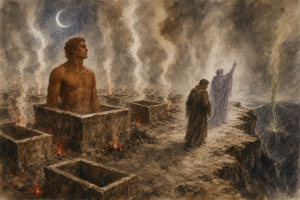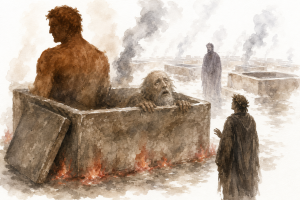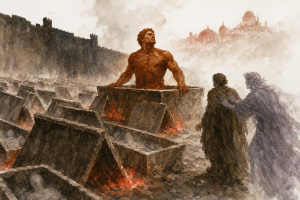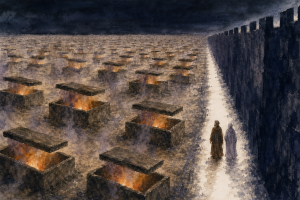
Out of Limbo’s fog rises a castle ringed by seven walls and a bright little stream the poets cross like solid ground — and inside, on a meadow of green enamel, Dante is shown the great spirits of antiquity, from Hector and Caesar to Aristotle seated among his philosophical family, with a Muslim sultan and two Islamic philosophers granted places no Christian map of the afterlife had offered them before.
Inferno · Canto 4 · Lines 106–151 · Scene 13
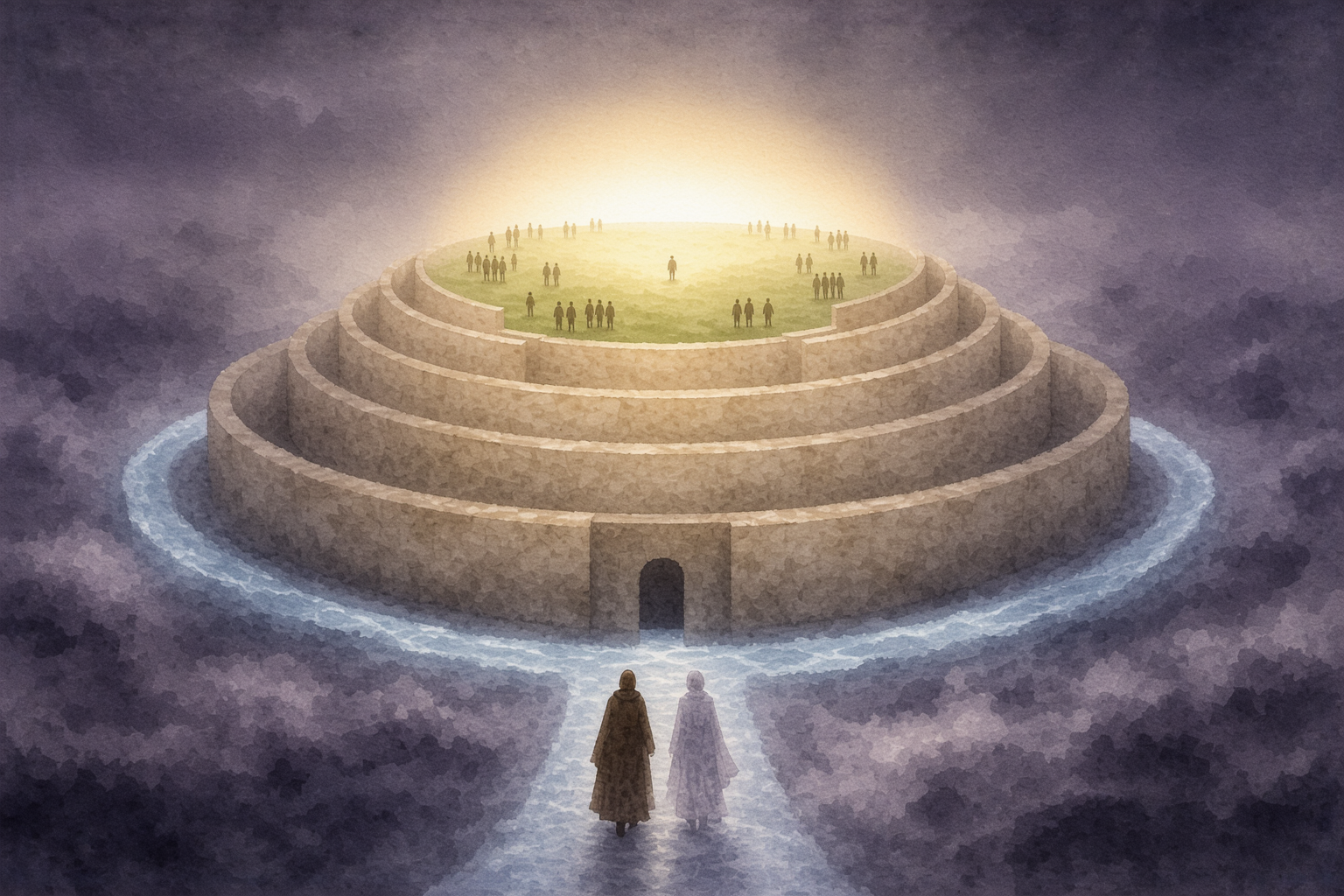
Walking on from the reunion with the four poets, Dante and Virgil arrive at the foot of a noble castle — circled seven times by high walls, and defended all around by a beautiful little stream. Then something quietly impossible happens: they walk across the stream as if it were solid ground. Dante passes through seven gates with the five wise poets and comes out onto a meadow of fresh green grass — the first living color he has seen since the dark wood. The people here are unlike anyone else in Hell. They have slow, serious eyes and faces full of authority; they speak rarely, and when they do, their voices are soft. The group climbs to an open spot, high and bright, where Dante can see everyone spread out below him on the green — and he starts naming names, openly proud just to have seen them. First the heroes: Electra with her many companions, including Hector and Aeneas of Troy, and Caesar in armor with fierce, hawk-like eyes. Camilla and the warrior queen Penthesilea; King Latinus sitting with his daughter Lavinia; the Brutus who drove out Rome’s last king; four famous Roman women — and then, sitting alone, apart from everyone: Saladin, the Muslim sultan who fought the Crusaders. Dante raises his eyes a little higher and sees the center of the whole gathering: ‘the master of those who know’ — he never says the name Aristotle, because he doesn’t have to — seated among his philosophical family, with everyone gazing at him in honor. Socrates and Plato stand closest, and around them a crowd of thinkers, mathematicians, and healers, ending with two more Muslims: the physician Avicenna, and Averroes, honored for writing the great commentary on Aristotle. Then Dante stops himself — there are too many to tell, and the story is pulling him forward. The company of six poets splits back into two. Virgil leads him out of the stillness, into air that trembles. And the canto ends with a single line: Dante comes to a place where nothing shines.
Go deeper: the college-level reading (about 500 words)
Quotes the Italian closely, with philological detail and cross-references.
The castle is given three architectural facts and no explanation: ‘sette volte cerchiato d’alte mura’ (107, circled seven times by high walls), ‘difeso intorno d’un bel fiumicello’ (108, defended all around by a beautiful little stream), and seven gates — ‘per sette porte intrai con questi savi’ (110). The stream is crossed ‘come terra dura’ (109), like solid ground, a small unexplained miracle the poem spends no words on. What the sevens mean — liberal arts, virtues, something else — the text never says, and the interpretive silence has been generating commentary since the fourteenth century. Inside is the poem’s first green since the dark wood: ‘prato di fresca verdura’ (111), later hardened into ‘verde smalto’ (118) — green enamel, nature rendered as artifice. The inhabitants are defined by restraint: ‘occhi tardi e gravi’ (112, slow and grave eyes), ‘parlavan rado, con voci soavi’ (114, they spoke seldom, with soft voices) — a dignity of near-silence set against the endless sighing of the wider circle. From an open place, ‘luminoso e alto’ (116), Dante is shown ‘li spiriti magni’ (119), the great spirits, ‘che del vedere in me stesso m’essalto’ (120) — the sight itself is something he exalts in. The catalogue that follows runs in two movements. First the line of Troy and Rome: Electra ‘con molti compagni’ including Hector and Aeneas (121–22), ‘Cesare armato con li occhi grifagni’ (123, Caesar armed, with hawk-like eyes), Camilla and Penthesilea, Latinus and Lavinia (124–26), the Brutus who expelled Tarquin, Lucretia, Julia, Marcia, and Cornelia (127–28) — and then, breaking the genealogy entirely: ‘e solo, in parte, vidi ‘l Saladino’ (129), alone, apart, Saladin. The second movement raises the eyes: ‘vidi ‘l maestro di color che sanno / seder tra filosofica famiglia’ (131–32) — the master of those who know, never named, seated among his philosophical family, with ‘tutti lo miran, tutti onor li fanno’ (133). Socrates and Plato stand nearest (134–35); then the pre-Socratics, including ‘Democrito che ‘l mondo a caso pone’ (136), Democritus who ascribes the world to chance — an entire cosmology compressed into a dismissive relative clause; then healers, astronomers, and moralists — Dioscorides, Orpheus, Cicero, Linus, ‘Seneca morale’ (141), Euclid, Ptolemy, Hippocrates, Avicenna, Galen — closing on ‘Averoìs che ‘l gran comento feo’ (144), Averroes who made the great commentary. The scene then performs its own insufficiency: ‘Io non posso ritrar di tutti a pieno’ (145), the long theme drives him on, ‘che molte volte al fatto il dir vien meno’ (147) — the telling falls short of the fact. The exit is swift and structural: ‘La sesta compagnia in due si scema’ (148) — the company of six, formed only forty-six lines earlier, diminishes to two — and Virgil leads him ‘fuor de la queta, ne l’aura che trema’ (150), out of the quiet, into trembling air. The canto’s last line stands alone: ‘e vegno in parte ove non è che luca’ (151) — and I come to a place where nothing shines. The fire that ‘conquered a hemisphere of darkness’ at 68–69 is revealed, in the end, to be strictly local.
Go deeper still: the scholarly reading (about 450 words)
The commentary tradition, the sources, and what is documented versus inferred.
The noble castle has carried one of the heaviest allegorical loads in the early commentary tradition precisely because the text refuses to gloss itself. The fourteenth-century commentators read the architecture emblematically but could not agree on the emblem: the seven walls appear variously as the seven liberal arts and as the seven virtues (moral and intellectual), the seven gates tracking whichever scheme the commentator preferred, and the ‘bel fiumicello’ glossed as eloquence, or as the flow of worldly goods the wise pass over untouched — and none of these keys is confirmed by the text. Modern criticism has largely stepped back from key-fitting allegoresis toward the scene’s structural argument: the castle as Dante’s constructed image of pagan achievement, built from the materials pagan literature itself supplied. The green meadow and the elevated viewing place have long been read against Aeneid VI — the Elysian Fields where Anchises shows Aeneas the parade of souls — so that Dante houses the virtuous pagans inside the best afterlife their own tradition imagined, an act readable either as homage or as pointed limitation, since that afterlife is precisely not the Christian one. The catalogue itself belongs to the epic inventory tradition, and its closing gesture at 145–47 is a textbook instance of what Curtius catalogued as the inexpressibility topos — the theme outrunning the telling. The most discussed feature of the roster is its three Muslims. Saladin, within living memory of Dante’s era a military opponent of Christendom, sits ‘solo, in parte’ — his medieval European reputation for magnanimity (he circulates as an exemplum of largesse in the Novellino and later in the Decameron) is usually taken to explain his admission, though the poem states no criterion. Avicenna and Averroes close the philosophical catalogue, and the line honoring Averroes for ‘il gran comento’ — the Great Commentary on Aristotle — has drawn particular attention: Dante grants a place in the afterlife of honor to a Muslim thinker for the act of commentary itself, the same activity by which Dante’s own poem would be transmitted, and scholarship on Dante’s relation to the Arabic-Aristotelian inheritance (a line of inquiry running from Asín Palacios’s contested claims about Islamic eschatology through more recent work on the Mediterranean transmission of Aristotle) has kept the trio at the center of arguments about how far the poem’s intellectual world is Latin-Christian at all. Against all this honor stands the canto’s final line, ‘e vegno in parte ove non è che luca,’ which critics have consistently treated as the scene’s own verdict on itself: the castle’s light does not travel. Whether that boundary reads as tragic limit or as just proportion — reason honored exactly as far as reason reaches — is the fault line along which the scene’s interpretation still divides.
The Italian — The Noble Castle
Source: Wikisource (public domain, pre-1929 text)
Lines 106–108
106. Venimmo al piè d’un nobile castello,107. sette volte cerchiato d’alte mura,108. difeso intorno d’un bel fiumicello.
cultural ref: Line 107 — ‘sette volte cerchiato d’alte mura’ — circled seven times by high walls. The text never says what the seven walls mean, and the early commentators disagreed: some glossed them as the seven liberal arts, others as the seven virtues, with the stream below variously read as eloquence or as worldly goods the wise pass over. The allegory has been contested since the fourteenth century precisely because the poem declines to supply its own key. [Model knowledge · medium]
Lines 109–111
109. Questo passammo come terra dura;110. per sette porte intrai con questi savi:111. giugnemmo in prato di fresca verdura.
literary key: Line 109 — ‘passammo come terra dura’ — we crossed it as if solid ground. A small unexplained miracle: the poets walk over the stream’s surface, and the poem spends not one further word on it — in a canto that has already withheld how Dante crossed the Acheron, water is again passed without explanation. [Model knowledge · medium]
literary key: Line 111 — ‘prato di fresca verdura’ — a meadow of fresh green. The first living color since the dark wood, and it appears inside Hell. The green meadow has long been read against the Elysian Fields of Aeneid VI — the resting place of the blessed dead in Virgil’s own poem, which Dante here rebuilds and relocates inside Limbo. [Model knowledge · medium]
Lines 112–114
112. Genti v’eran con occhi tardi e gravi,113. di grande autorità ne’ lor sembianti:114. parlavan rado, con voci soavi.
vocabulary: Line 114 — ‘parlavan rado, con voci soavi’ — they spoke seldom, with soft voices. Dignity rendered as restraint: against the wider circle’s perpetual sighing (IV.25–27), the castle’s inhabitants are defined by how little sound they make. Notably, no one inside the castle speaks a single quoted word in the entire scene. [Model knowledge · high]
Lines 115–117
115. Traemmoci così da l’un de’ canti,116. in loco aperto, luminoso e alto,117. sì che veder si potien tutti quanti.
literary key: Line 116 — ‘in loco aperto, luminoso e alto’ — an open place, luminous and high. The vantage point converts the scene into a viewing: what follows is not an encounter but a display, closer to Anchises showing Aeneas the parade of souls in Aeneid VI than to any exchange — Dante will see and name, but never speak with, the great spirits. [Model knowledge · medium]
Lines 118–120
118. Colà diritto, sovra ‘l verde smalto,119. mi fuor mostrati li spiriti magni,120. che del vedere in me stesso m’essalto.
translation note: Line 118 — ‘verde smalto’ — green enamel. The fresh meadow of line 111 returns hardened into artifice: enamel is a made surface, jeweled and permanent, and the shift from living green to crafted green quietly matches a place where nothing grows or changes. [Model knowledge · medium]
vocabulary: Line 120 — ‘che del vedere in me stesso m’essalto’ — at the seeing of whom I exalt within myself. The verb is present tense: the poet, writing years later, still glories in having seen them — the honor of the sight outlives the pilgrimage. [Model knowledge · medium]
Lines 121–123
121. I’ vidi Eletra con molti compagni,122. tra ‘ quai conobbi Ettòr ed Enea,123. Cesare armato con li occhi grifagni.
cultural ref: Line 121 — ‘Eletra’ — this is not the Electra of Greek tragedy but the daughter of Atlas, mother of Dardanus the founder of Troy: the catalogue opens at the genealogical root of the Troy–Rome line that Dante elsewhere treats as the providential spine of world history. [Model knowledge · high]
vocabulary: Line 123 — ‘con li occhi grifagni’ — with hawk-like eyes. ‘Grifagno’ is a falconry term for a raptor captured as an adult, fierce and untamed; Caesar alone in the catalogue is ‘armato,’ in armor, his single-line portrait built entirely from predatory alertness. [Model knowledge · medium]
Lines 124–126
124. Vidi Cammilla e la Pantasilea;125. da l’altra parte vidi ‘l re Latino126. che con Lavina sua figlia sedea.
literary key: Line 124 — ‘Cammilla’ — the warrior maiden of the Aeneid returns: she was already named in the poem’s first canto (Inf. I.107) among those who died for Italy. Paired here with Penthesilea, queen of the Amazons, she opens a tercet of women and kings from the Latin side of the Trojan war’s aftermath. [Model knowledge · high]
Lines 127–129
127. Vidi quel Bruto che cacciò Tarquino,128. Lucrezia, Iulia, Marzïa e Corniglia;129. e solo, in parte, vidi ‘l Saladino.
cultural ref: Line 127 — ‘quel Bruto che cacciò Tarquino’ — that Brutus who drove out Tarquin: the specification matters, distinguishing the republic’s founder from the other Brutus, Caesar’s assassin, whom the poem will place at the very bottom of Hell. Same name, opposite ends of Dante’s moral universe. [Model knowledge · high]
cultural ref: Line 129 — ‘e solo, in parte, vidi ‘l Saladino’ — and alone, apart, I saw Saladin. The catalogue’s most startling admission: a Muslim sultan who fought the Crusaders, dead barely a century before Dante’s birth, seated among the founders of Troy and Rome. His medieval European reputation for magnanimity — he circulates as an exemplum of largesse in the Novellino — is usually taken to explain his presence, but the poem itself gives no criterion, and marks his apartness twice in one line: ‘solo, in parte.’ [Model knowledge · high]
Lines 130–132
130. Poi ch’innalzai un poco più le ciglia,131. vidi ‘l maestro di color che sanno132. seder tra filosofica famiglia.
literary key: Line 131 — ‘l maestro di color che sanno’ — the master of those who know. Aristotle, never named: the periphrasis is itself the tribute, since it assumes every reader will recognize him without the name — the same gesture by which scholastic writers called him simply ‘the Philosopher.’ Raising the eyes (‘innalzai… le ciglia’) places philosophy literally above the heroes surveyed so far. [Model knowledge · high]
Lines 133–135
133. Tutti lo miran, tutti onor li fanno:134. quivi vid’ïo Socrate e Platone,135. che ‘nnanzi a li altri più presso li stanno;
cultural ref: Line 134 — Socrates and Plato stand nearest to Aristotle, but beneath him — a ranking that reflects the thirteenth-century Latin reception, in which the rediscovered Aristotle had become the framework of university learning while Plato was known mostly at second hand. The arrangement is a diagram of medieval intellectual history drawn in seating positions. [Model knowledge · medium]
Lines 136–138
136. Democrito che ‘l mondo a caso pone,137. Dïogenès, Anassagora e Tale,138. Empedoclès, Eraclito e Zenone;
literary key: Line 136 — ‘Democrito che ‘l mondo a caso pone’ — Democritus, who ascribes the world to chance. An entire cosmology — atomism — compressed into a single dismissive relative clause, and yet its author is still honored with a place: the castle admits thinkers whose doctrines Dante’s own theology rejects outright. [Model knowledge · medium]
Lines 139–141
139. e vidi il buono accoglitor del quale,140. Dïascoride dico; e vidi Orfeo,141. Tulïo e Lino e Seneca morale;
cultural ref: Line 141 — ‘Seneca morale’ — the moral Seneca. The epithet reflects a medieval habit of distinguishing Seneca the moral philosopher from ‘Seneca the tragedian,’ sometimes believed to be two different men. In this tercet the mythic singers Orpheus and Linus stand beside Cicero (‘Tulïo’) and Seneca — legendary poets and Roman moralists ranked together as sages, with no line drawn between myth and history. [Model knowledge · medium]
Lines 142–144
142. Euclide geomètra e Tolomeo,143. Ipocràte, Avicenna e Galïeno,144. Averoìs che ‘l gran comento feo.
cultural ref: Line 144 — ‘Averoìs che ‘l gran comento feo’ — Averroes, who made the great commentary. The catalogue’s final honor goes to a Muslim philosopher, and for a specific act: his Great Commentary on Aristotle, the work through which the Latin West largely learned to read ‘the master of those who know.’ The philosophical family thus closes on the labor of commentary itself — the same activity by which Dante’s own poem would be transmitted for centuries. [Model knowledge · high]
cultural ref: Line 143 — ‘Avicenna’ between Hippocrates and Galen — the Persian physician-philosopher set directly into the Greek medical canon, his Canon of Medicine a standard university text in Dante’s Europe. With Saladin at 129, the castle now holds three Muslims, all admitted without one word of justification from the poem. [Model knowledge · high]
Lines 145–147
145. Io non posso ritrar di tutti a pieno,146. però che sì mi caccia il lungo tema,147. che molte volte al fatto il dir vien meno.
literary key: Line 147 — ‘al fatto il dir vien meno’ — the telling falls short of the fact. A formal declaration of insufficiency — the inexpressibility topos of classical and medieval rhetoric — deployed here for the first time in the poem; the same gesture will return at far higher stakes in Paradiso, where language fails before God rather than before a guest list. [Model knowledge · medium]
Lines 148–150
148. La sesta compagnia in due si scema:149. per altra via mi mena il savio duca,150. fuor de la queta, ne l’aura che trema.
literary key: Line 148 — ‘La sesta compagnia in due si scema’ — the company of six diminishes to two. The honor of ‘sesto tra cotanto senno’ (IV.102), conferred only forty-six lines earlier, is quietly dissolved: the four poets stay in the castle’s light, and Dante’s membership in their number turns out to be exactly as long as his visit. [Model knowledge · high]
vocabulary: Line 150 — ‘fuor de la queta, ne l’aura che trema’ — out of the quiet, into air that trembles. The trembling air is the poem’s first signal of Canto V: the tempest of the lustful is already audible in the atmosphere before Minos or a single sinner is seen. [Model knowledge · medium]
Lines 151
151. E vegno in parte ove non è che luca.
literary key: Line 151 — ‘ove non è che luca’ — where nothing shines. The canto’s single closing line revokes its central image: the fire that ‘conquered a hemisphere of darkness’ (68–69) turns out to reach no further than the castle it lights. Whether that boundary is tragedy or justice — reason honored exactly as far as reason extends — is the question the whole scene leaves standing. [Model knowledge · high]
Seven Centuries of Reading The Noble Castle
What the castle signifies
The seven walls, the stream crossed like dry land, the seven gates and the green meadow are conventional allegory, objects standing for ideas, and they have defeated readers in every century. Mazzoni devoted many pages to the history of the question without resolving it. He took the castle as the good life of human beings without grace, all that the moral and intellectual virtues could achieve. Padoan took it as philosophy, with its seven disciplines.
Hollander tests both against the roster: of the thirty-five named inhabitants, fourteen are figures of the active life, and eight of those are women. Caesar, Camilla, Latinus and Lavinia sit oddly in an allegory of philosophy. His own answer is deliberately modest: the best that human beings can be without God.
Virgil’s Elysium
The meadow and the raised, open, luminous place from which the great spirits are seen (115–117) recall the vantage point from which Anchises shows Aeneas the souls in Elysium (Aeneid VI.752–755). Boccaccio noticed this, and so had Pietro Alighieri before him, in the third redaction of his commentary. Lino Pertile wondered why Caesar should be in arms at 123.
Seneca and the narrator
«Seneca morale» (141) raised a question of medieval learning. Paget Toynbee shared the widespread view that Dante, like others in his time, believed the moralist and the tragedian to be two different men. Mazzoni, drawing on Giuseppe Billanovich’s work, argued that this confusion became current only after Boccaccio’s mistaken suppositions at mid-century, which later misled Petrarch.
The closing admission that the telling falls short of the fact (145–147) belongs to a larger modern discussion of the difference between Dante the narrator and Dante the character. Hollander cites Leo Spitzer (1946), Singleton and Gianfranco Contini among those who made that distinction central to reading the poem.
What remains open
The canto ends «in parte ove non è che luca» (151), in a place where nothing shines. Whether the castle’s light is a tribute to pagan achievement or the measure of its limit is still debated. The question is sharper now that Dante is known to have placed the virtuous pagans in Limbo on his own authority, against Thomas.
The Two Main Positions on The Noble Castle
The Monument to Reason Reading
The castle is the poem’s shrine to pagan achievement — the high-water mark of Dante’s intellectual generosity. He grants earthly fame a real afterlife purchase (‘grazïa acquista in ciel,’ IV.78), seats Aristotle as the unnamed master everyone recognizes, gives the heroes of Troy and Rome a green field and light in the middle of Hell, and — extraordinarily for a fourteenth-century Christian poem — extends the honor across the border of Christendom itself, to Saladin, Avicenna, and Averroes. On this reading the walls defend rather than confine: the castle is what human excellence looks like when a poet who loves it builds its house with his own hands.
Key passage: The sustained honorific vocabulary of lines 106–44 — ‘nobile castello’ (106), ‘li spiriti magni’ (119), ”l maestro di color che sanno’ (131), ‘tutti lo miran, tutti onor li fanno’ (133) — and the deliberate inclusion of three Muslims in a catalogue otherwise built from the Trojan-Roman line, an admission the poem makes without apology or explanation.
The Gilded Exile Reading
Every honor in the scene is bounded, and the boundaries are the point. The walls enclose as much as they defend; the inhabitants gaze and are gazed at but never speak; the green meadow echoes Virgil’s own Elysian Fields, so that Dante houses the pagans inside the best afterlife their literature could imagine — which is precisely not heaven. The more genuinely the poem honors these souls, the more exactly it measures what they lack: the castle is Limbo’s sorrow made architectural, and the canto’s final line quietly repossesses everything the fire at line 68 seemed to promise.
Key passage: The single-line close, ‘e vegno in parte ove non è che luca’ (151) — the light that ‘conquered a hemisphere of darkness’ at 68–69 is revealed to stop at the castle’s own walls — together with the near-silence of the honored dead (‘parlavan rado,’ 114) set against a circle defined by audible sighing (IV.25–27).
What the Text Does — and What That Means (Contested)
On the page: The text never explains the seven walls, the seven gates, or the stream; no figure inside the castle speaks a single line of dialogue; the honor conferred is entirely visual and nominal — Dante watches, lists names, and leaves. The doctrine stated earlier in the canto — ‘sanza speme vivemo in disio’ (IV.42, without hope we live in desire) — is never suspended for the castle’s inhabitants, and the canto’s final line locates the border of the castle’s light at the castle itself.
What scholars dispute: Whether the castle honors natural reason or measures its insufficiency is argued in both directions across seven centuries of commentary, and the allegory of the walls, gates, and stream was already disputed among the fourteenth-century commentators. The text supplies the architecture and withholds the key.
What Dante Leaves Unresolved
The text never glosses its own allegory — walls, gates, and stream are described and abandoned. No inhabitant of the castle is given a voice. And the poem never states the criterion by which Saladin, Avicenna, and Averroes — non-Christians standing entirely outside the Trojan-Roman genealogy, one of them a crusader-era opponent of Christendom — were admitted. The scene shows the honor and withholds the rule that grants it, leaving open whether the castle is the afterlife reason deserves or the one it is condemned to.
The Open Question
The noble castle grants antiquity’s greatest souls light, green ground, and everlasting honor inside Hell itself — is it Dante’s monument to what human reason achieved without revelation, or the poem’s most refined image of exile: a walled enclosure whose light stops at its own boundary, built for souls who live forever in desire without hope?
Explore More
About This Article

Written by Lucy Bamboo. Lucy Bamboo has been reading the Divine Comedy for fifteen years — first in translation, then stubbornly in Medieval Tuscan with a dictionary and far too many footnotes. Reading Dante is her scene-by-scene walk through the poem: the original Italian, seven centuries of scholarly argument presented as argument rather than answer, and the human questions sitting underneath the theology. More about this site.
Verify this against a primary source
Specifics change, and your situation may differ from the one described here. These are the authorities worth checking directly:
- Digital Dante, Columbia University — text, commentary and translation apparatus
- Princeton Dante Project — the Commedia with historical commentary
- Dartmouth Dante Project — searchable commentary from 1322 onward