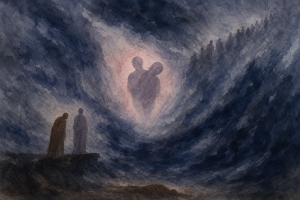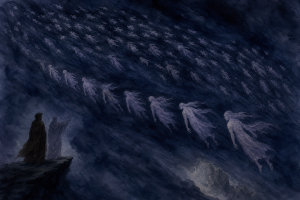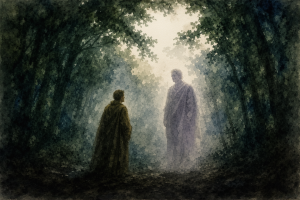
A fire appears ahead in the dark — the first light Dante has seen since entering Hell — and out of its glow come four towering shades who greet Virgil as one of their own; then, with no test, no trial, and no verse of Dante’s held up for judgment, they simply make room for him as number six.
Inferno · Canto 4 · Lines 64–105 · Scene 12
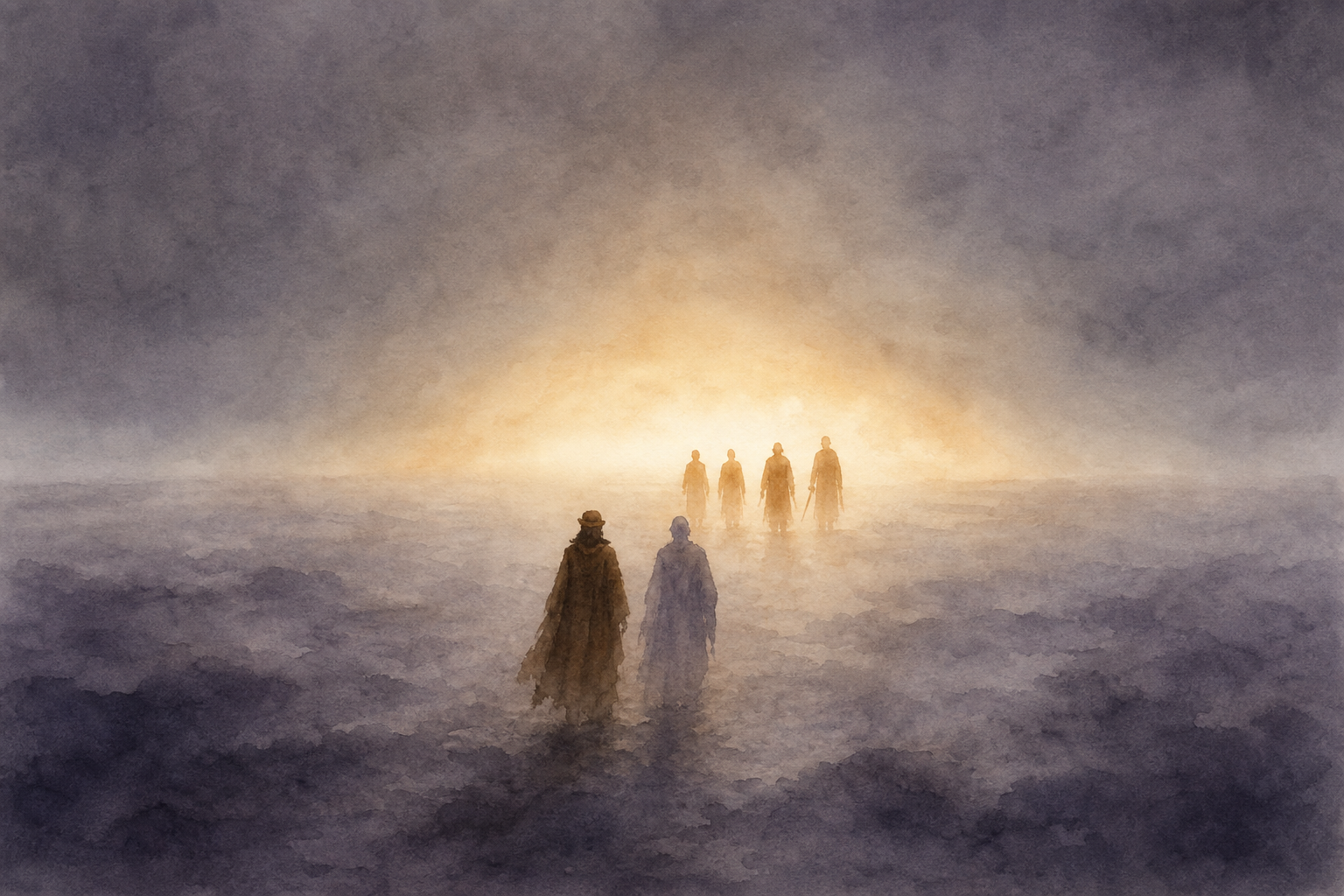
Dante and Virgil keep walking through the crowded, sighing fog of Limbo, and after a while Dante notices something new: a fire up ahead, glowing so brightly it pushes back an entire dome of darkness around itself. As they get closer, he can tell the fire belongs to some kind of honored group — the people around it clearly aren’t like the anonymous crowds sighing all around them. Dante asks who these separated, honored souls are, and Virgil explains: their fame on earth earned them special favor here. Then a voice calls out from the group: ‘Honor the loftiest poet — his shade is returning, the one that had left us.’ That’s Virgil himself being welcomed back, because he had left Limbo earlier in the story to go fetch Dante. Once the voice stops, four huge shades come forward to meet them, and their faces show neither sadness nor joy — just a kind of settled dignity. Virgil names them one by one: Homer, carrying a sword, walking in front of the other three like their leader; then Horace, then Ovid, then Lucan last. Virgil explains why they’re greeting him so warmly: they all share the same title he does — poet — the word the voice called out — so honoring him is honoring what they all are together. Dante watches this whole reunion happen, calls it ‘the beautiful school’ gathered around Homer, ‘the lord of the highest song, who flies above the rest like an eagle.’ Then something remarkable happens almost as an afterthought. After talking a while longer, the four poets turn to Dante and give him a friendly nod of greeting. Virgil smiles at this. And then, with no test, no demonstration, no proof of anything Dante has ever written, they simply make him one of their group: sixth, among that much genius. Dante doesn’t explain why they let him in. He just tells us it happened.
The Italian — Sixth Among Such Wisdom
Source: Wikisource (public domain, pre-1929 text)
Lines 64–66
64. Non lasciavam l’andar perch’ei dicessi,65. ma passavam la selva tuttavia,66. la selva, dico, di spiriti spessi.
translation note: Line 66 — ‘la selva, dico, di spiriti spessi’ — the wood, I say, thick with spirits. The repetition of ‘selva’ recalls the poem’s opening wood (Inf. I.2) while redefining it: Limbo is now pictured as a forest not of trees but of densely packed souls. [Model knowledge · medium]
Lines 67–69
67. Non era lunga ancor la nostra via68. di qua dal sonno, quand’io vidi un foco69. ch’emisperio di tenebre vincia.
literary key: Line 69 — ‘ch’emisperio di tenebre vincia’ — that overcame a hemisphere of darkness. The first light of any kind since the pilgrim entered Hell, and it is described in terms of conquest — ‘vincia’ (overcame) — framing illumination itself as a victory over the surrounding dark rather than a neutral visual fact. [Model knowledge · high]
vocabulary: Line 68 — ‘di qua dal sonno’ — this side of the sleep. Dante measures the distance traveled against his own unexplained crossing of the Acheron (Canto IV’s opening scene), continuing to use the sleep as the poem’s reference point for time and distance in a place where neither functions normally. [Model knowledge · low]
Lines 70–72
70. Di lungi n’eravamo ancora un poco,71. ma non sì ch’io non discernessi in parte72. ch’orrevol gente possedea quel loco.
vocabulary: Line 72 — ‘orrevol gente’ — honored, worthy people. Before any figure is named, Dante can already tell from a distance that this group is categorically distinct from the anonymous ‘turbe… molte e grandi’ of the wider circle (IV.30). [Model knowledge · medium]
Lines 73–75
73. «O tu ch’onori scïenzïa e arte,74. questi chi son c’hanno cotanta onranza,75. che dal modo de li altri li diparte?».
literary key: Line 73 — ‘O tu ch’onori scïenzïa e arte’ — o you who honor knowledge and art. Dante’s address to Virgil names the two things Virgil is credited with honoring, framing the coming introduction as a matter of learning and craft rather than piety or moral standing. [Model knowledge · low]
Lines 76–78
76. E quelli a me: «L’onrata nominanza77. che di lor suona sù ne la tua vita,78. grazïa acquista in ciel che sì li avanza».
theology: Line 78 — ‘grazïa acquista in ciel che sì li avanza’ — earns them grace in Heaven that so advances them. A striking claim inside a circle whose defining doctrine, stated one scene earlier, is that no merit earns salvation here (IV.34–42, 63); the poem does not reconcile the tension between literary fame as advantage and Limbo’s flat denial of blessedness. [Model knowledge · medium]
Lines 79–81
79. Intanto voce fu per me udita:80. «Onorate l’altissimo poeta;81. l’ombra sua torna, ch’era dipartita».
literary key: Line 81 — ‘l’ombra sua torna, ch’era dipartita’ — his shade returns, which had departed. The consensus reading identifies ‘l’altissimo poeta’ as Virgil: his shade ‘departed’ Limbo in Canto II, summoned by Beatrice to fetch Dante, and is now recognized as ‘returning’ — a two-canto absence quietly closed by an anonymous voice. [Model knowledge · high]
Lines 82–84
82. Poi che la voce fu restata e queta,83. vidi quattro grand’ombre a noi venire:84. sembianz’avean né trista né lieta.
vocabulary: Line 84 — ‘sembianz’avean né trista né lieta’ — their bearing was neither sad nor glad. A description that matches Limbo’s larger emotional register — ‘duol sanza martìri,’ sorrow without torments — extended here to a settled, affectless dignity rather than either grief or joy. [Model knowledge · medium]
Lines 85–87
85. Lo buon maestro cominciò a dire:86. «Mira colui con quella spada in mano,87. che vien dinanzi ai tre sì come sire:
cultural ref: Line 86 — ‘con quella spada in mano’ — with that sword in hand. Homer’s attribute is conventional in medieval iconography, marking epic’s martial subject matter; Dante had no direct access to Homer’s Greek text and knew him only through Latin citation and reputation, making the sword an inherited emblem rather than a response to any text Dante had read. [Model knowledge · medium]
Lines 88–90
88. quelli è Omero poeta sovrano;89. l’altro è Orazio satiro che vene;90. Ovidio è ‘l terzo, e l’ultimo Lucano.
cultural ref: Line 89 — ‘Orazio satiro’ — Horace the satirist. Dante’s label narrows Horace to a single genre, satire, though the historical Horace also wrote odes and epistles — a compression typical of the medieval accessus tradition, which tended to fix each classical author to one defining genre. [Model knowledge · medium]
Lines 91–93
91. Però che ciascun meco si convene92. nel nome che sonò la voce sola,93. fannomi onore, e di ciò fanno bene».
literary key: Line 92 — ‘nel nome che sonò la voce sola’ — in the name the single voice sounded: ‘poeta.’ Virgil grounds the four poets’ welcome in a shared title rather than personal acquaintance — honoring him is honoring what they all, collectively, are. [Model knowledge · medium]
Lines 94–96
94. Così vid’i’ adunar la bella scola95. di quel segnor de l’altissimo canto96. che sovra li altri com’aquila vola.
literary key: Line 96 — ‘che sovra li altri com’aquila vola’ — who flies above the rest like an eagle. Dante subordinates Virgil, Horace, Ovid, and Lucan to Homer’s primacy in a single image, even though Homer never speaks a word anywhere in the poem — his authority is entirely reported, never demonstrated on the page. [Model knowledge · medium]
Lines 97–99
97. Da ch’ebber ragionato insieme alquanto,98. volsersi a me con salutevol cenno,99. e ‘l mio maestro sorrise di tanto;
literary key: Line 97 — ‘ragionato insieme alquanto’ — conversed together for a while. The content of this conversation, held among the five poets before they turn to Dante, is never reported — the poem withholds exactly the exchange a reader might expect to justify what happens next. [Model knowledge · medium]
Lines 100–102
100. e più d’onore ancora assai mi fenno,101. ch’e’ sì mi fecer de la loro schiera,102. sì ch’io fui sesto tra cotanto senno.
literary key: Line 102 — ‘sì ch’io fui sesto tra cotanto senno’ — so that I was sixth among such great wisdom. One of the most discussed single lines in the Commedia: Dante’s own claim to stand among Homer, Virgil, Horace, Ovid, and Lucan, made with no demonstration of merit on the page and no other witness in the poem to confirm it. [Model knowledge · high]
literary key: Line 100 — ‘e più d’onore ancora assai mi fenno’ — and they did me still greater honor yet. The claim contrasts sharply with Dante-pilgrim’s protest two cantos earlier, ‘Io non Enëa, io non Paulo sono’ (Inf. II.32) — I am not Aeneas, I am not Paul — a refusal of comparison the poem has, by this point, quietly reversed. [Model knowledge · medium]
Lines 103–105
103. Così andammo infino a la lumera,104. parlando cose che ‘l tacere è bello,105. sì com’era ‘l parlar colà dov’era.
translation note: Line 104 — ‘parlando cose che ‘l tacere è bello’ — speaking of things it is fitting to keep silent. The scene ends by explicitly withholding its own content a second time: first the pre-induction conversation (97), now this conversation on the way to the light, both closed off from the reader. [Model knowledge · medium]
vocabulary: Line 103 — ‘la lumera’ — the light. The fire glimpsed at a distance in the scene’s opening tercet (68–69) is now the traveling company’s destination, setting up the noble castle it illuminates for the scene that follows. [Model knowledge · medium]
Seven Centuries of Reading Sixth Among Such Wisdom
Medieval Commentators: Honor, Fame, and Moral Order
Pietro Alighieri, writing in the mid-fourteenth century, read the passage through a moral lens: the noble castle and its distinguished inhabitants illustrated the Aristotelian idea that natural reason, cultivated to its highest pitch, earns a kind of natural honor even outside Christian grace — the claim Virgil compresses into ‘grazïa acquista in ciel’ (78). The poets and philosophers gathered there had achieved what unaided human intellect could achieve. That was both their dignity and their limit.
Boccaccio’s Esposizioni pressed further into literary territory. He dwelt on Homer’s prominence — ‘con quella spada in mano… sì come sire’ (86–87), sword in hand, like a lord — as a sign of epic poetry’s supremacy among the arts. Boccaccio treated the induction of Dante’s pilgrim into the group with genuine enthusiasm, reading it as a statement about the dignity of vernacular poetry rather than as personal vanity. Dante, in his telling, was not flattering himself; he was arguing for a tradition.
Benvenuto da Imola, in the commentary recorded by Lacaita in 1887, was more interested in historical identification. He spent considerable energy placing each named poet in relation to genre and reputation. The scene’s deeper self-canonizing logic drew less of his attention. The Ottimo Commento similarly catalogued the poets but read the episode as an affirmation of fame’s power — the idea that earthly renown (‘onrata nominanza,’ 76) generates a form of celestial advantage, even in Limbo’s constrained afterlife.
Renaissance Readers: The Classical Competition Sharpens
Humanist readers of the fifteenth and sixteenth centuries brought a different pressure to the passage. They knew their Latin texts far more intimately than Dante had, and some read his positioning of himself alongside Homer with skepticism. How could a vernacular poet, who knew Homer only by reputation and Latin paraphrase, claim a seat at that table? Critics like Bembo admired Dante’s ambition but doubted the Italian vernacular’s fitness for sustained epic dignity.
Other Humanists read the scene differently, as a founding gesture that Italian letters needed. Landino’s influential commentary framed Dante’s self-inclusion as programmatic — a claim about what the Comedy was doing, not merely what its author thought of himself. The debate between those two positions, audacity versus program, has never fully closed.
The Nineteenth Century: Romantic Genius and National Poet
Francesco De Sanctis, writing in the 1860s and 1870s, recovered something that scholastic commentary had partly suppressed: the emotional drama of the moment. The Comedy’s power, he argued, lay in its lived particularity, not its doctrinal scaffolding. This scene showed Dante conscious of his own greatness — not arrogance, but the honest self-awareness of a genuine creative force. The Romantic tradition made the scene a touchstone for the idea of the poet as visionary, standing apart from ordinary human measure.
That reading carried risks. It tended to flatten the scene’s irony — the fact that the honor arrives from other voices, not from Dante’s own declaration — into a simple portrait of genius recognized. The scene is more complicated than that, and the twentieth century worked to recover the complication.
Twentieth-Century Criticism: Theology, Figuration, and the Secular Poet
Charles Singleton read Limbo’s noble castle within his broader theological framework: the scene dramatizes the exact boundary of natural virtue — real, admirable, and finally insufficient. The poets’ onrata nominanza carries them to the edge of grace but no further. The pilgrim’s inclusion among them becomes a sign of the journey’s direction — away from natural wisdom, toward something greater.
Erich Auerbach brought a different emphasis. His concept of figural realism led him to stress how concretely Dante renders these figures — not as allegories of literary genres, but as individual souls whose earthly identities remain fully intact in the afterlife. The scene’s power, for Auerbach, lay precisely in that vividness: Homer walks forward with a sword; the school gathers; Dante takes his place. History and eternity occupy the same frame.
Teodolinda Barolini offered the sharpest challenge to theological containment. She argued that Dante constructs himself here as a secular poet making a claim about literary history — not a Christian pilgrim being briefly honored before moving on. The silence about what the poets discussed, and the poem’s refusal to test the claim against actual verses, is for Barolini a structural feature, not an oversight. The Comedy that follows is the implicit argument; this scene is the thesis.
The Scene Today: Digital Tools and Open Questions
Line 102 has accumulated seven centuries of glosses, and projects like Columbia’s Digital Dante now hold that record — manuscript tradition and commentary alike — in one searchable place. Researchers can trace exactly how commentators weighted onrata nominanza across centuries, or map how the list of named poets was glossed in different manuscript families. The tools are new; the questions are old.
The live debates today circle three points. First, whether Dante’s ignorance of actual Homeric Greek is a problem the poem suppresses or a condition it honestly encodes — Homer leads, but Dante cannot read him. Second, whether the scene’s silence about what the poets said to each other hides the claim’s weakness or simply refuses to argue it. Third, whether the ninety-six cantos that follow succeed in making the implicit case that the induction claimed. Readers keep returning to those few lines — sì ch’io fui sesto tra cotanto senno — because the poem asks them to decide.
The Two Main Positions on Sixth Among Such Wisdom
The Audacity Reading
This is one of the boldest self-canonizing gestures in the Western tradition: Dante-the-poet, writing years after the pilgrimage he narrates, places his own persona among Homer — a poet he had never read directly, knowing him only by reputation and Latin citation — and the three great Roman poets, on the authority of a private scene no other figure in the poem corroborates. The claim is audacious precisely because it is self-authored and unfalsifiable: the reader has only the poet’s word that the induction happened at all.
Key passage: Inf. IV.100–102 — ‘e più d’onore ancora assai mi fenno, / ch’e’ sì mi fecer de la loro schiera, / sì ch’io fui sesto tra cotanto senno’ — narrated entirely in Dante’s own first-person voice, with no humility formula softening the claim, in sharp contrast to his vigorous refusal of comparison to Aeneas and Paul two cantos earlier (‘Io non Enëa, io non Paulo sono,’ II.32).
The Earned Claim Reading
The scene’s audacity is deliberate and the poem spends its remaining ninety-six cantos justifying it: this is a programmatic announcement, staged as narrative rather than declared as a proem-style boast, that vernacular poetry now has standing beside classical epic. Read against Canto II’s refusal of comparison, the progression from ‘I am not Aeneas, I am not Paul’ to quiet acceptance two cantos later is a sequence Dante constructs on purpose — humility first, honor received rather than claimed, second — making the induction a considered thesis statement about the Comedy’s ambitions rather than simple self-flattery.
Key passage: The structural contrast between Inf. II.10–32, where Dante-pilgrim actively rejects the comparison Virgil offers him, and Inf. IV.100–102, where the honor is conferred by others without Dante requesting or resisting it — a shift the poem builds across two full cantos rather than asserting in a single line.
What the Text Does — and What That Means (Contested)
On the page: The induction occurs entirely off-page: line 97 reports only that they ‘ragionato insieme alquanto’ (conversed together for a while) before the honor is conferred; no content of that conversation, no test, and no citation of Dante’s own poetry appears anywhere in lines 64–105. The claim to inclusion is made in the first-person retrospective voice of the poet-narrator, describing an event with no other textual witness inside the poem to confirm it independently.
What scholars dispute: Whether the absence of any demonstrated merit makes ‘sesto’ a self-authored, unverifiable claim, or whether that same absence is the point — an honor too complete to require staged proof — is not resolved by the text and is argued in both directions across the commentary tradition.
What Dante Leaves Unresolved
The poem grants the honor with no trial and no cited verse, and never tells us what the four poets discussed before including him. Whether that silence is evasion — a claim that couldn’t survive being tested on the page — or confidence — an honor secure enough not to need demonstrating — is a question the text poses and declines to answer, leaving it to the ninety-six cantos that follow to argue the case implicitly.
The Open Question
When the four great classical poets make room for Dante as ‘sesto tra cotanto senno’ — sixth among such great wisdom — with no test, no verse of his read aloud, no demonstration of merit on the page, is this one of literature’s boldest acts of self-coronation, or a deliberate, earned claim about what the vernacular Comedy is doing to the tradition of epic, staged through action rather than assertion?
Explore More
About This Article

Written by Lucy Bamboo. Lucy Bamboo has been reading the Divine Comedy for fifteen years — first in translation, then stubbornly in Medieval Tuscan with a dictionary and far too many footnotes. Reading Dante is her scene-by-scene walk through the poem: the original Italian, seven centuries of scholarly argument presented as argument rather than answer, and the human questions sitting underneath the theology. More about this site.
Verify this against a primary source
Specifics change, and your situation may differ from the one described here. These are the authorities worth checking directly:
- Digital Dante, Columbia University — text, commentary and translation apparatus
- Princeton Dante Project — the Commedia with historical commentary
- Dartmouth Dante Project — searchable commentary from 1322 onward