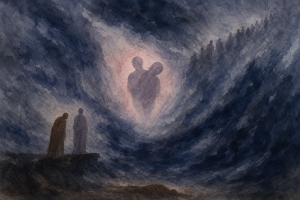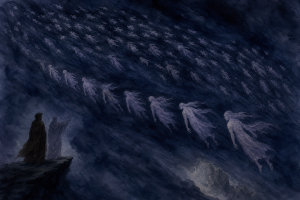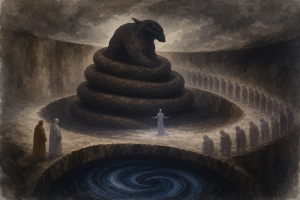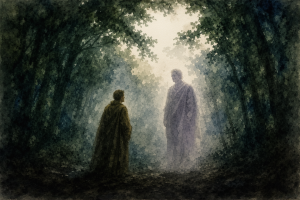
Virgil answers the question Dante hasn’t yet asked out loud — who are these souls? — and in the course of explaining admits, almost in passing, that he is one of them; then, asked whether anyone has ever left Limbo for good, he tells the only story in the poem of a rescue, describing its author only as "a mighty one," never by name.
Inferno · Canto 4 · Lines 31–63 · Scene 11
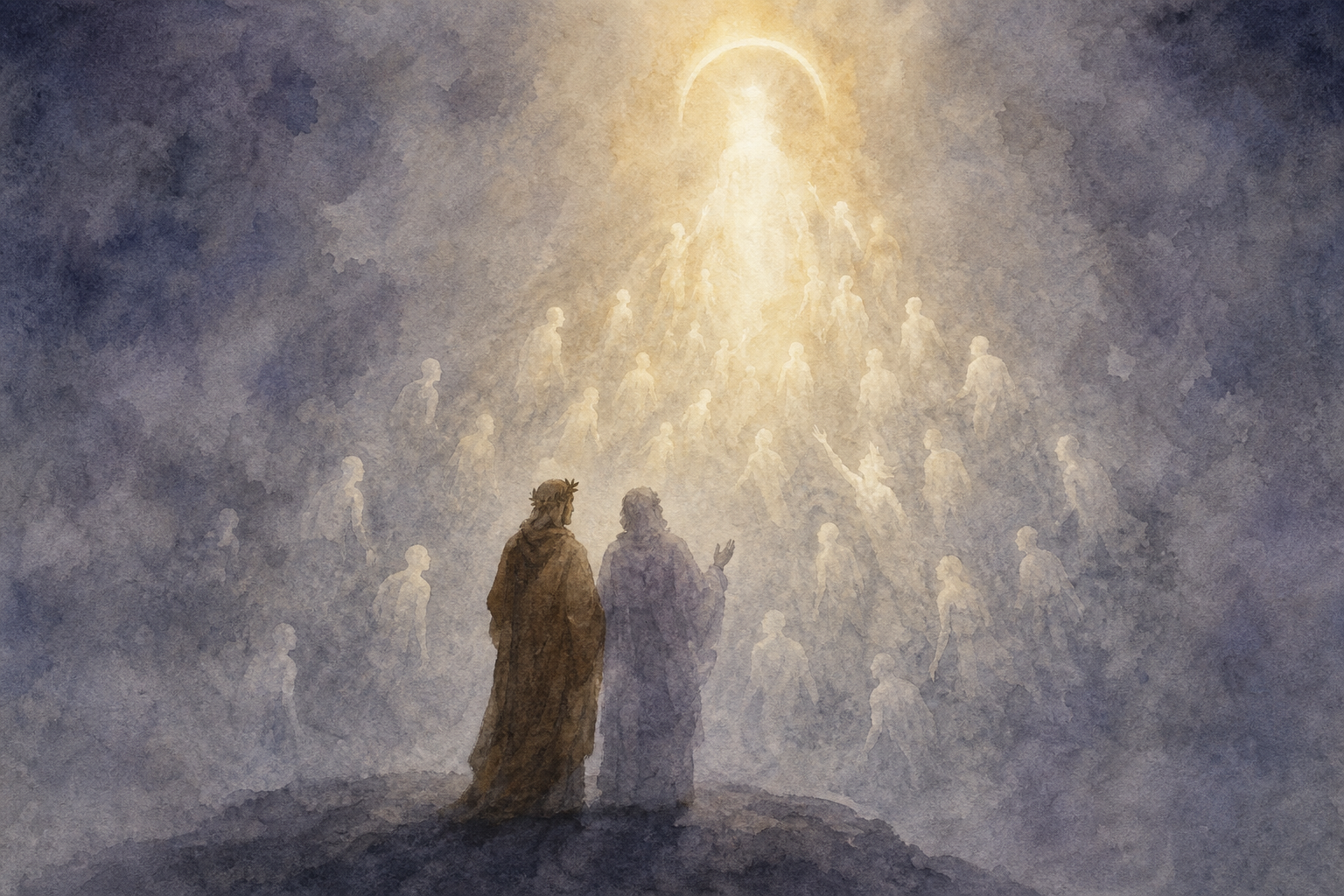
Virgil finally answers the question Dante has been too polite to ask out loud: who are all these people? He reads it off Dante’s face before Dante can say a word. These souls did nothing wrong, he explains — that’s the entire point of the place. Their only failing is that they never received baptism, which is the door into the faith Dante believes, and if they lived before Christianity existed at all, they never had the chance to worship God the right way. Then Virgil adds something Dante wasn’t expecting: for exactly this reason, and no other, we are lost — and I myself am one of these. Not a comparison. A plain confession, delivered as flatly as everything else he’s just said. Dante is hit hard by this, but notice what actually does the hitting: not Virgil’s admission by itself, but the moment right after, when he starts recognizing names and realizes that people of enormous worth are stuck in this circle forever. So he asks the question that’s really been on his mind: has anyone ever gotten out of here — by their own effort, or by someone else’s? Virgil says yes, once. Soon after he arrived in Limbo himself, he watched a powerful figure descend into Hell, crowned like the winner of a contest, and pull certain souls out for good: Adam, Abel, Noah, Moses, Abraham, King David, Jacob with his father and his sons, Rachel, and many others. He made them blessed. Then Virgil adds the detail that lands hardest of all: before that one visit, no human soul, ever, had been saved. And here’s the thing worth sitting with — in this entire speech, describing the most important rescue in the history of the world, Virgil never once says who did the rescuing. He calls him "a mighty one." That’s all he calls him.
The Italian — Virgil’s Confession
Source: Wikisource (public domain, pre-1929 text)
Lines 31–33
31. Lo buon maestro a me: «Tu non dimandi32. che spiriti son questi che tu vedi?33. Or vo’ che sappi, innanzi che più andi,
literary key: Line 32 — Virgil answers a question Dante has not asked, reading it off his face — a mirrored gesture: in the previous scene Dante read Virgil’s pallor and misjudged it, now Virgil reads Dante’s silence and judges it correctly. [Model knowledge · high]
translation note: Line 33 — ‘innanzi che più andi’ — before you go further. Virgil frames the explanation that follows as necessary orientation, not digression: understanding must precede continued movement through the circle. [Model knowledge · medium]
Lines 34–36
34. ch’ei non peccaro; e s’elli hanno mercedi,35. non basta, perché non ebber battesmo,36. ch’è porta de la fede che tu credi;
theology: Line 34 — ‘ch’ei non peccaro’ — they did not sin. The defining doctrinal claim of the whole circle: innocence, not transgression, explains their placement, distinguishing Limbo structurally from every circle that follows. [Model knowledge · high]
theology: Line 36 — ‘porta de la fede’ — the door of the faith. Standard medieval sacramental language for baptism as entry-point; Limbo’s population is defined by a missing sacrament, not a moral failing. [Model knowledge · medium]
Lines 37–39
37. e s’e’ furon dinanzi al cristianesmo,38. non adorar debitamente a Dio:39. e di questi cotai son io medesmo.
theology: Line 38 — ‘non adorar debitamente a Dio’ — did not worship God duly. The qualifier is precise: it does not deny the pre-Christian dead worshipped God at all, only that their worship lacked the completeness revelation supplies — a formulation generous enough to antiquity that commentators from the Ottimo Commento onward return to it repeatedly. [Model knowledge · medium]
literary key: Line 39 — ‘e di questi cotai son io medesmo’ — and of just such as these am I myself. The confession arrives with no rhetorical preparation, in the same flat declarative register as the doctrine that precedes it — the emotional peak of the passage delivered as plainly as a definition. [Model knowledge · high]
Lines 40–42
40. Per tai difetti, non per altro rio,41. semo perduti, e sol di tanto offesi42. che sanza speme vivemo in disio».
theology: Line 40 — ‘Per tai difetti, non per altro rio’ — for such defects, not for other guilt. ‘Rio’ (crime, guilt) is explicitly denied; ‘difetti’ (defects, lacks) is the operative word, distinguishing privation from transgression as the basis of the sentence. [Model knowledge · high]
literary key: Line 42 — ‘sanza speme vivemo in disio’ — without hope we live in longing. The canonical formula for Limbo’s punishment, spoken in the first-person plural present tense by a permanent resident describing an ongoing condition, not a sentence handed down once and finished. [Model knowledge · high]
Lines 43–45
43. Gran duol mi prese al cor quando lo ‘ntesi,44. però che gente di molto valore45. conobbi che ‘n quel limbo eran sospesi.
literary key: Line 43 — ‘Gran duol mi prese al cor’ — great grief seized my heart. Note the object of the grief: not fear, and not pity for Virgil specifically — Dante is moved by a category (‘gente di molto valore’) before any individual name has been supplied to him. [Model knowledge · medium]
vocabulary: Line 45 — ‘sospesi’ — suspended. The verb that gives Limbo its structural motion: hanging, neither ascending nor descending, matching the ‘sanza speme… vivemo in disio’ condition Virgil has just described. [Model knowledge · medium]
Lines 46–48
46. «Dimmi, maestro mio, dimmi, segnore»,47. comincia’ io per volere esser certo48. di quella fede che vince ogne errore:
literary key: Line 46 — The doubled address ‘maestro mio… segnore’ — my master, my lord — is a higher register than Dante typically uses with Virgil, signaling the emotional weight of the question he is building toward. [Model knowledge · medium]
theology: Line 48 — ‘quella fede che vince ogne errore’ — that faith which conquers every error. Dante prefaces his question with a declaration of orthodoxy before asking something that edges toward doctrinal risk, as his own next line acknowledges by calling the question ‘veiled.’ [Model knowledge · medium]
Lines 49–51
49. «uscicci mai alcuno, o per suo merto50. o per altrui, che poi fosse beato?».51. E quei che ‘ntese il mio parlar coverto,
theology: Line 49 — ‘o per suo merto / o per altrui’ — by his own merit or another’s. The question tests two possibilities that sit uneasily inside settled doctrine: salvation earned retroactively by an individual soul, or salvation granted through someone else’s intercession, either of which complicates the finality Limbo has just been described as having. [Model knowledge · medium]
translation note: Line 51 — ‘il mio parlar coverto’ — my veiled speech. Dante-poet’s own retrospective label for what he had just asked; the pilgrim knows, even as he asks it, that the question needs cover. [Model knowledge · high]
Lines 52–54
52. rispuose: «Io era nuovo in questo stato,53. quando ci vidi venire un possente,54. con segno di vittoria coronato.
history: Line 52 — ‘Io era nuovo in questo stato’ — I was new to this condition. Virgil dates his own arrival: since Virgil died in 19 BCE and tradition dates the Harrowing to Christ’s death around 33 CE, ‘new’ spans roughly fifty years, quietly suggesting how little duration means inside Limbo. [Model knowledge · medium]
literary key: Line 54 — ‘con segno di vittoria coronato’ — crowned with the sign of victory. The poem’s entire physical description of the rescuer: a crown and an emblem of triumph, no face, no name. [Model knowledge · high]
Lines 55–57
55. Trasseci l’ombra del primo parente,56. d’Abèl suo figlio e quella di Noè,57. di Moïsè legista e ubidente;
cultural ref: Line 55 — The roll call begins with ‘il primo parente’ — the first parent, Adam — and draws on the apocryphal Harrowing of Hell tradition (Gospel of Nicodemus / Descensus ad Inferos), non-canonical in origin but standard in medieval liturgy and art, which the poem treats as settled fact rather than as contested source material. [Model knowledge · medium]
vocabulary: Line 57 — ‘legista e ubidente’ — lawgiver and obedient. A doubled epithet for Moses, giving him both his historical office (author of the Law) and his moral character (obedience) in four words. [Model knowledge · medium]
Lines 58–60
58. Abraàm patrïarca e Davìd re,59. Israèl con lo padre e co’ suoi nati60. e con Rachele, per cui tanto fé,
cultural ref: Line 60 — ‘per cui tanto fé’ — for whom he did so much. A compressed allusion to Genesis 29: Jacob’s fourteen years of labor to marry Rachel, assumed here as common knowledge rather than explained. [Model knowledge · medium]
literary key: Line 59 — The names pile without connective tissue — patriarch, king, father and sons, wife — generating the momentum of a long line rather than a set of isolated portraits. [Model knowledge · low]
Lines 61–63
61. e altri molti, e feceli beati.62. E vo’ che sappi che, dinanzi ad essi,63. spiriti umani non eran salvati».
theology: Line 63 — ‘spiriti umani non eran salvati’ — no human spirits had been saved. The hardest single line in the passage: not one soul, of any merit, entered blessedness before this one event — closing off the possibility that Old Testament righteousness alone was ever sufficient. [Model knowledge · high]
literary key: Line 62 — The scene ends on this negative universal claim rather than on the Harrowing’s positive image — the doctrinal severity, not the triumph, is left as the last note before the poem turns outward to the noble castle in the following scene. [Model knowledge · medium]
Seven Centuries of Reading Virgil’s Confession
The Medieval Commentators: Theology First
Pietro Alighieri, writing in the 1340s, treated the passage as a lesson in sacramental necessity. For Pietro, the phrase “non ebber battesmo” settled the question quickly: unbaptized souls lack the grace that opens paradise, and Virgil’s inclusion among them was simply correct doctrine made visible. The emotional weight of the scene — Virgil speaking of himself, in the first person, as lost — drew Pietro’s attention far less than the theological framework it illustrated.
Boccaccio’s lectures on this canto, delivered in Florence around 1373, moved somewhat differently. Boccaccio lingered on the humanity of the moment. Virgil’s words “son io medesmo” — and I myself am one of these — struck him as a remarkable act of poetic self-disclosure. He noted the sorrow Dante the pilgrim feels, and he connected that sorrow to the reader’s own experience of admiring great minds who lived before Christ. The scene, for Boccaccio, belonged as much to literature as to theology.
Benvenuto da Imola, in his Latin commentary (Lacaita edition, 1887), was more clinical. He catalogued which virtuous pagans Dante placed in Limbo and cross-referenced them against patristic sources on the fate of the unbaptized. Benvenuto did notice Virgil’s circumlocution — “un possente” rather than any name — but he explained it briefly, as classical decorum, and moved on. The Ottimo Commento took a similar institutional line: the scene demonstrated that natural virtue, however admirable, cannot substitute for faith.
Renaissance and Early Modern Readers: The Poet Steps Forward
Humanist readers of the fifteenth and sixteenth centuries began to separate Virgil-the-character from Virgil-the-Latin-poet, and the results were not always comfortable. Cristoforo Landino‘s influential 1481 commentary read Virgil allegorically as human reason. Virgil’s confession of limitation became not a personal tragedy but a philosophical statement: reason, unaided, reaches only so far. The silence around “un possente” registered as reason’s structural ceiling, not one soul’s grief.
Later commentators in the sixteenth century tended to systematize further. Bernardino Daniello and Alessandro Vellutello both emphasized Dante’s doctrinal correctness. They praised the passage for its orthodoxy. The scene’s interior drama — a great poet saying ‘e di questi cotai son io medesmo’ (39), counting himself among the lost — receded behind the question of whether Dante had represented church teaching accurately. He had, they agreed, and that settled it.
The Nineteenth Century: Emotion Reclaimed
Francesco De Sanctis, writing in the 1860s, broke sharply with the doctrinal tradition. The power of the passage was precisely its feeling: the pilgrim’s grief at learning that Virgil is lost is one of the Commedia‘s most humanly true moments. Dante-the-poet had, he argued, placed theology in tension with love — and the tension, not the doctrine, was the literary achievement. The Romantic tradition he helped to establish would read Limbo as a space of beautiful, irretrievable melancholy.
This reading had consequences. If what mattered was the emotion, then Virgil’s periphrasis “un possente” became less interesting as a theological datum and more interesting as an expressive gesture — the voice of a man who cannot quite say the name of the one who left him behind. De Sanctis did not develop this fully, but he opened the door.
Twentieth-Century Criticism: Three Competing Frames
Charles Singleton‘s theological reading, developed across his Commedia studies in the 1950s and 1960s, returned emphasis to the sacramental structure. Limbo is not a sentimental place but a precise doctrinal location, he argued, and Virgil’s account of the Harrowing confirms salvation’s logic. The omission of a name pointed upward: what Virgil could not say was what the whole poem would spend two more canticles approaching.
Erich Auerbach offered a different lens. Dante’s figural method makes each soul in the Commedia simultaneously historical and eternal — the person they truly were, now fixed. Virgil in Limbo is the historical Publius Vergilius Maro, genuinely lost, genuinely speaking. His circumlocution is then not a device but a fact of character: this particular man, shaped by this particular history, narrating an event he witnessed but could not fully comprehend.
Teodolinda Barolini pushed in a different direction. Dante, she argued, constructed Virgil as a secular poet whose limits mirror his own anxiety about poetry’s claims. The confession is Dante staging — and partly disavowing — his deepest literary model. Virgil’s “sanza speme vivemo in disio” becomes a line Dante put in his master’s mouth to define what Dante himself refused to accept as his own fate.
The Passage Today: Questions the Poem Keeps Open
Seven centuries of glosses now sit stacked on “un possente,” and Columbia’s Digital Dante makes the disagreements visible side by side: where Pietro and Benvenuto converge, where De Sanctis diverges, where Singleton and Barolini are simply answering different questions. The resource does not adjudicate; it maps.
The live scholarly debate still centers on two problems. First: is “un possente” Virgil’s personal incapacity, or is it the first instance of a silence that holds across all of Inferno, where the name never appears regardless of speaker? Second: does the poem distinguish between those two possibilities at all? Dante’s text gives no narrator’s gloss, no clarifying aside. The ambiguity appears to be load-bearing. Whether it was designed, or whether it simply arrived with the structure of the poem, is itself a contested claim — and the argument continues.
The Two Main Positions on Virgil’s Confession
Virgil’s Bounded Speech
The periphrasis belongs to Virgil specifically. Having just confessed, in his own voice, that he is lost for failing to worship God ‘debitamente’ — duly, completely — he then narrates the one event that put God’s completeness beyond doubt, yet cannot bring himself, or is not permitted by the poem’s logic, to supply the name. The omission is read as continuous with his confession: the deficiency he names in himself at line 39 is the same deficiency that empties his account of the Harrowing of its central word.
Key passage: Inf. IV.39, ‘e di questi cotai son io medesmo,’ sits thirteen lines before the unnamed ‘possente’ of IV.53 — both spoken in the same unbroken speech, by the same soul, about the same theological gap.
The Canticle’s Law
The silence is not personal to Virgil but structural to the whole of Hell. The name ‘Cristo’ never appears anywhere in Inferno — not in Virgil’s mouth, not in any damned soul’s, not in the poet-narrator’s own — and first enters the poem only in Purgatorio, reserved in Paradiso to rhyme exclusively with itself. On this reading, Virgil’s periphrasis here simply supplies Hell’s first occasion for a rule that would have applied to any speaker describing this event from inside Inferno’s geography, independent of Virgil’s particular history.
Key passage: The total absence of any form of ‘Cristo’ across the entirety of Inferno’s cantos, contrasted with the word’s appearance beginning in Purgatorio — a lexical pattern noted across the commentary tradition rather than confined to this single passage.
What the Text Does — and What That Means (Contested)
On the page: The rescuer in IV.52–60 is named only by apposition and pronoun, never by proper name, across the full description of his descent and its effects. The word ‘Cristo’ does not occur anywhere in the text of Inferno, in any voice. The confession ‘e di questi cotai son io medesmo’ (IV.39) comes only moments before the unnamed rescuer’s description, inside the same uninterrupted speech.
What scholars dispute: Whether the missing name in this passage specifically dramatizes Virgil’s own confessed deficiency, or is better explained as the canticle’s opening instance of a rule that has nothing to do with who is speaking, is not settled by the text — both readings are compatible with every word on the page, and the poem gives no stage direction distinguishing a personal inability from a structural law.
What Dante Leaves Unresolved
The poem never distinguishes a private inability from a public law. ‘Un possente’ is exactly as legible as the wound of one soul’s specific failure as it is as the first sentence of a silence that will hold for the rest of the canticle — and Dante gives readers no line, no gloss, no narratorial aside that tips the balance either way.
The Open Question
Across nine lines describing the single most consequential rescue in the poem’s theology, Virgil never names the one who performed it — calling him only ‘a mighty one, crowned with the sign of victory.’ Is that silence Virgil’s personal limit, the mark of a soul who cannot say the name he failed to worship duly in life, or is it the first instance of a rule governing all of Inferno, in which the name of Christ never appears at all, regardless of who is speaking?
Explore More
About This Article

Written by Lucy Bamboo. Lucy Bamboo has been reading the Divine Comedy for fifteen years — first in translation, then stubbornly in Medieval Tuscan with a dictionary and far too many footnotes. Reading Dante is her scene-by-scene walk through the poem: the original Italian, seven centuries of scholarly argument presented as argument rather than answer, and the human questions sitting underneath the theology. More about this site.
Verify this against a primary source
Specifics change, and your situation may differ from the one described here. These are the authorities worth checking directly:
- Digital Dante, Columbia University — text, commentary and translation apparatus
- Princeton Dante Project — the Commedia with historical commentary
- Dartmouth Dante Project — searchable commentary from 1322 onward