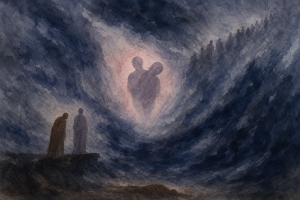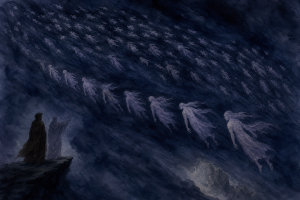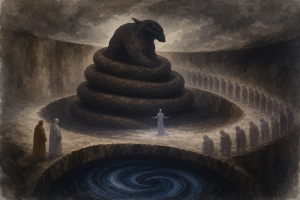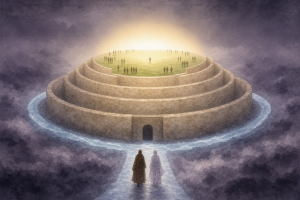
Driven back down toward the darkness by the wolf, Dante cries out to the first shape he sees — not knowing whether it is a man or a shade — and the answer changes the poem: the voice belongs to Virgil, dead for thirteen centuries, who names the beast, prophesies its destroyer, and offers Dante the only way forward: not past the wolf, but through Hell itself.
Inferno · Canto 1 · Lines 61–136 · Scene 3
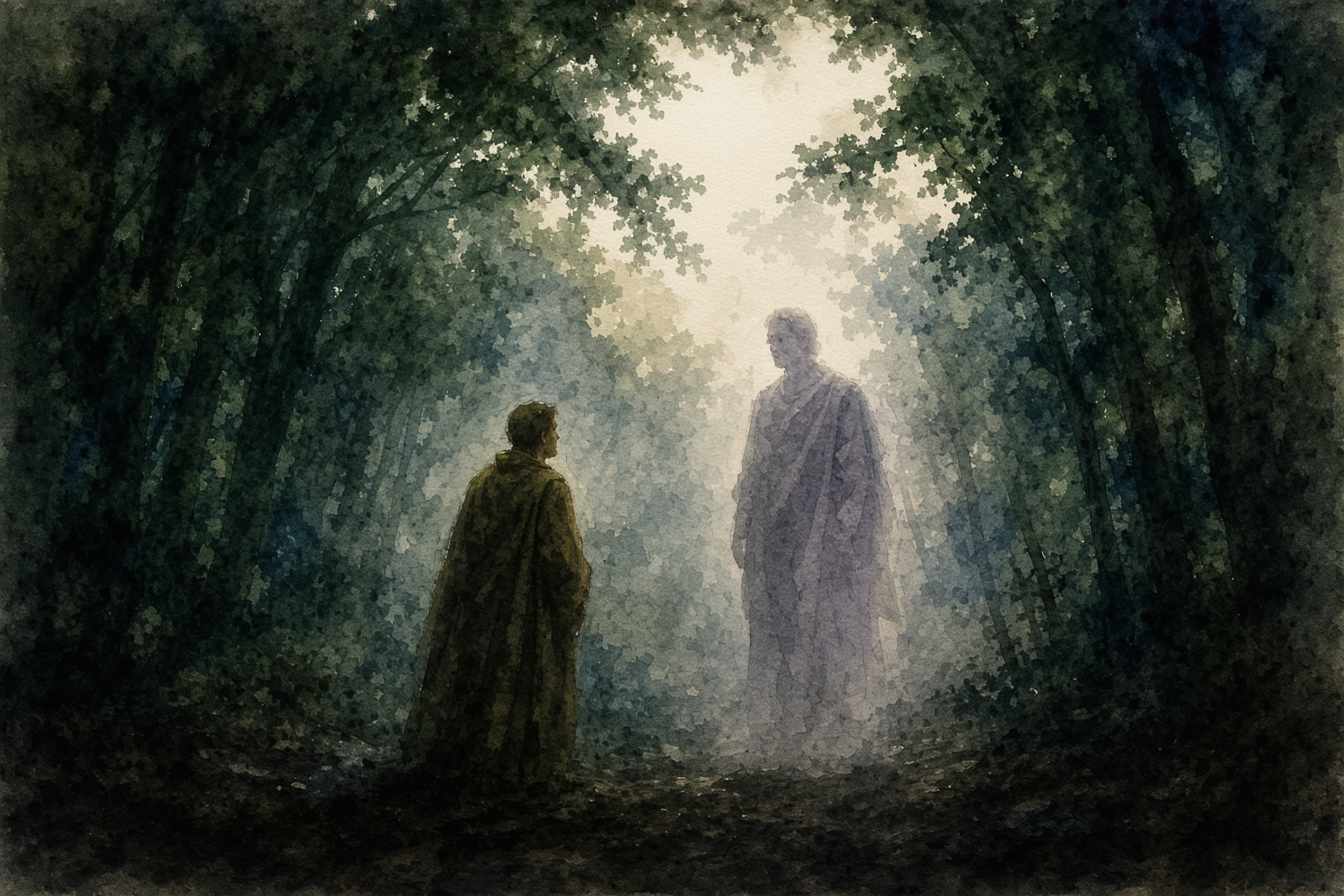
In the darkest moment — driven back into the forest, all hope of the hill gone — Dante sees something. A figure. Dim, barely visible, as if it hadn’t spoken in a very long time. Dante cries out: whoever you are, shadow or man, have mercy on me. The figure answers: not a man — not anymore. Once, yes. A poet. Born in Mantua, wrote in Latin, sang of Aeneas and the founding of Rome. Dante recognizes him immediately. It’s Virgil. His teacher. The poet he studied for years, whose every line he knows. He calls him ‘my master and my author.’ And Virgil, seeing Dante weeping, makes him an offer: not the hill — that path is blocked. But another way. Through the worst of it first. Through the place of eternal pain, then up through the mountain of purgation. At the top, someone else will take over — someone Virgil cannot follow. Dante says yes.
The Italian — The Shade of Virgil
Source: Wikisource (public domain, pre-1929 text)
Lines 61–63
61. Mentre ch’i’ rovinava in basso loco,62. dinanzi a li occhi mi si fu offerto63. chi per lungo silenzio parea fioco.
translation note: Line 63 — ‘per lungo silenzio parea fioco’ — who seemed faint through long silence. Virgil’s first quality is not his appearance but his voice: dimmed, attenuated by centuries of not being read or heard. A shade made faint by historical neglect — the opposite of the she-wolf’s relentless presence. [Model knowledge · high]
Lines 64–66
64. Quando vidi costui nel gran diserto,65. ‘Miserere di me’, gridai a lui,66. ‘qual che tu sia, od ombra od omo certo!’
theology: Line 65 — ‘Miserere di me’ — Have mercy on me. The opening words of Psalm 51 (the Miserere), the great penitential psalm of David after his sin. Dante’s first words to Virgil are a cry drawn from Scripture — addressed to a pagan shade who cannot fulfill their full theological weight. The prayer lands in the wrong place and still begins the journey. [Model knowledge · high]
Lines 67–69
67. Rispuosemi: ‘Non omo, omo già fui,68. e li parenti miei furon lombardi,69. mantovani per patria ambedui.
translation note: Line 67 — ‘Non omo, omo già fui’ — Not a man; a man I once was. Virgil’s self-introduction turns on tense: past tense for his humanity, present tense for his shade. The gap between ‘was’ and ‘am’ is the gap between the living and the dead — and between the ancient world and Dante’s present. [Model knowledge · high]
Lines 70–72
70. Nacqui sub Iulio, ancor che fosse tardi,71. e vissi a Roma sotto ‘l buono Augusto72. nel tempo de li dèi falsi e bugiardi.
history: Line 70 — ‘sub Iulio, ancor che fosse tardi’ — under Julius Caesar, though it was late. Virgil was born in 70 BCE when Julius Caesar was a young man. ‘Though it was late’ acknowledges the historical proximity to the Incarnation he missed: born under the world-empire that would carry Christ’s birth, but too early. [Model knowledge · high]
translation note: Line 72 — ‘nel tempo de li dèi falsi e bugiardi’ — in the time of the false and lying gods. Virgil’s own judgment on the religion he served and celebrated in the Aeneid. He does not defend it. This retrospective condemnation is Dante’s invention — there is nothing like it in Virgil’s actual writing. [Model knowledge · high]
Lines 79–81
79. ‘Or se’ tu quel Virgilio e quella fonte80. che spandi di parlar sì largo fiume?’,81. rispuos’ io lui con vergognosa fronte.
translation note: Line 79 — ‘quella fonte / che spandi di parlar sì largo fiume’ — that spring which pours forth so broad a river of speech. Dante’s image for Virgil’s poetic authority is hydraulic: a source, a fountain, a broad river. The metaphor places Dante downstream — his own writing as a channel fed from Virgil’s original spring. [Model knowledge · high]
translation note: Line 81 — ‘vergognosa fronte’ — blushing brow. Dante blushes with shame or awe — the Italian word covers both. This physical detail is the only moment of physical self-consciousness in the scene. Dante, who will go on to judge emperors and popes, blushes before his literary master. [Model knowledge · medium]
Lines 82–84
82. ‘O de li altri poeti onore e lume,83. vagliami ‘l lungo studio e ‘l grande amore84. che m’ha fatto cercar lo tuo volume.
translation note: Line 82 — ‘onore e lume’ — honor and light. Dante addresses Virgil as the source of both reputation and illumination for all other poets. The pairing matters: honor is social recognition, lume is cognitive clarity. Virgil is both admired and clarifying — a model of achievement and a way of seeing. [Model knowledge · high]
Lines 85–87
85. Tu se’ lo mio maestro e ‘l mio autore,86. tu se’ solo colui da cu’ io tolsi87. lo bello stilo che m’ha fatto onore.
translation note: Line 85 — ‘Tu se’ lo mio maestro e ‘l mio autore’ — You are my master and my author. One of the most quoted lines in the Comedy. ‘Autore’ in medieval Italian carries the weight of ‘authority’ as well as ‘author’: an auctor is not just a writer but a source of canonical truth. Dante is attributing to Virgil a kind of textual authority that his own poem will ultimately inherit and exceed. [Model knowledge · high]
translation note: Line 87 — ‘lo bello stilo che m’ha fatto onore’ — the beautiful style that has brought me honor. Dante’s boast, placed in a moment of reverence, is also a statement of poetic succession: the style is Virgil’s, but the honor it has already generated is Dante’s own. The pupil names the source and implicitly announces the achievement. [Model knowledge · high]
Lines 94–96
94. ché questa bestia, per la qual tu gride,95. non lascia altrui passar per la sua via,96. ma tanto ‘mpedisce che l’ancide;
translation note: Line 96 — ‘tanto ‘mpedisce che l’ancide’ — she impedes so much that she kills. The she-wolf is not merely an obstacle but a cause of death. This escalates what the scene showed — Dante being driven back — into a statement of ultimate consequence: the path she blocks leads, if stayed on, to destruction. [Model knowledge · high]
Lines 97–99
97. e ha natura sì malvagia e ria,98. che mai non empie la bramosa voglia,99. e dopo ‘l pasto ha più fame che pria.
wordplay: Line 99 — ‘dopo ‘l pasto ha più fame che pria’ — after eating she is hungrier than before. The clearest statement of insatiability as the she-wolf’s defining nature. This is not hunger that eating relieves but hunger that eating intensifies — a structure of desire that is its own punishment. Virgil’s diagnosis of the she-wolf is more precise than anything in Dante’s own terrified encounter with her. [Model knowledge · high]
Lines 100–102
100. Molti son li animali a cui s’ammoglia,101. e più saranno ancora, infin che ‘l Veltro102. verrà, che la farà morir con doglia.
history: Line 101 — The Veltro — the greyhound — is one of the most debated proper nouns in all of medieval literature. Medieval readers proposed Cangrande della Scala (whose name means ‘great dog’), Henry VII, a reformed papacy, and others. Modern scholars have added Dante himself as the Veltro in a self-referential reading. The identification has never been settled. [Model knowledge · high]
Lines 103–105
103. Questi non ciberà terra né peltro,104. ma sapïenza, amore e virtute,105. e sua nazion sarà tra feltro e feltro.
wordplay: Line 103 — ‘terra né peltro’ — land nor silver (pewter). The Veltro will not be fed by territorial ambition or wealth — the two hungers that define corrupt secular and ecclesiastical power. His food is wisdom, love, and virtue (line 104). This distinguishes him from every power that fed the she-wolf. [Model knowledge · high]
history: Line 105 — ‘tra feltro e feltro’ — between felt and felt. One of the Comedy’s most contested phrases. Interpretations include: between two towns named Feltre/Feltro (in northern Italy), between two humble felt garments (suggesting low birth), between two astrological signs (Gemini, symbolized by felt), or deliberately obscure. The obscurity may be intentional — a prophecy that names the savior without naming him. [Model knowledge · medium]
Lines 112–114
112. Ond’ io per lo tuo me’ penso e discerno113. che tu mi segua, e io sarò tua guida,114. e trarrotti di qui per loco etterno;
translation note: Line 114 — ‘per loco etterno’ — through the eternal place. Hell named by its defining quality before it is named directly. Eternal not as timeless but as permanent — the opposite of Purgatory, which is temporary. Virgil offers the descent as the only available road, not as punishment. [Model knowledge · high]
Lines 124–126
124. ché quello imperador che là sù regna,125. perch’ i’ fu’ ribelle a la sua legge,126. non vuol che ‘n sua città per me si vegna.
theology: Line 125 — ‘perch’ i’ fu’ ribelle a la sua legge’ — because I was rebel to his law. Virgil’s disqualification from Paradise is framed as rebellion, but the rebellion is not sinful choice — it is historical accident. He was born before the law existed in its Christian form. The word ‘ribelle’ makes the condition sound like defiance; the context reveals it as mere chronology. This ambiguity runs through every reading of Virgil’s fate. [Model knowledge · high]
Lines 133–135
133. che tu mi meni là dov’ or dicesti,134. sì ch’io vegga la porta di san Pietro135. e color che tu fai cotanto mesti.’
theology: Line 134 — ‘la porta di san Pietro’ — the gate of Saint Peter. In context this refers to the gate of Purgatory (described in Purgatorio IX), not to Heaven. Dante’s final line of Canto I ends with a reference forward, not upward: the goal named is the threshold of conversion, not the destination. The journey is framed from the beginning as threshold-crossing, not arrival. [Model knowledge · high]
Seven Centuries of Reading The Shade of Virgil
The Medieval Commentators: Reason, Authority, and the Ancient Poet
The earliest readers of this passage reached quickly for allegory. Pietro Alighieri, writing in the mid-fourteenth century, identified the figure who appears before his father as human reason — the rational faculty that guides us toward understanding but cannot, on its own, reach God. This interpretation felt natural to medieval readers trained in Scholastic theology. Reason illuminates; grace transforms.
Boccaccio, in his Esposizioni, brought a warmer and more literary eye. He dwelt on the emotional texture of the meeting — Dante’s awe, the trembling declaration of debt in lines 79–90. Boccaccio heard those lines as genuine feeling, not merely allegorical furniture. The ancient poet mattered to Dante personally, not just philosophically.
Benvenuto da Imola, in his Latin commentary edited by Lacaita in 1887, pressed both registers simultaneously. He read the figure as reason and as the historical Virgil, the actual Latin poet whose Aeneid Dante had studied. For Benvenuto, the scene works precisely because the allegory and the biography cannot be separated. The Ottimo Commento took a similar line, emphasizing the guide’s embodiment of philosophical wisdom earned through long human effort.
Renaissance Shifts: From Allegory Toward History
Humanist readers of the fifteenth and sixteenth centuries grew restless with purely allegorical approaches. They were recovering classical texts, admiring classical Latin, and reading Virgil directly. That context changed what they saw in Dante’s tribute.
For many Renaissance commentators, the ancient poet represented something more historically specific than a faculty of the mind. He stood for the achievement of classical civilization as a whole — its rhetoric, its poetry, its moral philosophy. The lines “tu se’ lo mio maestro e ‘l mio autore” (you are my master and my author) read less like a diagram of rational psychology and more like a Renaissance scholar’s declaration of intellectual inheritance.
This shift did not erase the allegorical reading. It ran alongside it. But the balance tipped: the historical Virgil, the Latin poet from Mantua, grew more visible as the period’s own investment in antiquity deepened.
The Nineteenth Century: De Sanctis and the Elegiac Encounter
Francesco De Sanctis, writing in the 1860s and 1870s, argued that the Scholastic allegory had obscured what was most alive in the poem. He wanted readers to feel the scene before they explained it. The meeting between the two poets was, for De Sanctis, genuinely elegiac — a moment where Dante stages the encounter between the ancient world and the Christian world, and mourns what the ancient world could not know.
De Sanctis insisted that Dante’s admiration in these lines is not ornamental. It is the admission that classical civilization accomplished something real and irreplaceable, and that its representative can guide the living man through Hell and up the mountain, but cannot follow him into the light. That limitation is a loss, not merely a doctrinal boundary.
The Romantic tradition more broadly shared this instinct. It recovered what medieval allegory had sometimes smoothed over: the pathos of the ancient guide who cannot enter Paradise. Later in the poem, at Purgatorio XXX, Dante turns to find this guide gone, and calls out his name in grief, calling him “my salvation” — salute — the same word the poem uses for Christian redemption. De Sanctis took that moment as the emotional key to the whole relationship, planted here at the first meeting.
The Twentieth Century: Three Competing Frameworks
Charles Singleton read the scene through rigorous Thomistic theology. The ancient guide represents the natural intellect at its highest reach — a capacity that is real and valuable, but structurally incomplete. Singleton argued this was not Dante’s personal sentiment but a doctrinal architecture deliberately built into the poem. The guide’s limit is not a tragedy; it is a precise theological boundary.
Erich Auerbach approached the passage differently. His concept of figural realism held that the historical person of Virgil — the actual Latin poet, with his actual biography — is not dissolved into allegory but fulfilled by it. The figure is both the Roman poet and something more than himself. Both are real simultaneously. Auerbach argued that this double reality is Dante’s most original achievement.
Teodolinda Barolini pushed hardest against theological readings. She argued that Dante constructs his guide’s authority so carefully, and the tribute in lines 79–90 so warmly, that the poem creates a secular poetic lineage operating alongside the Christian narrative — and sometimes in tension with it. The ancient guide does not simply illustrate a doctrine. He represents a competing claim about what poetry can do and who can lead.
Reading the Scene Today
Digital Dante and other scholarly platforms now make the full history of commentary searchable in ways earlier readers could not imagine. That access has sharpened, rather than settled, the central questions. Scholars can now trace precisely how each generation read the passage — and the disagreements remain productive.
Live questions include: Is the use of salute at Purgatorio XXX — Dante calling this guide his “salvation” — an intentional ambiguity or an accident of Italian usage? Does the tribute in lines 79–90 represent Dante’s genuine feeling, a rhetorical performance, or both? And what does it mean that the guide prophesies the Veltro — a mysterious deliverer — whose identity Dante never clarifies?
The passage remains, after seven centuries, one of the most argued-over encounters in European literature. Readers keep returning to it because Dante placed a question inside the tribute: how much can the greatest human achievement — without grace, without revelation — actually see?
The Two Main Positions on The Shade of Virgil
Medieval allegorical
Virgil is human reason — the highest capacity of the natural mind, available to all people through the philosophical tradition. As reason, he can illuminate Hell (understanding sin) and guide the climb of Purgatory (practicing virtue) but cannot enter Paradise, because the beatific vision requires grace, which reason alone cannot generate. This reading, standard from the earliest commentators through Benvenuto da Imola and into modern Thomistic readings, maps the entire journey onto the soul’s ascent: reason carries us to the threshold of faith; faith (Beatrice) carries us the rest of the way.
Key passage: Inf. I.91–93 — ‘A te convien tenere altro viaggio’ (you must take another road) — Virgil proposes the alternative journey as if reason itself is redirecting the will toward a more appropriate path
Humanist / literary-historical
Virgil is not ‘reason’ but the classical tradition itself — the greatest human achievement prior to Christianity. His limit is not the limit of a faculty but the limit of a historical moment: he preceded the Incarnation and therefore lacks not intelligence but revelation. This reading, developed by De Sanctis and extended by Mazzotta and others, treats Dante’s tribute to Virgil in lines 79–90 as genuinely elegiac: Dante is staging the encounter between antiquity and Christianity, honoring what classical civilization accomplished and mourning what it could not know.
Key passage: Inf. I.85 — ‘Tu se’ lo mio maestro e ‘l mio autore’ — Dante’s tribute names Virgil as literary origin, not as allegorical function
What the Text Does — and What That Means (Contested)
On the page: Dante places Virgil in Limbo — not Hell proper — among the virtuous pagans who lived before Christ (Canto IV). Virgil serves as guide through all of Inferno and Purgatorio but disappears at the summit of Purgatory when Beatrice arrives. Dante never has Virgil condemn his own condition or express regret; he accepts his limit without complaint.
What scholars dispute: Whether Virgil ‘represents’ human reason (the standard medieval allegorical reading), the classical literary tradition, natural virtue without grace, or something more personal and irreducible to allegory is one of the most contested questions in Dante studies. The ‘reason’ reading is a medieval shorthand. Barolini, Mazzotta, and Freccero each argue that the poem’s actual handling of Virgil exceeds and resists the neat category, and that his disappearance at Purgatory’s summit is an elegy as much as a structural necessity.
What Dante Leaves Unresolved
At Purgatorio XXX, when Beatrice arrives and Virgil has disappeared without farewell, Dante turns to look for him and weeps. He calls out ‘Virgilio a cui per mia salute diedi’ — Virgil to whom I gave myself for my salvation. The word ‘salute’ is the same word used for spiritual salvation throughout the Comedy. Whether Dante intended the ambiguity — calling Virgil his salvation in the poem about Christian salvation — is a question the text opens and does not close. Virgil’s vanishing is one of the poem’s most discussed silences.
The Open Question
Dante chooses a pagan poet as his guide through Hell and Purgatory — calls him ‘my master and my author,’ credits him with everything in his own poetry. Yet this same guide cannot enter Paradise. He is stopped not by sin but by birth: he existed before Christ. What does it mean when the best available human guide turns out to be constitutively unable to reach the destination?
Explore More
About This Article

Written by Lucy Bamboo. Lucy Bamboo has been reading the Divine Comedy for fifteen years — first in translation, then stubbornly in Medieval Tuscan with a dictionary and far too many footnotes. Reading Dante is her scene-by-scene walk through the poem: the original Italian, seven centuries of scholarly argument presented as argument rather than answer, and the human questions sitting underneath the theology. More about this site.
Verify this against a primary source
Specifics change, and your situation may differ from the one described here. These are the authorities worth checking directly:
- Digital Dante, Columbia University — text, commentary and translation apparatus
- Princeton Dante Project — the Commedia with historical commentary
- Dartmouth Dante Project — searchable commentary from 1322 onward