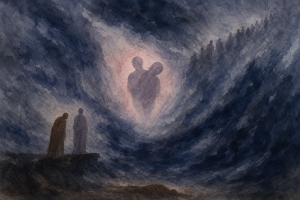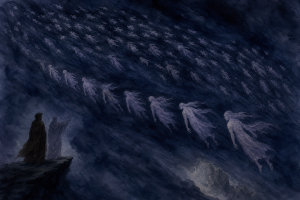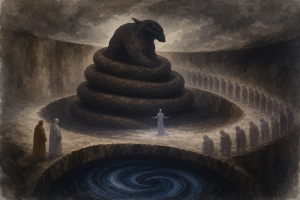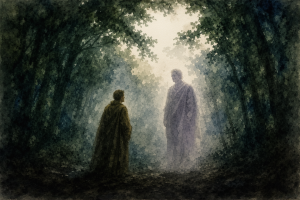
Canto 2 opens at nightfall — all creatures at rest, Dante alone still burdened — and immediately retracts the assent given at the end of Canto 1. He agreed to follow Virgil. Now he needs to know why he specifically should make this journey. Two precedents exist: Aeneas descended to serve the founding of Rome, Paul was taken up to authorize his apostolic mission. Dante can claim nothing comparable. ‘I am not Aeneas, I am not Paul’ — the disclaimer that follows has divided readers for seven centuries over what it actually is: genuine humility, rhetorical strategy, or both at once.
Inferno · Canto 2 · Lines 1–42 · Scene 4
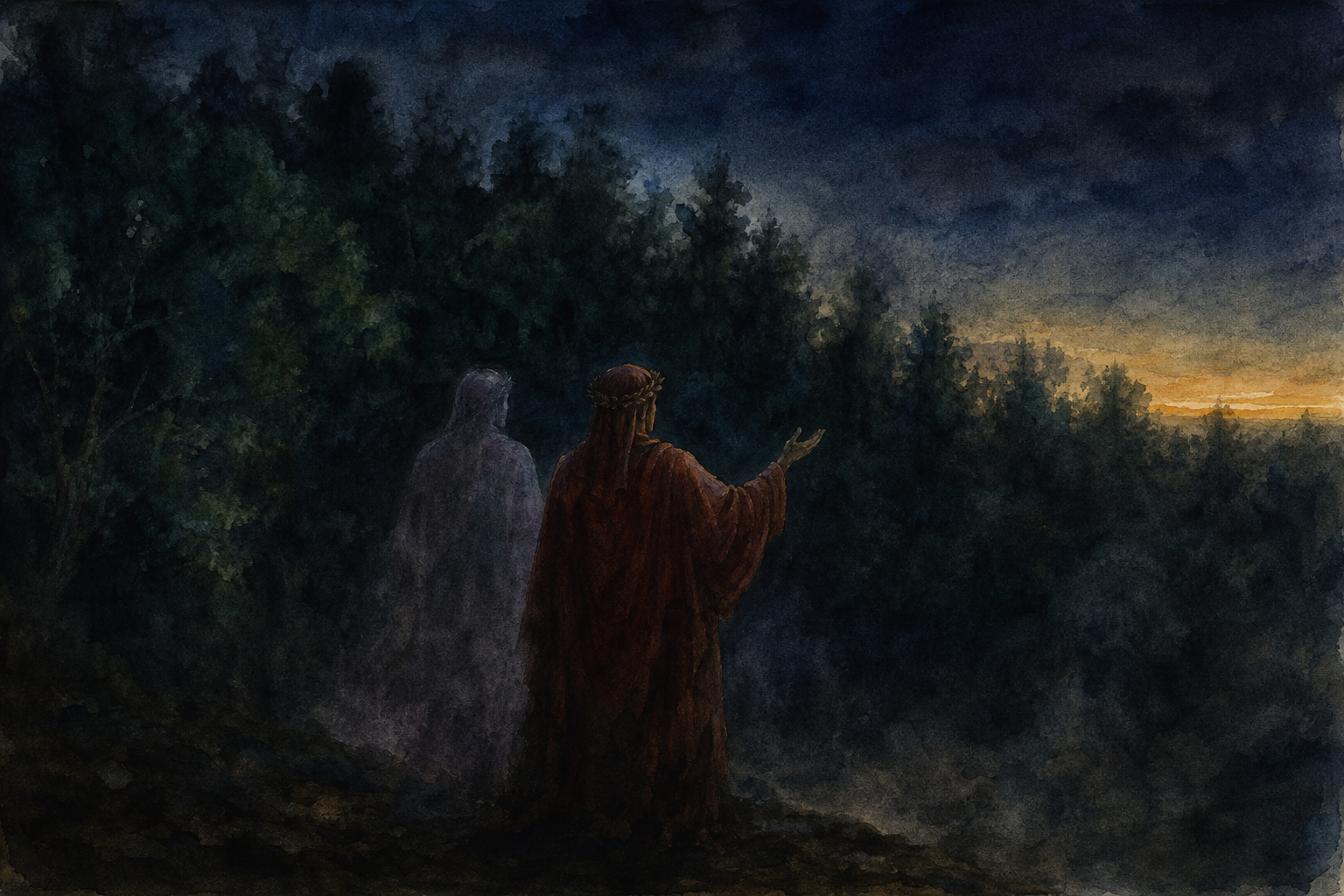
Dante stops. The interval between Virgil’s proposal and their departure has been enough for doubt to take hold. He raises the question of precedent: on what basis does a living man enter the realm of the dead and return? He identifies two cases. Aeneas descended to consult Anchises, and that journey served a providential purpose — the founding of Rome and, through Rome, the institution of the Church. Paul was taken up to Paradise, and what he witnessed there underwrote his apostolic mission. Each had a designated function; the journey followed from it. Dante can claim no equivalent standing. Examined directly, his situation looks not courageous but presumptuous — the word he reaches for is folle, mad or reckless. The assent he gave Virgil moments ago gives way under this pressure.
The Italian — Dante’s Doubt
Source: Wikisource (public domain, pre-1929 text)
Lines 1–3
1. Lo giorno se n’andava, e l’aere bruno2. toglieva li animai che sono in terra3. da le fatiche loro; e io sol uno
literary echo: Line 1 — The opening echoes Virgil’s Aeneid II and IV, both of which stage key scenes at nightfall. Dante places the Comedy in conscious relation to the epic tradition he is about to exceed. Night also signals transition in Biblical typology: darkness before revelation. [Model knowledge · high]
translation note: Line 3 — ‘e io sol uno’ — and I alone. The syntax isolates Dante from all creatures at rest: while the world sleeps, he alone remains awake and burdened. The isolation is existential before it is dramatic — he is uniquely tasked, though he does not yet know why. [Model knowledge · high]
Lines 7–9
7. O muse, o alto ingegno, or m’aiutate;8. o mente che scrivesti ciò ch’io vidi,9. qui si parrà la tua nobilitate.
literary echo: Line 7 — Classical epic invocation — compare Virgil’s ‘Musa, mihi causas memora’ (Aeneid I.8) and Homer’s opening call to the Muse. Dante doubles the address: both the classical Muses and his own memory are invoked, installing a new poetics where divine recall supplements pagan inspiration. [Model knowledge · high]
theology: Line 8 — ‘o mente che scrivesti ciò ch’io vidi’ — O memory that wrote down what I saw. Dante addresses his own memory as the medium of the poem. The Comedy claims to be a record of a vision, not a literary invention. This single line encodes Dante’s entire theory of poetic authority: he did not make the journey up; he is writing it down. [Model knowledge · high]
Lines 13–15
13. Tu dici che di Silvïo il parente,14. corruttibile ancora, ad immortale15. secolo andò, e fu sensibilmente.
literary echo: Line 13 — ‘di Silvïo il parente’ — the kinsman of Silvius: Aeneas, father of Silvius and son of Anchises. Dante names Aeneas by his family relationships rather than directly, placing him within a providential lineage. The descent to Avernus in Aeneid VI is Dante’s primary narrative model for the Comedy. [Model knowledge · high]
theology: Line 14 — ‘corruttibile ancora’ — still corruptible, still in a mortal body. This qualifier is the key: Aeneas descended in the flesh, as a living person, not as a shade. The same condition applies to Dante. This distinguishes both journeys from the ordinary experience of the dead and gives the living traveler’s journey its unique theological weight. [Model knowledge · high]
Lines 28–30
28. Andovvi poi lo Vas d’elezïone,29. per recarne conforto a quella fede30. ch’è principio a la via di salvazione.
theology: Line 28 — ‘lo Vas d’elezïone’ — the Vessel of Election: St. Paul, named by his title from Acts 9:15, where God calls him ‘a chosen vessel.’ Paul’s rapture to the third heaven (2 Corinthians 12:2–4) is the scriptural precedent Dante invokes alongside the classical one. Where Aeneas represents Roman civilization, Paul represents Christian mission — together the two pillars of Western history that Dante places before himself. [Source: Acts 9:15; 2 Corinthians 12:2–4; Singleton, Commentary]
Lines 31–33
31. Ma io perché venirvi? o chi ‘l concede?32. Io non Enea, io non Paulo sono;33. me degno a ciò né io né altri ‘l crede.
literary key: Line 32 — ‘Io non Enea, io non Paulo sono’ — the most-quoted line of Canto 2 and one of the most analyzed in the Comedy. By naming both classical and scriptural authority in a single negative sentence, Dante places himself in their exact company in the act of denying membership. Barolini (The Undivine Comedy, 1992) identified this as the Comedy’s founding rhetorical paradox: the disclaimer that structurally performs a claim. [Source: Barolini, The Undivine Comedy (1992); Hollander ad loc.]
translation note: Line 33 — ‘me degno a ciò né io né altri ‘l crede’ — neither I nor others believe me worthy of this. The line closes the disclaimer with a social dimension: not just Dante’s private doubt but what anyone would think. He preempts the judgment of readers who might find his claim presumptuous — by voicing that judgment himself. [Model knowledge · high]
Lines 37–39
37. E qual è quei che disvuol ciò che volle38. e per novi pensier cangia proposta,39. sì che dal cominciar tutto si tolle,
simile: Line 37 — The verb ‘disvuol’ — un-wills — is distinctive and rare. Will can actively undo itself, not merely weaken. This is not simply weakness of resolve but an interior contradiction: the will working against itself. Freccero (Dante: The Poetics of Conversion, 1986) read this as a precise Augustinian diagnosis — the condition of the will divided against itself that Augustine describes in Confessions VIII before his conversion. [Source: Freccero, Dante: The Poetics of Conversion (1986); Augustine, Confessions VIII]
Lines 40–42
40. tal mi fece ï’ in quella oscura costa,41. pensando, tanto ch’i’ avvilupai42. l’impresa che fu nel cominciar sì tosta.
vocabulary: Line 41 — ‘avvilupai’ — entangled, wrapped up, enveloped. The word suggests a web of second thoughts that the mind spins around itself. The ‘impresa’ (the enterprise) that had seemed so clear at the end of Canto 1 is now entangled beyond recognition. The thinking itself becomes the obstacle. [Model knowledge · high]
Seven Centuries of Reading Dante’s Doubt
Medieval Readings: Humility Before Grace
The medieval commentators read Dante’s hesitation as Christian. Pietro Alighieri treated the doubt as a necessary posture before a grace-driven mission: the soul must recognize its own insufficiency before Providence can act. Benvenuto da Imola saw in it a portrait of universal human weakness — the tendency to shrink before divine tasks. Boccaccio made a different observation: he argued that the invocation of the Muses in lines 7–9, which comes several lines before Dante names his unworthiness, signals deliberate literary ambition. The humility of lines 31–33 and the high claim of the invocation are, for Boccaccio, part of the same gesture. Only Boccaccio hinted the humility might be calculated; the rest of the early tradition largely accepted it at face value.
The Renaissance: A Rhetorical Move
Humanist readers in the fifteenth and sixteenth centuries reframed the scene. They were less interested in the theology of grace than in literary genealogy. For them, ‘Io non Enea, io non Paulo sono’ signaled Dante’s conscious positioning within a tradition — a modesty topos that placed him in the same sentence as his two great predecessors in the act of denying the comparison. They called it skilled; they did not yet call it paradoxical. What this reading also implied — that the disclaimer is a rhetorical device — created a new tension. If the modesty is performed, Dante is already asserting his authority even as he denies it. Renaissance commentators admired this move without pressing its implications.
De Sanctis and Psychological Realism
Francesco De Sanctis changed the reading entirely. For De Sanctis, the doubt was not rhetorical posture but psychological document — a portrait of Dante’s own crisis of confidence before the magnitude of his undertaking. The Romantic tradition read this interpretation eagerly. Nineteenth-century readers wanted a Dante who hesitated genuinely, who felt the weight of the thing. What this reading risked was collapsing the careful literary construction into personal confession, treating the opening of Canto 2 as autobiography rather than art.
Singleton, Auerbach, and the Paradox of the Disclaimer
Charles Singleton brought the theological reading to its most rigorous form. He argued that the hesitation is spiritually precise: Dante lacks the supernatural certitude that Aeneas and Paul possessed, and Beatrice’s intercession supplies exactly what is missing. The doubt is real, the cure is grace, and the passage records a specific movement of the soul. Erich Auerbach offered a complementary account: Dante’s uncertainty is both historical and figural, both the particular crisis of a particular man and the type of every soul confronting its own unworthiness.
Teodolinda Barolini‘s reading changed the conversation most sharply. She identified what she called the paradox of the disclaimer: by placing himself in the same sentence as Aeneas and Paul, Dante performs the claim he denies. ‘Io non Enea, io non Paulo sono’ is structurally a petition for inclusion in that company. The Comedy that follows is the proof: Dante does go where they went, does see what they saw, does write it down with divine authorization. The disclaimer was always a prologue to assertion. The passage remains, after seven centuries, genuinely open.
The Two Main Positions on Dante’s Doubt
The Genuine Humility Reading
Dante’s hesitation is authentic Christian kenosis — the necessary emptying of self-confidence before a grace-driven mission can begin. He does not yet know why he has been chosen. The doubt is the precondition for the revelation Virgil is about to deliver: that three blessed women have intervened on his behalf. Without genuine uncertainty, there is no real conversion — only performance.
Key passage: ‘l’anima tua è da viltate offesa’ (your soul is struck by cowardice, line 45) — Virgil treats the hesitation as a genuine spiritual failure requiring diagnosis and cure, not as a rhetorical move to be decoded.
The Paradox of the Disclaimer (Barolini and others)
The line ‘Io non Enea, io non Paulo sono’ is structurally a claim, not a denial. By positioning himself between Aeneas and Paul as a third candidate for consideration, Dante implicitly argues for his own comparable stature. The humility and the boast are the same gesture. The entire poem that follows — which does precisely what the disclaimer denies — is the proof that the disclaimer was always a prologue to assertion.
Key passage: ‘Io non Enea, io non Paulo sono’ (line 32) — ‘I am not Aeneas, I am not Paul’ — the disclaimer that names both authorities in the act of denying kinship with them.
What the Text Does — and What That Means (Contested)
On the page: Dante invokes Aeneas by circumlocution (‘di Silvïo il parente’) and Paul by title (‘lo Vas d’elezïone’), assigns each a cosmic justification for their journey, and then denies having any comparable justification. The simile of lines 37–42 applies to his own state: a man who changes his mind and ‘entangles’ the enterprise that had so recently seemed clear.
What scholars dispute: Whether the hesitation is psychologically real (a genuine crisis of unworthiness that Beatrice’s intercession resolves) or rhetorically calculated (a disclaimer that implicitly claims the authority it denies) is among the most contested questions in Dante studies. Singleton read it as genuine spiritual preparation; Barolini as literary performance; Freccero as Augustinian acedia on its way to being cured by grace.
What Dante Leaves Unresolved
Line 32 — ‘Io non Enea, io non Paulo sono’ — sharpens the terms of the question Dante has just asked (line 31: ‘Ma io perché venirvi?’). By the end of Canto 2, the hesitation is resolved, the journey proceeds, and the poem happens. What stays open is the claim implicit underneath the disclaimer: what made Dante the third candidate, the one for whom Beatrice crossed from Heaven into Limbo? Virgil’s account explains the mechanism of intercession with precision. It doesn’t say why this particular man was the occasion for it. Dante doesn’t press the question. The Comedy that follows is, in one reading, the answer. But an answer given by the same person who asked it is not quite the same as an answer.
The other open thread is simpler and more persistent: whether Virgil’s account actually cures the doubt, or merely supplies information sufficient to override it. Freccero read the doubt as Augustinian acedia — the will divided against itself, requiring grace to heal rather than argument to persuade. Singleton read the intercession as exactly that grace, arriving through Virgil’s narrative. What neither reading settles is what, precisely, changes in Dante between lines 1–42 and the moment at the end of Canto 2 when he tells Virgil to lead the way. The recovery is decisive in the text. Its inner mechanism is not described.
The Open Question
Dante says he is not Aeneas, not Paul — and then writes a poem that goes where they went, sees what they saw, and claims divine sanction for every word. The hesitation is real at line 31. By the end of Canto 2 it is gone. What changed? Information arrived. Is that sufficient? Or is the readiness always there — the doubt a formal gesture the journey was always going to overrule?
Explore More
About This Article

Written by Lucy Bamboo. Lucy Bamboo has been reading the Divine Comedy for fifteen years — first in translation, then stubbornly in Medieval Tuscan with a dictionary and far too many footnotes. Reading Dante is her scene-by-scene walk through the poem: the original Italian, seven centuries of scholarly argument presented as argument rather than answer, and the human questions sitting underneath the theology. More about this site.
Verify this against a primary source
Specifics change, and your situation may differ from the one described here. These are the authorities worth checking directly:
- Digital Dante, Columbia University — text, commentary and translation apparatus
- Princeton Dante Project — the Commedia with historical commentary
- Dartmouth Dante Project — searchable commentary from 1322 onward