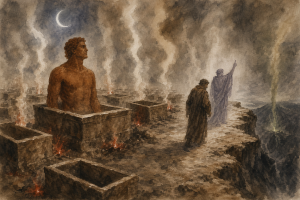
Dante’s Hell has nine circles. That much every list on the internet agrees on. Two things about those lists are usually wrong, and both of them matter if you are trying to actually read the poem rather than memorise it.
The first: the nine circles are not the seven deadly sins with two extra. Dante’s ordering comes from Aristotle by way of Aquinas, and it sorts sins by kind — appetite, violence, fraud — not by a catechism list. That is why heresy gets a circle and pride does not.
The second: not everyone in Hell is in a circle. The poem’s most famous crowd of the damned, the ones who “lived without blame and without praise,” are outside the count entirely.
The Nine Circles at a Glance
Every row below is anchored to the canto where Dante actually puts those souls. Where a circle is subdivided, the subdivisions are listed, because in the lower Hell the subdivision is where all the detail lives.
| Circle | Sin | Cantos | What is there |
|---|---|---|---|
| Vestibule — not a circle | Indifference | III | A blank banner they chase forever, on the near bank of the Acheron |
| 1 | Limbo — no baptism | IV | No torment at all; the Noble Castle, and the poets of antiquity |
| 2 | Lust | V | Minos judging at the entrance; an endless storm |
| 3 | Gluttony | VI | Cold filthy rain; Cerberus |
| 4 | Avarice and prodigality | VII | Two mobs shoving weights at each other; Plutus |
| 5 | Wrath and sullenness | VII–VIII | The marsh of the Styx; Phlegyas the ferryman |
| 6 | Heresy | IX–XI | Inside the iron walls of the city of Dis; open tombs under fire |
| 7 | Violence, in three rings | XII–XVII | Against others: a river of boiling blood. Against self: a wood of thorn trees. Against God: burning sand under falling fire |
| 8 | Fraud, in ten ditches | XVIII–XXX | Malebolge — ten concentric stone trenches, each with its own species of deceit |
| 9 | Treachery, in four zones | XXXII–XXXIV | Cocytus, a frozen lake, with Satan at the centre |
If you would rather be tested on this than read it, there is a fourteen-question quiz on the circles, with the line behind every answer.
Virgil Stops the Poem to Explain the Plan
Dante does not leave the architecture to be inferred. In Canto XI the two travellers sit down on the edge of the seventh circle to let their noses adjust to the stench coming up from below, and Virgil uses the pause to draw the map. It is the most openly structural passage in the Commedia.
His division is threefold. Above the walls of Dis lie the sins of incontinence — appetite that got away from its owner. Below lie the sins of violence and then of fraud, which Dante treats as worse because they involve not weak will but working intelligence. Of the seventh circle Virgil says:
cominciò poi a dir, “son tre cerchietti
di grado in grado, come que’ che lassi.
“Then he began to say: they are three little circles, rank below rank, like those you are leaving.” The three rings sort violence by its object — against one’s neighbour, against oneself, against God — and the third is where Dante puts blasphemers, sodomites, and usurers together, on the reasoning that each assaults God directly: in his person, in nature, or in the art by which nature is made to yield a living.
That last grouping is the one modern readers find hardest, and it is also the single most reliable way to catch someone who has only skimmed a list: usurers are not in the circle of the greedy. Lending at interest, for Dante, is not avarice. It is violence.
What Is Not in Any Circle
Before Dante reaches the first circle he crosses a stretch of Hell that has no number. Just inside the gate, in the dark, an enormous crowd runs after a banner with nothing written on it, stung by wasps and hornets. These are the people who took no side.
che visser sanza ‘nfamia e sanza lodo
“Who lived without infamy and without praise.” Heaven will not have them and Hell proper will not either — Virgil’s instruction is to look and move on. Then comes the Acheron, Charon, and only then the first circle.
So the honest answer to “how many levels does Dante’s Hell have” is: nine circles, plus a vestibule that is not one of them, plus the whole dark funnel of Malebolge and Cocytus subdivided into fourteen more compartments. Nine is the number of the frame, not the number of the places.
The nine, incidentally, is not an accident. Dante builds in threes and in squares of three throughout — a habit traced in his number obsession.
Upper Hell: Circles One to Five
The first circle, Limbo, is the strangest place in the Inferno, because nothing happens there. No wind, no rain, no demon. Its souls are there for something they lacked rather than something they did, and Virgil — asked to explain who they are — includes himself in the answer. He says so in the first person, which is one of the quietest and most devastating moments in the poem.
The second circle begins the punishments proper, and it begins with a bureaucrat: Minos, who hears each arriving soul’s confession and then coils his tail around himself to signal which circle it goes to. The whole machinery of sentencing is compressed into twenty-four lines. Past him, the lustful are blown about in a storm that never rests, and Dante stops to talk to two souls who get the most sympathetic hearing anyone in Hell receives.
The third is gluttony, under a rain Dante calls eternal, accursed, cold and heavy, with Cerberus flaying the souls and a Florentine named Ciacco sitting up out of the slush to prophesy the ruin of their city.
The fourth is the first circle to pair opposites. Hoarders and squanderers heave the same weights at each other, each shouting the other’s vice: Perché tieni? and Perché burli? — why hoard, why squander. Dante puts them in one place because to him they are one disorder read from either end.
The fifth pairs opposites too: the wrathful tearing at each other on the surface of the Styx, and the sullen submerged beneath it, gurgling a hymn they cannot get out of their throats. Phlegyas rows this water — not Charon, who belongs to the Acheron several cantos earlier, and who is the single most commonly confused figure in the poem.
The Wall: Where Hell Changes Character
Between the fifth circle and the sixth there is a wall, and the wall has a gate, and the gate is held shut against Virgil by devils. It is the only point in the journey where his authority fails outright. The Furies appear on the tower, Medusa is threatened, and the travellers are stuck until someone arrives from outside the system.
Dante never names the figure who comes. He crosses the marsh without getting his feet wet, opens the gate with a wand, and leaves without a word to either traveller:
Passava Stige con le piante asciutte
Seven centuries of commentary have proposed Mercury, an angel, Christ, and grace itself. The poem declines to say.
Inside is the sixth circle: the city of Dis, and the heretics in open sepulchres under fire. This is the circle whose placement scholars argue about most, because heresy fits neither the incontinence above nor the malice below — it is an error of the intellect about God, and Dante gives it the hinge position between the two halves of Hell. Farinata and Cavalcante rise from the same tomb here, in one of the poem’s great set pieces.
Lower Hell: Violence, Fraud, Treachery
The seventh circle runs for six cantos and three rings: a river of boiling blood patrolled by centaurs; a pathless wood in which the suicides have become thorn trees that bleed when broken; and a desert of burning sand with slow fire falling on it like snow.
The eighth is the longest stretch of the Inferno — thirteen cantos — and it has a name of its own:
Luogo è in inferno detto Malebolge
“There is a place in Hell called Malebolge” — evil pouches. Ten stone ditches in concentric rings, crossed by bridges, each holding a different species of fraud: panders and seducers, flatterers, simonists, diviners, corrupt officials, hypocrites in gilded lead, thieves, fraudulent counsellors, sowers of discord, and falsifiers. Ulysses burns in the eighth of them, and it is in the ninth that the poem finally says the word for its own logic out loud — contrapasso, the principle that makes every punishment a description of its sin.
The ninth circle is ice. Dante’s lowest Hell is not a furnace; it is a frozen lake, and the cold is generated by Satan’s own wings beating uselessly at the bottom of the universe. Its four zones are named for betrayers:
| Zone | Named for | Betrayers of |
|---|---|---|
| Caina | Cain | Their own kin |
| Antenora | Antenor of Troy | Their country or party |
| Ptolomea | Ptolemy | Their guests |
| Judecca | Judas | Their lords and benefactors |
Francesca already threatened her husband with the first of these, back in the second circle — Caina attende chi a vita ci spense, Caina awaits the man who took our life. It is the only time in the poem a soul in upper Hell names a place in lower Hell, and it is a reminder that Dante expects you to be holding the whole map in your head — she makes the claim in the same speech that argues love leaves nobody any choice.
In Antenora, Count Ugolino gnaws the skull of the archbishop who starved him and his sons to death — the darkest episode in the canticle.
At the Bottom
Satan is frozen into the ice at the waist, in the centre of the earth, at the point furthest from God in Dante’s universe. He has three faces on one head and six wings, and in each of his three mouths he chews a traitor: Judas head-first in the middle, Brutus and Cassius in the two beside.
He does not rule Hell. He does not speak. He weeps, and the wind from his wings is what keeps the lake frozen — the devil’s only activity in the entire poem is manufacturing his own prison. Dante’s final image of evil is not power but paralysis, and the travellers climb down his flank and out.
Why Nine?
Because nine is three squared, and three is the Trinity. Dante builds the whole Commedia on that arithmetic: three canticles, a hundred cantos (one plus thirty-three times three), terza rima in interlocking threes. Hell gets nine circles, Purgatory nine regions, Paradise nine spheres, and all three canticles end on the same word. The symmetry is the argument — a cosmos ordered all the way down, including the part of it that is in revolt.
Which is also why the vestibule is outside the count. The people who never chose have no place in a structure built out of choices.
Common Questions
Are the nine circles the seven deadly sins? No. Four of the seven — lust, gluttony, avarice, wrath — have circles, but sloth and envy and pride do not appear as circles at all, and heresy, violence, fraud and treachery are not on the deadly-sins list. Dante is using an Aristotelian division by kind of sin, not a penitential list.
Which circle is the worst? The ninth, treachery. Dante’s hierarchy puts cold betrayal of trust below violence and below fraud, because it corrupts the bond that makes society possible.
Is Limbo a circle of Hell? Yes — the first. It is inside the gate and across the Acheron, and it is in Hell by location even though nobody in it is punished. This trips people up because later theology moved Limbo’s status around; Dante’s poem is unambiguous about where it sits.
Where are the indifferent? In the vestibule, before the river, in no circle. Virgil tells Dante not to discuss them.
Where are the usurers? The seventh circle, third ring, with the blasphemers and sodomites — classified as violence against God, not as greed. Virgil explains the reasoning in Canto XI.
Is the bottom of Hell fire or ice? Ice. The ninth circle is a frozen lake, and Satan is embedded in it.
Reading It Rather Than Listing It
A map is useful for about ten minutes, and then the only thing that helps is the text. The canto-by-canto readings on this site work through the Inferno in order — the Italian tercet by tercet, what each line actually says, and where the translations quietly decide something for you.
About This Article

Written by Lucy Bamboo. Lucy Bamboo has been reading the Divine Comedy for fifteen years — first in translation, then stubbornly in Medieval Tuscan with a dictionary and far too many footnotes. Reading Dante is her scene-by-scene walk through the poem: the original Italian, seven centuries of scholarly argument presented as argument rather than answer, and the human questions sitting underneath the theology. More about this site.
Verify this against a primary source
Specifics change, and your situation may differ from the one described here. These are the authorities worth checking directly:
- Digital Dante, Columbia University — text, commentary and translation apparatus
- Princeton Dante Project — the Commedia with historical commentary
- Dartmouth Dante Project — searchable commentary from 1322 onward