Read any serious commentary on the Commedia and within a page you will hit a sentence like “the pilgrim pities Francesca, but the poet has placed her in Hell.” It sounds like a scholarly tic. It is not. It is the single most useful distinction anyone can hand you before you start reading, and the poem does not work without it.
There are two Dantes in the Divine Comedy, and they share a name, a body, a biography, and the pronoun io.
The Pilgrim and the Poet
Dante the pilgrim is the character inside the story: a frightened man of thirty-five who gets lost in a wood, is led underground by a stranger, and spends a hundred cantos having things explained to him. He does not know what is coming. He faints, weeps, argues, gets things wrong, and is repeatedly corrected.
Dante the poet is the man who writes all of that down years later, in exile, having already completed the journey and worked out what it meant. He knows the ending. He chose who goes where. He assigned the punishments.
Every line of the poem is spoken by the second about the first — in the past tense, which is the quietest and most important fact about the Commedia‘s construction. Nel mezzo del cammin di nostra vita / mi ritrovai: I found myself. Found, not find. The voice narrating has long since got out.
| Dante the pilgrim | Dante the poet | |
|---|---|---|
| Where | Inside the story, Easter 1300 | Outside it, writing c. 1308–1320, in exile |
| Knows | Only what he has been told so far | Everything, including his own exile |
| Can be | Wrong, frightened, taken in | The authority that shows him being wrong |
| Speaks to | Virgil, the dead | You |
The Poem Tells You, in So Many Words
Dante is not subtle about the second voice. Several times he stops the action and addresses the reader directly — something the character inside the story obviously cannot do. In Canto IX, with the Furies on the tower:
O voi ch’avete li ‘ntelletti sani,
mirate la dottrina che s’asconde
sotto ‘l velame de li versi strani.
“O you who have sound intellects, look at the doctrine hidden under the veil of these strange verses.” That is the poet, leaning out of the frame to tell you there is a reading you are meant to be doing. The pilgrim at that moment is standing on a riverbank being told to shut his eyes. The two voices are four lines apart.
Where the Gap Opens Widest: Pity
The clearest demonstration in the whole canticle is what happens to the pilgrim’s compassion, and what the poet does about it.
In Canto V he meets Francesca, hears her explain that love leaves nobody any choice, and is destroyed by it. The canto ends:
E caddi come corpo morto cade.
“And I fell as a dead body falls.” The pilgrim cannot take it. But note who put Francesca in the storm in the first place, and who wrote her a speech good enough to cause the collapse. The poet engineered his own undoing and then published it. The sympathy in Canto V is not a contradiction of the sentence — it is the poet showing you how hard the sentence is to accept, including for him.
Fifteen cantos later, among the diviners whose heads have been twisted backwards, the pilgrim weeps again, and this time Virgil turns on him:
“Ancor se’ tu de li altri sciocchi?
Qui vive la pietà quand’è ben morta;
chi è più scellerato che colui
che al giudicio divin passion comporta?”
“Are you still one of the other fools? Here pity lives when it is quite dead. Who is more wicked than one who brings passion to the divine judgement?” It is the harshest thing Virgil says to him in the Inferno.
And a few lines earlier in the same canto, the poet had turned to us about exactly this — di tua lezione, or pensa per te stesso, “from your reading, now think for yourself.” The pilgrim is being scolded for feeling; the reader is being told to work it out. Same canto, two voices, two entirely different jobs.
Whether Virgil is right is a separate and much-argued question — he is a guide, not an oracle, and the poem is not shy about his limits. But the structure is unmistakable: the character has to be taught the lesson that the author already knows.
The Exile Trick
The most audacious use of the split is prophecy. The poem is set in 1300. Dante was driven out of Florence in 1302 and never returned. So the poet can have the dead tell the pilgrim his future — and the pilgrim’s future is the poet’s past.
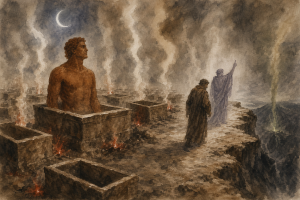
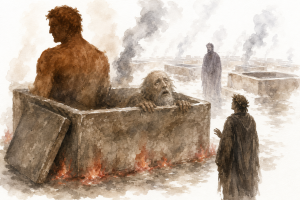
Farinata does it in Canto X, and because of how Dante arranges it, the line lands on the reader as a fact and on the character as a threat. The exile is foretold to a man who does not yet know by a poet who has already lived every year of it. The same device supplies Ciacco’s prophecy of Florence’s ruin in Canto VI.
Read it without the distinction and it is a bit of supernatural machinery. Read it with the distinction and it is a man in exile writing a scene in which he is warned, twenty years too late, by someone he put in Hell.
Why It Keeps Mattering
The practical use is this: when something in the poem seems to be in tension with itself, the question to ask is which Dante is responsible for it.
| When you notice… | Ask |
|---|---|
| A damned soul is sympathetic | Is this the pilgrim’s reaction, or the poem’s verdict? They are rarely the same. |
| A soul claims something about itself | The poet reports the claim. He does not thereby endorse it. |
| The narrator seems to admire someone in torment | Admiration and damnation are not mutually exclusive here — see Farinata, Brunetto, Ulysses. |
| Dante says “I” | Which one? Check the tense and check who is being spoken to. |
The three figures in that third row are the test cases. Farinata is magnificent and a heretic. Brunetto Latini is addressed with a tenderness Dante gives almost nobody, and he is in the third ring of the seventh circle. Ulysses gets one of the great speeches in European literature from inside a flame. In each case the pilgrim’s response and the poet’s sentence point in opposite directions, on purpose.
Flatten the two Dantes into one and you get a poem that is either incoherent or cruel. Keep them apart and you get what the Commedia actually is: a man judging his own earlier self, in public, at enormous length.
Where the Distinction Comes From
Readers have always sensed it, but the formulation that stuck was worked out in the 1950s by two critics approaching it from different directions. Gianfranco Contini described Dante as a personaggio-poeta — a character who is also the poet — and treated the doubling as the key to reading the poem’s first person. Charles Singleton, in Dante’s Commedia: Elements of Structure (Harvard, 1957) and the Dante Studies around it, built an account of the poem’s whole architecture on the distance between the two.
Since then it has become standard equipment, and the terms vary: pilgrim and poet, character and author, Dante personaggio and Dante autore, the pilgrim and the scribe. They all mean the same split.
Common Questions
What does “Dante the pilgrim” mean? It is the term critics use for Dante as a character inside the Divine Comedy — the traveller who journeys through Hell, Purgatory and Paradise — as distinct from Dante the poet, who wrote the poem afterwards and knows how it ends.
Are the pilgrim and the poet the same person? Historically, yes: both are Dante Alighieri. Narratively, no. The poem is told in the past tense by someone who has already finished the journey, about an earlier self who has not.
Why does it matter? Because the pilgrim’s reactions are not the poem’s judgements. Readers who treat them as identical conclude that Dante contradicts himself whenever he writes a sympathetic sinner.
Is the pilgrim a reliable narrator? The pilgrim is not the narrator. The poet narrates, and he is careful to show the pilgrim being mistaken — frightened in Canto II, overwhelmed in Canto V, rebuked in Canto XX.
Where is the distinction most visible? In Canto V, where the pilgrim faints at Francesca’s speech while the poet has placed her in the storm; and in Canto XX, where the pilgrim weeps and Virgil tells him his pity is a kind of wickedness.
Reading With Both in View
Every canto-by-canto reading on this site keeps the two apart, because the Italian often does: the tense shifts, the addresses to the reader, the moments where the narrating voice knows something the walking one does not. The pilgrim’s doubt in Canto II — Io non Enëa, io non Paulo sono, “I am not Aeneas, I am not Paul” — is the best place to start, because it is the one moment the character states his own unfitness for the poem the poet is about to write.
About This Article

Written by Lucy Bamboo. Lucy Bamboo has been reading the Divine Comedy for fifteen years — first in translation, then stubbornly in Medieval Tuscan with a dictionary and far too many footnotes. Reading Dante is her scene-by-scene walk through the poem: the original Italian, seven centuries of scholarly argument presented as argument rather than answer, and the human questions sitting underneath the theology. More about this site.
Verify this against a primary source
Specifics change, and your situation may differ from the one described here. These are the authorities worth checking directly:
- Digital Dante, Columbia University — text, commentary and translation apparatus
- Princeton Dante Project — the Commedia with historical commentary
- Dartmouth Dante Project — searchable commentary from 1322 onward