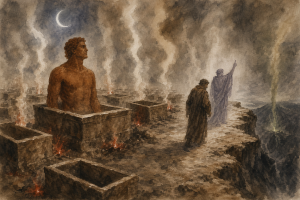
The Inferno ends on one line standing by itself, after thirty-four cantos underground:
E quindi uscimmo a riveder le stelle.
“And thence we came forth to see again the stars.” It is the last line of Canto XXXIV, line 139, and it is the first time the word “stars” has appeared since the gate. Dante has spent the entire canticle under a roof.
The Word That Does the Work
Riveder is ri- plus vedere: to see again. Not to see the stars — to see them a second time, after an interval in which they were lost. The whole emotional weight of the line sits in two letters, and they are two letters that English has a hard time attaching to “see.”
| Italian | Sense |
|---|---|
| E quindi | And from there — the exit, a round opening |
| uscimmo | we came out (first person plural, past) |
| a riveder | to see again, to behold once more |
| le stelle | the stars |
Two translators of the nineteenth century, both working in verse, both reaching for that prefix:
| Version | Inferno XXXIV.139 |
|---|---|
| Cary, 1814 | “Thus issuing we again beheld the stars.” |
| Longfellow, 1867 | “Thence we came forth to rebehold the stars.” |
Longfellow coins “rebehold” — a word that barely exists in English — rather than lose the prefix. Cary splits it off into a separate adverb, “again beheld,” which is better English and slightly weaker verse: the repetition stops being built into the verb and becomes a comment on it. Both translators understood that if you render the line as “and then we went out and saw the stars,” you have thrown away the poem’s last gesture.
What Comes Just Before
The line reads as a release because of what Dante puts in front of it. The two travellers have climbed down Satan’s flank, through the centre of the earth, and up a hidden passage:
salimmo sù, el primo e io secondo,
tanto ch’i’ vidi de le cose belle
che porta ‘l ciel, per un pertugio tondo.
E quindi uscimmo a riveder le stelle.
“We climbed up, he first and I second, until I saw some of the beautiful things the sky carries, through a round opening.” The sky arrives in pieces, through a hole, before the final line opens out onto all of it. Dante makes you squint before he lets you look up.
All Three Canticles End on the Same Word
This is the detail that turns a beautiful line into an architectural signature. Dante ends the Inferno, the Purgatorio and the Paradiso on the word stelle — and he does it by engineering the rhyme to land there each time.
| Canticle | Final line | Longfellow |
|---|---|---|
| Inferno XXXIV.139 |
E quindi uscimmo a riveder le stelle | “Thence we came forth to rebehold the stars.” |
| Purgatorio XXXIII.145 |
puro e disposto a salire a le stelle | “Pure and disposed to mount unto the stars.” |
| Paradiso XXXIII.145 |
l’amor che move il sole e l’altre stelle | “The Love which moves the sun and the other stars.” |
Look at the grammar of the three, in order. In the Inferno, the stars are something seen — an object recovered. In the Purgatorio, they are a destination: a salire a le stelle, to climb to them, with the pilgrim washed in Lethe and Eunoe and ready. In the Paradiso, they are no longer the point at all; they are the thing being moved, and the subject of the sentence is the love doing the moving.
Seen, approached, understood. The same word three times, and the relation to it changes completely each time. Dante is marking the stages of the journey with a single noun.
There is a technical nicety here too. In terza rima, a canto closes with a single line rhyming against the middle line of the final tercet. Dante sets up an -elle rhyme in all three places — belle in the Inferno, novelle in the Purgatorio, velle in the Paradiso — so that stelle can land as the closing rhyme every time. The coincidence is manufactured three cantos in advance, three times. Translators working in any approximation of the rhyme scheme have to solve it three times too.
Why Stars
Partly because of where they are. Hell has no sky; the stars are the first physical proof that the pilgrim has left it. Partly because of what they meant in 1300: the heavens were the visible, ordered, moving evidence of God’s governance, and the thing an astrologically minded fourteenth century read for the shape of a life.
And partly because the poem is about orientation. Dante gets lost in Canto I under a sky he cannot see, in a wood where the sun is blocked — the selva oscura — and the whole descent is a long way round to a position from which he can look up again. The last line of the Inferno is not a happy ending. It is a man getting his bearings back.
Common Questions
What does “riveder le stelle” mean? “To see the stars again.” It is from the last line of Dante’s Inferno: E quindi uscimmo a riveder le stelle — “and thence we came forth to see again the stars.” The prefix ri- carries the sense of return.
Where does the line appear? Inferno, Canto XXXIV, line 139 — the final line of the canticle, standing alone after the last tercet.
Do all three parts of the Divine Comedy end with “stelle”? Yes. Inferno XXXIV.139, Purgatorio XXXIII.145, and Paradiso XXXIII.145 all end on the word stelle, and the rhyme in each case is set up to make it land there.
Is it “riveder” or “rivedere”? Rivedere is the dictionary form; riveder is the apocopated form Dante uses to fit the hendecasyllable. They are the same verb.
What is the famous last line of the Paradiso? l’amor che move il sole e l’altre stelle — “the love which moves the sun and the other stars.” It is the last line of the whole Commedia.
Keep Reading
The word stelle and the design it marks out are followed across all three canticles in this companion piece on Dante’s star endings. For the descent that makes the line land, the canto-by-canto readings start in the dark wood.
About This Article

Written by Lucy Bamboo. Lucy Bamboo has been reading the Divine Comedy for fifteen years — first in translation, then stubbornly in Medieval Tuscan with a dictionary and far too many footnotes. Reading Dante is her scene-by-scene walk through the poem: the original Italian, seven centuries of scholarly argument presented as argument rather than answer, and the human questions sitting underneath the theology. More about this site.
Verify this against a primary source
Specifics change, and your situation may differ from the one described here. These are the authorities worth checking directly:
- Digital Dante, Columbia University — text, commentary and translation apparatus
- Princeton Dante Project — the Commedia with historical commentary
- Dartmouth Dante Project — searchable commentary from 1322 onward