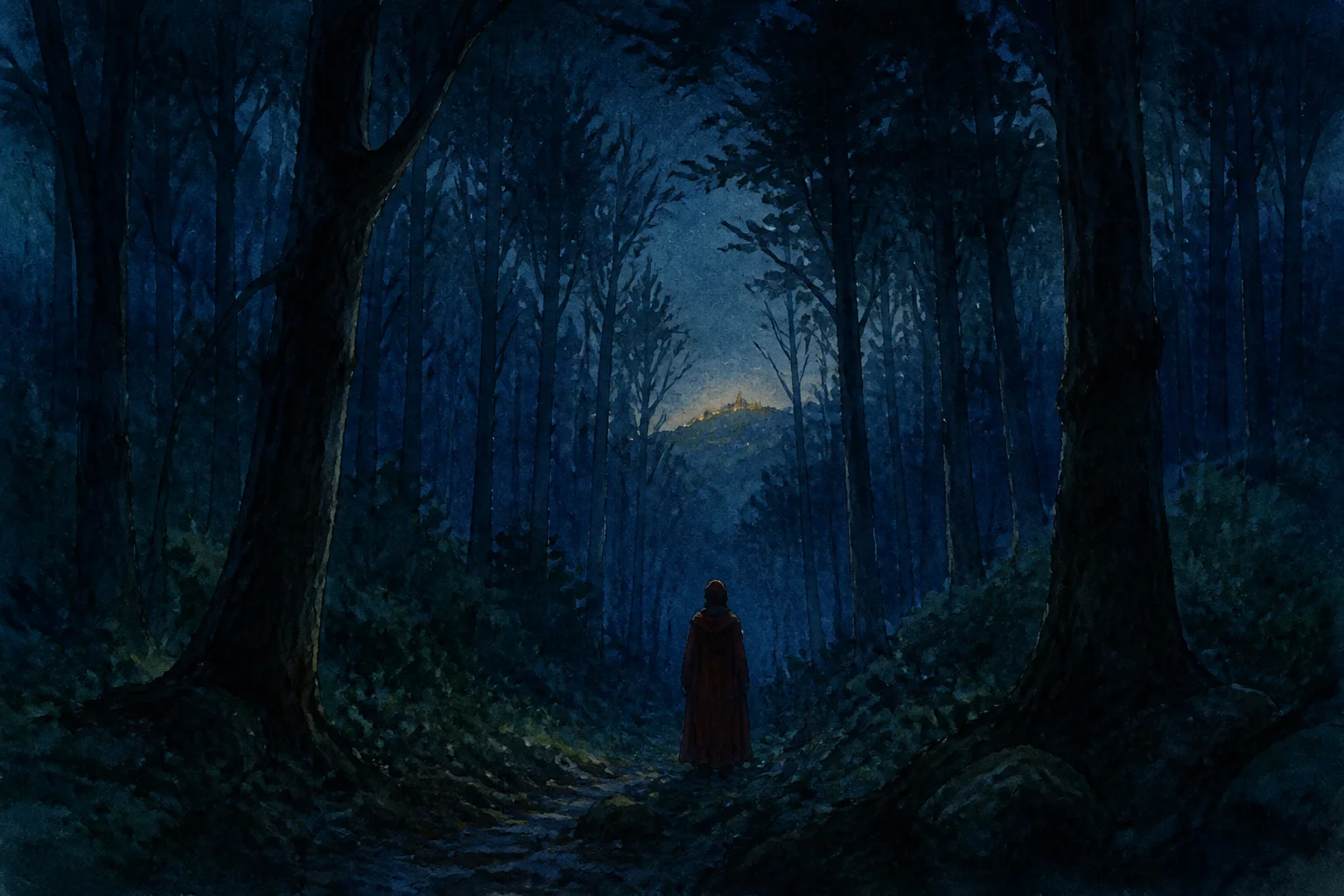
Nobody plans to end up in the dark wood. That’s what makes it a wood and not a road. You look up one ordinary afternoon and the path you were sure you were on is simply gone.
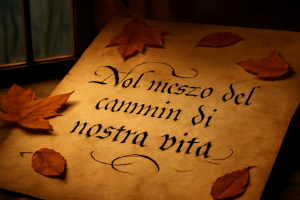
Dante’s first line announces this quietly, almost without ceremony: nel mezzo del cammin di nostra vita — midway through the journey of our life. Not his life. Ours. He implicates you from the first word. Whatever the dark wood is, Dante is telling you before he even describes it: you have been here, or you will be. The hook is that “our.” The poem reaches out and takes your hand before you’ve agreed to go anywhere.
The verb that follows is worth stopping on. Mi ritrovai — the reflexive past of ritrovare — carries both “I found myself” and “I found myself again,” a second meaning English loses almost entirely. The “again” implies a prior state: Dante was once oriented, once found, and has since become un-found. Every translation has to choose. Most give you “I found myself” and drop the “again.” What Dante’s Italian holds that English can’t quite carry is the suggestion that being lost is not a single rupture — a moment when everything changed — but the condition of someone who had been found and, through whatever accumulation of inattention, drifted. The verb already contains the essay’s whole argument: the dark wood is not where you ended up when you fell. It’s where you arrived when you stopped paying attention to the direction.
The Wood Is the Address, Not the Exception
We tend to think of disorientation as a detour — something that happens when you take a wrong turn, when you fail somehow, when you end up somewhere you should have avoided. Then there’s a corrective, and you find your way back, and the path continues.
Dante’s poem doesn’t allow this. He is thirty-five when the Comedy opens — not young, not old, midway through the biblical lifespan of seventy years. By any account he should know where he is. He’s a serious poet, a philosophical thinker, a man who has spent his adult life attending carefully to the good. And still. The path is gone.
What if losing the path isn’t a sign that you wandered off it, but a thing that happens because you were on one? What if the well-lived life doesn’t avoid the dark wood — it passes through it? The uncomfortable implication in Dante’s opening is that the crisis at the center of his poem is not an aberration. It is the terrain.
The First Thing Light Does Is Show You You’re Lost
Before Dante can move, he needs to see where he is. He has emerged from the wood’s interior — barely, with the fear still in his body like a man pulled from drowning water who cannot stop staring back at what nearly took him — and he looks up. A hillside. Dawn light on its shoulder. A planet that guides others straight on every road.
This is the first appearance of light in the Comedy. And notice what it does: it doesn’t rescue him. It orients him. Which is not the same thing, and not the relief we might want.
Orientation means you can see where you actually are. That’s useful. It’s also, often, the worst news. You thought you were closer than you are. You thought the damage was smaller than it is. Light as diagnosis before it is ever rescue. The light doesn’t comfort Dante — it shows him the hill he cannot reach and the distance between himself and it.
The Only Way Out Is Down
Here is what Dante actually tries. He sees the hill. He starts climbing. It is the natural response to a dark valley — move toward the thing catching light. And three beasts drive him back. A lonza (spotted, quick), a leone (rearing, roaring), a lupa (lean and hunger-wrecked) — desire, ambition, appetite in their animal forms. He cannot go over. The beasts push him back toward the wood.
Virgil finds him there. And Virgil — who functions in the poem as something like accumulated human wisdom, the best the ancient world could do — tells him the route.
It is down.
Through Hell. All the way down, past the violent and the fraudulent and the traitors, down to the frozen lake at the bottom where Lucifer is locked in ice. Down to the absolute center of the earth. And only then, from the far side of the lowest point, does the path curve back up toward the stars.
We tell each other to move toward the light. Dante’s poem says something stranger and harder: that sometimes the exit is at the bottom, and the only honest way through the dark is to go all the way into it. The hill lit with dawn is visible from the valley. But Dante cannot reach it by climbing straight toward it. He has to earn the ascent by completing the descent first.
This isn’t pessimism. It’s structure. The Comedy is arguing that you cannot shortcut past some forms of disorientation. You have to go through the territory of what you fear. Climb too soon and the beasts are waiting. There is only one way through, and it runs down.
Light Isn’t a Place. It’s a Direction.
What does Dante actually do with light, once he begins to reach it?
He doesn’t stop. Not in Hell, which ends: e quindi uscimmo a riveder le stelle — and from there we emerged again to see the stars. Not on the mountain of Purgatory, which ends: puro e disposto a salire a le stelle — pure and ready to rise to the stars. Paradise itself is no different, ending on l’amor che move il sole e l’altre stelle — the love that moves the sun and the other stars.
All three canticles end on the same word. Stars. Each time Dante arrives somewhere, the stars are already further up. The light is not a harbor. It is a direction.
This matters for the question we started with. “Where is the light” assumes a location — somewhere you could arrive, stand still, and finally be in it. Dante’s poem treats it differently. Light is the thing you keep facing. The orientation you have to re-establish after each descent. The pull that keeps the journey moving. You don’t get the light. You get to keep facing it.
That’s a harder answer than a destination. It is also, if you stay with it, a more honest one.
Who Walks with You in the Dark?
Dante doesn’t descend alone. Virgil goes ahead of him, shields him from the worst of it, explains what he sees, keeps him moving when he freezes in terror or grief or horror. The guide in the dark is not someone who has avoided the dark — it’s someone willing to go into it alongside you.
But here is what the poem insists on and does not soften: Virgil reaches a boundary. He can accompany Dante through Hell and up the mountain, but at the summit of Purgatory he has to stop. He cannot enter Paradise. Reason can take you through the dark. It cannot take you all the way. At some point something else has to guide.
What the poem is careful not to do is make this a failure. Virgil doesn’t stop because the journey proved too much for him or because he got something wrong. He stops because of what he is: the best human reason ever produced, a guide who has witnessed everything the human world contains. And still — constitutionally, by definition — he cannot cross into what comes next. What comes next is not more knowledge. It isn’t a better argument or a deeper philosophy. It’s something categorically different, something Dante names Beatrice and theologians name grace and secular readers tend to find the hardest part of the poem to accept. The limit of reason isn’t a bug in the architecture. It’s the architecture. The wisest guide you can find will take you as far as wisdom goes, and then you are standing at a threshold that wisdom built but cannot cross.
So the question of “where is the light” may turn out to be, at a certain depth, the wrong question. The question that matters more may be: who is willing to go down with you? And then, the harder one the poem leaves sitting in the air without answering: what do you do when even they have to stop?
About This Article

Written by Lucy Bamboo. Lucy Bamboo has been reading the Divine Comedy for fifteen years — first in translation, then stubbornly in Medieval Tuscan with a dictionary and far too many footnotes. Reading Dante is her scene-by-scene walk through the poem: the original Italian, seven centuries of scholarly argument presented as argument rather than answer, and the human questions sitting underneath the theology. More about this site.
Verify this against a primary source
Specifics change, and your situation may differ from the one described here. These are the authorities worth checking directly:
- Digital Dante, Columbia University — text, commentary and translation apparatus
- Princeton Dante Project — the Commedia with historical commentary
- Dartmouth Dante Project — searchable commentary from 1322 onward