
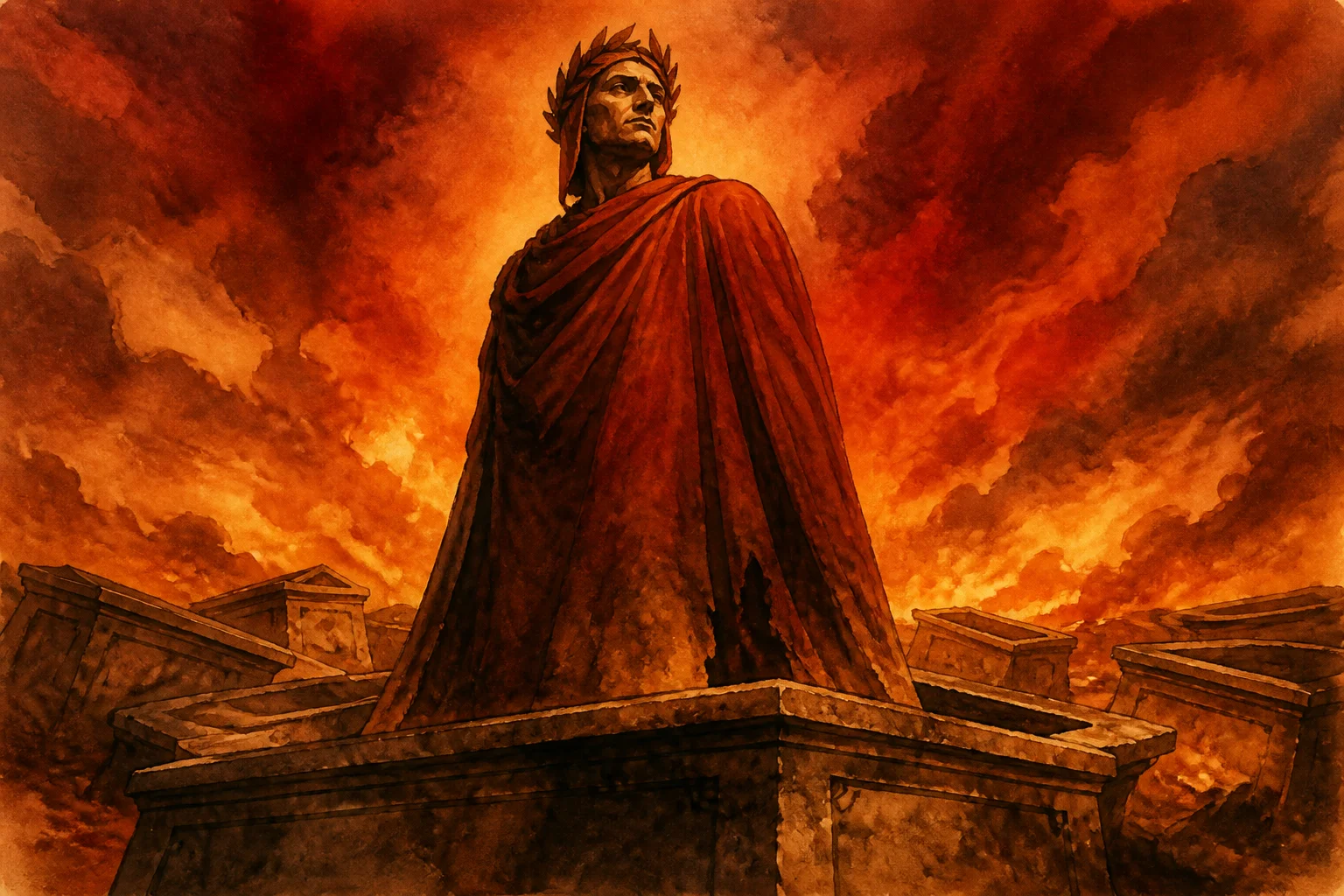
There are many memorable encounters in the Inferno, but few are as electrically charged as the moment in Canto X when a figure rises from a burning tomb to challenge Dante directly. He doesn’t ask for mercy. No weeping, no begging. He rises chest and brow erect — diritto s’ergea col petto e con la fronte — and within seconds he’s demanding to know about Dante’s politics.
This is Farinata degli Uberti. He is, in my view, one of the most extraordinary characters in all of the Commedia — a man so proud, so defined by his identity, that even hell cannot diminish him.
Who Was Farinata degli Uberti?
Farinata degli Uberti (c. 1212–1264) was the most powerful Ghibelline leader in Florence during the mid-thirteenth century. In a city perpetually torn between Guelph (pro-Papal) and Ghibelline (pro-Imperial) factions, Farinata was the Ghibelline strongman. He was feared, admired, and hated in roughly equal measure — depending entirely on which side you were on.
His defining moment came in 1260, when the Ghibellines, having been exiled from Florence, returned with a Sienese and German imperial force to fight the Florentine Guelphs at the Battle of Montaperti. The battle was a catastrophic Guelph defeat — one of the bloodiest in Tuscan history. The Arbia river, in Dante’s phrase, ran red with Guelph blood: fece l’Arbia colorata in rosso (Canto X, line 86).
After the victory, a Ghibelline council at Empoli proposed razing Florence entirely. Only Farinata objected. He stood alone against the council and refused — declaring that he had fought to return to Florence, not to destroy it. Florence was saved by its greatest enemy.
Farinata died in 1264, before Dante was born. But his family’s political legacy defined the world Dante grew up in, and the Inquisition later convicted his wife of heresy posthumously — formally condemning Farinata himself in 1283.
The Sixth Circle: Heresy
Farinata appears in the Sixth Circle of Hell, reserved for heretics. His specific heresy was Epicurean: he believed, with the followers of Epicurus, that the soul dies with the body — that there is no afterlife, no divine judgement, no resurrection. For the medieval Church, this was one of the gravest philosophical errors possible.
The contrapasso — Dante’s principle that each punishment mirrors the sin — is precise here. The Epicureans denied the soul’s immortality, so they suffer in tombs. The burning tombs are simultaneously their graves and their eternal location, making resurrection impossible for themselves within the poem’s logic. They are trapped in the very form of death they thought was final.
When Dante and Virgil walk through the Sixth Circle, the tombs are open — on the Day of Judgement, they will be sealed forever. Even now, they burn.
The Scene in Canto X
The canto begins with Dante asking Virgil if he can see the souls within the tombs. Almost as if summoned by the question, Farinata rises:
“O Tosco che per la città del foco / vivo ten vai così parlando onesto, / piacciati di restare in questo loco.”
“O Tuscan, you who walk alive through this city of fire, speaking so properly — be pleased to stay a moment here.”
The opening move is remarkable. Farinata identifies Dante as Tuscan from his speech — recognising a compatriot. He addresses him with a courtly formality (onesto, proper) that belongs to the world of civic life, not hell. He is not humbled by his location. He is, in a sense, hosting.
Virgil has to encourage him to speak.
What follows is a compressed political confrontation. Farinata immediately establishes that Dante’s ancestors were his enemies — the Uberti and Dante’s family (the Alighieri) were on opposite sides. Dante pushes back: his family was twice exiled, but twice returned. The Uberti, he pointedly notes, have not learned to do the same.
It’s a brutal exchange between two proud Florentines — and Farinata rises to it. Then a second soul appears from the same tomb: Cavalcante de’ Cavalcanti, father of Dante’s closest friend Guido. He asks why Guido is not here — and his question reveals something odd. Farinata and the heretics can see the future but not the present. Cavalcante misreads Dante’s hesitation and concludes, weeping, that Guido is already dead.
Farinata barely reacts. He simply continues his conversation with Dante as if the interruption hadn’t happened — explaining his vision, prophesying Dante’s exile, and then saying something extraordinary about his own situation in hell. He knows that Florence has decreed that his family will never return. He feels this shame more than his burning tomb.
How Translators Handle Farinata
Farinata’s defining quality is his bearing — proud, upright, contemptuous. The challenge for translators is capturing it without melodrama.
The key line is Canto X, line 35: com’avesse l’inferno a gran dispitto — “as if he held hell in great contempt.” The Dante original gives us this as Dante’s own observation about Farinata’s bearing as he rises. Translators diverge interestingly here:
- Longfellow (1867): “as if of Hell he had great scorn” — literal, dignified, slightly archaic
- Ciardi (1954): “as if he considered Hell no great affair” — looser but captures the dismissiveness well
- Mandelbaum (1980): “as if he had great scorn for Hell” — clean and direct
- Hollander (2000): “as though he had great scorn for Hell” — essentially Mandelbaum’s reading, which is probably the natural English rendering
- Mary Jo Bang (2012): “as if he thought Hell wasn’t worth his disdain” — the most aggressively contemporary reading, giving a double-negative that adds a layer Bang seems to enjoy
The trickier translation challenge comes in Farinata’s prophecy of Dante’s exile (lines 79-81). He says something like: “Before the face of the Moon who now rules lights this world fifty times / this art that you want to learn / will you know how heavy it is to descend and come up another’s stairs.” The exile prophecy is deliberately oblique — Farinata knows what will happen to Dante but is not gentle about it. How much dignity to give the prophecy, and how much menace, varies considerably across translations.
Farinata and the Poet’s Sympathy
One of the things that makes Farinata haunting is the unmistakeable sympathy Dante the poet has for him. He saved Florence. He was proud — but not small. His heresy was philosophical, not petty. He rises from his burning tomb with the bearing of a great man, not a sinner.
And yet he is in hell, and Dante has put him there.
The encounter is adversarial, tense, and oddly moving.
The final image of Farinata is his own words about what wounds him most: not the burning tomb, but the knowledge that Florence has condemned his family to permanent exile. His pride has not broken — but underneath it, Dante lets us see, is the grief of a man who loved his city as fiercely as Dante himself loved his.
For more on why Dante—a proud Guelph—chose to render his family’s Ghibelline enemy with such unmistakable admiration, see our companion essay, Farinata degli Uberti: The Ghibelline Hero Dante Put in Hell But Couldn’t Stop Admiring.
About This Article

Written by Lucy Bamboo. Lucy Bamboo has been reading the Divine Comedy for fifteen years — first in translation, then stubbornly in Medieval Tuscan with a dictionary and far too many footnotes. Reading Dante is her scene-by-scene walk through the poem: the original Italian, seven centuries of scholarly argument presented as argument rather than answer, and the human questions sitting underneath the theology. More about this site.
Verify this against a primary source
Specifics change, and your situation may differ from the one described here. These are the authorities worth checking directly:
- Digital Dante, Columbia University — text, commentary and translation apparatus
- Princeton Dante Project — the Commedia with historical commentary
- Dartmouth Dante Project — searchable commentary from 1322 onward