Search for the words above Dante’s Gate of Hell and you’ll find people asking for them in Latin. Tattoo forums debate the “correct” Latin phrasing. Quote sites offer up lines like “Omnem spem relinquite, o vos intrantes” as though they were transcribing the original. They aren’t. Dante never wrote a Latin word of it.
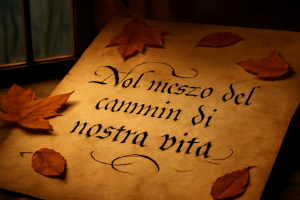
The inscription is Italian — specifically, the Florentine vernacular of the early 1300s. And the fact that so many people assume otherwise isn’t just a trivia correction. It gets at something Dante was doing on purpose.
What the Gate Actually Says
Here is the inscription as Dante wrote it, Inferno III, lines 1–9:
Per me si va ne la città dolente,
per me si va ne l’etterno dolore,
per me si va tra la perduta gente.
Giustizia mosse il mio alto fattore:
fecemi la divina podestate,
la somma sapienza e ‘l primo amore.
Dinanzi a me non fuor cose create
se non etterne, e io etterno duro.
Lasciate ogne speranza, voi ch’intrate.
Every word of that is Tuscan Italian, not Latin — ogne instead of the modern ogni, etterne instead of eterne, spellings that mark it as fourteenth-century vernacular rather than the Church’s Latin or even the standardized Italian that came later. Longfellow’s familiar English rendering, “Abandon all hope, ye who enter here,” is a translation of an Italian line, not a Latin one. There is no Latin original to translate back to. Any “Latin version” you find online was built in the other direction — English or Italian translated into Latin after the fact, for the novelty of it — not recovered from anything Dante wrote.
Why the Confusion Makes Sense
It’s not a silly mistake. The line sounds like it should be Latin. It has the gravity of a legal pronouncement, the syntax of an oracle, the kind of weight English readers associate with inscriptions on old buildings and courtroom Latin mottoes. “Abandon all hope, ye who enter here” reads like it was carved into a lintel in ancient Rome. Longfellow’s translation, with its archaic “ye” and its formal cadence, only reinforces that.
And Dante himself was perfectly capable of writing that register in actual Latin — he did it elsewhere, extensively. That’s what makes the vernacular choice here worth pausing on.
Dante Could Have Written This in Latin. He Chose Not To.
This wasn’t a case of a poet reaching for the only language available to him. Dante wrote real Latin prose. Around 1304–1307, likely while he was working on the Commedia itself, he wrote De Vulgari Eloquentia — a treatise arguing that vernacular languages like Italian were not degraded, second-tier alternatives to Latin but legitimate, powerful languages in their own right. He wrote it, pointedly, in Latin — the language of the audience he needed to convince. A decade or so later he wrote Monarchia, a political treatise on empire and papal authority, also in Latin, also aimed at an educated, Latin-reading elite.
So Dante had Latin. He used it when he was writing for scholars and clergy, in the genres where Latin was expected. Then he sat down to write the single most ambitious poem of his life — a comprehensive vision of sin, purgation, and paradise, addressed to God himself — and wrote the whole thing in Italian. Every line of the Inferno, including the one carved over its front door.
The Gate’s Signage Is Aimed at Everyone
Latin, in Dante’s Florence, was the language of the Mass, of university lectures, of official documents — the language you needed education and usually money to access. It was not the language ordinary Florentines spoke to each other, argued in the street, or fell in love in. Writing an epic about the architecture of the afterlife in Latin would have been the expected, respectable choice. Writing it in Italian was an argument all by itself: that this vision of judgment and mercy belonged to everyone who could hear Tuscan spoken, not only to those who’d been taught to read the Church’s language.
The gate’s inscription is the sharpest instance of that argument, because it’s the first thing anyone reads on entering Hell. It isn’t a scholar’s Latin proclamation. It’s Tuscan — the same vernacular Dante’s Florentine neighbors used to buy bread and settle debts — describing the outer edge of eternal justice. Hell, in other words, doesn’t need Latin to be terrifying. It speaks the reader’s own language, and that turns out to be more unsettling, not less.
So the next time you see “Lasciate ogne speranza” rendered as some invented Latin phrase, the correction isn’t just pedantry. Getting the language right is getting the point right: Dante built the whole poem, gate included, so that anyone who spoke his Tuscan could stand at the threshold of Hell and read the warning for themselves.
About This Article

Written by Lucy Bamboo. Lucy Bamboo has been reading the Divine Comedy for fifteen years — first in translation, then stubbornly in Medieval Tuscan with a dictionary and far too many footnotes. Reading Dante is her scene-by-scene walk through the poem: the original Italian, seven centuries of scholarly argument presented as argument rather than answer, and the human questions sitting underneath the theology. More about this site.
Verify this against a primary source
Specifics change, and your situation may differ from the one described here. These are the authorities worth checking directly:
- Digital Dante, Columbia University — text, commentary and translation apparatus
- Princeton Dante Project — the Commedia with historical commentary
- Dartmouth Dante Project — searchable commentary from 1322 onward