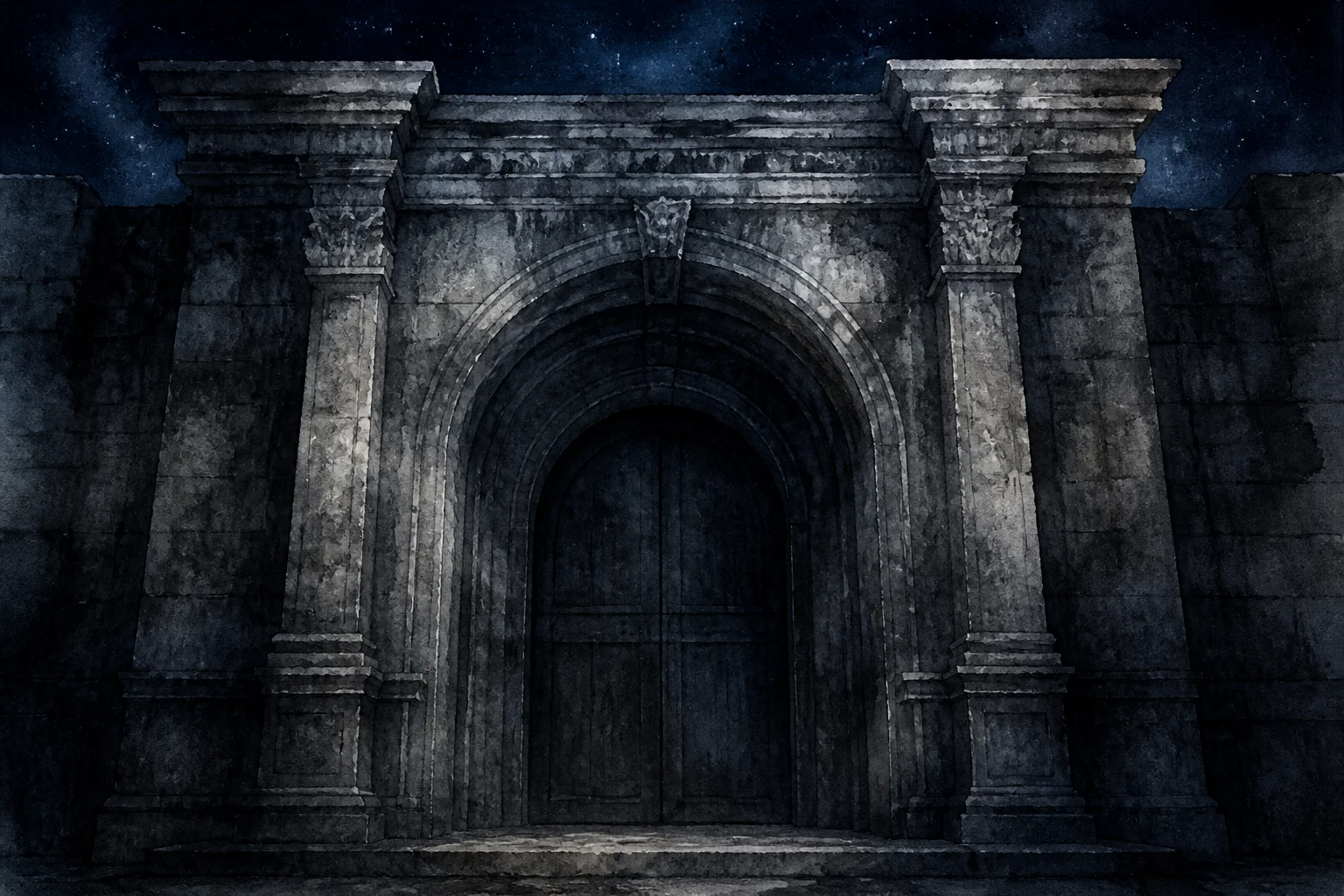
Most readers remember “Abandon all hope” — the last line of the inscription on Hell’s gate in Canto III. Few stop on the line that precedes it, the one that is, in some ways, the most philosophically and theologically dense of the nine:
Dinanzi a me non fur cose create
se non etterne, e io etterno duro.
“Before me nothing was created, except eternal things, and I endure eternally.”
This is line 7-8 of the inscription, and it contains a double use of the root word etterne/etterno — eternal — that is both theologically precise and sonically beautiful. And it is one of the hardest lines in the inscription for translators to handle.
What the Line Actually Claims
Throughout the inscription, the gate speaks in first person. Here it says: before the gate existed, only eternal things had been created. Eternal things, in medieval Christian theology, means: God, the angels, the empyrean (the highest heaven), and — crucially for the logic of the poem — hell itself.
The chronology implied is important. When did hell come into existence? Not with the creation of the physical universe (which happens with the sun and stars and Earth). God created hell before all of that — at the moment of Lucifer’s fall, when the rebel angels required a place of confinement. The Gate of Hell is, in this sense, one of the oldest created things in existence.
The line’s second claim is that the gate endures eternally: io etterno duro. “I endure forever.” This is an implicit contrast with everything mortal — humans, animals, the temporal world — which does not endure. The gate has been here since before the stars, and it will be here after them.
Dante’s doubling of etterne/etterno is intentional. Dante is making the gate echo itself, creating a sonic loop that mirrors the eternal circularity it describes.
The Full Inscription: Context
Before focusing on line 8, it helps to see the inscription whole. Here is the Italian of Canto III, lines 1-9:
Per me si va ne la citta dolente,
per me si va ne l’etterno dolore,
per me si va tra la perduta gente.
Giustizia mosse il mio alto fattore;
fecemi la divina podestate,
la somma sapienza e ‘l primo amore.
Dinanzi a me non fur cose create
se non etterne, e io etterno duro.
Lasciate ogne speranza, voi ch’intrate.
Notice the structural symmetry: the first three lines concern the gate’s function (through me you go to…), and the middle three concern its creation (Justice moved my maker; Divine Power, supreme Wisdom, and primal Love made me). The last three concern its permanence (before me nothing but eternal things, and I endure forever — abandon all hope).
Line 8 is the hinge of the third section. It explains the gate’s absolute authority: it is older than the human world, made by the same divine forces that made heaven. “Abandon all hope” lands harder because we’ve just been told the gate is eternal.
The Translation Problem: Double Eternals
The core challenge is the repetition of etterne/etterno. In Italian, the two forms (plural feminine adjective modifying cose, and masculine adjective modifying the gate itself) are different enough to read clearly. In English, “eternal/eternal” or “eternity/eternal” risks becoming tautological rather than resonant.
Let’s look at how the major translators handle this line:
Henry Wadsworth Longfellow (1867)
“Before me there were no created things, / Only eterne, and I eternal last.”
Longfellow uses “eterne” (an archaic English form that would have been recognisable to his nineteenth-century readers) for the first instance and “eternal” for the second. The distinction is subtle — “eterne” sounds older, more formal, more Latinate. The gate is “eternal” in the ordinary sense; the things before it are “eterne” in the cosmic, divine sense. It’s a nice distinction, if you know to hear it.
Dorothy Sayers (1949)
“Nothing ere I was made was made to be / Save things eternal, and eternal I shall be.”
Sayers rhymes here (as she attempts throughout), using “be/be” as her terminal rhyme. The double “eternal” is preserved, and the gate’s self-assertion (“eternal I shall be”) has a note of defiance — almost pride — that is interesting. The rearrangement is dramatic rather than literal.
John Ciardi (1954)
“Before me nothing but eternal things were made, / and I endure eternally.”
Ciardi uses “eternal” and “eternally” — adjective and adverb — to create the double without full repetition. “Endure eternally” is punchy and clear. This is Ciardi’s characteristic approach: fidelity to the sense with American energy in the phrasing.
Allen Mandelbaum (1980)
“Before me nothing but eternal things were made, / and I endure eternally.”
Mandelbaum gives us the same English as Ciardi. This is one of those moments where different translators arrive at essentially the same rendering because it is the most natural way to say it in English. The line doesn’t give much to argue about — it’s simply clear.
Robert Hollander (2000)
“Before me nothing was created but eternal things / and I endure forever.”
Hollander breaks from the Ciardi/Mandelbaum rendering by using “forever” instead of “eternally” for the gate’s own claim. This is an interesting choice: “endure eternally” sounds cosmic; “endure forever” sounds more immediate — almost like something the gate is growling at you. Hollander’s commentary notes that duro is deliberately stark and simple, and “forever” captures that better than the more elevated “eternally.”
Mary Jo Bang (2012)
“Before me was only what lasts forever. / I will also last forever.”
Bang makes the most drastic change — “eternal things” becomes “what lasts forever,” and “I endure eternally” becomes “I will also last forever.” The repetition of “last forever” is her version of Dante’s double etterno. The effect is stark and conversational, stripping the cosmic Latin vocabulary entirely. Whether this helps or hurts depends on whether you feel the philosophical weight of the line lives in its vocabulary or in its logic — Bang bets on the logic.
What the Repetition Does
The most interesting question about this line is why Dante chose to repeat the root at all. He was a supremely conscious craftsman — every word in the inscription is deliberate.
I think the repetition does two things simultaneously. First, it creates a circle: the inscription begins with etterno dolore (eternal pain, line 2) and arrives at io etterno duro (I endure eternally, line 8) — the gate has been resonating with “eternity” throughout, and the full weight lands just before “abandon all hope.” The repetition is a formal preparation for the final line.
Second, it establishes the gate’s authority by analogy. The eternal things that existed before the gate are, in theological terms, God and the divine realm. The gate endures “eternally” in the same mode — not because it is divine, but because it partakes of divine permanence. Hell lasts because God’s justice lasts. The double etterno is an argument: I am what I am because what is before me is what it is.
That double — which most translators preserve in some form but which no English version fully captures — is the sound of that argument closing on itself. It’s one of those moments where reading Dante in Italian, even haltingly, rewards the effort.
About This Article

Written by Lucy Bamboo. Lucy Bamboo has been reading the Divine Comedy for fifteen years — first in translation, then stubbornly in Medieval Tuscan with a dictionary and far too many footnotes. Reading Dante is her scene-by-scene walk through the poem: the original Italian, seven centuries of scholarly argument presented as argument rather than answer, and the human questions sitting underneath the theology. More about this site.
Verify this against a primary source
Specifics change, and your situation may differ from the one described here. These are the authorities worth checking directly:
- Digital Dante, Columbia University — text, commentary and translation apparatus
- Princeton Dante Project — the Commedia with historical commentary
- Dartmouth Dante Project — searchable commentary from 1322 onward