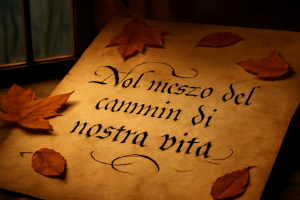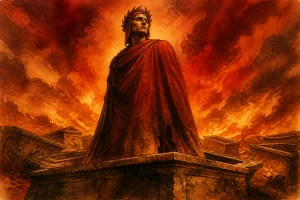
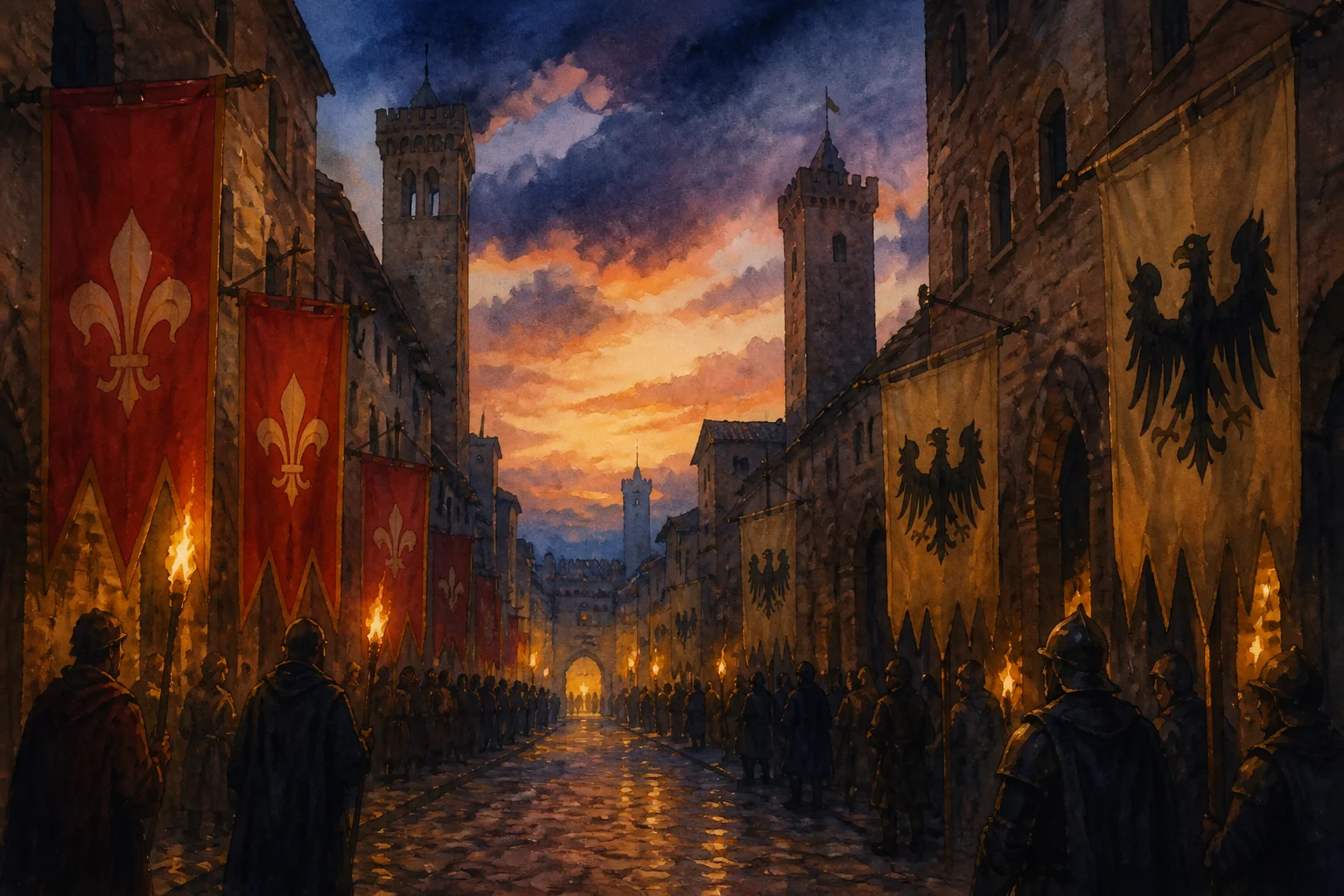
If you want to understand the Divine Comedy, you need to understand Florentine politics in the late thirteenth century. Not because the poem is political propaganda — it is far more than that — but because Dante’s exile drove him to write the Commedia, and that exile was the direct consequence of a factional defeat in the streets and council chambers of Florence.
The short answer to whether Dante was Guelph or Ghibelline: he was a Guelph — specifically a White Guelph. But that answer requires quite a bit of unpacking to make sense.
Guelphs and Ghibellines: The Basic Division
The Guelph–Ghibelline division was one of the defining conflicts of medieval Italian politics, running from roughly the twelfth through the fourteenth centuries. At the broadest level:
- Guelphs supported the Pope and the papacy’s authority in temporal matters
- Ghibellines supported the Holy Roman Emperor and imperial authority in Italy
In practice, the division was messier and more local than this. Italian city-states used Guelph and Ghibelline as political labels for local factional conflicts that were really about power, trade, family alliances, and territorial control. A city might be “Guelph” simply because its rival city was “Ghibelline” and the label had calcified through military conflict.
Florence was a Guelph city for most of Dante’s lifetime. The Ghibellines had been expelled decisively after 1267, following the defeat of Manfred of Sicily (a Ghibelline Imperial ally) and the restoration of papal-aligned power in Florence. By the time Dante was politically active, there were essentially no significant Ghibellines left in Florentine civic life.
The Split Within the Guelphs: Black and White
The problem — for Dante, and ultimately for us — is that the Florentine Guelphs split into two factions in the 1290s.
The Black Guelphs were closely aligned with Pope Boniface VIII and the ambitions of the papal court. They favoured strong papal involvement in Florentine affairs and were backed by the powerful Donati family.
The White Guelphs were also pro-papal in principle but valued Florentine independence from direct papal interference. They were associated with the Cerchi family and, broadly, with the more established merchant families of Florence.
Dante was a White Guelph. He was actively involved in Florentine civic life — he served as one of the six Priors (the city’s governing council) for a two-month term in 1300. His political activity put him squarely in the White camp.
The Crisis of 1301: Pope Boniface and Charles of Valois
In 1301, Pope Boniface VIII — whom Dante despised and placed in hell in the Inferno (Canto XIX) — engineered a political coup in Florence. He invited Charles of Valois (a French prince and papal ally) into Florence under the pretext of peacekeeping. Charles arrived in November 1301. The Black Guelphs used his presence to seize control of the city.
Violence and property destruction followed. Black Guelph supporters attacked White Guelph homes. The power balance shifted decisively.
Dante’s Exile: 1302
Dante was not in Florence when Charles arrived — he had been part of a White Guelph embassy to Rome, trying (without success) to negotiate with Boniface. When the Black Guelphs took over, he did not return.
In January 1302, the Black Guelph administration charged him in absentia with barratry (corruption, specifically taking money in exchange for political favours), opposition to papal authority, and other offences. The charges were political — there is no evidence he was more corrupt than any other Florentine official of the period. The ruling imposed a fine and banned him from Tuscany for two years.
He did not pay. In March 1302, a second condemnation followed: if he were ever found in Florentine territory, he was to be burned alive.
Dante never returned to Florence. He died in Ravenna in 1321, still in exile, still condemned.
How the Exile Shaped the Commedia
The Divine Comedy is, in ways both explicit and deep, a work of exile. This shows in at least three ways:
1. The Poem Is Set in 1300 — Before the Exile
Dante sets the poem’s imaginary journey in Easter week of 1300 — two years before his exile. This allows him to present multiple characters prophesying what will happen to him: Farinata prophesies it in Canto X, Ciacco in Canto VI, Brunetto Latini in Canto XV, Cacciaguida in Paradiso XVII. The vision of his exile is woven into the poem as divine foreshadowing — a way of processing the catastrophe and giving it cosmic significance.
2. His Political Enemies Are in Hell
The Inferno contains a remarkable number of Dante’s political enemies, real and symbolic. Pope Boniface VIII is predicted to arrive in hell (Canto XIX). Black Guelph leaders and their allies appear throughout. Dante even placed some still-living people in hell — a form of artistic revenge that would have been unmistakeable to contemporary Florentine readers.
3. The Ghibelline Emperors Are His Heroes
Here is a political complexity that trips up many readers: by the time Dante wrote the Commedia, he had become sympathetic to — even enthusiastic about — the idea of a strong Holy Roman Emperor as a counterweight to papal overreach. His political treatise De Monarchia argued for exactly this.
This has led some readers to think Dante “became” Ghibelline in exile. He did not, exactly. His disillusionment with Florentine Guelph politics (which had destroyed his world), combined with his fury at papal corruption, drove him toward the Imperial idea — one he would never have embraced in his earlier years. In Paradiso, the eagle of Empire and the vision of a just world order that transcends factional politics is one of the poem’s most heartfelt visions.
Why Farinata (Ghibelline) and Dante (White Guelph) Share a Bond
This is why the encounter with Farinata degli Uberti in Canto X carries such charge. Farinata was the greatest Ghibelline of the previous generation — Dante’s political opponent by inherited allegiance. And yet Dante gives him the most dignity of almost any damned soul in the Inferno.
Both men, from opposite sides of the divide, loved Florence and were ultimately betrayed by it. Farinata saved the city and died condemned by its Inquisition. Dante gave his political life to the city and was expelled from it on trumped-up charges. From the distance of exile, the Guelph–Ghibelline line may have looked less absolute than it had from inside the city.
The Line in the Poem
The sharpest statement of Dante’s political position comes from Cacciaguida, Dante’s great-great-grandfather, in Paradiso XVII. Speaking directly about the exile, he says:
“Tu lascerai ogne cosa diletta / più caramente; e questo è quello strale / che l’arco de lo essilio pria saetta.”
“You will leave everything you love most dearly; / and this is the arrow that the bow of exile / shoots first.”
The exile is not presented as mere political misfortune. It is the central wound of Dante’s life — the arrow loosed before all others. And the entire Divine Comedy, in some sense, is Dante’s way of answering it.
About This Article

Written by Lucy Bamboo. Lucy Bamboo has been reading the Divine Comedy for fifteen years — first in translation, then stubbornly in Medieval Tuscan with a dictionary and far too many footnotes. Reading Dante is her scene-by-scene walk through the poem: the original Italian, seven centuries of scholarly argument presented as argument rather than answer, and the human questions sitting underneath the theology. More about this site.
Verify this against a primary source
Specifics change, and your situation may differ from the one described here. These are the authorities worth checking directly:
- Digital Dante, Columbia University — text, commentary and translation apparatus
- Princeton Dante Project — the Commedia with historical commentary
- Dartmouth Dante Project — searchable commentary from 1322 onward