Ask what a poem gave the world and you usually get a reading list. Dante’s case is stranger. He didn’t just influence writers — he handed eighty million people the language they currently think in.
That’s the concrete version. The more unsettling versions go deeper: a picture of the afterlife that quietly overwrote scripture in the popular imagination; a form of literary character that made interiority visible in a way the form hadn’t quite done before; a cosmos arranged as a moral argument; and a template for what it means when an artist decides to put the world on trial by name. None of these appeared with him from nowhere. But none of them existed in quite this form before him either.
The question worth asking isn’t who Dante influenced. Influence catalogues are just reading lists. The question is: what didn’t exist before the Comedy?
A Language, Literally
The most concrete gift and, depending on how long you think about it, the most astonishing.
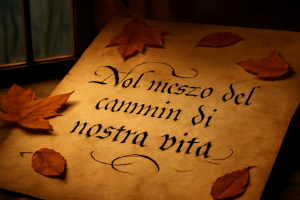
Before the Comedy, serious intellectual and literary work in Italy was written in Latin — not because writers couldn’t write in the vernacular, but because the vernacular wasn’t considered a vehicle for serious thought. Tuscan was for the unlettered, for the marketplace. Dante’s choice to write his great cosmic poem in the dialect of Florence — a choice he defended theoretically in De vulgari eloquentia — was almost an act of provocation. He was claiming that a living spoken language could hold theology, philosophy, astronomy, political argument, and the entire scope of human moral experience.
The claim stuck. Tuscan became the spine of modern standard Italian not because of politics or geography but because the poem that mattered most happened to be in Tuscan. No central edict could have done what the Comedy did: make one dialect feel inevitable. The academic consensus that Dante is one of the principal shapers of what became modern Italian is not romantic exaggeration — it’s linguistic history.
Sit with the strangeness of that for a moment. Most languages have no single moment you can point to. Modern Italian has a poem. Eighty million people think in a language whose standard form was partly shaped by one writer’s stylistic decision made in 1300. What does it mean that a poem can be the reason a country sounds the way it does?
The Afterlife You’re Picturing Is His, Not the Bible’s
This is the sneakiest gift, because people don’t realize it’s his.
The Bible is famously unspecific about Hell’s furniture. There’s fire, there’s outer darkness, there’s Gehenna and Sheol — but no levels, no architecture, no tailored punishments calibrated to fit the exact moral shape of each sin. The detailed, geographical, sightseeing Hell is Dante’s imaginative invention. He built a machine and people mistook it for a map.
When a modern person pictures Hell as having levels — when a cartoon, a film, or a casual argument invokes “the ninth circle” or punishment fitting the crime — they’re picturing Dante, not scripture. A 14th-century Florentine poet’s architectural imagination quietly overwrote the religious imagination of the West, and most people who think they’re paraphrasing the Bible are actually paraphrasing him.
This is thrilling and slightly alarming. It means a single work of fiction became so embedded in a civilization’s intuitions that it stopped being recognized as fiction. Dante didn’t just contribute to the tradition; he furnished a room that people now assume has always been there.
The Interior Human Being (Contested)
This one is worth treating carefully, because the claim is real but often overclaimed.
The argument, most rigorously made by Erich Auerbach: Dante’s souls have a psychological interiority that earlier literature rarely reached at this intensity. Francesca isn’t an illustration of lust; she’s a person making her own case, deploying her own self-deceptions, present to the reader as an individual rather than a type. You’re meant to inhabit her, not merely observe her.
The defensible version — which is all that’s needed, because it’s still significant — is that Dante demonstrated something about rendering a self that the form hadn’t fully done before at this scale. Not “Dante invented the interior human being.” That claim collapses under any serious contact with classical literature. But he showed what it looked like when a poet committed to making the souls in Hell as complicated as the souls in a room. The modern literary character — the figure whose inner life you’re invited to inhabit — has several great early proofs. One of them is here.
The Idea That the Cosmos Is Moral
The philosophical gift, and the one we’ve perhaps most completely lost.
Dante built a universe in which physics and ethics are the same structure. Where you are in the afterlife is a consequence of what you loved and how. The geography of Hell, Purgatory, and Paradise is a diagram of the human heart’s possible orientations — not a punishment system imposed from outside, but a revelation of what the soul already is. Distance from God measures everything: the frozen center of Hell is as far from light and love as it’s possible to be; the Empyrean is pure love, pure light, pure presence.
Whether or not you believe a word of the theology, the ambition is staggering. A coherent moral order in which every kind of human act has a place. A universe that means something. A cosmos as moral argument.
We no longer write this — not because the ambition is too large, but because we’ve lost the shared framework that made it possible. The Thomistic physics, the geocentric cosmology, the confidence that the structure of the universe reflects the structure of the good: all gone. Dante gave the world a totality we’ve since stopped being able to construct. We can analyze it, admire it, write essays about it. We cannot repeat it.
Permission to Argue with the Eternal
The subtlest gift, and the one that ties the rest together.
Dante did something audacious that’s easy to underestimate from this distance: he put real, named, living people in Hell and Heaven by his own judgment. Popes. Political enemies. A teacher he loved. His poetic predecessors. He assigned them eternal fates — not as metaphor, not dissolved into allegory, but by name and by his own authorial authority. He put himself in the position of sorting souls, and he did it in a poem he knew would circulate.
The gesture is extraordinary. It’s not the verdict that matters — it’s the nerve to render one. A writer claiming the authority to weigh the powerful against eternity; to say this one is damned and that one saved; to set his own political moment inside the framework of divine justice and let the framework speak. That’s art functioning as moral courage, and it’s a model that outlived its theology entirely.
We’ve long since lost the shared cosmology that gave Dante’s judgments their frame. But the example persisted: that literature is allowed to put the world on trial, that a writer can look at a pope or a tyrant or a teacher and say I know what this person was — and then say it where it lasts. It’s one of the reasons serious literature still feels, at its best, like it has stakes.
What He Really Brought Was a Question
Here’s the honest close to all of this: the gifts on this list are things Dante largely made up.
A Hell with architecture. A cosmos organized as a moral diagram. Verdicts on his neighbors’ eternal fates. These weren’t discoveries; they were constructions. The astonishing thing is that the world took them as real — or near-real, or real enough — for centuries. They installed themselves in the furniture of civilization and stopped looking like choices.
That’s what the list finally adds up to. Not a catalogue of influence but a demonstration of what one imagination can do: build a structure so internally coherent, so felt, so inhabited, that it becomes part of the world. People stop noticing it’s a made object. They quote it as scripture. They speak the language it shaped without knowing they’re speaking it. They picture his Hell when they think they’re picturing the Bible’s.
When a poem can give a civilization its language, its picture of Hell, and its idea of what a soul looks like from the inside — when it can do all of that and then disappear so completely into the background that people think they’re quoting something older — then the question of what separates a poem from a world starts to feel genuinely open.
About This Article

Written by Lucy Bamboo. Lucy Bamboo has been reading the Divine Comedy for fifteen years — first in translation, then stubbornly in Medieval Tuscan with a dictionary and far too many footnotes. Reading Dante is her scene-by-scene walk through the poem: the original Italian, seven centuries of scholarly argument presented as argument rather than answer, and the human questions sitting underneath the theology. More about this site.
Verify this against a primary source
Specifics change, and your situation may differ from the one described here. These are the authorities worth checking directly:
- Digital Dante, Columbia University — text, commentary and translation apparatus
- Princeton Dante Project — the Commedia with historical commentary
- Dartmouth Dante Project — searchable commentary from 1322 onward