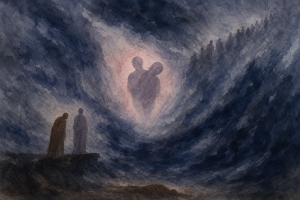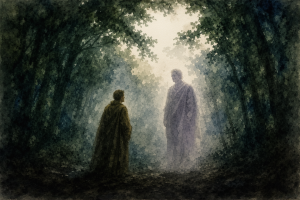
Virgil’s account of why he came to the dark wood takes up most of this passage, organized around a chain of mercy working downward from Heaven: an unnamed noble lady was moved to grief, sent Lucy, who went to Beatrice, who crossed from her place beside Rachel in Heaven to find Virgil and ask him to go. Love moved her — that is her explanation, unambiguous and unhedged. The scene introduces the poem’s central figure by her own declaration, establishes its entire intercession structure, and leaves open a question it does not resolve: how does a saved soul move freely through the place of the damned?
Inferno · Canto 2 · Lines 43–108 · Scene 5
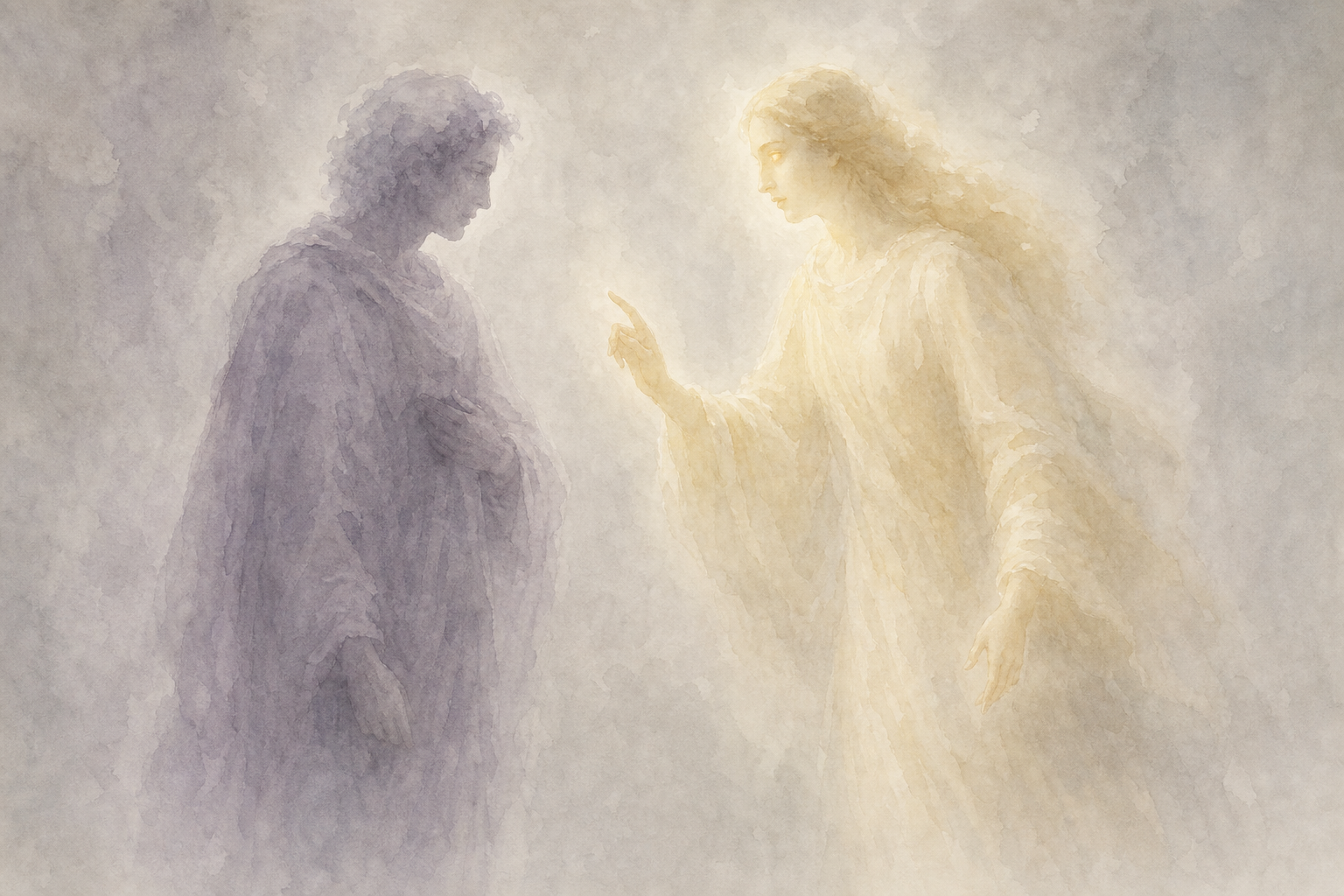
Virgil answers by tracing the chain of intercession that brought him to the wood. He was in Limbo when a woman appeared — luminous, her eyes outshining any star — and told him a friend was trapped, stopped by a beast, and that he must go and help. When Virgil asked why she was unafraid to descend, she explained that God’s grace made her impervious to this place: its misery cannot touch her, its fire does not reach her. She then named who had set the sequence in motion: a lady in Heaven saw Dante’s danger and was moved to grief; that lady sent Lucy; Lucy went to Beatrice. It is Beatrice, Virgil now makes clear, who came to Limbo and asked him to go. The woman who appeared to Virgil, who spoke of Beatrice in the third person, was Beatrice herself. She moved because love moved her — that is the word Virgil uses to report it.
The Italian — Beatrice in Limbo
Source: Wikisource (public domain, pre-1929 text)
Lines 43–45
43. «S’i’ ho ben la tua parola intesa»,44. rispuose del magnanimo quell’ombra,45. «l’anima tua è da viltate offesa;
vocabulary: Line 45 — ‘viltà’ — cowardice, but in a richer medieval sense: the failure of vital energy, the collapse of that spirited self-confidence required for noble action. Virgil names Dante’s condition precisely rather than dismissing it. The diagnosis is the beginning of the cure. [Model knowledge · high]
Lines 52–54
52. Io era tra color che son sospesi,53. e donna mi chiamò beata e bella,54. tal che di comandare io la richiesi.
theology: Line 52 — ‘color che son sospesi’ — those who are suspended: the souls of Limbo, Virgil’s own community in Hell. Neither damned nor saved, they exist in a state of permanent non-arrival. Virgil locates himself among them before introducing the figure who interrupts that suspension. [Model knowledge · high]
translation note: Line 54 — ‘tal che di comandare io la richiesi’ — such that I begged her to give me orders. Virgil’s response to Beatrice’s beauty is not desire but submission: he asks to be commanded. This reversal of the conventional power relation (the visitor asking the resident for instructions) marks Beatrice’s superiority from the scene’s first description. [Model knowledge · high]
Lines 55–57
55. Lucevan li occhi suoi più che la stella;56. e cominciommi a dir soave e piana,57. con angelica voce, in sua favella:
translation note: Line 55 — ‘Lucevan li occhi suoi più che la stella’ — her eyes shone brighter than any star. The first physical description of Beatrice in the Comedy, and it is entirely about light. She is described through what she emits rather than what she looks like — a luminous presence, not a bodily form. This will characterize Beatrice throughout the poem. [Model knowledge · high]
Lines 58–60
58. "O anima cortese mantoana,59. di cui la fama ancor nel mondo dura,60. e durerà quanto ‘l mondo lontana,
translation note: Line 58 — ‘O anima cortese mantoana’ — O courteous Mantuan soul. Beatrice addresses Virgil by his origin and his defining quality: courtesy. The honorific is not generic but precise — Virgil’s poetry is characterized by its civility, its restraint, its service to order. She is naming exactly what she needs from him. [Model knowledge · high]
Lines 70–72
70. I’ son Beatrice che ti faccio andare;71. vegno del loco ove tornar disio;72. amor mi mosse, che mi fa parlare.
literary key: Line 70 — ‘I’ son Beatrice che ti faccio andare’ — I am Beatrice who makes you go. The self-naming comes midway through her speech, after the request — placing her authority in her action rather than her identity. The verb ‘faccio andare’ (I make you go) is imperious without being harsh: she does not ask Virgil; she establishes that she is the efficient cause of his going. [Model knowledge · high]
theology: Line 72 — ‘amor mi mosse, che mi fa parlare’ — love moved me, which makes me speak. Beatrice’s motivation is named as love, not obligation or divine command. The same force that, in the poem’s cosmology, moves the sun and the other stars (Paradiso XXXIII, 145) moves her to Limbo. This links the intercession to the poem’s culminating theological proposition — love as prime mover — though whether Beatrice means the same love here as in Paradiso’s final line is a question the poem leaves open (see below). [Model knowledge · high]
Lines 82–84
82. Ma dimmi la cagion che non ti guardi83. de lo scender qua giuso in questo centro84. de l’ampio loco ove tornar tu ardi.
translation note: Line 82 — Virgil — within his own reported speech to Dante — asks Beatrice why she is not afraid to come to Hell. The question is theological: how can a blessed soul enter the domain of the damned without risk? The question also dramatizes Virgil’s own condition: for him, Limbo is home, and the deeper Hell is dangerous. Beatrice’s answer will distinguish their two modes of existence. [Model knowledge · high]
Lines 91–93
91. I’ son fatta da Dio, sua mercé, tale,92. che la vostra miseria non mi tange,93. né fiamma d’esto ‘nferno mi s’assale.
theology: Line 91 — ‘I’ son fatta da Dio, sua mercé, tale’ — I am made by God, by his mercy, such. The phrase ‘sua mercé’ (by his mercy) is the pivot: Beatrice’s immunity is not intrinsic but granted. She is not beyond harm because of her nature but because of God’s mercy applied to her nature. This keeps the Christian structure intact: even the highest figure is dependent on grace. [Source: Singleton, Inferno: Commentary (1970)]
translation note: Line 92 — ‘la vostra miseria non mi tange’ — your misery does not touch me. ‘Vostra’ — your — is plural: Beatrice addresses not Virgil alone but all the souls of Hell and Limbo. The immunity is total and structural. She is in Hell but not of it — a visitor from a different ontological register. [Model knowledge · high]
Lines 94–96
94. Donna è gentil nel ciel che si compiange95. di questo ‘mpedimento ov’io ti mando,96. sì che duro giudicio là sù frange.
theology: Line 94 — ‘Donna è gentil nel ciel’ — there is a noble lady in Heaven. The Virgin Mary is almost universally identified as this figure by commentators from the earliest period, though Dante withholds the name. The unnamed first cause of the entire chain of intercession: she wept, she acted, she set everything in motion. The silence around her name may be reverence. [Model knowledge · high]
translation note: Line 96 — ‘sì che duro giudicio là sù frange’ — so that she breaks rigid judgment above. The lady’s compassion has the force to crack strict divine judgment in Dante’s favor. This is an extraordinary claim: mercy, not law, is the final authority. The precedent for divine compassion overriding strict desert is Dante’s opening proposition about his own situation. [Model knowledge · high]
Lines 100–102
100. Lucia, nimica di ciascun crudele,101. si mosse, e venne al loco dov’i’ era,102. che mi sedea con l’antica Rachele.
theology: Line 100 — ‘Lucia, nimica di ciascun crudele’ — Lucy, enemy of all cruelty. St. Lucy of Syracuse, martyr and patron of sight. In the Comedy’s allegorical geography she represents illuminating grace — the grace that enables spiritual sight. Her enmity to cruelty aligns her with the rescue mission: Dante’s entrapment in the forest is a form of cruelty that grace opposes. [Model knowledge · high]
cultural ref: Line 102 — ‘con l’antica Rachele’ — with the ancient Rachel. Rachel, wife of Jacob and mother of Joseph and Benjamin, was a type of the contemplative life in medieval exegesis (as opposed to Leah, the active life). Beatrice is found seated beside her — placing Beatrice within the Hebrew tradition as well as the Christian, and aligning her with contemplation rather than action. [Source: Singleton; Genesis 29–30; Augustine, De civitate Dei]
Lines 106–108
106. Non odi tu la pieta del suo pianto?107. Non vedi tu la morte che ‘l combatte108. su la fiumana ove ‘l mar non ha vanto?"
translation note: Line 108 — ‘su la fiumana ove ‘l mar non ha vanto’ — on the flood-river over which the sea has no boast. A difficult phrase: the ‘fiumana’ is the river of life (the world as flood), and the sea cannot boast over it because the sea of death — the afterlife — has no dominion over the living. Lucy’s description of Dante’s situation frames it as a drowning rather than a blockage: not stopped, but overwhelmed. [Model knowledge · medium]
Seven Centuries of Reading Beatrice in Limbo
The Allegorical Framework: Medieval Commentators
The earliest readers reached immediately for allegory. Pietro Alighieri argued that Beatrice represented theology guiding reason toward salvation, her descent into Limbo a philosophical diagram dressed in narrative: grace (Mary, unnamed) prompting illumination (Lucy) prompting theology (Beatrice) prompting reason (Virgil) to rescue the straying soul. Pietro’s diagram was clean. It answered the question of why this particular chain of figures — rather than more direct divine intervention — by making the chain itself the theological content. The Ottimo Commento agreed on the essentials. Benvenuto da Imola was more interested in the historical Beatrice, noting that Dante’s relationship to the actual woman from Florence gave the scene its emotional specificity, but he still placed that specificity in service of the allegorical reading.
Boccaccio opened a crack in this consensus. Writing in the 1370s, he acknowledged the historical Beatrice Portinari directly and argued that her personal reality mattered to the poem’s power. To make her pure allegory, he suggested, was to miss what made Dante’s poem different from earlier visionary literature. Boccaccio himself bent toward allegory in the end, but his hesitation about it marked a fault line in the commentary tradition that would only widen.
De Sanctis and the Recovery of the Personal
Francesco De Sanctis blew that fault line open. He argued that the entire allegorical apparatus was a critical misreading. The line ‘amor mi mosse, che mi fa parlare’ was, for De Sanctis, the key to everything: it recorded a real love, felt by a real man for a real woman, and reducing that to theological machinery was to trade the poem’s beating heart for a diagram. Nineteenth-century readers embraced this reading with energy. What it risked — as later scholarship noted — was importing Romantic assumptions about personal lyric into a poem built from medieval theology.
Singleton, Auerbach, and the Question of Both at Once
Charles Singleton spent much of his career restoring the theological reading to rigor. His analysis of the three women as the three modes of grace — prevenient, illuminating, operative — gave the passage its dominant twentieth-century interpretation. Singleton’s Beatrice is not less real for being also an allegorical figure; she participates in a cosmic drama the historical Beatrice Portinari only partially prefigured. Erich Auerbach complicated Singleton by insisting on both dimensions simultaneously: the historical woman and the figural function are not alternatives. They coexist, and the poem’s power depends on neither canceling the other.
Teodolinda Barolini brought a different pressure. She argued that focusing exclusively on what Beatrice means risks treating Dante as his poem’s own truth-teller — accepting the fiction that the theology is real rather than performed. Barolini read the scene as a poet’s construction: Beatrice’s authority is an effect produced by the text, not a truth the text reports. ‘Amor mi mosse’ is a line of verse, and what it proves about Beatrice’s motivation is what any line of verse proves — which is not nothing, but is not the same as theological fact. The unnamed donna gentil, the mechanics of Beatrice’s immunity, the meaning of ‘amor mi mosse’ — these remain live questions. Seven centuries of commentary have deepened them without closing them.
The Two Main Positions on Beatrice in Limbo
Allegorical / Theological
The three women encode the three modes of divine grace that Catholic theology distinguished: prevenient grace (Mary, who intercedes before Dante can ask), illuminating grace (Lucy, who carries the light of understanding), and operative grace (Beatrice, who does the work of securing the guide). On this reading, the machinery of intercession is Dante’s theological system made narrative — grace personified and set in motion for a reader who needs to understand how salvation works, not just that it works.
Key passage: ‘I’ son fatta da Dio, sua mercé, tale / che la vostra miseria non mi tange’ (lines 91–92) — Beatrice’s immunity is a precise theological claim: she belongs to a different order of being, one grace has placed beyond the reach of Hell.
Personal / Biographical
The scene is powered by Dante’s real grief for the historical Beatrice Portinari, who died in 1290. Reducing her to an allegorical function evacuates the emotional engine that drives the poem. Beatrice’s descent to Limbo, her self-naming, her appeal to love as her motivation — these have the emotional specificity of a remembered person, not an abstraction. The poem’s theological architecture stands on a foundation of personal love, and collapsing the personal into the theological loses both.
Key passage: ‘amor mi mosse, che mi fa parlare’ (love moved me, which makes me speak, line 72) — the motivation named is love, not duty, not function, not category.
What the Text Does — and What That Means (Contested)
On the page: The three-woman chain is presented as Virgil’s first-person account of what actually happened — not as allegory he explains to Dante, but as narrative of a conversation he had. Beatrice identifies herself by name midway through her speech. She explains her immunity from Hell. She names Lucy as the intermediary between the unnamed noble lady and herself. The unnamed lady is not identified within the scene.
What scholars dispute: Whether the three women are primarily allegorical figures (Grace in its various modes) or primarily individuals whose historical particularity matters to the poem’s meaning has divided readers since the earliest commentators. The ‘donna gentil’ is almost universally identified with the Virgin Mary by later commentators, but Dante does not name her here. Whether that silence is reverence, tact, or deliberate ambiguity is contested.
What Dante Leaves Unresolved
Line 94 — ‘Donna è gentil nel ciel che si compiange’ — names the first cause of the entire intercession and withholds her name. Seven centuries of commentators agree the unnamed noble lady is the Virgin Mary. Dante doesn’t say so here. The silence is commonly read as reverence; some scholars have argued it is structural — the first mover should remain unnamed, the cause behind the named causes. What it is not is an oversight. Whether the silence is tact, design, or deliberate ambiguity has no definitive answer in the text.
The mechanics of Beatrice’s immunity raise a separate question. She says God made her such that Hell’s misery does not touch her (lines 91–92). The claim resolves the dramatic question — she can be here without risk — but leaves open how the poem’s cosmology accommodates a saved soul moving freely through the place of the damned. The answer is given as assertion rather than explanation. Whether the assertion is sufficient depends on how much the poem’s cosmological architecture has earned your trust by this point.
‘Amor mi mosse, che mi fa parlare’ (line 72) is the first direct statement of what becomes the poem’s final proposition. Beatrice names love as her motivation without further specification: she does not distinguish between her personal love for the historical Dante and the theological love that, in Paradiso XXXIII, moves the sun and the other stars. Whether these are the same love or different expressions of one thing is a question the poem opens here and returns to in its last line — and leaves open between them.
The Open Question
Four figures are required to reach one man lost in a wood: an unnamed lady who weeps, a saint sent in response to that grief, a dead woman who crosses into the place of the damned, a Roman poet who walks back out into the living world. The economy of mercy is exact and elaborate. What the poem does not say is whether all of this was organized specifically for Dante — or whether this is simply what intercession looks like, and Dante was the one who could write it down.
Explore More
About This Article

Written by Lucy Bamboo. Lucy Bamboo has been reading the Divine Comedy for fifteen years — first in translation, then stubbornly in Medieval Tuscan with a dictionary and far too many footnotes. Reading Dante is her scene-by-scene walk through the poem: the original Italian, seven centuries of scholarly argument presented as argument rather than answer, and the human questions sitting underneath the theology. More about this site.
Verify this against a primary source
Specifics change, and your situation may differ from the one described here. These are the authorities worth checking directly:
- Digital Dante, Columbia University — text, commentary and translation apparatus
- Princeton Dante Project — the Commedia with historical commentary
- Dartmouth Dante Project — searchable commentary from 1322 onward