Canto 2 is the poem’s first crisis of nerve. Dante has agreed to go; lines 10–42 record his immediate reversal. Lines 109–142 record the recovery — Virgil finishes his account of Beatrice’s mission, presses Dante with three rapid questions, and something shifts. The flower simile at line 127 is where the passage becomes genuinely difficult: flowers pressed shut by frost do not choose to open. The sun opens them. That image has generated centuries of disagreement about whether Dante’s recovered resolve is an act of will, an effect of grace, or something the poem deliberately refuses to name.
Inferno · Canto 2 · Lines 109–142 · Scene 6
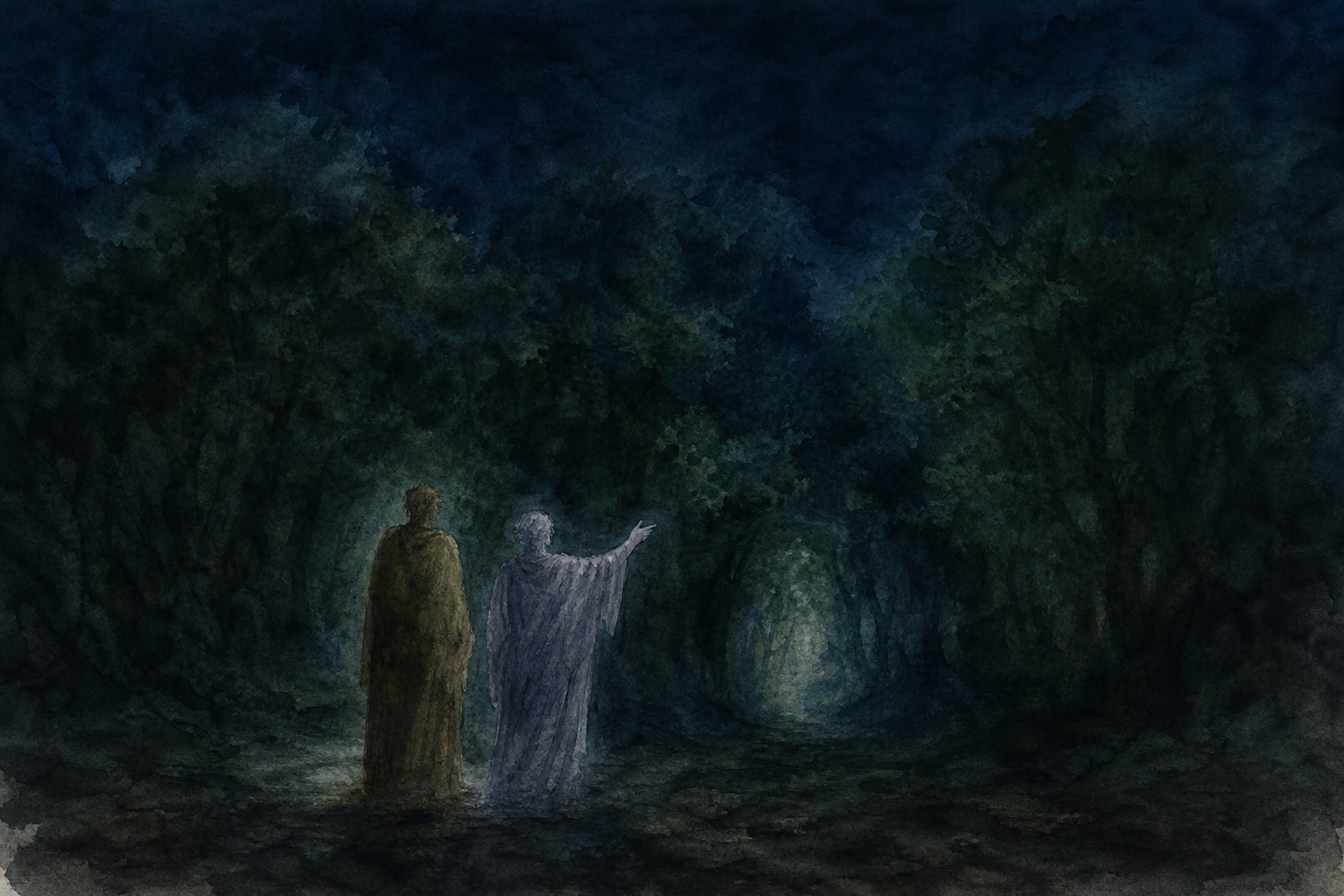
With Virgil’s account of Beatrice’s mission complete, the canto turns on a single question: why does Dante still hold back? Virgil names three women of Heaven who have intervened on Dante’s behalf, and presses the point with deliberate economy — the case for proceeding has been made; no further argument is available or needed. What follows is one of the Commedia‘s most precisely observed psychological moments. Dante compares himself to flowers that cold has pressed shut through the night: they do not recover by effort but by exposure to warmth, and they straighten one by one, opening in sequence. On one reading, the simile locates the change outside Dante’s volition — something acts on him rather than he upon himself, closer to grace than to willpower. His reply to Virgil makes this explicit: both the woman who showed mercy and Virgil who obeyed so promptly have moved him. He does not claim to have recovered his courage; he acknowledges that it has been restored. The declaration that follows — tu duca, tu segnore e tu maestro, you my guide, you my lord, you my master — echoes and resolves the crisis of confidence that opened Canto 2, and the canto closes not on speech but on motion: Virgil moves forward, Dante follows, and they enter what the text calls the high and wild road without further comment on what Dante feels.
The Italian — The New Resolve
Source: Wikisource (public domain, pre-1929 text)
Lines 115–117
115. «Che è dunque? perché, perché restai?116. perché tanta viltà nel core allette?117. perché ardire e franchezza non hai,
translation note: Line 115 — Virgil turns from narrative to direct challenge — three rapid questions that strip away any remaining excuse. The triple ‘perché’ (why, why, why) mirrors the structure of Beatrice’s triple intercession, now applied as a rhetorical hammer. After the gentleness of the Beatrice story, Virgil shifts register: urgency, almost impatience. [Model knowledge · medium]
Lines 118–120
118. poscia che tai tre donne benedette119. curan di te ne la corte del cielo,120. e ‘l mio parlar tanto ben ti promette?»
theology: Line 118 — ‘tai tre donne benedette’ — such three blessed women. Virgil names the intercession not to repeat it but to use it as a rebuke: you know these three women care for you; you have been told this; what else is needed? The facts of grace are now grounds for reproach if Dante fails to act on them. [Model knowledge · medium]
Lines 127–129
127. Quali i fioretti dal notturno gelo128. chinati e chiusi, poi che ‘l sol li ‘mbianca,129. si drizzan tutti aperti in loro stelo,
simile: Line 127 — The flower simile is one of the Comedy’s most celebrated. Frost bends flowers shut at night; the morning sun opens them. Dante uses the image for the recovery of his courage — but the simile does not show the flowers deciding to open. They respond to the sun as a natural effect. This detail has driven the debate about whether Dante’s recovery is an act of will or an effect of grace — commentators who favor the grace reading point to exactly this passivity, though the classical-virtue camp reads the same image as staging, not explaining, the recovery. [Source: Freccero, Dante: The Poetics of Conversion (1986); Mazzotta, Dante’s Vision and the Circle of Knowledge (1993)]
Lines 130–132
130. tal mi fec’io di mia virtude stanca,131. e tanto buono ardire al cor mi corse,132. ch’i’ cominciai come persona franca:
translation note: Line 130 — ‘di mia virtude stanca’ — of my exhausted virtue. ‘Virtude’ here is both virtue in the moral sense and vital energy in the Aristotelian sense — the animating force of the soul. It was not merely cowardice that had seized Dante but an exhaustion of vitality, which the simile of the flowers precisely describes: cold closes living things; warmth restores them. [Model knowledge · high]
translation note: Line 132 — ‘come persona franca’ — like a free person, a frank person, one no longer bound. The word ‘franca’ carries both senses: freedom from constraint (he is no longer paralyzed) and frankness of speech (he will say what he means directly). The hesitant Dante of lines 10–42 has been replaced. [Model knowledge · high]
Lines 136–138
136. Tu m’hai con disiderio il cor disposto137. sì al venir con le parole tue,138. ch’i’ son tornato nel primo proposto.
vocabulary: Line 138 — ‘ch’i’ son tornato nel primo proposto’ — I have returned to my first intention. Dante names what has happened precisely: a return, not an advance. He is back where he was at the end of Canto 1, when he first agreed to go. The intervening crisis was a detour, not a development. The journey can begin again from where it should have started. [Model knowledge · high]
Lines 139–141
139. Or va, ch’un sol volere è d’ambedue:140. tu duca, tu segnore e tu maestro."141. Così li dissi; e poi che mosso fue,
literary key: Line 139 — ‘ch’un sol volere è d’ambedue’ — one will in two. The phrase is the canto’s structural resolution: Dante’s divided will has been healed into unity with Virgil’s. The image of two wills becoming one is Augustinian — the cured will does not strain against its guide but joins with it. Freccero read this line as the Comedy’s conversion moment precisely formulated. [Source: Freccero, Dante: The Poetics of Conversion (1986); Augustine, Confessions]
translation note: Line 140 — ‘tu duca, tu segnore e tu maestro’ — you my guide, you my lord, you my master. The triple honorific inverts Dante’s earlier protest (‘Io non Enea, io non Paulo sono’): where the crisis was defined by what Dante is not, the resolution is defined by what Virgil is, to him, now and for the journey ahead. The three titles cover three domains: duca (practical guidance), segnore (authority), maestro (intellectual mastery). [Model knowledge · high]
Lines 142
142. intrai per lo cammino alto e silvestro.
literary key: Line 142 — The closing line of Canto 2 is grammatically bare: intrai per lo cammino alto e silvestro — I entered the high and wild road. No report of what Dante feels as he enters. No description of the path ahead. The canto closes on motion, not on emotion — and that silence has prompted as much discussion as any of the lines before it. [Model knowledge · high]
Seven Centuries of Reading The New Resolve
Medieval Commentators on The New Resolve
Pietro Alighieri read the flower simile as a moral allegory. For him, the closed flowers stood for a soul weighed down by sin. The sun represented divine illumination. Pietro emphasized Dante’s recovery of virtue, not a sudden conversion. He read the passage as ethical instruction for any Christian reader.
Boccaccio’s Esposizioni covers only through Canto 17, so he does not address this passage. He consistently read Virgil as reason guiding the will. For Boccaccio, Dante’s paralysis was a failure of rational courage. Virgil’s speech restores that courage by supplying good arguments. Boccaccio stressed the literary beauty of the simile over its doctrinal weight.
Benvenuto da Imola, in his 1887 Lacaita edition, took a similar line. He admired the simile as a piece of classical rhetoric, while also noting the three blessed women as genuinely theological figures. Benvenuto balanced poetic and doctrinal readings without fully choosing between them. The Ottimo Commento likewise stressed the grace of the three women as essential to the scene’s meaning.
Renaissance and Early Modern Shifts
Humanist readers of the fifteenth and sixteenth centuries pulled the passage toward classical rhetoric. They admired Virgil as the ideal philosopher-teacher. For them, persuasion by reason was the drama’s core. The three women receded in importance. The scene became a model of eloquence moving a reluctant student to action.
Counter-Reformation readers resisted this secular emphasis. They insisted on the women’s intercessory role. For them, Dante’s resolve was properly a gift, not an achievement. Neither camp produced a systematic account of the flower simile’s mechanism. Both sides read the ending line — the entry into the high and wild road — as confident departure. Neither dwelt on its silence.
The Nineteenth Century and The New Resolve
Francesco De Sanctis transformed the passage in Romantic terms. He argued that Dante’s greatness was his fierce personal will. De Sanctis read the flower simile as a portrait of inner strength returning. Grace, for De Sanctis, was almost beside the point. The hero recovers himself; that recovery is the drama.
This reading shaped a century of Italian criticism, though it arguably invented something Dante does not state. The grace camp would point out that the text places the change outside Dante’s own effort — the flowers do not open themselves — but De Sanctis’s Dante became enormously influential regardless. His Romantic hero defined popular understanding well into the twentieth century.
Twentieth-Century Critics: Singleton, Auerbach, Barolini
Charles Singleton argued for a rigorously theological reading of what Dante presents here. For Singleton, the flower simile was not decoration. It enacted Augustinian grace operating on the will from outside. The soul cannot open itself; it is opened. Singleton placed this moment within the entire Commedia‘s sacramental structure.
Erich Auerbach approached the passage differently. He emphasized figural realism: Dante the pilgrim is a historically real figure enacting a real change. For Auerbach, the simile worked because it was concrete and earthy, not abstract. The “high and wild road” was a real landscape with real weight. Auerbach resisted turning the scene into pure doctrine.
Teodolinda Barolini pressed back against both approaches. She argued that Singleton’s theological frame risked making the poem’s art invisible. She insisted on reading Dante as a self-conscious literary craftsman. For Barolini, the flower simile is a poetic performance. It creates the feeling of change without specifying its cause. That ambiguity, she argued, is the point.
Open Questions Today
Digital Dante at Columbia University makes centuries of commentary searchable and comparable. Scholars can now trace how the flower simile was read across time with new precision. Researchers note how few commentators discussed the final line’s silence. Dante places Dante-pilgrim on the road without reporting his emotional state. That omission continues to generate debate.
Today’s live questions focus on what “resolve” actually means in the passage. Is it a permanent state or a momentary posture? Does the entry into the wild road confirm the change, or simply follow it? The passage is perhaps best understood as an open threshold. Scholars across camps agree on that much, at least.
The Two Main Positions on The New Resolve
Conversion / Augustinian
Canto 2 enacts the Augustinian structure of conversion: will divided against itself is healed by grace into single resolve. The flower simile is not decorative but doctrinal — grace operates on the soul as the sun operates on flowers, from outside, irresistibly, naturally. The healing is not earned or decided; it is received. Dante’s formal declaration to Virgil is the verbal sign of a change that has already happened at the level of the will.
Key passage: ‘ch’un sol volere è d’ambedue’ (one will in two, line 139) — the image of wills unified suggests that the prior division has been resolved, not merely overcome by a stronger impulse.
Decision / Classical Virtue
Dante hears a persuasive argument (the three women care for him) and changes his mind. This is the classical model of rational persuasion: Virgil acts as philosopher-teacher, presents reasons, and Dante’s logos responds. The flower simile describes the feel of the change, not its mechanism — relief feels like flowers opening, but relief is the appropriate rational response to having one’s fears removed by good evidence. No supernatural grace is required.
Key passage: ‘Sé’ savio; intendi me’ ch’i’ non ragiono’ (line 36, earlier in the canto) — Dante explicitly asked Virgil to reason on his behalf, and Virgil did. The recovery follows the reasoning.
What the Text Does — and What That Means (Contested)
On the page: Virgil’s challenge to Dante (asking why he still harbors cowardice after three women in heaven care for him) precedes the change. The change itself is described through a natural simile, not as an act of will. Dante speaks formally to Virgil, commits to the journey, and they enter. The closing line gives no emotional report — only the fact of entry.
What scholars dispute: Whether the recovery is a genuine act of free will (Dante chooses to go) or an effect of grace working on him (the sun opens the flowers; he does not open himself) is debated. Freccero sees conversion — the will healed into unity by grace. Others read a simpler narrative logic: Virgil’s explanation removed the uncertainty, and without uncertainty Dante simply moves. The flower simile tips the question toward grace: the flowers do not decide to open.
About This Article

Written by Lucy Bamboo. Lucy Bamboo has been reading the Divine Comedy for fifteen years — first in translation, then stubbornly in Medieval Tuscan with a dictionary and far too many footnotes. Reading Dante is her scene-by-scene walk through the poem: the original Italian, seven centuries of scholarly argument presented as argument rather than answer, and the human questions sitting underneath the theology. More about this site.
Verify this against a primary source
Specifics change, and your situation may differ from the one described here. These are the authorities worth checking directly:
- Digital Dante, Columbia University — text, commentary and translation apparatus
- Princeton Dante Project — the Commedia with historical commentary
- Dartmouth Dante Project — searchable commentary from 1322 onward