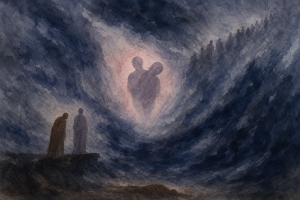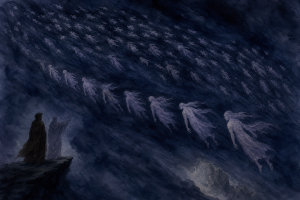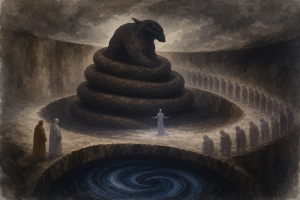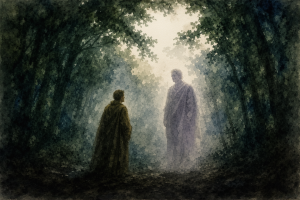
The gate speaks first. Nine lines of self-description in the first person — built by Power, Wisdom, and Primal Love — end with the instruction to abandon all hope. Dante reads them and tells Virgil they are hard. Virgil’s reply is the opposite of hard: here you must leave all hesitation behind. That the entrance to eternal punishment was built by love is the poem’s first theological provocation, planted at the threshold before a single soul is encountered. Seven centuries of readers have been trying to hold those two things together ever since.
Inferno · Canto 3 · Lines 1–30 · Scene 7
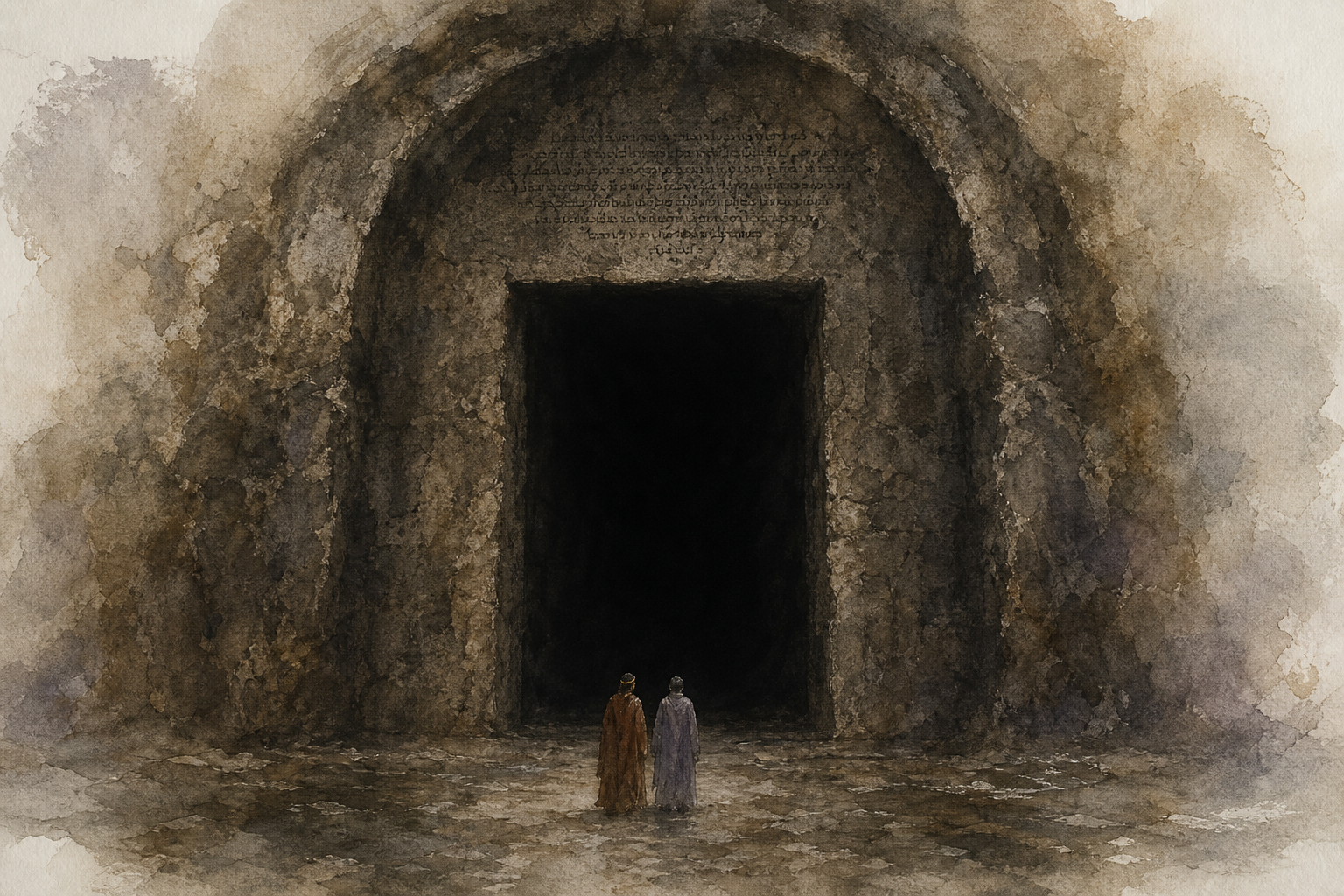
The path through the dark wood ends at a gate. Above its arch, an inscription in dark letters: the gate identifies itself as the entrance to grief, to eternal pain, to the lost — made by Power, Wisdom, and Love, coeternal with the eternal things that preceded it. The final line commands those who enter to abandon hope. Dante finds the words obscure and severe and looks to Virgil for help. Virgil’s response is brief and practical: set fear aside, because this is the place he had spoken of earlier — where Dante will see those who have lost the good of the intellect.
The Italian — The Gate of Hell
Source: Wikisource (public domain, pre-1929 text)
Lines 1–3
1. «Per me si va ne la città dolente,2. per me si va ne l’etterno dolore,3. per me si va tra la perduta gente.
literary key: Line 1 — The inscription opens with three anaphoric lines — ‘per me si va’ (through me one goes) — establishing the gate as speaker in the first person. This is an ekphrasis in reverse: instead of the narrator describing an inscription, the inscription speaks for itself, claiming the reader as its audience. The ‘città dolente’ (city of grief) names Hell as a city — a political and social structure, not merely a landscape of punishment. [Model knowledge · high]
vocabulary: Line 3 — ‘la perduta gente’ — the lost people. ‘Perduta’ (lost) contains the Italian ‘perso,’ which also names a shade of blue-grey. Dante activates this double meaning throughout the Inferno — the damned are simultaneously morally lost and, in the visual economy of the poem, a particular color of absence. [Model knowledge · medium]
Lines 4–6
4. Giustizia mosse il mio alto fattore;5. fecemi la divina podestate,6. la somma sapïenza e ‘l primo amore.
theology: Line 4 — ‘Giustizia mosse il mio alto fattore’ — Justice moved my high maker. The gate identifies divine justice as the efficient cause of its existence. But lines 5–6 immediately complicate this by naming the formal cause: the Trinity in its three persons. The gate was made by all three — Power (Father), Wisdom (Son), primal Love (Holy Spirit). Justice set the motive; the entire Trinity executed it. [Source: Singleton, Inferno: Commentary (1970); Aquinas, Summa Theologiae]
theology: Line 6 — ‘l primo amore’ — primal love, traditionally the Holy Spirit’s attribute (caritas). The attribution of Hell’s creation to love — specifically divine love — is the inscription’s central theological scandal and has generated more commentary than any other line in the canto. It is not cruelty, not wrath, but love that built the gate. Singleton read this as orthodox Thomism (justice as an expression of love for order); Mazzotta read it as a deliberate unsettling of the reader’s assumptions about what love entails. [Source: Mazzotta, Dante, Poet of the Desert (1979); Singleton, Inferno: Commentary (1970)]
Lines 7–9
7. Dinanzi a me non fuor cose create8. se non etterne, e io etterno duro.9. Lasciate ogne speranza, voi ch’intrate».
theology: Line 7 — ‘Dinanzi a me non fuor cose create / se non etterne’ — before me nothing was created but eternal things. The gate establishes its own antiquity: only the angels and prime matter predate it. Hell is coeval with creation’s first moment — not an afterthought but a structural feature of the universe from the beginning. This places damnation inside God’s original creative intention, which is the deepest form of the inscription’s theological challenge. [Model knowledge · high]
literary key: Line 9 — ‘Lasciate ogne speranza, voi ch’intrate’ — abandon all hope, you who enter here. The most quoted line in the Comedy outside the first tercet. Freccero noted that ‘voi ch’intrate’ is addressed to any who enter, not specifically to the damned — it speaks to Dante, and through Dante to the reader. Hope is the theological virtue oriented toward future good; its absence is the defining condition of Hell, which has no future, only an eternal present of the state chosen at death. [Source: Freccero, Dante: The Poetics of Conversion (1986); Aquinas on the theological virtues]
Lines 10–12
10. Queste parole di colore oscuro11. vid’ïo scritte al sommo d’una porta;12. per ch’io: «Maestro, il senso lor m’è duro».
translation note: Line 10 — ‘di colore oscuro’ — of dark color. Dante describes the inscription’s color before its content — the visual fact before the reading. ‘Colore oscuro’ is the darkness of the words on the stone, but also the darkness of their meaning. The same phrase has been used to describe the dark wood of Canto 1: the Comedy’s opening darkness returns at the entrance to Hell. [Model knowledge · medium]
translation note: Line 12 — ‘il senso lor m’è duro’ — their meaning is hard to me. Dante’s first reaction to the inscription is not theological objection but a confession that he cannot fully understand it. ‘Duro’ (hard, difficult, harsh) is both an intellectual and an emotional description: the words resist interpretation and feel harsh to read. Dante does not attempt to answer the paradox; he admits its difficulty. This is his characteristic epistemological humility at thresholds. [Model knowledge · high]
Lines 13–15
13. Ed elli a me, come persona accorta:14. «Qui si convien lasciare ogne sospetto;15. ogne viltà convien che qui sia morta.
literary key: Line 13 — ‘come persona accorta’ — like a knowing person, a perceptive person. Virgil does not explain the inscription. He responds to Dante’s confusion not with theology but with instruction. ‘Accorto’ suggests practical wisdom, situational intelligence — Virgil knows that this is not the moment for exegesis. What the gate requires is not understanding but the willingness to enter. [Model knowledge · high]
vocabulary: Line 15 — ‘ogne viltà convien che qui sia morta’ — all cowardice must die here. The word ‘viltà’ closes the arc begun in Canto 2 (line 123), where Virgil directly rebuked Dante’s hesitation as ‘viltà.’ Now, at the gate, that cowardice must be left behind not as a psychological preparation but as an ontological requirement. The threshold demands it. The cure administered in Canto 2 is confirmed at Canto 3’s opening: what was healed there must now be proven dead here. [Model knowledge · high]
Lines 16–18
16. Noi siam venuti al loco ov’i’ t’ho detto17. che tu vedrai le genti dolorose18. c’hanno perduto il ben de l’intelletto».
theology: Line 18 — ‘c’hanno perduto il ben de l’intelletto’ — who have lost the good of the intellect. This phrase, drawn from Aristotle via Aquinas, defines damnation structurally: the intellect’s proper good is God (Aquinas: ‘beatitudo est bonum intellectus’). To lose that good is not merely to be denied pleasure but to be denied the fulfillment of one’s deepest faculty. Hell is not primarily suffering — it is the permanent absence of the thing the intellect was made to find. [Source: Aquinas, Summa Theologiae I-II.3.8; Aristotle, Nicomachean Ethics X; Singleton, Inferno: Commentary (1970)]
Lines 19–21
19. E poi che la sua mano a la mia puose20. con lieto volto, ond’io mi confortai,21. mi mise dentro a le segrete cose.
literary key: Line 19 — ‘la sua mano a la mia puose’ — he placed his hand in mine. The first physical contact between Virgil and Dante in the poem: a guide taking the hand of someone he leads. The gesture is at once practical (Virgil will guide Dante in) and symbolic (human and shade, reason and its ward, touching at the threshold). The hand-clasp recurs at other thresholds throughout the Comedy. [Model knowledge · high]
translation note: Line 20 — ‘con lieto volto’ — with a cheerful face. Virgil’s expression at the entrance to Hell is cheerful — not solemn, not fearful, not performatively courageous. The detail is carefully placed: after the darkness of the inscription and Dante’s confusion, Virgil’s cheerfulness is the human (or ghostly) register of practical wisdom. He knows where they are. The knowing face is his gift to Dante’s morale. [Model knowledge · high]
literary echo: Line 21 — ‘mi mise dentro a le segrete cose’ — he led me inside the secret things. The word ‘segrete’ (secret, hidden, interior) names what Hell is: not publicly displayed punishment but something hidden from the living world, requiring a guide to enter and a poet to report. The phrase is syntactically final — the entry has happened. The gate is behind them. Everything from here is ‘le segrete cose.’ [Model knowledge · high]
Lines 22–24
22. Quivi sospiri, pianti e alti guai23. risonavan per l’aere sanza stelle,24. per ch’io al cominciar ne lagrimai.
literary key: Line 22 — The first sensory experience of Hell is acoustic: sighs, weeping, loud cries. Before Dante sees anything inside the gate, he hears it. The progression — sounds before sights — structures the entrance to Hell as an experience of the ear before the eye, emphasizing the emotional register of suffering before its visual spectacle. [Model knowledge · high]
translation note: Line 23 — ‘per l’aere sanza stelle’ — through the air without stars. Hell’s air has no stars: the starless sky is the interior condition of a place sealed from the cosmos above. Stars in Dante are always associated with hope, with orientation, with the structure of the heavens that points toward God. Their absence here literalizes the gate’s instruction: abandon hope means also abandon the sky that makes hope possible. [Model knowledge · high]
translation note: Line 24 — ‘al cominciar ne lagrimai’ — at the beginning I wept from it. Dante’s immediate response to Hell’s sounds is tears — before he has seen anything, before he has understood where he is or who suffers. The weeping is involuntary, bodily, prior to thought. It is the one moment in the Inferno where Dante cries not from pity for a specific soul but from sheer contact with suffering as a condition. [Model knowledge · high]
Lines 25–27
25. Diverse lingue, orribili favelle,26. parole di dolore, accenti d’ira,27. voci alte e fioche, e suon di man con elle
literary key: Line 25 — A list of sounds, not sights: ‘diverse tongues, horrible speech, words of pain, accents of anger, high and hoarse voices, and sounds of hands among them.’ The catalogue is syntactically exhausting — clause after clause without a verb to rest on — and acoustically overwhelming. Dante gives Hell a soundscape before a landscape, establishing that suffering here is first of all something heard. [Model knowledge · high]
Lines 28–30
28. facevano un tumulto, il qual s’aggira29. sempre in quell’aura sanza tempo tinta,30. come la rena quando turbo spira.
translation note: Line 29 — ‘sanza tempo tinta’ — stained without time, dyed outside of time. The phrase is one of Dante’s most compressed formulations: Hell’s atmosphere is not merely dark but outside time, permanently colored by something prior to any temporal sequence. The word ‘tinta’ (dyed, stained) is tactile — the darkness is not an absence of light but a substance that permeates the air. [Model knowledge · high]
simile: Line 30 — ‘come la rena quando turbo spira’ — like sand when a whirlwind blows. The first extended simile inside Hell compares the circling tumult of sounds to sand whipped by a storm. The simile is kinetic where the sounds are acoustic: it converts the experience of hearing into an experience of seeing and moving, giving the reader a physical analogy for a purely sensory overwhelm. Sand in a whirlwind has no direction, no center — it churns. So does the noise of Hell’s vestibule. [Model knowledge · high]
Seven Centuries of Reading The Gate of Hell
The Medieval Defense: Love and Justice as One
The earliest readers of the inscription faced its hardest claim directly. If Hell was built by Power, Wisdom, and Primal Love — as the gate’s opening lines assert — then eternal punishment is an expression of love, not its contradiction. Pietro Alighieri met this head-on with scholastic argument: God’s love orders all things justly, and Hell is the just consequence of freely chosen sin. The gate doesn’t contradict divine love; it demonstrates divine love applied to divine justice. Benvenuto da Imola developed this through Aquinas: love, in the scholastic sense, wills the good of the order, and the damnation of those who refused correction completes the order they rejected. The Ottimo Commento took a similar line. None of these readers found the inscription troubling. They found it precise.
Boccaccio’s engagement was different. He paused on Dante’s tears — the pilgrim weeps at the sounds within just as he’s led inside — and treated the emotional response as significant data. Where purely theological readings moved quickly through the inscription to its doctrinal content, Boccaccio noted that the poem makes you feel something before it explains anything. That emotional architecture mattered.
Renaissance and Early Modern Readers: The Inscription’s Form
Humanist readers in the fifteenth and sixteenth centuries were drawn to the inscription’s formal properties. They admired its classical epigraphic structure — nine tercets in the first person, built like a Roman monument inscription — and its rhetorical compression. Landino‘s Neoplatonic commentary treated the three divine attributes in lines 4–6 — Power, Wisdom, Love — as the Trinitarian first principles of scholastic philosophy given poetic form. The literary elegance of the gate’s self-description interested these readers as much as its theology. By the seventeenth century, interest in the passage had shifted toward admiration of its rhetorical design rather than close engagement with its doctrinal claims.
De Sanctis: The Theodicy in Miniature
Francesco De Sanctis identified the inscription as the poem’s theodicy in miniature. The gate states Dante’s entire theological proposition: that God’s justice and love are not in tension but identical, that what looks like cruelty is the completion of freedom. De Sanctis argued this was Dante’s central idea and the inscription its most compressed expression. He also noted, with characteristic candor, that the idea is disturbing — that ‘abandon all hope’ attributed to love is exactly the kind of claim that either transforms or repels a reader, and Dante knew this and planted it at the threshold deliberately.
Twentieth-Century Scholarship on The Gate of Hell
Charles Singleton traced each of the inscription’s nine lines to its scholastic sources, arguing that the gate encodes a precise argument that needs to be read term by term. Erich Auerbach was more interested in what the gate does: it makes Hell seem reasonable before you’ve seen anything in it, which is precisely what makes the subsequent cantos so disturbing — you cannot dismiss what you encounter as irrational cruelty, because the poem has already given you the rationale. Teodolinda Barolini focused on Virgil’s response — ‘here you must leave all hesitation behind.’ Virgil is calm. He accepts the inscription without flinching. His equanimity is itself a theological statement: reason at its peak can accommodate divine justice. It is also a limit, since what Virgil cannot see is whether that accommodation might constitute its own kind of blindness.
The Two Main Positions on The Gate of Hell
Hell as Justice / Thomistic Reading
Hell is made by love because divine justice is itself an expression of divine love — love for the good and for created order requires that disorder be corrected. The damned chose to depart from good; Hell is the proper terminus of that choice. Love made Hell not to punish but to honor the logic of freedom: if creatures can choose good, they can choose its opposite, and that choice has a permanent location. ‘Abandon all hope’ is simply a statement of permanence — not cruelty but ontological fact.
Key passage: Thomas Aquinas, Summa Theologiae I.23.3 and I-II.87 — justice is ordered love; punishment is the restoration of proportion violated by sin.
The Scandal of the Inscription (Mazzotta and others)
The juxtaposition of ‘primal love’ and ‘abandon all hope’ is meant to disturb, not comfort. Dante places the paradox at the literal entrance to the poem’s longest canticle and never resolves it. Hell made by love is a theological scandal that recurs throughout the Inferno — in the contrapasso, in Francesca’s love-speech, in Ulysses’ desire. The point is not that love and hell are compatible but that they are in unbearable tension, and the reader must carry that tension through every canto.
Key passage: The inscription addresses those who enter — including Dante the living pilgrim, including the reader — as much as the damned. ‘Voi ch’intrate’ is second-person plural, universal. The hopelessness is not limited to the souls inside; it is the condition of entry, even for the traveler who will leave.
What the Text Does — and What That Means (Contested)
On the page: The inscription is syntactically structured as nine lines of self-description by the gate. Lines 1–3 state the gate’s function (entry to grief, pain, the lost). Lines 4–6 attribute creation to the Trinity. Lines 7–8 establish the gate’s eternal prior existence. Line 9 gives the famous injunction. Virgil’s response to Dante’s reaction is not theological explanation but exhortation: enter, leave cowardice here.
What scholars dispute: Whether ‘primo amore’ (primal love) refers to the Holy Spirit in its traditional theological attribute or to something more specific — divine love as the ultimate cause of all created things, including punishment — is debated. Singleton read it as straightforwardly Trinitarian. Mazzotta and others have read it as unsettling: love as the origin of Hell means that divine love is not the opposite of eternal suffering but its maker.
What Dante Leaves Unresolved
The inscription’s central claim — ‘primo amore’ (Primal Love) built this place — is named but not explained. On Singleton’s Thomistic reading, ‘primo amore’ names the first principle of creation in its scholastic sense — divine love as the cause of all that exists, including punishment; Mazzotta reads the same phrase as holding that identification unresolved rather than settled. But what kind of love makes Hell? The poem asserts the logic of the contrapasso — every punishment is the soul’s own choice made permanent — but the inscription does not demonstrate the connection. It states it. Whether that statement is sufficient has divided readers since the fourteenth century.
Lines 7–8 add a stranger claim: that the gate predates even the damned — it existed before the first soul ever crossed it. Hell was not made in response to sin; it was part of the original creation. What it means that God made a place of eternal suffering before anyone had yet sinned is a question the inscription opens in two lines and Dante never returns to explicitly. The commentators have been returning to it ever since.
Virgil’s equanimity before the inscription is the third open question. He reads it without flinching. He tells Dante that hesitation has no place here. His calm is the calm of reason at its peak — and the poem leaves open whether that peak is the right vantage point, or whether something in the inscription exceeds what reason alone can hold.
The Open Question
The gate was built by love. Virgil tells Dante to leave hesitation behind. Whether those two facts cohere — or whether Virgil’s calm is itself a thing the poem is asking us to examine — is not something the inscription resolves. It just makes you walk through.
Explore More
About This Article

Written by Lucy Bamboo. Lucy Bamboo has been reading the Divine Comedy for fifteen years — first in translation, then stubbornly in Medieval Tuscan with a dictionary and far too many footnotes. Reading Dante is her scene-by-scene walk through the poem: the original Italian, seven centuries of scholarly argument presented as argument rather than answer, and the human questions sitting underneath the theology. More about this site.
Verify this against a primary source
Specifics change, and your situation may differ from the one described here. These are the authorities worth checking directly:
- Digital Dante, Columbia University — text, commentary and translation apparatus
- Princeton Dante Project — the Commedia with historical commentary
- Dartmouth Dante Project — searchable commentary from 1322 onward