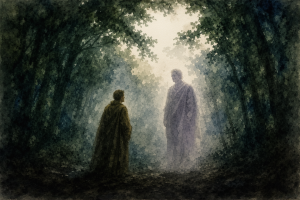
Before Hell proper begins, Dante has to walk through a crowd that belongs to neither Heaven nor Hell — and the first soul he recognizes there, he refuses to name.
Inferno · Canto 3 · Lines 31–69 · Scene 8
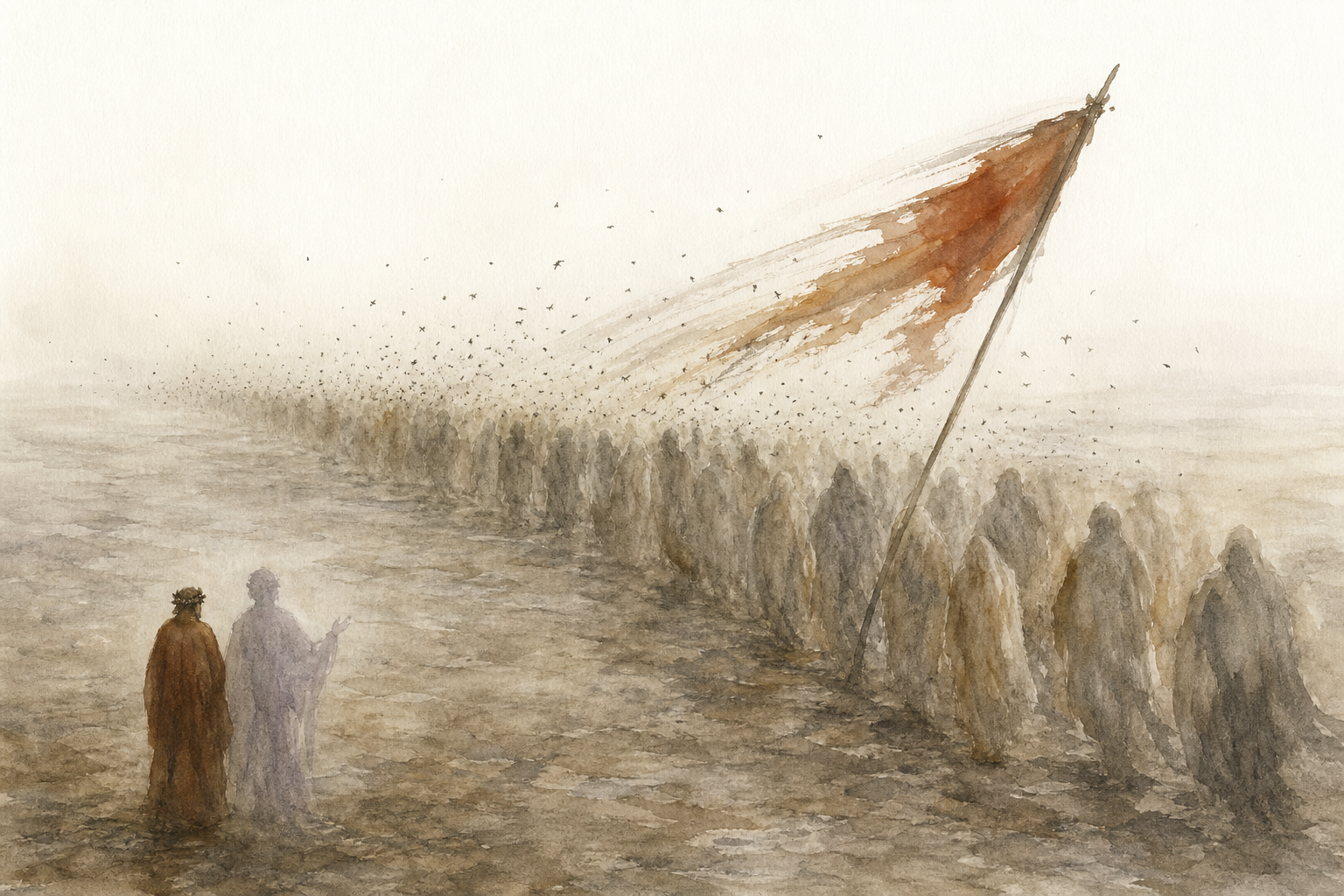
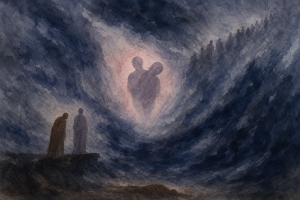
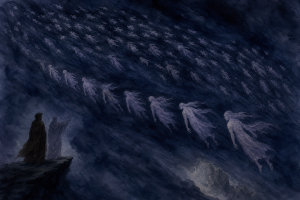
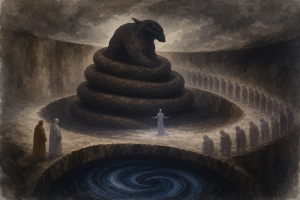
The moment they pass through the gate, the sounds start — sighing, weeping, cries of pain, echoing through air that has no stars in it. Dante asks what he’s hearing, and who these people are. Virgil’s answer is blunt: these are the souls of people who never took a side in anything, not virtuous enough to be praised and not wicked enough to be blamed. Mixed among them are angels who, when Satan rebelled against God, refused to fight for either side. Heaven wants nothing to do with them, since their presence alone would make Heaven slightly less perfect. Hell won’t take them either, because letting them in would give the truly damned something to feel superior about. So they exist in between, with no hope of ever finding an end to it, chasing a blank banner that never once slows down while wasps and flies sting them without pause, and blood and tears run down to their feet, where worms gather what falls. Somewhere in that crowd, Dante recognizes a face. He doesn’t say the name out loud — and neither does Virgil, who tells him only to look, and keep walking.
The Italian — The Indifferent
Source: Wikisource (public domain, pre-1929 text)
Lines 31–33
31. E io ch’avea d’error la testa cinta,32. dissi: «Maestro, che è quel ch’i’ odo?33. e che gent’è che par nel duol sì vinta?».
translation note: Line 31 — ‘d’error la testa cinta’ — literally, ‘my head girded with error.’ Dante figures his own confusion as a physical binding, an image that echoes the disorientation of Canto 1’s opening and signals that understanding, not just courage, is still incomplete even after passing through the gate. [Model knowledge · high]
literary key: Line 33 — Dante’s first question inside Hell is not about sin or punishment but about identity: ‘what people is this?’ The vestibule’s inhabitants are unclassifiable before they are even described — Dante cannot place what he hears into any category, which anticipates the point Virgil is about to make: this group resists every category the rest of Hell will provide. [Model knowledge · high]
Lines 34–36
34. Ed elli a me: «Questo misero modo35. tegnon l’anime triste di coloro36. che visser sanza ‘nfamia e sanza lodo.
theology: Line 36 — ‘sanza ‘nfamia e sanza lodo’ — without infamy and without praise. Virgil defines the group by double negation: not merely sinless, but also without any positive achievement to their name. The formula denies them a place in either moral ledger — they cannot be condemned for wrongdoing or celebrated for virtue, because they did neither. [Source: Singleton, Inferno: Commentary (1970)]
vocabulary: Line 34 — ‘misero modo’ — wretched manner, or wretched way of existing. ‘Modo’ suggests a mode of being rather than a location: the vestibule souls are defined by how they exist — perpetually, aimlessly — rather than by where they are. [Model knowledge · medium]
Lines 37–39
37. Mischiate sono a quel cattivo coro38. de li angeli che non furon ribelli39. né fur fedeli a Dio, ma per sé fuoro.
theology: Line 39 — ‘ma per sé fuoro’ — but were for themselves. Medieval angelology generally held that Lucifer’s rebellion forced every angel to choose a side, for God or against Him. Dante adds a third category absent from that inherited theology: angels who chose neither, opting instead for self-interest — his own theological invention, not received doctrine. [Model knowledge · high]
vocabulary: Line 37 — ‘quel cattivo coro’ — that wretched choir. ‘Coro’ (choir) is the technical term for an order of angels in medieval cosmology, one of the nine ranks. Applying it to this group is a bitter irony: they form a ‘choir’ in name only, a mock-order defined by refusal rather than praise. [Model knowledge · medium]
Lines 40–42
40. Caccianli i ciel per non esser men belli,41. né lo profondo inferno li riceve,42. ch’alcuna gloria i rei avrebber d’elli».
theology: Line 42 — ‘ch’alcuna gloria i rei avrebber d’elli’ — for the wicked would have some glory from them. Even the damned, in this logic, retain a kind of relative dignity: they made a choice, however evil, and that choice distinguishes them from a soul that chose nothing at all. The neutral are denied even the grim status of being genuinely damned. [Source: Mazzotta, Dante, Poet of the Desert (1979)]
literary key: Line 40 — Heaven’s stated motive is aesthetic, not moral — ‘per non esser men belli,’ so as not to be less beautiful. The neutral would mar Heaven’s beauty merely by their presence, a striking non-ethical justification that stands out against the language of justice used everywhere else in the canto. [Model knowledge · high]
Lines 43–45
43. E io: «Maestro, che è tanto greve44. a lor che lamentar li fa sì forte?».45. Rispuose: «Dicerolti molto breve.
literary key: Line 45 — Virgil’s promise to answer ‘molto breve’ — very briefly — matches his register throughout the vestibule: procedural, unwilling to linger. The brevity anticipates his explicit instruction six lines later not to discuss these souls any further. [Model knowledge · medium]
Lines 46–48
46. Questi non hanno speranza di morte,47. e la lor cieca vita è tanto bassa,48. che ‘nvidïosi son d’ogne altra sorte.
theology: Line 46 — ‘non hanno speranza di morte’ — they have no hope of death. For souls already dead, this is a striking formulation: what they lack is not life but the finality death would still offer, even in this state. There is no second death available as an exit from the vestibule. [Source: Singleton, Inferno: Commentary (1970)]
translation note: Line 48 — ‘invidïosi son d’ogne altra sorte’ — envious of every other fate. Even the torments of Hell proper would represent, to these souls, a preferable alternative: an identity, however damned, over the erasure of never having chosen one. [Model knowledge · high]
Lines 49–51
49. Fama di loro il mondo esser non lassa;50. misericordia e giustizia li sdegna:51. non ragioniam di lor, ma guarda e passa».
literary key: Line 49 — ‘Fama di loro il mondo esser non lassa’ — the world does not let report of them survive. Even historical memory refuses the neutral a record, a second erasure layered on top of their exclusion from Heaven and Hell — a severe judgment from a poem this invested in fame and literary memory. [Model knowledge · high]
literary key: Line 51 — ‘non ragioniam di lor, ma guarda e passa’ — let us not reason of them, but look and pass on. Virgil’s closing instruction is the vestibule’s only explicit directive in the scene, and it is a directive against discussion itself — one that sits in visible tension with the commentary tradition, this post included, that has spent seven centuries doing exactly what Virgil forbids. [Model knowledge · medium]
Lines 52–54
52. E io, che riguardai, vidi una ‘nsegna53. che girando correva tanto ratta,54. che d’ogne posa mi parea indegna;
literary key: Line 52 — The banner (‘nsegna) is the vestibule’s central image and its contrapasso: an emblem with no cause, no army, and no destination, chased eternally by souls who likewise committed to nothing. The banner’s motion has no purpose beyond motion itself. [Source: Freccero, Dante: The Poetics of Conversion (1986)]
translation note: Line 54 — ‘d’ogne posa mi parea indegna’ — it seemed to me unworthy of any rest. An odd moral judgment to apply to an inanimate object; the effect is to transfer the souls’ own restlessness onto the thing they are chasing. [Model knowledge · medium]
Lines 55–57
55. e dietro le venìa sì lunga tratta56. di gente, ch’i’ non averei creduto57. che morte tanta n’avesse disfatta.
literary key: Line 57 — ‘ch’i’ non averei creduto / che morte tanta n’avesse disfatta’ — reworked by T. S. Eliot in The Waste Land (‘I had not thought death had undone so many’). The line registers the pilgrim’s shock at sheer numbers: a scale of moral failure — indecision, not villainy — that he had not anticipated. [Model knowledge · high]
cultural ref: Line 56 — The line’s afterlife in English poetry is one of the most cited instances of Dante’s direct influence on Anglophone modernism. Eliot preserved it nearly verbatim rather than paraphrasing it, an unusual choice that marks its perceived untranslatable exactness. [Model knowledge · medium]
Lines 58–60
58. Poscia ch’io v’ebbi alcun riconosciuto,59. vidi e conobbi l’ombra di colui60. che fece per viltade il gran rifiuto.
history: Line 60 — ‘che fece per viltade il gran rifiuto’ — who, through cowardice, made the great refusal. The line names no one. Its identity has been debated since the earliest commentaries; see the two-camp discussion below. [Model knowledge · high]
literary key: Line 59 — ‘vidi e conobbi’ — I saw and I recognized. The verb ‘conobbi’ implies prior acquaintance or at least prior awareness of who this figure was: Dante does not encounter a stranger’s face but identifies someone he already has information about, part of why the withheld name has struck readers as deliberate rather than accidental. [Model knowledge · high]
Lines 61–63
61. Incontanente intesi e certo fui62. che questa era la setta d’i cattivi,63. a Dio spiacenti e a’ nemici sui.
theology: Line 63 — ‘a Dio spiacenti e a’ nemici sui’ — displeasing to God and to His enemies. The line completes the vestibule’s total exclusion: these souls are rejected by both sides of the poem’s central cosmic conflict. Even Satan’s faction finds them contemptible. [Source: Singleton, Inferno: Commentary (1970)]
vocabulary: Line 62 — ‘la setta d’i cattivi’ — the sect of the wretched. ‘Setta’ (sect) borrows the language of religious or political factionalism to describe a group defined by its refusal of factionalism — belonging-language applied to a group whose defining trait is non-belonging. [Model knowledge · medium]
Lines 64–66
64. Questi sciaurati, che mai non fur vivi,65. erano ignudi e stimolati molto66. da mosconi e da vespe ch’eran ivi.
theology: Line 64 — ‘che mai non fur vivi’ — who were never truly alive. The harshest line in the passage: Dante denies these souls even the status of having lived, despite their biological existence. To live, in the poem’s terms, requires having chosen something — a soul that never chose is judged never to have been fully alive. [Source: Mazzotta, Dante, Poet of the Desert (1979)]
literary key: Line 65 — Nakedness marks the vestibule souls as it marks every damned soul in the Inferno, but paired here with generic insect torment rather than a punishment tailored to a specific sin — indecision, unlike lust or fraud, has no natural contrapasso of its own, and the undifferentiated torment reflects that. [Model knowledge · medium]
Lines 67–69
67. Elle rigavan lor di sangue il volto,68. che, mischiato di lagrime, a’ lor piedi69. da fastidiosi vermi era ricolto.
literary key: Line 69 — ‘da fastidiosi vermi era ricolto’ — was gathered by loathsome worms. The scene closes on decomposition imagery normally associated with the grave, applied to souls who are, in the poem’s terms, still ‘alive’ in their eternal punishment — collapsing the distinction between living torment and bodily decay. [Model knowledge · high]
translation note: Line 67 — ‘sangue’ mixed with ‘lagrime’ — blood and tears, the two most basic bodily signs of suffering, physical and emotional, combined and then consumed by the worms below. The vestibule scene closes on an image of total, undignified consumption, preparing the transition to the Acheron and Charon that follows. [Model knowledge · medium]
Seven Centuries of Reading The Indifferent
The First Readers: Medieval Commentators
The earliest commentators treated this passage as a moral lesson first and a puzzle second. Pietro Alighieri, writing in the mid-fourteenth century, emphasized the theological category: souls who chose neither good nor evil forfeited any claim on divine justice and therefore belong to no realm. He read the running banner as an emblem of purposeless motion — action without commitment, endlessly repeated. The Ottimo Commento took a similar line, stressing that these souls are barred from Hell proper because even damnation requires a meaningful choice.
Benvenuto da Imola, whose lectures were compiled in the 1380s and edited by Lacaita in 1887, was among the first to argue confidently for Pope Celestine V as the soul Dante says he recognized. Benvenuto read “il gran rifiuto” — the great refusal — as Celestine’s abdication of 1294, an act that opened the papacy to Boniface VIII. Boccaccio’s Esposizioni, which covers only the first seventeen cantos, reaches this scene and also leans toward the Celestine reading, though Boccaccio frames it with more caution than Benvenuto. Both commentators noticed that Dante withholds the name, but neither treated the omission as deliberate ambiguity — they assumed the identification was obvious to any contemporary reader.
Humanist and Early Modern Recasting
Fifteenth- and sixteenth-century commentators, including Cristoforo Landino in his influential 1481 Florentine commentary, tended to foreground civic and political ethics alongside the theological reading rather than replacing it. Landino’s Florence was itself preoccupied with questions of civic virtue and political responsibility, and readers in that tradition were drawn to what the scene implied about public life: the soul who refuses to act — who steps back from power, from commitment, from consequence — reads, on this account, as a figure for the failed citizen as much as the failed Christian.
The Celestine identification remained the dominant reading, but its emphasis shifted. Where medieval commentators had stressed Celestine’s failure as a spiritual defect, Humanist-era readers tended to foreground its political consequences — the abdication that, in this telling, opened the door to Boniface VIII. That shift in emphasis is easier to trace in general terms than to pin to one commentator’s stated argument, and it likely owed as much to the political preoccupations of Renaissance Italy as to any close textual case made in a specific commentary. Still, the effect was to make the unnamed shade feel more contemporary: readers steeped in their own cities’ politics could map the same failure onto figures closer to home.
The Romantic Recovery: De Sanctis and the Nineteenth Century
Francesco De Sanctis, in his enormously influential Storia della letteratura italiana (1870–71), brought a different set of questions entirely. He was drawn to what he called the drama of Dante’s own consciousness moving through Hell. De Sanctis argued that the power of this scene lies not in the theological category it illustrates but in Dante’s emotional response — the horror of recognizing purposeless souls more pitiable than the damned.
This Romantic reading recovered something the Humanists had downplayed: the personal stakes of the encounter. For De Sanctis, the unnamed shade mattered precisely because Dante reacts before he explains. The recognition precedes the identification, and the identification never arrives. That gap, which earlier commentators had glossed over, became for De Sanctis the expressive center of the passage.
Twentieth-Century Scholarship: Three Competing Frameworks
Charles Singleton‘s landmark commentaries placed the scene within a rigorous theological architecture. Singleton argued that Dante constructed Hell as a mirror of divine justice, and that the souls placed here — between the gate and Hell proper — reflect a specific scholastic argument about the relation between will and act. For Singleton, understanding what these souls represent requires understanding Aquinas on the privation of good, not just reading the poetry on its own terms.
Erich Auerbach offered a different emphasis. His concept of figural realism led him to read each soul in the Commedia as fully historical and fully symbolic at once — neither detail cancels the other. On Auerbach’s account, if the unnamed shade is Celestine, that historical specificity is the point: the eternal condition is made legible through the concrete, named world Dante and his readers shared.
Teodolinda Barolini pushed back against readings that subordinate the poem’s craft to its theology. She argued that Dante constructs the fiction of his own authority — the fictio of the journey — and that readers should attend to how the text produces effects rather than assuming Dante’s theological intentions explain them. On this view, the withheld name is a narrative decision, not a doctrinal one, and it deserves to be read as craft.
Open Questions in Current Scholarship
Digital Dante and other current platforms have made it easier to trace the full range of commentary from the Trecento forward, and that breadth has sharpened rather than resolved the central dispute. The Celestine identification remains the majority reading, but scholars who favor deliberate anonymity — the view that Dante chose not to name the shade because the moral category matters more than any one biography — have grown more vocal in recent decades.
Live questions include: why Dante uses “recognized” rather than “named”; whether Virgil’s command to “look and pass” instructs Dante the pilgrim, Dante the poet, or the reader; and whether the angels mixed among these souls — those who took no side in the rebellion — are meant to implicate the souls morally or simply share their punishment. None of these questions has a settled answer. The passage continues to generate new readings precisely because Dante gives the reader recognition without resolution.
The Two Main Positions on The Indifferent
The Celestine V Identification
Pope Celestine V abdicated the papacy in 1294, five months after his election, clearing the way for the election of Boniface VIII — the pope Dante held responsible for the political maneuvering that led to his exile from Florence, and whom the poem attacks by name elsewhere (Inf. XIX; Par. XXVII). On this reading, ‘il gran rifiuto’ is Celestine’s abdication: a specific, recent, and widely discussed act of cowardice with a personal consequence for Dante’s own life. The identification also explains why Dante says he ‘recognized’ the shade — Celestine’s resignation was notorious in Dante’s own lifetime, not obscure history requiring explanation.
Key passage: Inf. III.60, ‘che fece per viltade il gran rifiuto,’ read against Dante’s explicit, named condemnation of Boniface VIII at Inf. XIX.52–57, and Saint Peter’s unnamed but unmistakable denunciation of him at Par. XXVII.22–24 — the immediate political beneficiary of the ‘refusal,’ whom Dante had every documented reason to resent.
The Deliberate Anonymity Reading
Dante nowhere confirms the Celestine identification, which is unusual for a poet who names souls throughout the Inferno with genealogical precision, including enemies far less consequential than a former pope. Read this way, the omission is a choice, not a diplomatic caution or an oversight — Dante names Boniface VIII directly elsewhere in the poem, so he is demonstrably willing to name this specific enemy when he wants to. Withholding the name here instead turns ‘the great refusal’ into an open moral category: a failure any reader could recognize in themselves or in a contemporary, rather than one man’s biography closed off by identification.
Key passage: Inf. III.58–59, ‘Poscia ch’io v’ebbi alcun riconosciuto, / vidi e conobbi l’ombra di colui’ — The specific choice not to name this one is itself the textual fact requiring explanation.
What the Text Does — and What That Means (Contested)
On the page: The text attaches only the phrase ‘per viltade’ (out of cowardice) to the refusal, with no name, office, or circumstance given. The verb ‘conobbi’ (I recognized/knew) implies the shade was someone Dante had prior knowledge of, not a stranger picked at random from the crowd.
What scholars dispute: Whether Dante intended a specific, identifiable contemporary or historical figure, or a deliberately anonymous emblem of moral cowardice open to any reader, is not settled by the text itself. The two readings carry different implications for how the vestibule functions in the poem’s moral architecture — as a settling of a personal or political score, or as a universal category with no single referent.
What Dante Leaves Unresolved
Dante gives the reader recognition without identification — ‘I saw and knew the shade of him,’ followed immediately by an act rather than a name. Whether that omission points outward to a single, contemporary, unmistakable figure, or inward to something Dante wanted to keep permanently general, the poem does not say. Commentators have proposed candidates since the earliest Trecento commentaries; the text itself supplies only a cowardice and a consequence, and leaves the identification to the reader’s own century.
The Open Question
Dante says he recognized a shade among the neutral souls and names his failure — ‘per viltade il gran rifiuto,’ the great refusal made from cowardice — but withholds his name. Dante names dozens of far less significant souls elsewhere in the canticle. Why does he refuse to name the one figure he says he recognized?
Explore More
About This Article

Written by Lucy Bamboo. Lucy Bamboo has been reading the Divine Comedy for fifteen years — first in translation, then stubbornly in Medieval Tuscan with a dictionary and far too many footnotes. Reading Dante is her scene-by-scene walk through the poem: the original Italian, seven centuries of scholarly argument presented as argument rather than answer, and the human questions sitting underneath the theology. More about this site.
Verify this against a primary source
Specifics change, and your situation may differ from the one described here. These are the authorities worth checking directly:
- Digital Dante, Columbia University — text, commentary and translation apparatus
- Princeton Dante Project — the Commedia with historical commentary
- Dartmouth Dante Project — searchable commentary from 1322 onward