At the river that marks the real boundary of Hell, an ancient ferryman takes one look at Dante and refuses to let him aboard — and it takes a single unexplained couplet from Virgil to change his mind.
Inferno · Canto 3 · Lines 70–136 · Scene 9
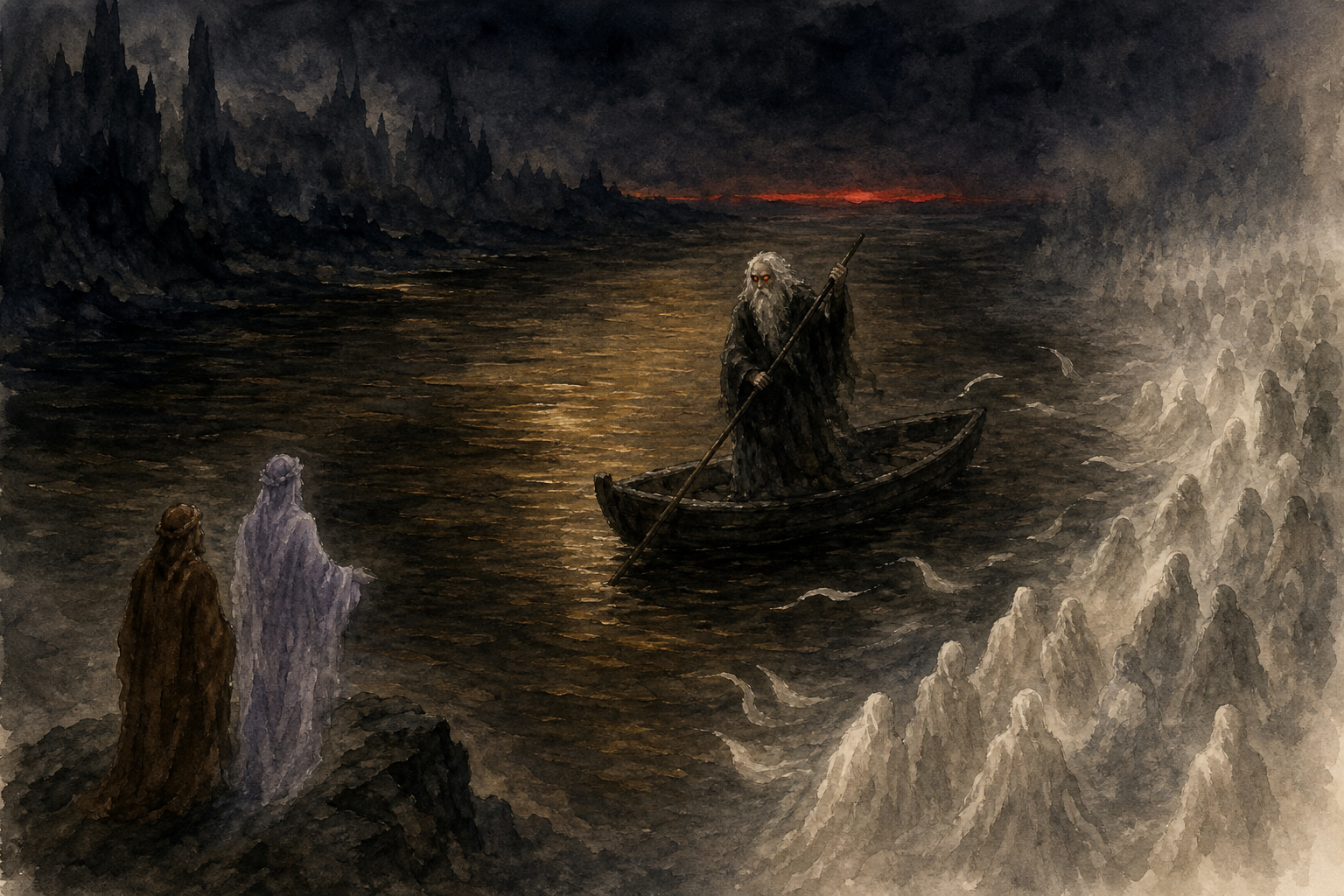
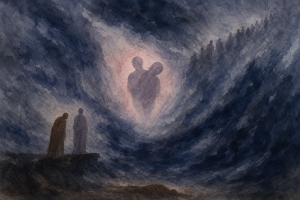
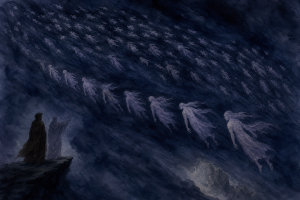
Virgil tells Dante the vestibule crowd will make more sense once they reach the river, and a few steps later they do: a huge crowd waiting on the bank of the Acheron, all of them somehow eager to cross to the other side. Before Dante can ask why, an old boatman rows toward them, shouting at the crowd to give up any hope of ever seeing Heaven again — he’s here to ferry them into eternal fire and ice. Then he gets a good look at Dante and stops cold. Living people don’t cross here, he says; find another way. Virgil answers with a formula that ends the argument instantly: it is willed where it can be willed, and don’t ask again. The fire in the boatman’s eyes goes out, and he says nothing more. But the souls around him hear something different in Virgil’s words — they start cursing God, their parents, their own births, existence itself, out of pure terror. The boatman starts loading them anyway, striking anyone too slow with his oar. Dante watches them let go of the shore the way autumn leaves let go of a branch, one at a time, or the way a falcon can’t help answering its handler’s call — pulled, not walking. The boat crosses, and before it’s even back, a new crowd has already gathered to wait for the next trip. Virgil explains: everyone who dies at odds with God ends up here, and they’re actually in a hurry to cross, because divine justice has turned their fear into desire — no soul bound for anywhere good ever waits on this particular shore. Then the ground starts shaking, a red light flashes overhead, and it overwhelms Dante so completely that he passes out. Canto 3 ends there, with Dante unconscious on the ground, the crossing itself left offstage.
The Italian — The Boatman of Acheron
Source: Wikisource (public domain, pre-1929 text)
Lines 70–72
70. E poi ch’a riguardar oltre mi diedi,71. vidi genti a la riva d’un gran fiume;72. per ch’io dissi: «Maestro, or mi concedi
literary key: Line 70 — ‘E poi ch’a riguardar oltre mi diedi’ — and when I turned to look further. A plain transition marker: Dante the narrator directs the reader’s attention exactly as he directs his own gaze, a recurring device the poem uses to move between scenes without a formal break. [Model knowledge · medium]
translation note: Line 71 — ‘riva d’un gran fiume’ — the bank of a great river. Dante withholds the river’s name here; it isn’t identified as the Acheron until Virgil names it two tercets later, so the withholding briefly matches the reader’s ignorance to Dante’s own. [Model knowledge · medium]
Lines 73–75
73. ch’i’ sappia quali sono, e qual costume74. le fa di trapassar parer sì pronte,75. com’i’ discerno per lo fioco lume».
literary key: Line 73 — Dante’s question again seeks classification — ‘quali sono’ (who they are) — echoing his very first question in the vestibule at line 33. The pattern repeats: Dante meets a crowd, then reaches for understanding through a question rather than through observation alone. [Model knowledge · high]
translation note: Line 75 — ‘per lo fioco lume’ — by the dim light. A reminder that this is Hell without stars, established at the very start of the canto; visibility stays poor through the whole Charon episode. [Model knowledge · medium]
Lines 76–78
76. Ed elli a me: «Le cose ti fier conte77. quando noi fermerem li nostri passi78. su la trista riviera d’Acheronte».
history: Line 78 — ‘la trista riviera d’Acheronte’ — the first naming of the Acheron, one of the rivers of the underworld inherited from classical sources (Homer, and especially Virgil’s Aeneid). Dante is building his Hell’s geography directly on the pagan one, importing its rivers along with the ferryman who will appear a few lines later. [Model knowledge · high]
Lines 79–81
79. Allor con li occhi vergognosi e bassi,80. temendo no ‘l mio dir li fosse grave,81. infino al fiume del parlar mi trassi.
literary key: Line 79 — ‘occhi vergognosi e bassi’ — ashamed, downcast eyes. Dante reacts with something close to social embarrassment at his own persistent questioning, an oddly human beat of self-policing curiosity inside a supernatural journey, and one of several small moments that characterize the pilgrim as anxious to avoid overstepping with his guide. [Model knowledge · medium]
Lines 82–84
82. Ed ecco verso noi venir per nave83. un vecchio, bianco per antico pelo,84. gridando: «Guai a voi, anime prave!
history: Line 82 — Charon’s entrance imports the ferryman directly from Aeneid VI, where Virgil the poet describes an old man of terrible aspect guarding the river of the dead. Dante the poet stages a meeting between his own pilgrim and a figure lifted from his guide’s own epic — a layered literary allusion mostly available to readers who already know the Aeneid. [Model knowledge · high]
literary key: Line 84 — ‘anime prave’ — wicked souls. Charon addresses the crowd collectively before individuating anyone, treating damnation as a category applied wholesale rather than case by case, from the very first word he speaks. [Model knowledge · medium]
Lines 85–87
85. Non isperate mai veder lo cielo:86. i’ vegno per menarvi a l’altra riva87. ne le tenebre etterne, in caldo e ‘n gelo.
theology: Line 85 — ‘Non isperate mai veder lo cielo’ — never hope to see Heaven. Charon’s opening line to the damned specifies, for this particular crowd, the general sentence already posted at the gate: ‘Lasciate ogne speranza.’ [Source: Singleton, Inferno: Commentary (1970)]
translation note: Line 87 — ‘in caldo e ‘n gelo’ — in heat and in ice. An early gesture toward the climatic range of Dante’s Hell, which will end, in Canto XXXIV, frozen rather than burning — a detail this line anticipates without yet explaining. [Model knowledge · medium]
Lines 88–90
88. E tu che se’ costì, anima viva,89. pàrtiti da cotesti che son morti».90. Ma poi che vide ch’io non mi partiva,
literary key: Line 88 — ‘anima viva’ — living soul. The phrase that stops Charon’s tirade cold: a supernatural authority recognizing Dante’s exceptional status by sight alone, unprompted, the first time this happens in the poem. [Model knowledge · high]
vocabulary: Line 89 — ‘pàrtiti’ — get away, leave. A blunt imperative; Charon’s register shifts from ritual denunciation of the crowd to direct, personal address the instant he singles Dante out. [Model knowledge · medium]
Lines 91–93
91. disse: «Per altra via, per altri porti92. verrai a piaggia, non qui, per passare:93. più lieve legno convien che ti porti».
literary key: Line 93 — ‘più lieve legno convien che ti porti’ — a lighter craft must carry you. This line has been read as an unintended prophecy: Purgatorio opens with souls ferried by an angel piloting a boat that needs no oar or sail, arguably the ‘lighter craft’ Charon gestures toward without knowing it. [Model knowledge · medium]
Lines 94–96
94. E ‘l duca lui: «Caron, non ti crucciare:95. vuolsi così colà dove si puote96. ciò che si vuole, e più non dimandare».
literary key: Line 94 — ‘non ti crucciare’ — don’t torment yourself, don’t be troubled. A notably gentle opening for what is otherwise an order to stand down without explanation. [Model knowledge · medium]
theology: Line 95 — The interpretive center of this scene: Virgil’s two-line formula, repeated verbatim at Inf. V.23-24 to silence Minos, discussed at length in the two-camp debate below. [Source: model_knowledge]
Lines 97–99
97. Quinci fuor quete le lanose gote98. al nocchier de la livida palude,99. che ‘ntorno a li occhi avea di fiamme rote.
literary key: Line 97 — ‘le lanose gote’ — the woolly cheeks. An oddly tactile, almost comic physical detail for a demon, consistent with Dante’s habit of grounding supernatural figures in specific bodily texture rather than leaving them abstract. [Model knowledge · medium]
theology: Line 99 — ‘di fiamme rote’ — wheels of flame, Charon’s fiery eyes. This detail has no precedent in Virgil’s comparatively neutral classical ferryman; Dante’s revision consistently intensifies and demonizes the figure he borrows. [Model knowledge · medium]
Lines 100–102
100. Ma quell’anime, ch’eran lasse e nude,101. cangiar colore e dibattero i denti,102. ratto che ‘nteser le parole crude.
literary key: Line 100 — ‘lasse e nude’ — weary and naked. Nakedness functions here as a baseline condition of the damned across the Inferno generally, not a punishment specific to this location. [Model knowledge · medium]
translation note: Line 101 — ‘cangiar colore e dibattero i denti’ — changed color and chattered their teeth. Pure physiological terror rendered with clinical precision; Dante often shows extreme emotion through observable bodily symptom rather than naming the feeling directly. [Model knowledge · medium]
Lines 103–105
103. Bestemmiavano Dio e lor parenti,104. l’umana spezie e ‘l loco e ‘l tempo e ‘l seme105. di lor semenza e di lor nascimenti.
theology: Line 104 — The catalogue of blasphemy is total — God, parents, the human species, the place, the time, and the ‘seed’ of their own conception — a repudiation reaching back past the sinner’s own choices to the bare biological fact of having been born, a scope broader than the blasphemy punished elsewhere in the canticle. [Model knowledge · medium]
Lines 106–108
106. Poi si ritrasser tutte quante insieme,107. forte piangendo, a la riva malvagia108. ch’attende ciascun uom che Dio non teme.
literary key: Line 108 — ‘ch’attende ciascun uom che Dio non teme’ — which awaits every man who does not fear God. Dante briefly generalizes outward from this specific crowd, stating a rule about who ends up here rather than only describing who already has. [Model knowledge · medium]
Lines 109–111
109. Caron dimonio, con occhi di bragia110. loro accennando, tutte le raccoglie;111. batte col remo qualunque s’adagia.
vocabulary: Line 109 — ‘Caron dimonio’ — the poem’s own label. Whatever Charon was in Virgil’s epic, Dante’s version is explicitly reclassified here as a demon, not left implicit. [Model knowledge · high]
literary key: Line 111 — ‘batte col remo qualunque s’adagia’ — strikes with the oar whoever lingers. The crossing is compelled, not chosen: even souls Virgil will shortly describe as eager to cross still have to be struck into motion, a small tension inside the canto’s own account of their desire. [Model knowledge · medium]
Lines 112–114
112. Come d’autunno si levan le foglie113. l’una appresso de l’altra, fin che ‘l ramo114. vede a la terra tutte le sue spoglie,
history: Line 112 — The autumn-leaves simile draws directly on Aeneid VI’s own image of souls thick as falling autumn leaves crowding the banks of the Styx — Dante borrowing not just Charon but his source poem’s central simile for the same scene, a close and deliberate echo rather than a coincidence of imagery. [Model knowledge · high]
Lines 115–117
115. similemente il mal seme d’Adamo116. gittansi di quel lito ad una ad una,117. per cenni come augel per suo richiamo.
theology: Line 115 — ‘il mal seme d’Adamo’ — the evil seed of Adam. The souls are named collectively through their descent from Adam, tying this crowd’s damnation to original sin as their most basic shared identity, prior to any individual act. [Model knowledge · medium]
literary key: Line 117 — The falcon simile shifts from passive falling (leaves) to compelled response (a trained bird answering a call it cannot resist), doubling the image of the souls’ motion: released like leaves, yet also drawn like falcons — at once passive and compelled. [Model knowledge · medium]
Lines 118–120
118. Così sen vanno su per l’onda bruna,119. e avanti che sien di là discese,120. anche di qua nuova schiera s’auna.
literary key: Line 120 — ‘anche di qua nuova schiera s’auna’ — already on this side a new company gathers. The poem denies the crossing any pause: before one group has finished arriving, the next is already assembling, establishing the ferry as continuous and inexhaustible rather than a single event Dante happens to witness. [Model knowledge · medium]
Lines 121–123
121. «Figliuol mio», disse ‘l maestro cortese,122. «quelli che muoion ne l’ira di Dio123. tutti convegnon qui d’ogne paese;
vocabulary: Line 121 — ‘Figliuol mio’ — my son. One of the more tender terms of address Virgil uses for Dante in the canticle, arriving right after a scene of considerable strangeness and dread, as if to steady the pilgrim before explaining what he has just witnessed. [Model knowledge · medium]
Lines 124–126
124. e pronti sono a trapassar lo rio,125. ché la divina giustizia li sprona,126. sì che la tema si volve in disio.
theology: Line 126 — ‘sì che la tema si volve in disio’ — so that fear itself turns into desire. Virgil’s account of the crowd’s psychology: not mere resignation but an active conversion of dread into want, driven by divine justice rather than chosen by the souls themselves. [Source: Mazzotta, Dante, Poet of the Desert (1979)]
Lines 127–129
127. Quinci non passa mai anima buona;128. e però, se Caron di te si lagna,129. ben puoi sapere omai che ‘l suo dir suona».
theology: Line 127 — ‘Quinci non passa mai anima buona’ — never does a good soul pass here. This sets up, without yet explaining, a contrast the poem develops explicitly in Purgatorio II, where redeemed souls cross to the mountain by an entirely different method: an angel-piloted boat that needs no oar and arrives swiftly, the deliberate opposite of Charon’s compelled, oar-driven crossing. [Model knowledge · high]
Lines 130–132
130. Finito questo, la buia campagna131. tremò sì forte, che de lo spavento132. la mente di sudore ancor mi bagna.
literary key: Line 132 — ‘la mente di sudore ancor mi bagna’ — my mind still bathes in sweat. Dante the narrator breaks into present tense to describe his own remembered fear, one of the poem’s clearest reminders that the narration is retrospective, composed after the journey by a Dante who still feels its residue while writing. [Model knowledge · high]
Lines 133–135
133. La terra lagrimosa diede vento,134. che balenò una luce vermiglia135. la qual mi vinse ciascun sentimento;
theology: Line 134 — ‘una luce vermiglia’ — a vermilion, blood-red light. Red light recurs at moments of overwhelming or climactic sensation elsewhere in the Inferno; here it accompanies the total collapse of Dante’s senses rather than any specific vision he goes on to describe. [Model knowledge · medium]
Line 136
136. e caddi come l’uom cui sonno piglia.
literary key: Line 136 — ‘e caddi come l’uom cui sonno piglia’ — and I fell as one whom sleep seizes. The canto’s last word is unconsciousness, not description: Dante declines to narrate his own crossing of the Acheron, leaving the mechanics of how a living body traverses the river of the dead permanently outside the text. [Model knowledge · high]
Seven Centuries of Reading The Boatman of Acheron
What the Medieval Commentators Saw First
Pietro Alighieri, writing in the mid-fourteenth century, treated Charon primarily as an allegorical figure: the old ferryman stood for the human body carrying the soul toward its earned punishment. Pietro was less interested in Charon’s rage than in what the rage signified — a dramatized image of moral causation. Boccaccio’s Esposizioni — the public lectures that break off partway through Canto 17 — does reach this canto, and his abiding emphasis on the poem’s capacity to dignify vernacular speech gives one lens for it: the scene’s raw, shouted imperatives (“Guai a voi, anime prave!”) elevate street-level language into epic register.
Benvenuto da Imola, in the Lacaita edition of 1887, pushed toward classical sources. He identified Charon’s ancestry in Virgil and Ovid, treating Dante’s scene as a learned transformation of ancient material. The Ottimo Commento took a more pastoral line, stressing the souls’ cursing of God, their parents, and their birth — reading that catalogue of blasphemies as a moral warning aimed at lay readers. None of these commentators spent much time on Virgil’s silencing formula. They registered it, moved on, and saved their energy for the theological machinery around it.
Humanist Readers and the Question of Classical Debt
Renaissance and early modern readers sharpened Benvenuto’s instinct. They measured Dante against Virgil more precisely and often found him wanting — or, in more sympathetic accounts, found him productively transforming. The leaves-falling simile (lines 112–117) drew particular attention: Dante places it in almost direct competition with Aeneid VI, and humanist commentators debated whether his version improved on the original or merely echoed it.
The silencing formula — “vuolsi così colà dove si puote / ciò che si vuole” — got read in this period less as theology than as rhetorical economy. Humanist readers admired compression. A line that ends an argument without elaborating it suited a culture that valued brevitas. Whether Dante intended the formula as a theological statement or a rhetorical gesture was not yet a question that seemed urgent. The classical frame made it look like the former without requiring the latter to be examined.
The Romantics and De Sanctis: Recovering the Dramatic Scene
Francesco De Sanctis, in the nineteenth century, redirected attention entirely. The greatness of this passage lay not in allegory or classical reference but in its dramatic immediacy — Charon ‘con occhi di bragia’ (109), the crowd of souls, the swirling dark. Dante’s power, he argued, came from making abstract moral states visible and kinetic. The souls who ‘bestemmiavano Dio e lor parenti’ (103) — cursing God and their own parents — yet still rush to the boat became his evidence of Dante’s psychological realism.
The Romantic tradition more broadly wanted to recover what medieval allegory had smoothed over: the terror, the pity, the human texture of the scene. This involved, critics have since noted, a certain invention alongside the recovery. Reading the souls’ desperate eagerness as tragic pathos is itself an interpretive choice — one the medieval commentators had largely resisted.
Twentieth-Century Scholarship: Three Major Positions
Charles Singleton brought the theological argument back to the center: the silencing formula is a genuine doctrinal statement, anticipating the fuller treatment of divine will Dante develops in Paradiso. Charon’s capitulation, he argued, models the correct creaturely response to divine authority: not understanding, but assent. The formula says all that needs to be said because divine will requires no supplementary justification.
Erich Auerbach‘s approach cut differently. Dante’s figures — Charon included — are real in a figural sense: they carry their earthly natures into eternity rather than leaving them behind. The demon’s fury is not merely symbolic; it is the permanent condition of a being fixed in that fury forever. The frame makes the scene’s violence feel ontological, not illustrative.
Teodolinda Barolini challenged both. Treating Dante as a theological authority, she argued, risks mistaking the poet’s rhetorical strategies for truth claims. The silencing formula is better understood as a narrative device — authorization machinery the poem deploys efficiently, twice — than as a considered statement about the nature of divine will. Her argument aligns with what scholars now call the formulaic reading: the couplet functions more like a password than a proof.
Open Questions in Contemporary Scholarship
Digital Dante and current commentary culture have made the scene’s unresolved questions more visible rather than settling them. Whose will does “colà” point to — God’s directly, or the whole celestial hierarchy acting on His behalf? The poem never clarifies, in this scene or when the formula reappears with Minos. Whether that silence reflects theological restraint or narrative efficiency remains genuinely contested.
Readers today also debate the leaves simile — ‘come d’autunno si levan le foglie’ (112) — with fresh precision. Digital tools allow line-by-line comparison of Dante’s version with Virgil’s and Homer’s antecedents, making the question of influence versus transformation more tractable — without resolving it. What seven centuries of commentary have clarified is that this passage rewards both theological seriousness and formal suspicion, and that neither approach alone captures what Dante places on the dark bank of the Acheron.
The Two Main Positions on The Boatman of Acheron
The Doctrinal Reading
The formula is a compressed but genuine statement of the principle Dante develops explicitly and at length in Paradiso: that divine will requires no further justification once directed toward securing a soul’s rightful path, and creaturely resistance to it is itself a species of disorder. Charon’s and Minos’s immediate capitulation model the correct response to that will — not comprehension, but assent — and the couplet’s reappearance is not evidence of formula but of consistency: the same truth invoked because it remains equally true and equally sufficient each time.
Key passage: Inf. III.95-96 / Inf. V.23-24, read against Par. III.85, ‘e ‘n la sua volontade è nostra pace’ (in His will is our peace) — spoken by Piccarda Donati as the poem’s clearest later statement of the same principle.
The Formulaic Reading
Reusing the exact couplet for two unrelated guardians and objections, rather than crafting a fresh justification each time, is itself evidence the line is functioning as reusable narrative machinery — an authorization formula Dante can deploy whenever a supernatural gatekeeper needs to stand down so the pilgrim can proceed, closer to a password than to an argument. On this reading the couplet’s theological content is thin by design: its job is structural, and treating it as a considered statement about the nature of divine will risks over-reading four lines built to do a narrow narrative job efficiently, twice.
Key passage: The verbatim, unmodified repetition at Inf. V.23-24 — a different guardian, a different scene, a different objection, answered with the same two lines rather than a new one, difficult to square with the idea that each instance represents a considered, situation-specific theological claim.
What the Text Does — and What That Means (Contested)
On the page: The couplet at Inf. III.95-96 and Inf. V.23-24 is verbatim identical, addressed to two different infernal guardians in two different circumstances. In both cases it ends the objection completely and immediately; in neither case does the poem supply the referent of ‘colà’ beyond what the reader is left to infer.
What scholars dispute: Whether the exact repetition indicates Dante intends a single, stable theological content each time — an appeal to the same real divine will, restated because it remains equally sufficient — or whether the repetition itself is evidence the line is functioning as a formula rather than a fresh doctrinal claim is not resolved by the text, and the two readings imply different things about how seriously the poem wants the line taken.
What Dante Leaves Unresolved
The poem gives the same couplet the power to silence two different guardians and never explains, in either scene, whose will ‘colà’ refers to or why that will is sufficient reason on its own. Whether that reticence is theological restraint, the divine will doesn’t require Dante’s elaboration to be authoritative, or simply the efficiency of a reused device, the text supplies the formula’s effects without ever supplying its grounds.
The Open Question
When Virgil silences Charon’s refusal to ferry a living soul with a single couplet — ‘vuolsi così colà dove si puote / ciò che si vuole,’ it is willed there where what is willed can be done, and ask nothing further — and then repeats the identical couplet two cantos later to silence Minos, is that formula doing genuine theological work, or functioning as portable narrative machinery for clearing obstacles?
Explore More
About This Article

Written by Lucy Bamboo. Lucy Bamboo has been reading the Divine Comedy for fifteen years — first in translation, then stubbornly in Medieval Tuscan with a dictionary and far too many footnotes. Reading Dante is her scene-by-scene walk through the poem: the original Italian, seven centuries of scholarly argument presented as argument rather than answer, and the human questions sitting underneath the theology. More about this site.
Verify this against a primary source
Specifics change, and your situation may differ from the one described here. These are the authorities worth checking directly:
- Digital Dante, Columbia University — text, commentary and translation apparatus
- Princeton Dante Project — the Commedia with historical commentary
- Dartmouth Dante Project — searchable commentary from 1322 onward